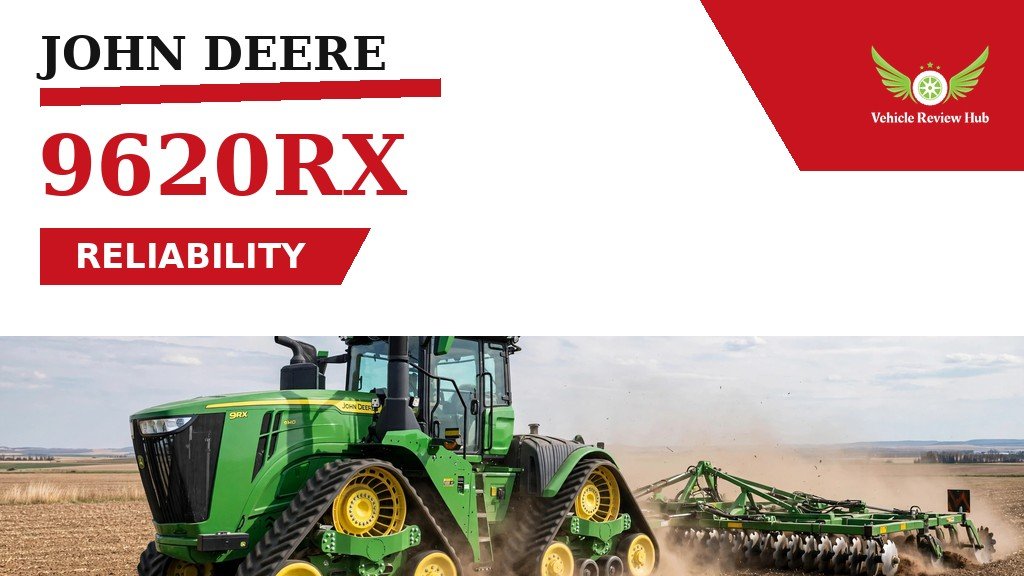
John Deere 9620RX maintenance is the difference between a four-track flagship that earns for another decade and one that eats its purchase price in track and repair bills. The 9620RX is a used-only machine now — the top model of the original 2015-launch 9RX family, with a 620-horsepower Cummins engine, an 18-speed PowerShift, and four rubber belt tracks. This guide covers the full John Deere 9620RX maintenance schedule, what each service costs, how reliable the tractor is over the long term, the common problems to watch for, and exactly how to inspect a used machine before money changes hands.
The short version of John Deere 9620RX maintenance: engine oil and filters every 500 hours, transmission and hydraulic oil every 1,500 hours, coolant at 6,000 hours, and track inspection every single day you run it. Tracks are the big-ticket item — a full set of belts can cost more than a good used row-crop tractor — so track discipline matters more on this machine than on any wheeled tractor.
John Deere 9620RX Maintenance Schedule and Service Costs
The John Deere 9620RX maintenance schedule follows the same service logic as the rest of Deere’s 9 family: short daily checks, a 500-hour engine service, a 1,500-hour transmission and hydraulic service, and a 6,000-hour coolant service. Because these tractors now carry anywhere from 1,000 to 6,000-plus hours, the schedule below is written for the used buyer. Estimates come from dealer quotes and owner reports.
Engine Oil, Fuel Filters, Air Filters and Cooling System
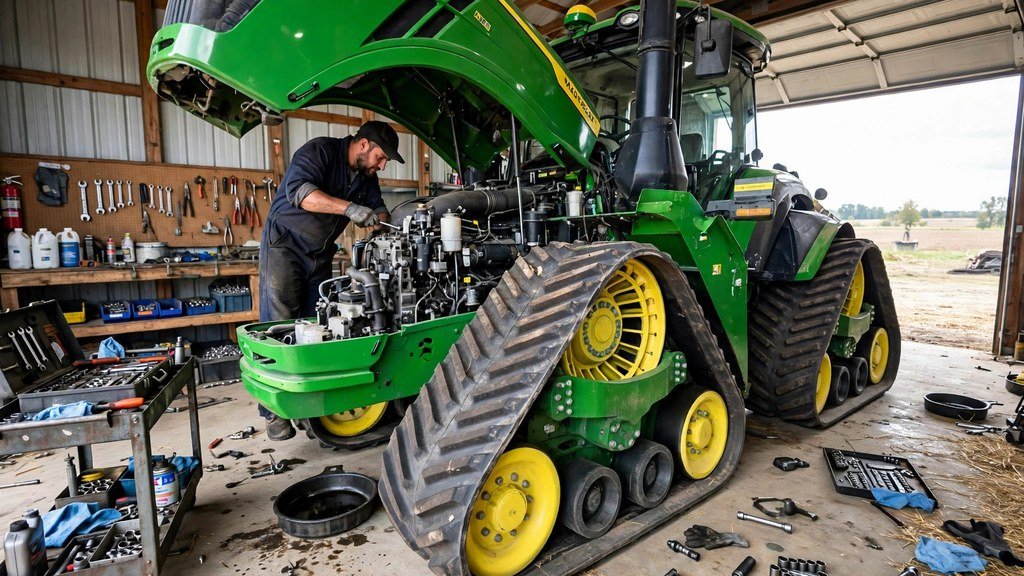
John Deere 9620RX maintenance starts with engine oil and filter service every 500 hours when using John Deere Plus-50 II oil; with other CJ-4 oils the interval drops to 250 hours, which is why most owners stick with the factory oil. Change both fuel filters at the same 500-hour visit, drain the water separator daily, and treat fuel quality as maintenance: the Cummins QSX15 runs a high-pressure fuel system that does not forgive dirty diesel or water contamination. A dealer 500-hour service typically runs $1,800–$3,000 (estimate), while a do-it-yourself service with factory filters and oil lands around $700–$1,200 (estimate). The air filter is a dual-stage unit with exhaust aspiration; inspect it annually and in dusty conditions far more often, because a restricted filter costs power and fuel long before it triggers a warning. The cooling system runs a 6,000-hour coolant drain interval with COOL-GARD II coolant and extender — check the coolant level and the radiator core daily in harvest dust, since a plugged core is the most common cause of load-related overheating on these tractors. If you are comparing service demands across the range, our 9620RX review and specs guide lays out the full machine specification, and the 9620RX performance and fuel usage guide covers what the engine drinks under load.
Transmission, Hydraulic Oil, Tracks and Lubrication
In the John Deere 9620RX maintenance schedule, transmission and hydraulic oil plus filters go every 1,500 hours — a dealer visit that typically costs $3,000–$5,000 (estimate) because of the oil volume involved: the system holds 58 gallons without a hitch and PTO, or 60 gallons with them. Grease on schedule, not on memory: hinge pins and track hardware get attention at 50 hours, and brakes, the neutral-start system, the park brake, and driveshafts are checked at 250 hours. Tracks get a daily walk-around — tension, guide lugs, tread bars, cuts, and debris packed between the belt and the wheels — because catching a failing belt early is worth thousands. The table below summarizes the schedule and the typical costs.
| Service item | Interval | Typical cost (est.) |
|---|---|---|
| Daily checks (fluids, tracks, leaks, belts, hoses) | Daily / 10 hours | Operator time only |
| Engine oil + filter (Plus-50 II) | 500 hours | $1,800–$3,000 dealer / $700–$1,200 DIY |
| Fuel filters + water separator | 500 hours | Included in 500-hour service |
| Track + hinge-pin service | 50 hours | Shop time + grease |
| Brakes, neutral start, park, driveshafts | 250 hours | Inspection labor |
| Transmission + hydraulic oil + filter | 1,500 hours | $3,000–$5,000 dealer (est.) |
| Coolant drain + COOL-GARD II | 6,000 hours | Dealer service (est.) |
| Replacement track belt (each, installed) | As needed | $10,000–$15,000+ per belt (est.) |
Keep this table with the machine’s service book so every interval is visible at a glance.
John Deere 9620RX Reliability and Long-Term Durability
The record on John Deere 9620RX maintenance is genuinely strong where it counts — engine, transmission, and frame — and expensive exactly where you would expect on a four-track machine: the undercarriage. These tractors were built for the heaviest draft work in North American agriculture, and well-kept examples routinely pass 5,000 hours with their original major components. The weak points are not mysterious: tracks and their running gear, the aftertreatment system, and the electronics that manage both.
Cummins QSX15 Engine, PowerShift Transmission and Hydraulics
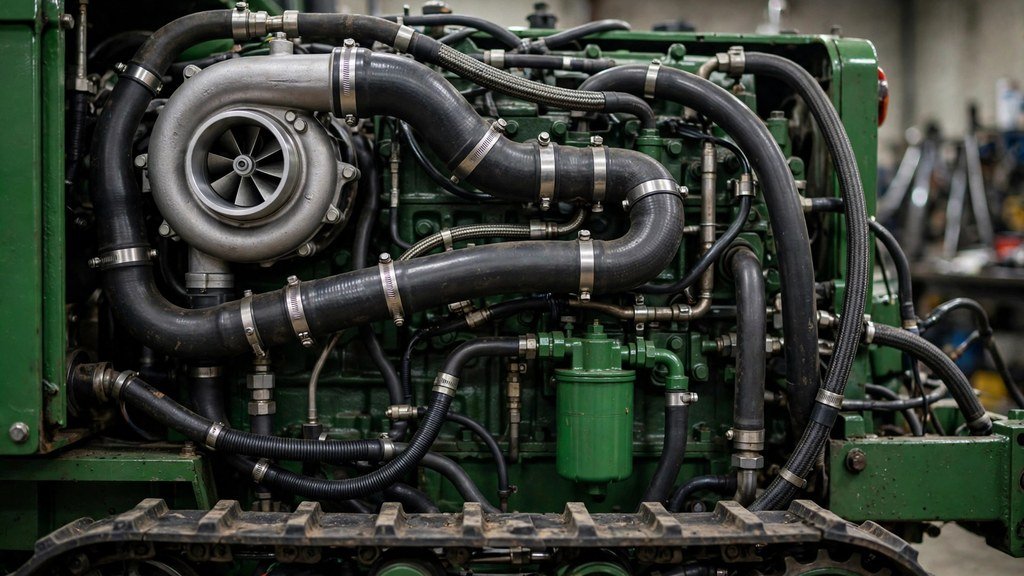
Here the John Deere 9620RX maintenance record needs to be set straight, because the 9RX engine story is widely confused. The smaller original 9RX models — the 9470RX and 9520RX — used John Deere’s own PowerTech PSS 13.5L engine. The 9620RX and 9570RX did not: they used the Cummins QSX15, a 14.9-liter (912 cu in) inline six with a single variable-geometry turbo, air-to-air aftercooling, cooled EGR, and DOC, DPF, and SCR aftertreatment meeting Final Tier 4. Rated output is 620 hp at 2,100 rpm with an 8 percent power boost, peak torque of 2,800 Nm (2,065 lb-ft) at 1,600 rpm, 36 percent torque rise, and 335 hp at the PTO. Note the torque figure carefully: one dealer spec sheet prints “3800 lb-ft” next to 2,800 Nm, but that conversion is wrong — 2,800 Nm equals 2,065 lb-ft, and the same misprint appears on the 9570RX page, so do not quote the 3,800 figure. Any source that calls the 9620RX a 13.5L PowerTech machine has mixed it up with its smaller siblings — check the engine badge and the serial plate on the machine itself, because that distinction drives parts, filters, and service procedures. The dealer spec sheet for the 9620RX confirms the Cummins QSX15, the 620 hp rating, and the hydraulic figures used here.
Factors Affecting Service Life, Downtime and Repair Costs
Three things decide John Deere 9620RX maintenance outcomes — how long a 9620RX lasts and what it costs to keep: hours, track history, and software. Hours alone mislead — a 3,000-hour tractor that spent its life on road transport and scraper work can need tracks sooner than a 5,000-hour tillage machine that never left the field. The second factor is electronics: owner reports consistently put software and sensor faults — code cascades, guidance gremlins, and aftertreatment sensors — ahead of hard mechanical failures as the most common surprise-repair category, and dealer diagnostic time is expensive. The third is simply parts scale: everything on a 620-horsepower four-track machine costs more than the same job on a row-crop tractor, from the 60-gallon transmission service to a single track belt. Budget a track reserve from day one. For the ownership-cost math behind these reserves, see our 9620RX ownership cost and resale guide.
John Deere 9620RX Common Problems and Warning Signs
No used 9620RX is problem-free, and John Deere 9620RX maintenance is mostly about catching problems early — read this section as a checklist, not a warning against the model. Most issues on these tractors announce themselves early — a code on the CommandCenter, a slow hydraulic function, a belt that starts to chunk — and the expensive failures are almost always the ones that were ignored for a season.
Engine, Electrical, Hydraulic and Transmission Symptoms
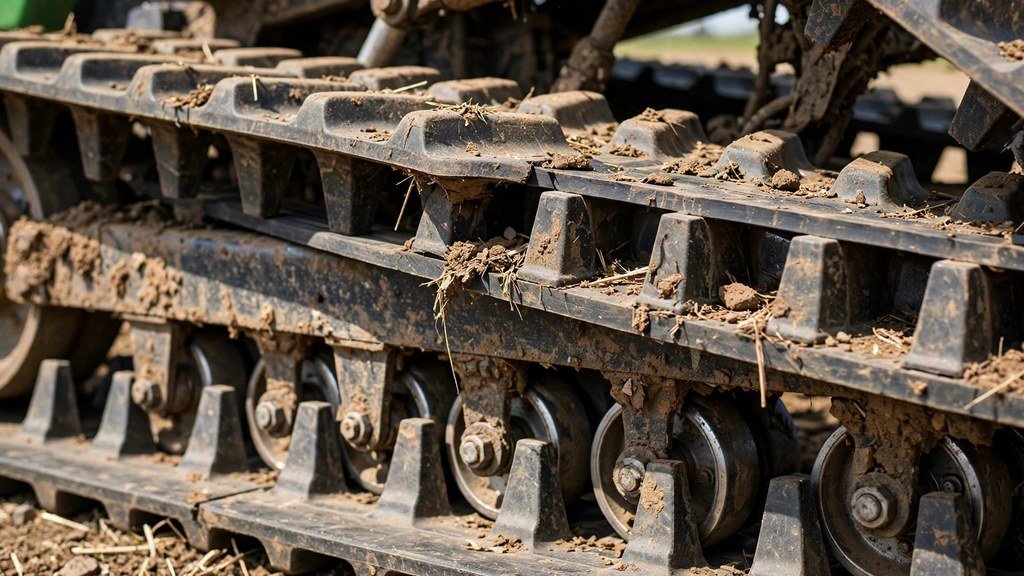
In John Deere 9620RX maintenance, the engine-side watch list starts with lost power, hard cold starts, and repeated DPF regeneration problems. Diagnostic cases on Deere Final Tier 4 machines show how a single failed sensor — for example, a DOC inlet temperature sensor reading out of range — can inhibit exhaust filter cleaning entirely, leaving the operator with a clogged filter and a dashboard full of codes; the fix is a sensor, but the symptom looks like a major engine failure. Electrical complaints usually start small: warning lights that stay lit, slow cranking, or a sensor that drops out intermittently — check batteries, grounds, and harness connectors before assuming a module has failed, since corrosion and loose connections cause a large share of nuisance faults. Hydraulic symptoms are slow or unresponsive functions, visible leaks at lines and couplers, and pressure that fades under load; on a machine with up to 115 gpm and eight SCVs, a weak pump or a bypassing valve shows up first on the most demanding implement. Transmission symptoms on the e18 include slipping, harsh or missed shifts, and unusual vibration — a recalibration sometimes cures shift-quality complaints, but slipping under load is a stop-and-diagnose fault, not a setting. Overheating under load usually traces back to a plugged radiator core or a tired fan drive before it traces to the engine itself.
Track Wear, Alignment and Undercarriage Inspection
Track problems are the signature expense in John Deere 9620RX maintenance, and they are also the most inspectable. Walk each belt end to end: look for tread-bar chunking, cuts, exposed cables, and guide-lug wear, and check that all four belts track straight with even tension. Misalignment shows as one-sided wear on the guide lugs and as belts that creep sideways; it usually traces to worn idlers, mid-rollers, or a bent component rather than to the belt itself. Measure remaining tread depth and compare corners — a machine with one fresh belt and three worn ones is telling you about an incident, not about maintenance. Check the drive sprockets for hooked or chipped teeth, the mid-rollers for flat spots and seal leaks, and the undercarriage frame for cracks at the pivot points. Owner-reported belt life runs 3,000 to 5,000-plus hours depending on roading, ballast, and tension discipline, and Camso — the maker of the Duradrive 3500 and 6500 belts fitted to the 9RX — backs agricultural belts with a 4-year/2,000-hour warranty. New belts need breaking in: Deere’s operator manual says to work the tractor in loose soil for at least 15 minutes after fitting new or freshly cleaned belts, and to avoid high-speed roading for the first 50–100 hours, because clean, unlubricated track components can generate damaging heat. The video below covers 9RX cost-of-operation solutions — e18 transmission, mid-roller replacement, and track belt maintenance — a useful look at the track system working under load.
John Deere 9620RX Safety Checks and Used-Tractor Inspection
Before you hand over money for a used John Deere 9620RX, run the full John Deere 9620RX maintenance inspection below. On this model, most buyers’ regrets are track-related — a set of belts at the end of its life can swallow $40,000–$60,000 (estimate) for a full set — so start with the undercarriage and work inward, and pay for a dealer inspection if the seller’s records are thin.
Pre-Purchase Checklist for a Used John Deere 9620RX
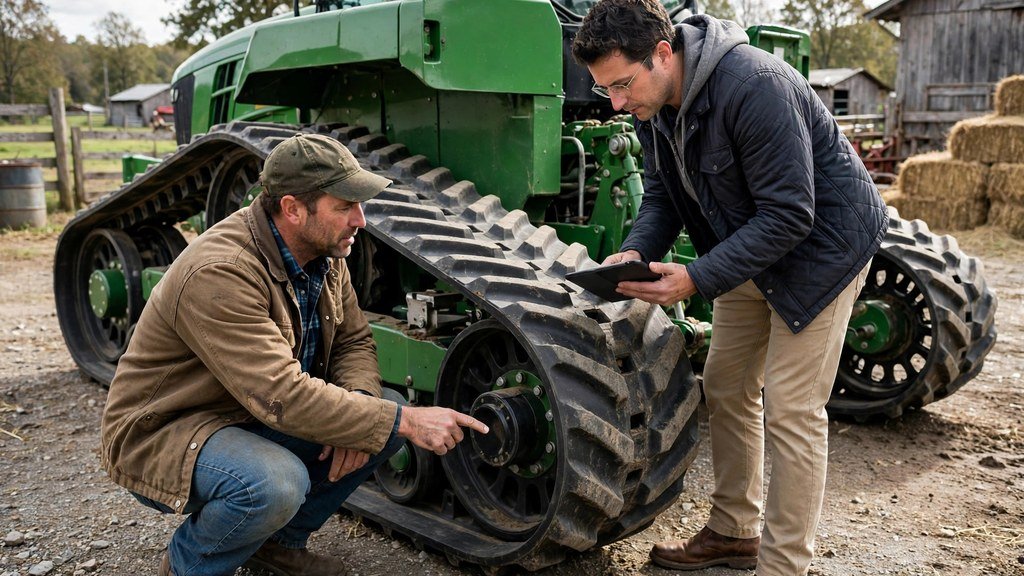
Run through these in order: service history — ask for the full dealer service record and cross-check hours against the 500-hour and 1,500-hour services; any gap in the 1,500-hour transmission service is a price negotiation point. Tracks — measure tread depth on all four belts, check guide lugs for one-sided wear, and look for cuts, exposed cables, and cracked tread bars; mismatched belt ages across corners are a red flag. Undercarriage — check mid-rollers and idlers for leaks and flat spots, drive sprockets for hooked teeth, and the frame for cracks at pivot points. Engine — cold-start it, watch for smoke, check blow-by, and confirm the aftertreatment system has no active codes or a history of repeated regens. Hydraulics — run every SCV under load and watch for slow functions and leaks at couplers. Electronics — confirm the CommandCenter, guidance, and all sensors respond, and that no fault codes are stored. Test drive — check shift quality through the e18 range, braking, steering response, and any vibration at road speed. Finally, check for open recalls on the machine’s serial number before you buy; Deere maintains a recall information page for this. The same inspection logic applies across the family — the 9570RX and 9520RX versions of this guide use the identical checklist — and for the sibling machines see the 9570RX maintenance guide and the 9520RX maintenance guide.
Frequently Asked Questions About John Deere 9620RX Maintenance
How often does a 9620RX need an oil change?
Engine oil and filter service is every 500 hours when using John Deere Plus-50 II oil, or every 250 hours with other CJ-4 oils, which is why most owners use the factory oil. Change both fuel filters at the same visit, and drain the water separator daily.
What is the biggest maintenance cost on a 9620RX?
Tracks, by a wide margin. A single replacement belt runs $10,000–$15,000+ installed (estimate), so a full set can cost $40,000–$60,000 (estimate). Daily track inspection and correct tension are the cheapest insurance on this machine.
Is the 9620RX reliable?
Yes — the Cummins QSX15 engine, e18 transmission, and frame have a strong long-term record, and well-kept examples pass 5,000 hours on original major components. The most common surprise repairs are software and sensor faults rather than hard mechanical failures, so a dealer diagnostic check matters on any used purchase.
How long do 9620RX tracks last?
Owner reports put belt life at 3,000 to 5,000-plus hours, depending on roading, ballast, and tension discipline. Belts with cuts, exposed cables, or one-sided guide-lug wear need replacement regardless of hours.
What should I check before buying a used 9620RX?
Service history against the 500-hour and 1,500-hour intervals, tread depth and guide-lug condition on all four belts, mid-roller and idler condition, a cold start with no active aftertreatment codes, every SCV under load, and shift quality through the e18 range — plus a serial-number recall check.
Does the 9620RX use a John Deere or Cummins engine?
The 9620RX uses the Cummins QSX15, a 14.9-liter inline six rated at 620 hp. The smaller 9470RX and 9520RX used John Deere’s own 13.5L PowerTech engine — do not let a listing confuse the two.
When is the transmission and hydraulic service due?
Every 1,500 hours, including oil and filter, at a typical dealer cost of $3,000–$5,000 (estimate) because the system holds 58–60 gallons of oil depending on hitch and PTO fitment.