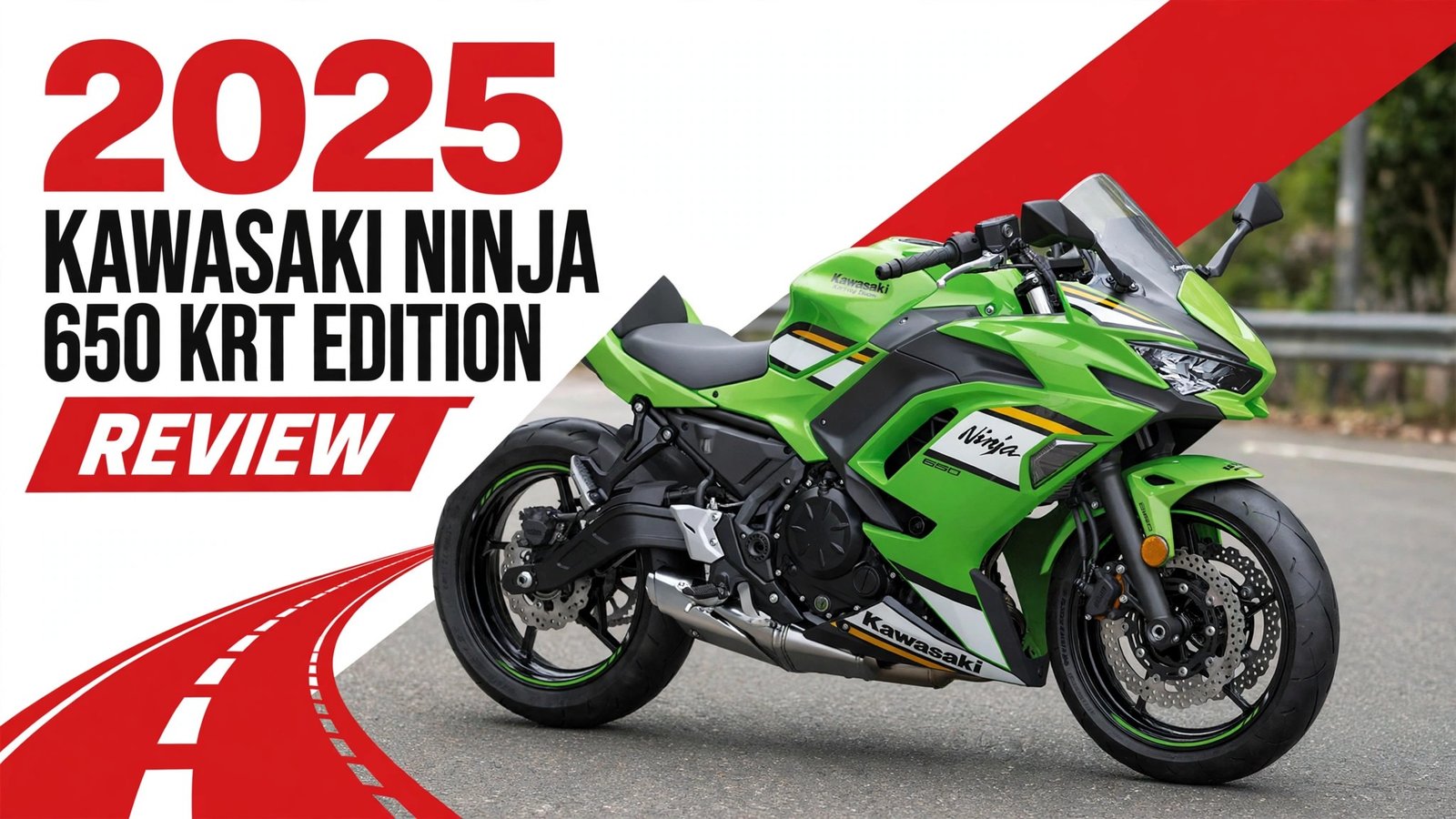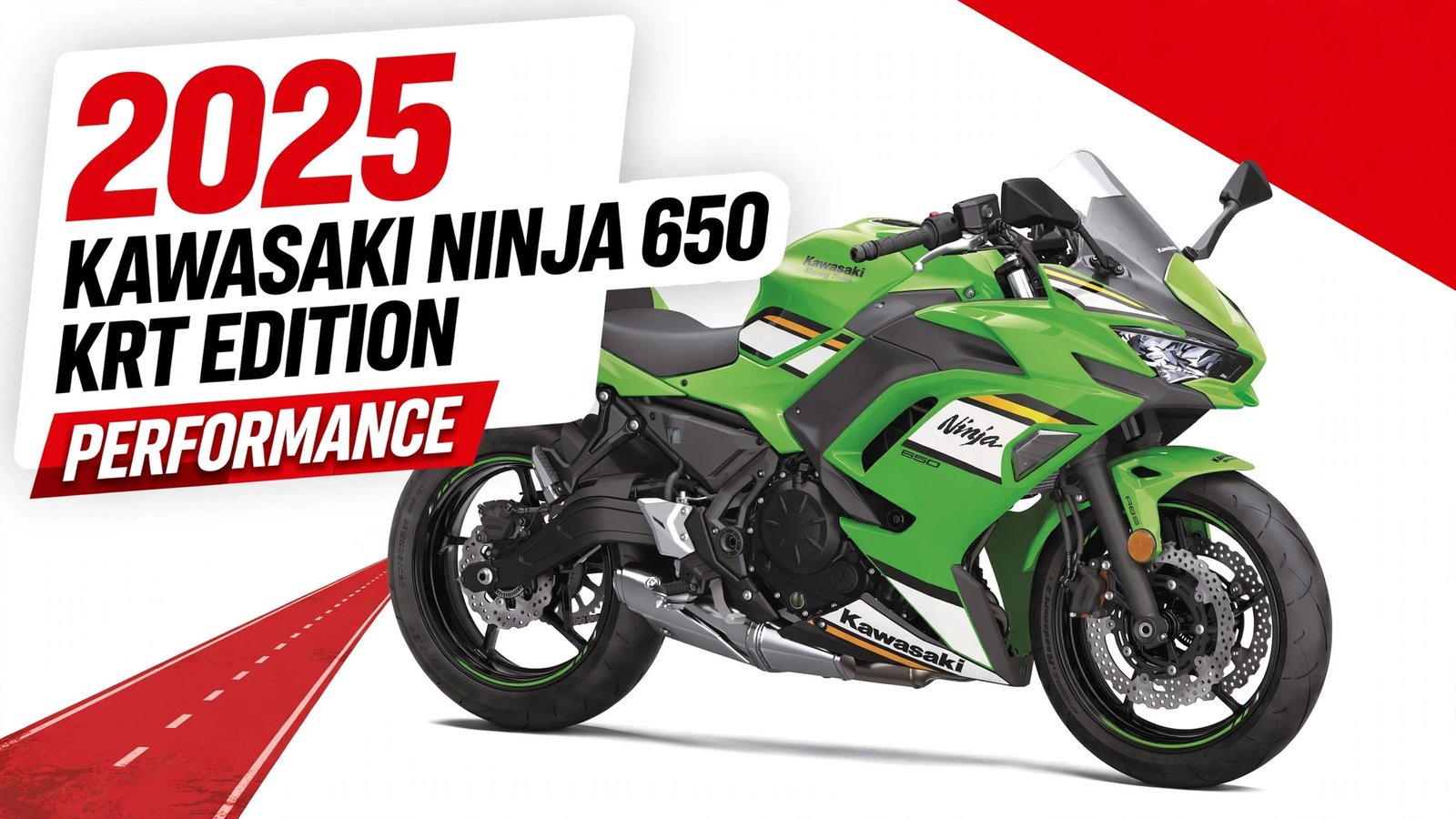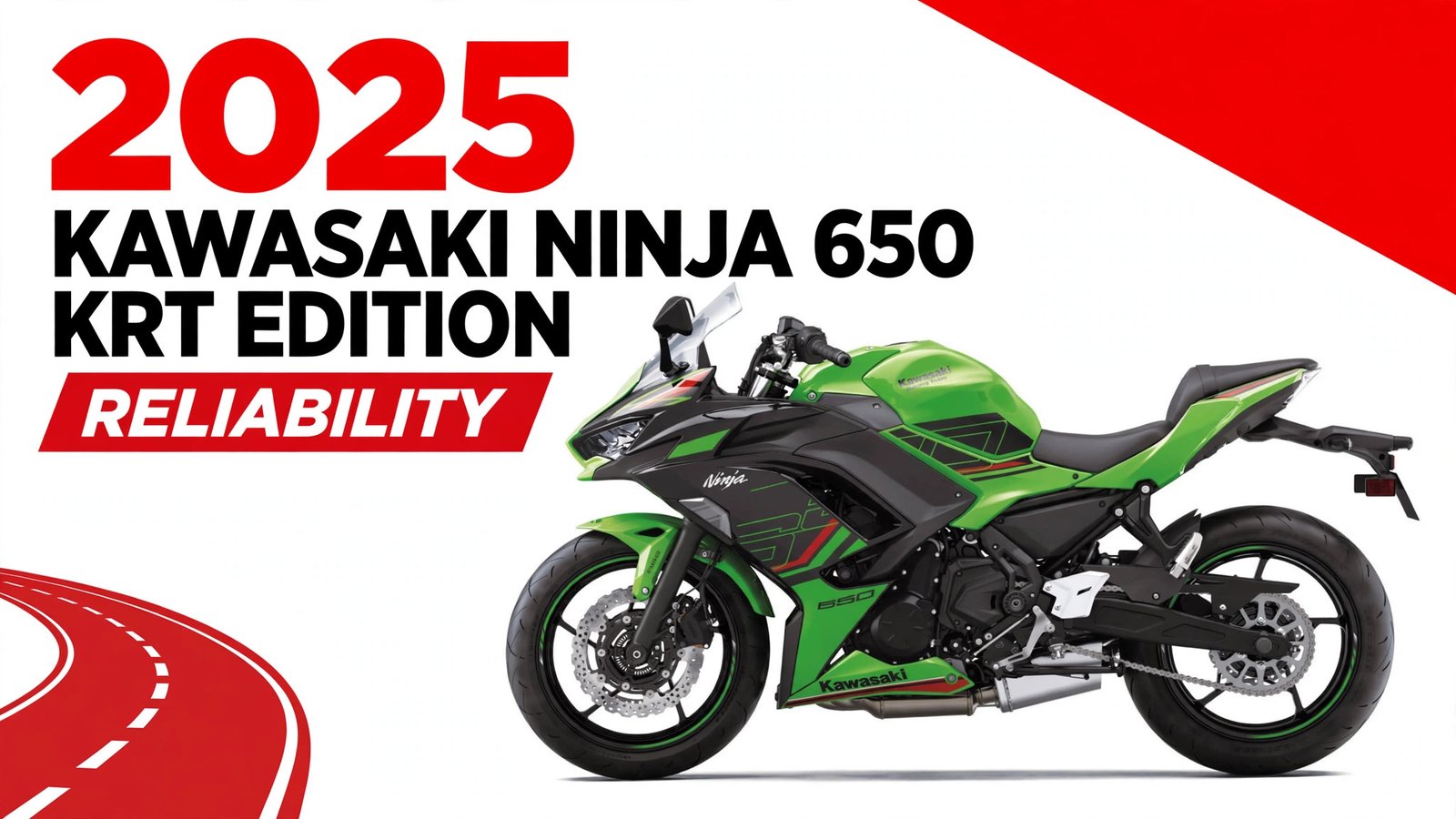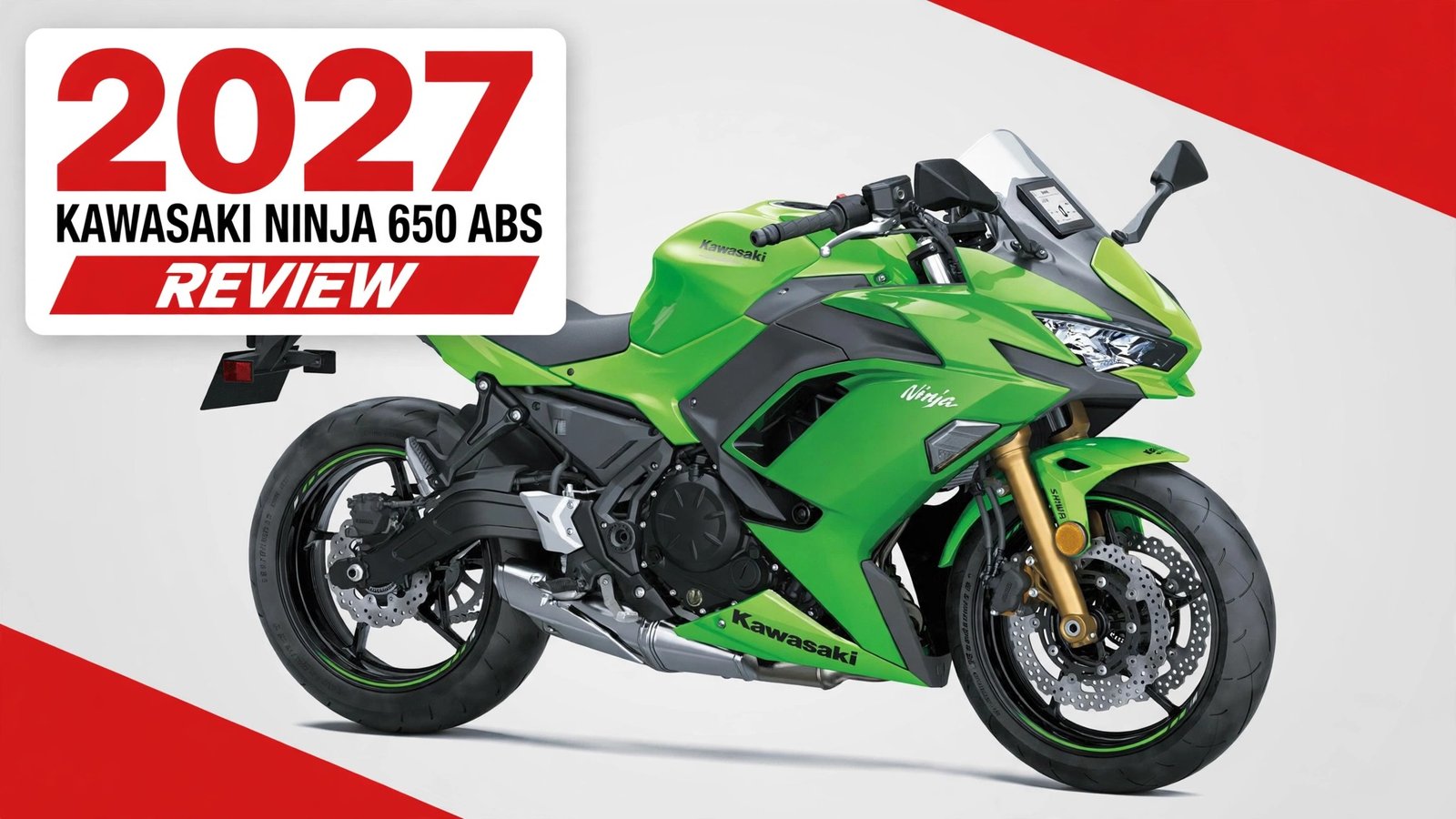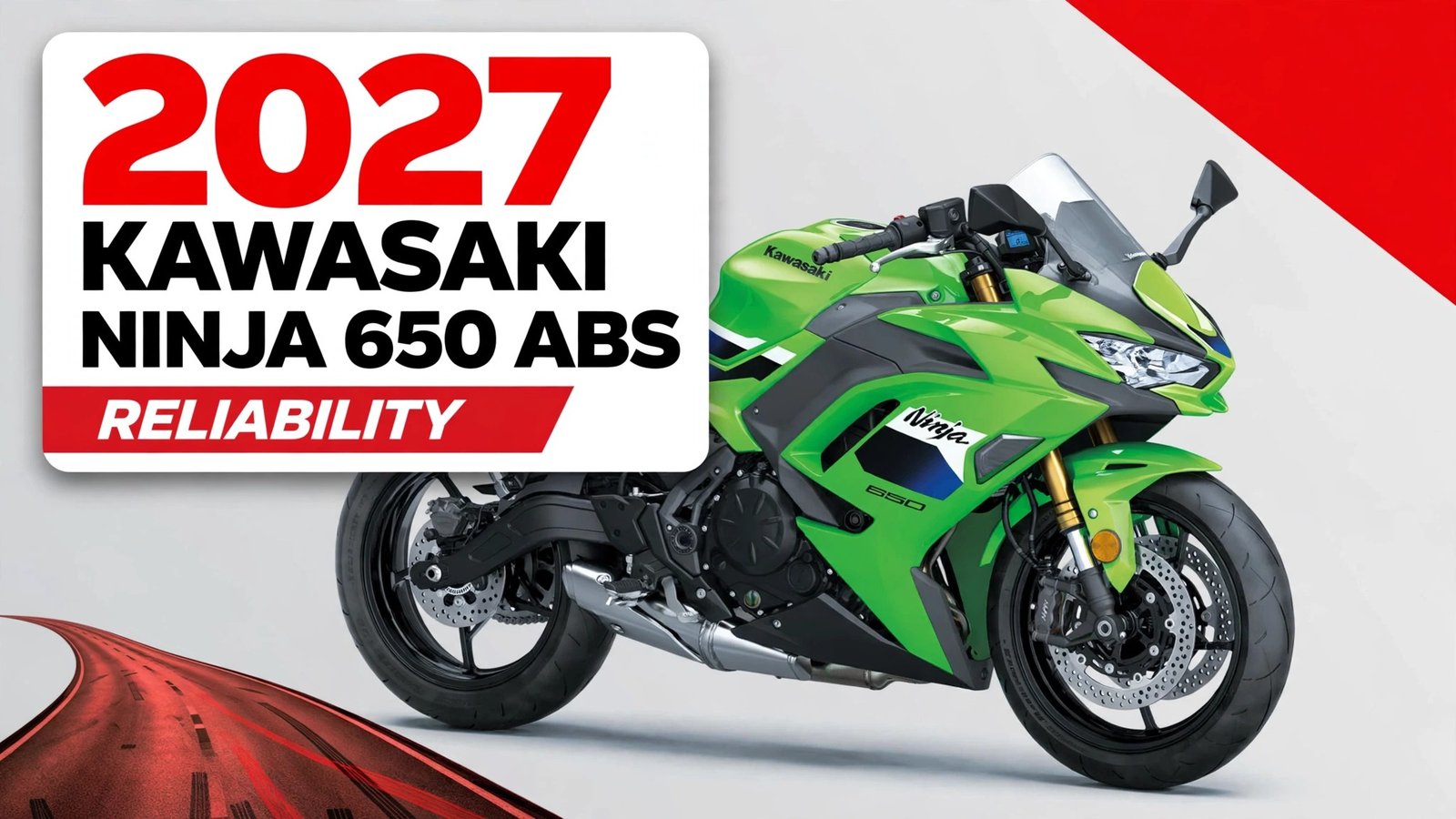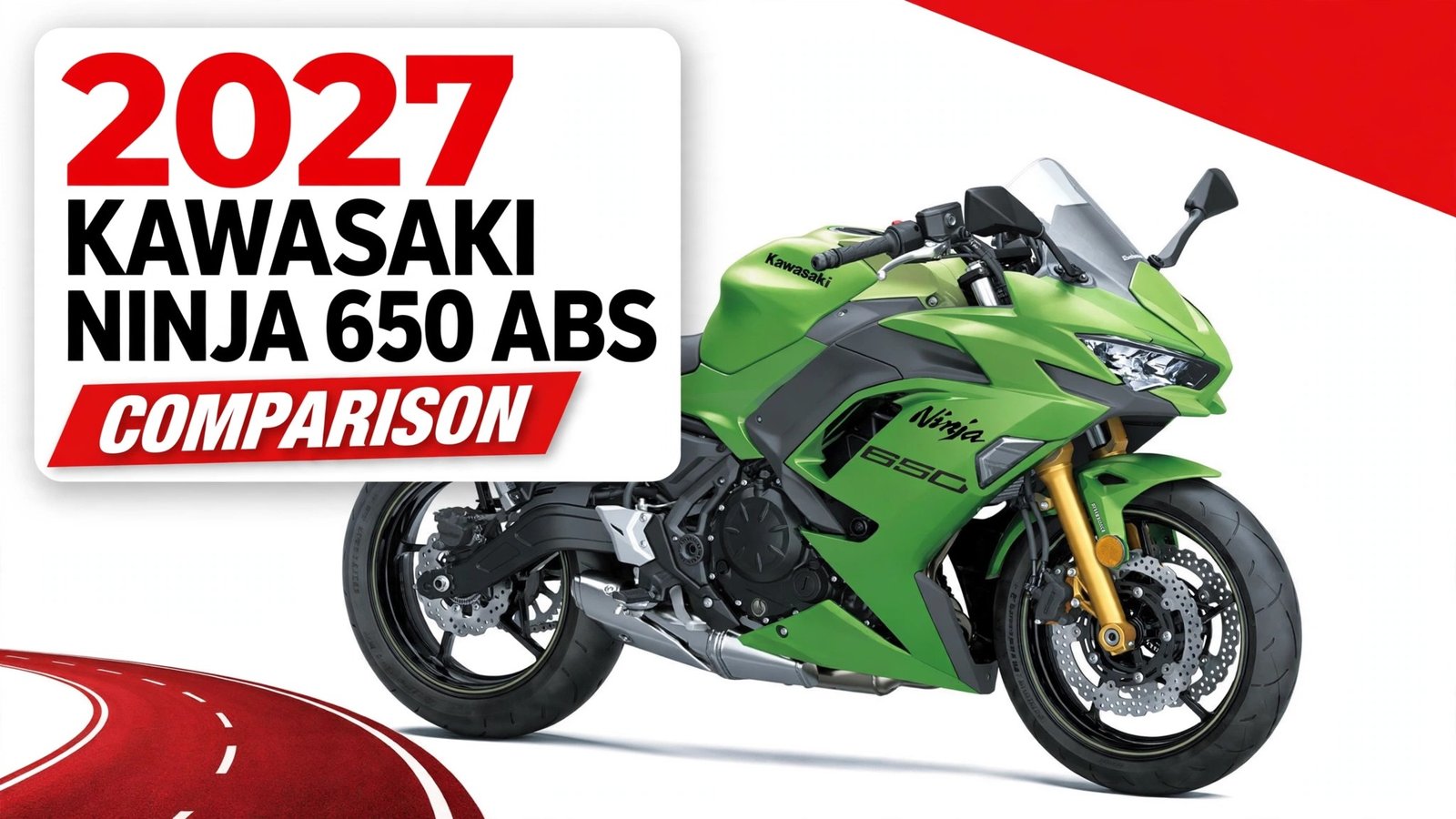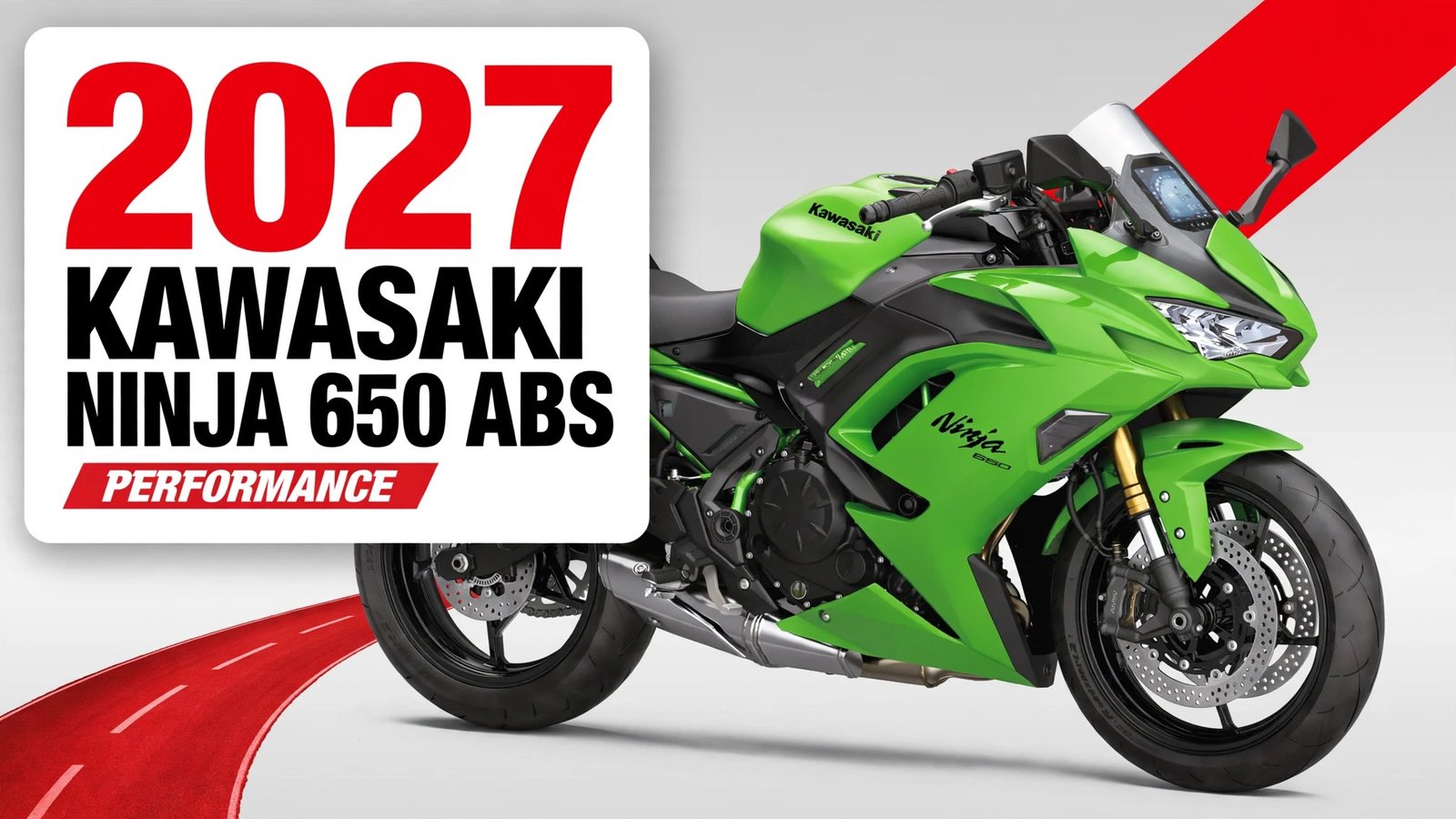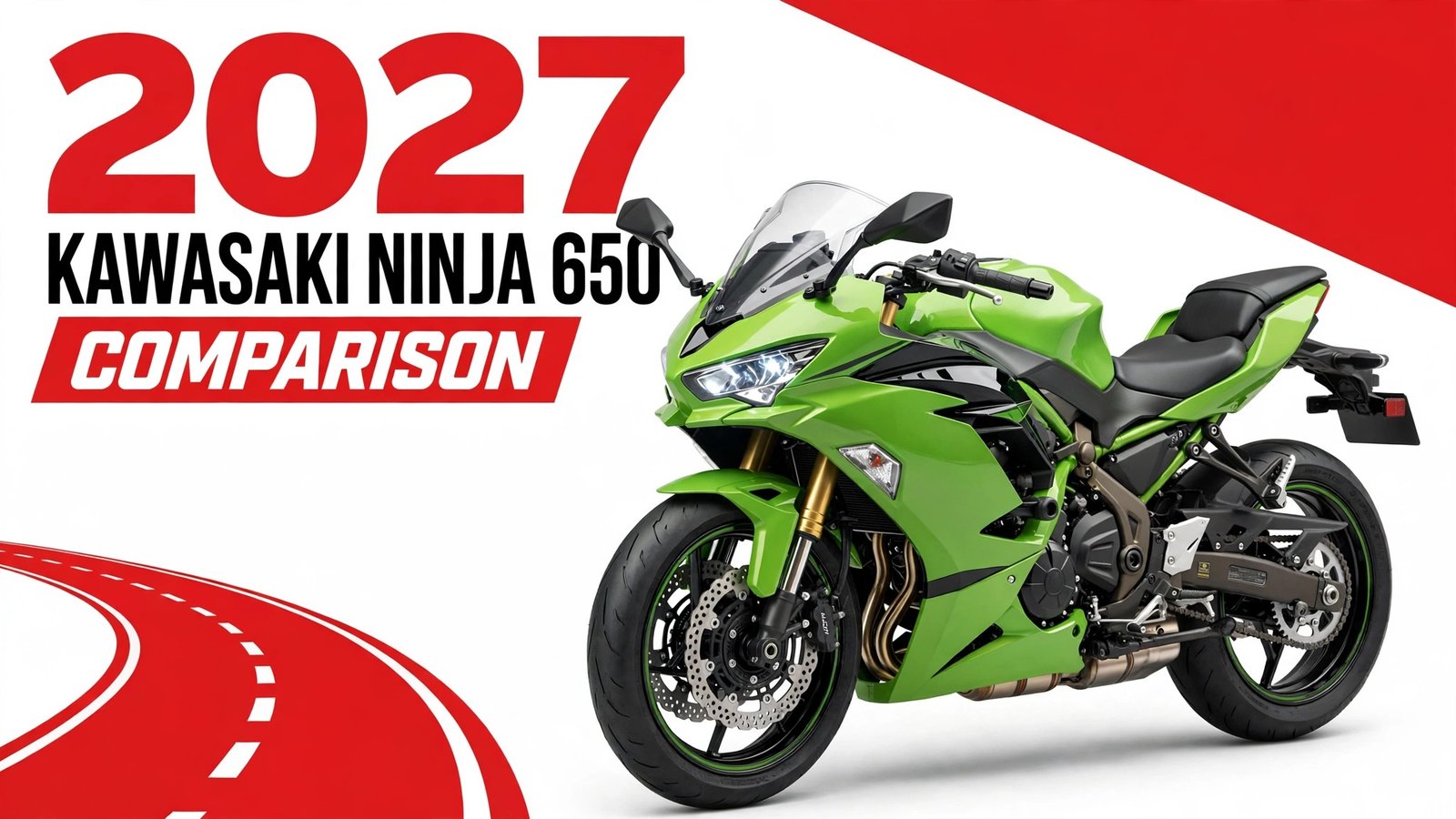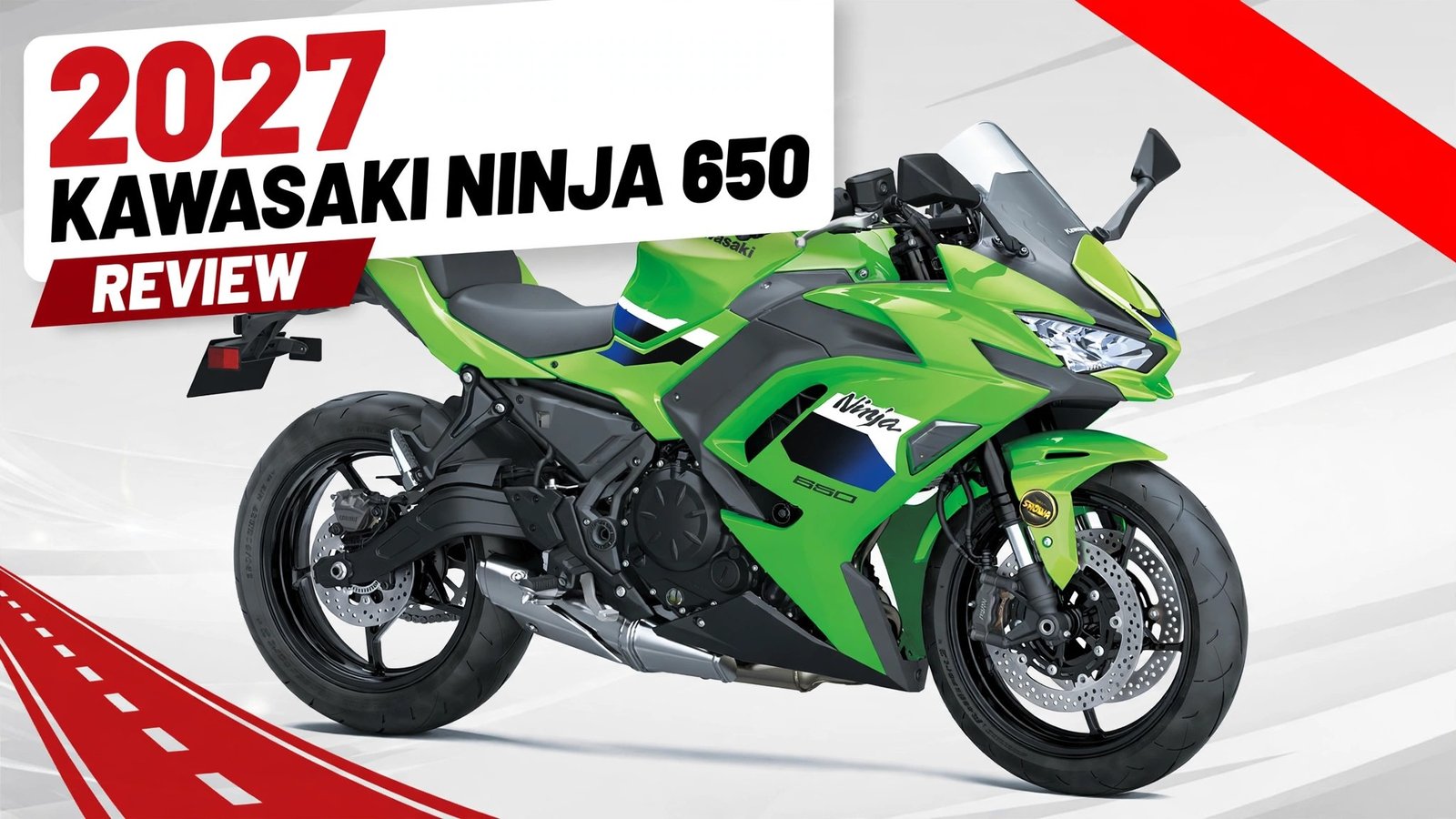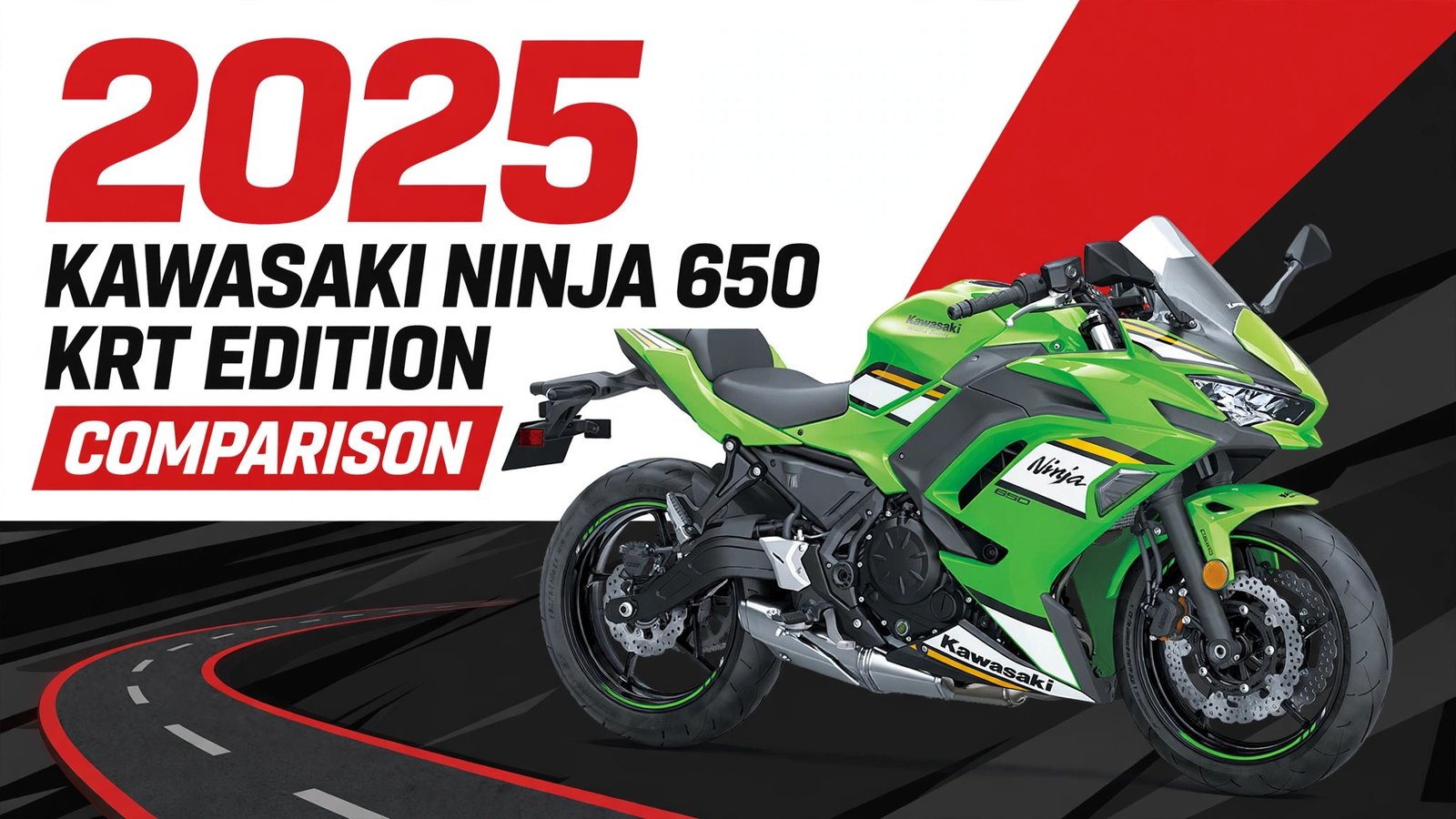
The cheapest new middleweight sportbike in this Kawasaki Ninja 650 KRT Edition comparison is not a new bike at all. It is a leftover: a new 2025 Ninja 650 KRT Edition ABS, listed at $6,999 total in November 2026 — $1,000 under its $7,999 sticker. The Yamaha YZF-R7 costs $10,074 delivered, the 2027 Ninja 650 ABS $8,784 and the Suzuki GSX-8R $9,949. The KRT is the same motorcycle as the Ninja 650 ABS — same 649cc twin, 67.0 hp, 423.4 lb curb weight and 2025 model code — with Lime Green and Ebony KRT paint as its only difference. So this Kawasaki Ninja 650 KRT Edition comparison is a contest of prices, and of what the extra money buys.
Kawasaki Ninja 650 KRT Edition Overview and Its Closest Rivals
Four bikes make up this Kawasaki Ninja 650 KRT Edition comparison: the leftover KRT, the Ninja 650 ABS, the Yamaha YZF-R7 and the Suzuki GSX-8R. The KRT and the ABS are the same bike at two prices; the R7 and the GSX-8R are genuinely different motorcycles — and they charge for it. The KRT Edition review covers the nine-year pricing.
Identity Only, by Design
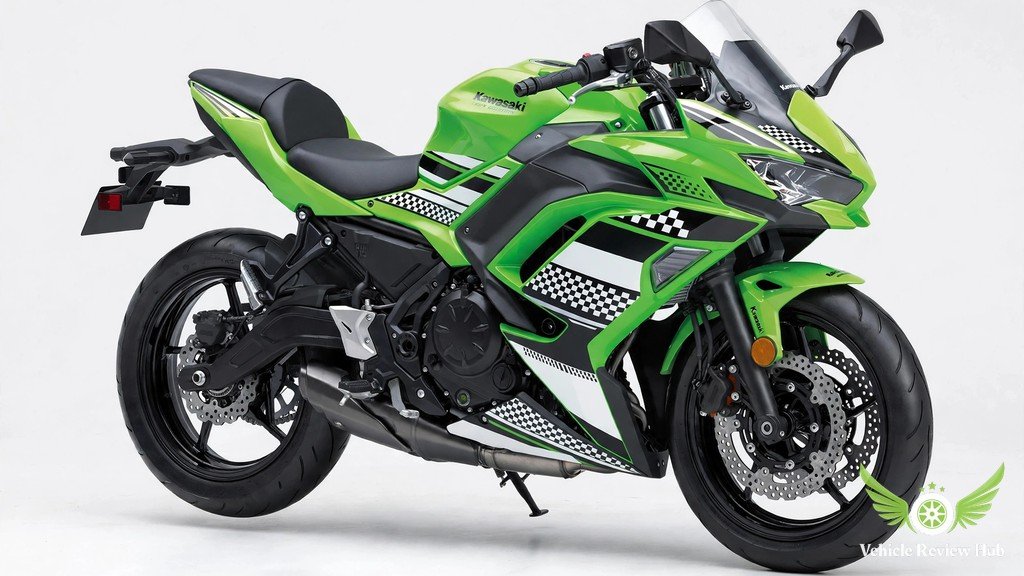
The KRT Edition is a colour and graphics package, nothing more. Kawasaki’s model copy, in every year of the nine-year run, listed the KRT’s only distinguishing feature as “Exclusive Kawasaki Racing Team (KRT) color & graphics.” No other feature line differed. Engine, chassis, brakes and electronics are the same: the 649cc twin, the 41 mm fork, the dual 300 mm Nissin discs with Bosch ABS, and the 4.3-inch TFT dash with KTRC and ride modes. In 2025 the KRT even shared the plain ABS bike’s model code, EX650PSFAL. That is the point of this Kawasaki Ninja 650 KRT Edition comparison: the KRT does not compete on hardware. It competes on price and on identity.
How the Four Bikes Differ at a Glance
At a glance, the four bikes split into two pairs in this Kawasaki Ninja 650 KRT Edition comparison: the KRT and the 2027 ABS are the same platform at different prices, and the GSX-8R and the R7 are the step-ups, for $2,950 and $3,075 over the leftover KRT.
| Bike | Engine | Claimed power | Delivered price |
|---|---|---|---|
| 2025 KRT Edition ABS (leftover) | 649cc parallel twin | 67.0 hp | $6,999 total |
| 2027 Ninja 650 ABS (base) | 649cc parallel twin | 67.0 hp | $8,784 |
| 2027 Suzuki GSX-8R | 776cc parallel twin | 81.8 hp | $9,949 |
| 2026 Yamaha YZF-R7 | 689cc CP2 twin | 72.4 hp | $10,074 |
Note: Delivered prices are MSRP plus destination, except the KRT, a dated November 2026 dealer leftover total ($6,999, $1,000 off its $7,999 MSRP). The 2027 ABS base is $8,099 + $685; the GSX-8R is $9,199 + $750; the R7 is $9,399 + $675. This Kawasaki Ninja 650 KRT Edition comparison uses 2027 rivals and the 2025 leftover KRT.
Kawasaki Ninja 650 KRT Edition vs Kawasaki Ninja 650 ABS
The first pairing in this Kawasaki Ninja 650 KRT Edition comparison is the strangest: the two bikes are the same bike. A 2025 KRT and a 2025 plain ABS are identical — same engine, chassis, brakes, electronics, 423.4 lb curb weight and EX650PSFAL model code — and both cost $7,999 in 2025, so the paint was free. The only real choice is a discounted leftover KRT or a new 2027 ABS, the same platform with genuinely new hardware. The KRT Edition performance guide and the Ninja 650 ABS comparison cover the shared platform and the plain bike’s rivals.
Engine, Specs and Performance Side by Side
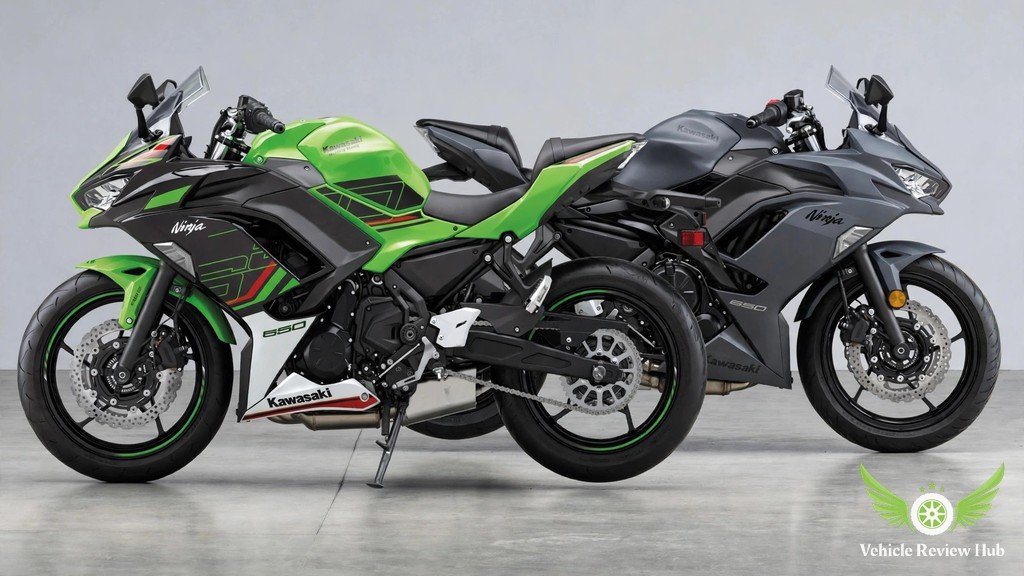
Nothing separates the KRT from the 2025 ABS on a spec sheet: both carry the 649cc liquid-cooled parallel twin — claimed 67.0 hp at 8,000 rpm and 48.5 lb-ft at 6,700 rpm under ISO 4106 — with the same six-speed gearbox, 41 mm fork, preload-only rear shock and dual 300 mm petal discs with Nissin calipers and Bosch ABS. No outlet ever dynoed a KRT as a KRT, so the measured figures are the platform’s: MCN recorded 60.38 bhp at the rear wheel, and Rider recorded 60.6 hp at 8,100 rpm on the mechanically identical Z650. The 2027 ABS is where the sheet changes: a 37 mm inverted Showa SFF-BP fork, radial-mount four-piston calipers and semi-floating discs on the same 649cc engine. The discs did not change — 300 mm front and 220 mm rear in both 2026 and 2027 — so this Kawasaki Ninja 650 KRT Edition comparison never says the 2027 discs “grew”.
| Specification | 2025 KRT Edition ABS | 2025 plain ABS | 2027 ABS (base) |
|---|---|---|---|
| Engine | 649cc parallel twin | 649cc parallel twin | 649cc parallel twin |
| Claimed power | 67.0 hp @ 8,000 rpm | 67.0 hp @ 8,000 rpm | 67.0 hp @ 8,000 rpm |
| Claimed torque | 48.5 lb-ft @ 6,700 rpm | 48.5 lb-ft @ 6,700 rpm | 48.5 lb-ft @ 6,700 rpm |
| Curb weight | 423.4 lb | 423.4 lb | Not stated here |
| Front fork | 41 mm telescopic, non-adjustable | 41 mm telescopic, non-adjustable | 37 mm inverted Showa SFF-BP |
| Front brakes | Dual 300 mm discs, Nissin 2-piston | Dual 300 mm discs, Nissin 2-piston | Dual 300 mm discs, radial 4-piston |
| ABS | Bosch 9.1M, two-channel | Bosch 9.1M, two-channel | Bosch, two-channel |
| Seat height | 31.1 in | 31.1 in | 31.1 in |
| Fuel capacity | 4.0 gal | 4.0 gal | 4.0 gal |
| Model code | EX650PSFAL | EX650PSFAL | Not stated here |
| MSRP | $7,999 | $7,999 | $8,099 |
Note: The 2025 KRT and the 2025 plain ABS are line-identical in this table because they are the same motorcycle — the claimed power is Kawasaki’s ISO 4106 figure, and the Bosch 9.1M supplier is documented on 2017-and-later bikes only. This Kawasaki Ninja 650 KRT Edition comparison uses the 2027 base price of $8,099; premium colours are $8,299.
Price, Equipment and Which Suits Which Rider
On price, the KRT and the 2025 ABS are a $0 comparison: both $7,999 at MSRP, both $8,664 delivered with the $665 destination charge, and the paint was free — Kawasaki charged $200 for the KRT paint in 2017, as Ultimate Motorcycling’s 2017 first ride shows in its $7,399/$7,799/$7,999 spread, then dropped the premium in the final year. The real money choice is the leftover KRT against the new 2027 ABS: the leftover is $6,999 all-in, $1,000 under its $7,999 sticker as of November 2026, against $8,784 delivered for the 2027 base and $8,984 for the premium-colour bike. That is $1,785 more for the base and $1,985 more for the premium bike in this Kawasaki Ninja 650 KRT Edition comparison, and the extra money buys the inverted Showa fork, the radial calipers and the semi-floating discs — the only hardware the 2027 bike adds. Buy the leftover KRT for the green livery and the lowest price; buy the 2027 ABS for the new fork and brakes.
Kawasaki Ninja 650 KRT Edition vs Yamaha YZF-R7
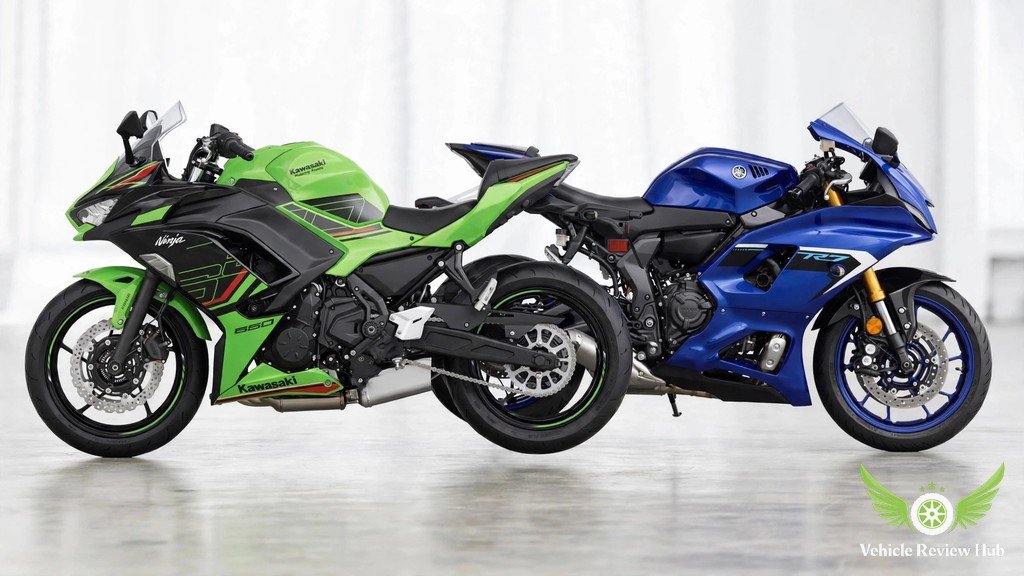
The Yamaha YZF-R7 is the most expensive bike in this Kawasaki Ninja 650 KRT Edition comparison, and the most different one. Where the KRT and the ABS are the same bike, the R7 is a different machine — a different engine, a more committed riding position and a different electronics package — with a 2026 refresh that added the equipment the 650 has never had. The gap is $3,075 delivered: the leftover KRT at $6,999 total against the R7 at $10,074. The live Yamaha YZF-R7 review and the KRT Edition reliability guide cover the Yamaha and the platform.
Engine, Specs and Performance Side by Side
The R7’s 689cc CP2 twin makes a claimed 72.4 hp at 8,750 rpm and 50.2 lb-ft at 6,500 rpm — 5.4 hp and 1.7 lb-ft more than the KRT’s 649cc twin. The bigger difference is the electronics: the 2026 R7 carries a six-axis IMU, ride-by-wire throttle, a third-generation quickshifter, cruise control and a 5-inch TFT dash, plus an inverted KYB 41 mm fork. The KRT carries the 650’s 4.3-inch TFT dash with KTRC and ride modes, a non-adjustable 41 mm fork and no quickshifter as standard. No US head-to-head test exists, so this Kawasaki Ninja 650 KRT Edition comparison does not invent one — the figures below are the manufacturers’ claimed figures.
| Specification | 2025 KRT Edition ABS | 2026 Yamaha YZF-R7 |
|---|---|---|
| Engine | 649cc parallel twin | 689cc CP2 parallel twin |
| Claimed power | 67.0 hp @ 8,000 rpm | 72.4 hp @ 8,750 rpm |
| Claimed torque | 48.5 lb-ft @ 6,700 rpm | 50.2 lb-ft @ 6,500 rpm |
| Curb weight | 423.4 lb | Not stated here |
| Front fork | 41 mm telescopic, non-adjustable | Inverted KYB 41 mm |
| Electronics | 4.3-in TFT, KTRC, ride modes, RIDEOLOGY | 5-in TFT, six-axis IMU, ride-by-wire, quickshifter, cruise |
| Seat height | 31.1 in | 31.1 in |
| Fuel capacity | 4.0 gal | Not stated here |
| MSRP | $7,999 | $9,399 |
| Delivered | $6,999 total (leftover) | $10,074 |
Note: Claimed power and torque are the manufacturers’ figures — the KRT’s are ISO 4106, and the R7’s 72.4 hp is the verified claim (Yamaha’s global claim is 73 hp). This Kawasaki Ninja 650 KRT Edition comparison states plainly that no US head-to-head test exists.
Price, Equipment and Which Suits Which Rider
The R7 costs $3,075 more than the leftover KRT delivered — $10,074 against $6,999 — and the extra money buys the 5.4 hp, the inverted KYB fork, and the electronics the 650 has never offered: the six-axis IMU, ride-by-wire, the quickshifter and cruise control. In this Kawasaki Ninja 650 KRT Edition comparison, buy the R7 for the newest electronics and the sharper position; buy the leftover KRT for the cheapest way into a new middleweight, and keep the $3,075. The RevZilla 2026 R7 first ride covers the refreshed bike, and the Motorcycle.com 2026 R7 first look lists the $9,399 base price and the $9,699 Anniversary price.
Kawasaki Ninja 650 KRT Edition vs Suzuki GSX-8R
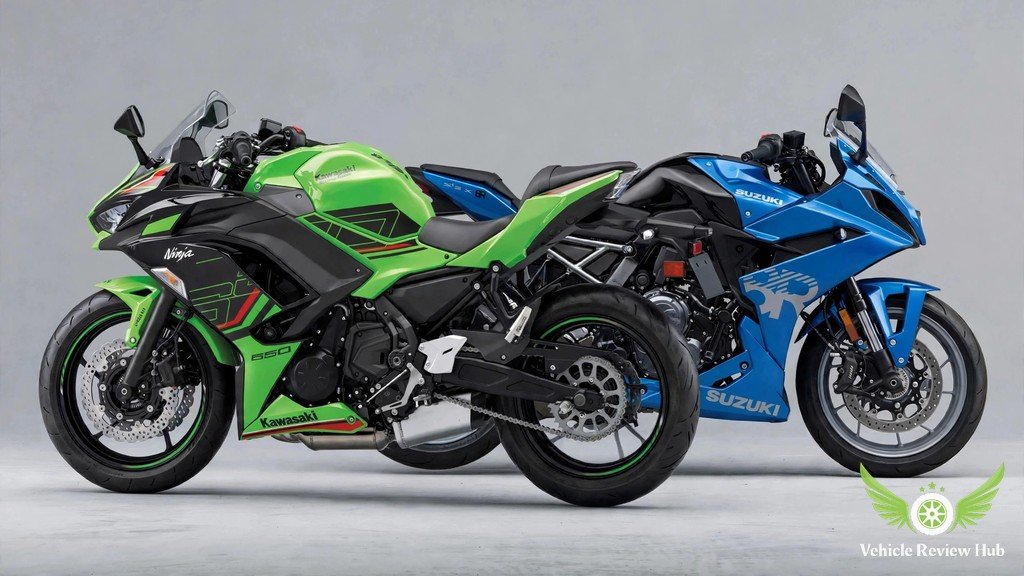
The Suzuki GSX-8R is the power step-up in this Kawasaki Ninja 650 KRT Edition comparison. Its 776cc parallel twin claims 81.8 hp — 14.8 hp more than the KRT’s 649cc twin — and its delivered price of $9,949 sits $2,950 above the $6,999 leftover KRT. The 8R is the newest-feeling rival here, a ground-up middleweight. The GSX-8R comparison and the KRT Edition review cover the Suzuki and the nine-year pricing story.
Engine, Specs and Performance Side by Side
The GSX-8R’s advantage is displacement: 776cc against the KRT’s 649cc, and a claimed 81.8 hp — equal to 83 PS — against the KRT’s claimed 67.0 hp. The measured figures narrow the gap: Cycle World recorded 72.75 hp at the rear wheel for the 8R, against MCN’s 60.38 bhp for the 650 — about 12 hp at the wheel. No US head-to-head test exists, so this Kawasaki Ninja 650 KRT Edition comparison rests on the claimed figures, the two dyno runs and the price gap.
| Specification | 2025 KRT Edition ABS | 2027 Suzuki GSX-8R |
|---|---|---|
| Engine | 649cc parallel twin | 776cc parallel twin |
| Claimed power | 67.0 hp @ 8,000 rpm | 81.8 hp (83 PS) |
| Claimed torque | 48.5 lb-ft @ 6,700 rpm | Not stated here |
| Rear-wheel dyno | 60.38 bhp (MCN) | 72.75 hp (Cycle World) |
| Curb weight | 423.4 lb | Not stated here |
| Seat height | 31.1 in | Not stated here |
| Fuel capacity | 4.0 gal | Not stated here |
| MSRP | $7,999 | $9,199 |
| Destination | $665 (2025) | $750 (2027) |
| Delivered | $6,999 total (leftover) | $9,949 |
Note: The dyno figures are from different outlets (MCN’s long-term 650 with an Arrow exhaust; Cycle World’s 8R), so the gap is indicative, not a same-day comparison. Every 8R price in this Kawasaki Ninja 650 KRT Edition comparison is labelled with its year: the 2027 bike is $9,199 + $750, and the 2026 bike was $9,699 + $700.
Price, Equipment and Which Suits Which Rider
The GSX-8R costs $2,950 more than the leftover KRT delivered — $9,949 against $6,999 — and the extra money buys the bigger engine, the roughly 12 hp rear-wheel advantage, and a newer middleweight platform. It does not buy a different class of bike: both are upright, beginner-friendly parallel twins with full fairings. For the most power per dollar in this Kawasaki Ninja 650 KRT Edition comparison, buy the 8R: the $2,950 buys a genuine performance step rather than paint. Buy the leftover KRT for the lowest price and the simplest ownership. The Motorcycle.com 2017 review covers the 650 platform the KRT is built on.
Kawasaki Ninja 650 KRT Edition Price and Value Compared
Price is where this Kawasaki Ninja 650 KRT Edition comparison is won. The leftover is $6,999 total — $1,785 under the cheapest new 2027 ABS and $3,075 under the R7 — a real dealer discount of $1,000 off the $7,999 MSRP, on a new, untitled 2025 bike. The other leftovers show the range: $7,408 total at Miller’s Motorsports and full $7,999 MSRP at Columbia Powersports Center. This Kawasaki Ninja 650 KRT Edition comparison puts the numbers side by side below; the KRT Edition performance guide covers the shared platform figures.
Leftover KRT: $6,999 Delivered
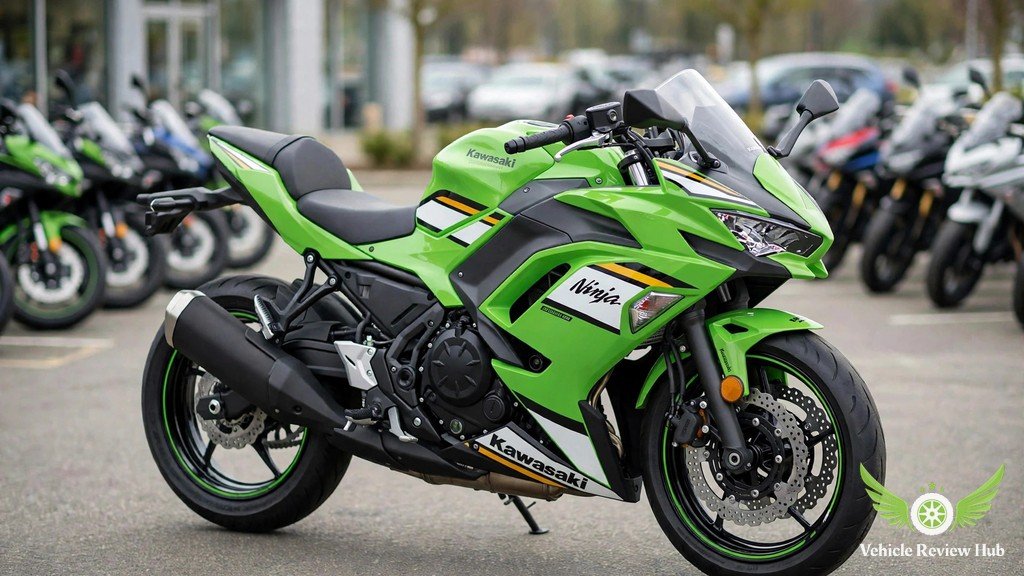
The $6,999 leftover is a dated dealer total from November 2026, on a new 2025 KRT Edition ABS (VIN ML5EXEP16SDAE6689) — a dated example in this Kawasaki Ninja 650 KRT Edition comparison, not a standing price. The arithmetic: $7,999 retail, $6,999 total — a $1,000 dealer discount. The other November 2026 leftovers bracket it: Miller’s Motorsports at $7,408 total, $591 off retail, and Columbia Powersports Center at $7,999 at MSRP; a new 2024 KRT ABS was also listed at $7,999 MSRP at Mainland Cycle Center. The used examples show the other end: a 2022 KRT ABS with 13,788 miles asking $5,999 and a 2022 KRT with 24,605 miles asking $4,999, both at MotoSport Hillsboro. Those are asking prices, not sale prices, and no resale percentage is claimed in this Kawasaki Ninja 650 KRT Edition comparison.
| Market | Bike | Price | Status |
|---|---|---|---|
| New, Nov 2026 | 2025 KRT ABS leftover | $6,999 total | Dated dealer total, $1,000 off MSRP |
| New, Nov 2026 | 2025 KRT ABS leftover | $7,408 total | Miller’s Motorsports, $591 off MSRP |
| New, Nov 2026 | 2025 KRT ABS leftover | $7,999 at MSRP | Columbia Powersports Center |
| New, Nov 2026 | 2024 KRT ABS leftover | $7,999 MSRP | Mainland Cycle Center |
| Used | 2022 KRT ABS, 13,788 mi | $5,999 asking | MotoSport Hillsboro, OR |
| Used | 2022 KRT, 24,605 mi | $4,999 asking | MotoSport Hillsboro, OR |
Note: Leftover prices are dated November 2026 dealer totals; this Kawasaki Ninja 650 KRT Edition comparison prints them as examples, not as a standing price band. Used prices are asking prices, not sale prices.
Running Costs and Resale Value Compared
Running costs do not separate these bikes in this Kawasaki Ninja 650 KRT Edition comparison, because the KRT and the ABS are the same motorcycle. Servicing falls every 7,500 miles or 12,000 km, with 1.8 litres of 10W-40 oil and NGK CR9EIA-9 plugs, and the valve check at 24,000 km — the manual chart’s mile column reads 15,200 mi, which the doc rounds to 15,000. Tyres are the same 120/70-17 front and 160/60-17 rear, and the only recall history is the platform’s two campaigns, 10V-323 and 12V-081, both predating the KRT’s 2017 debut. On resale, no verified premium exists for the KRT: the November 2026 asking prices track the plain 650 closely, and the clone caveat cuts the other way — every green panel and decal is a genuine Kawasaki part with a published part number, so a plain ABS bike can be converted to full KRT appearance, and the shared 2025 EX650PSFAL model code means the paperwork cannot tell a factory KRT from a conversion. Check the panels, the decals and the history before paying extra for a used KRT.
Kawasaki Ninja 650 KRT Edition Comparison Verdict and US Alternatives
The verdict of this Kawasaki Ninja 650 KRT Edition comparison is a price verdict: the leftover KRT at $6,999 total is the cheapest new middleweight in the set, and the only rival that buys genuinely different hardware is the 2027 ABS — for $1,985 more. The R7 and the GSX-8R buy more power and more electronics — and charge for it. The KRT Edition review and the SV650 comparison cover the nine-year pricing story and the other value alternative.
Verdict: $1,985 Buys Real Hardware
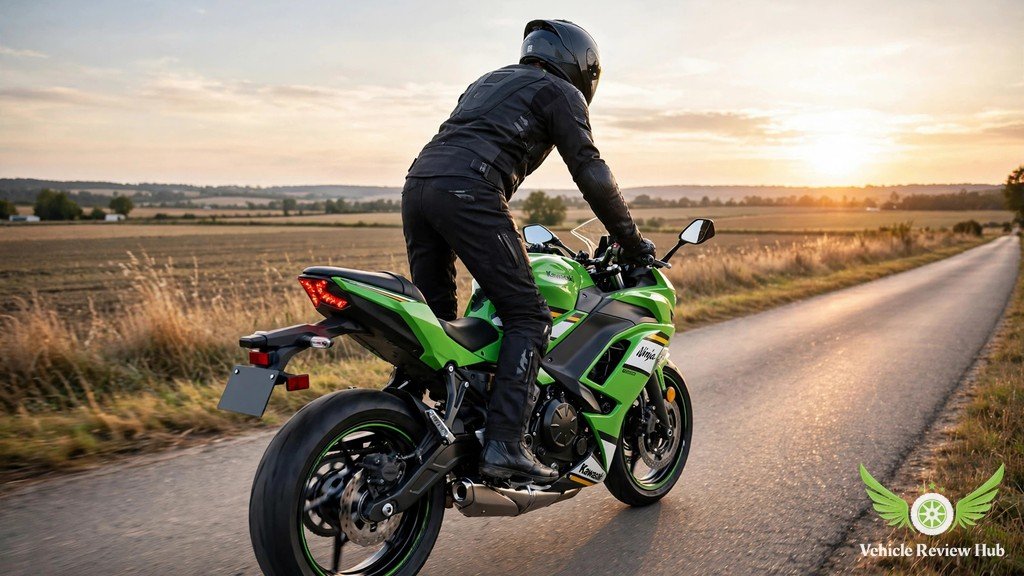
Here is the arithmetic this Kawasaki Ninja 650 KRT Edition comparison ends on. The leftover KRT is $6,999 total; the 2027 Ninja 650 ABS in premium colours is $8,984 delivered ($8,299 + $685) — $1,985 more for real hardware: the 37 mm inverted Showa SFF-BP fork, the radial-mount four-piston calipers and the semi-floating discs the KRT never received. Against the 2027 base at $8,784 delivered ($8,099 + $685), the difference is $1,785 for the same hardware. That is the only step in this Kawasaki Ninja 650 KRT Edition comparison where the extra money buys a different motorcycle rather than a different badge: the KRT already has the TFT dash, KTRC and ride modes, so the $1,985 buys the fork and the brakes, not the electronics. Buy the 2027 ABS for the best-handling 650; take the $6,999 leftover for the cheapest new 650 and keep the $1,985. The 2026 Suzuki SV650 at $8,749 delivered ($8,149 + $600) is the value twin in the class.
R7 Charges $300 for the Same Trick
Yamaha sells the same paint-only trick the KRT was, and charges $300 for it. The 2026 YZF-R7 70th Anniversary Edition costs $9,699, exactly $300 over the $9,399 base bike — $10,374 delivered against the base bike’s $10,074 — for paint, gold emblems and an anniversary badge, nothing mechanical. RevZilla’s 2026 first ride says it plainly: “It costs an extra $300 over the base R7.” Kawasaki did the same thing for eight years — a $200 paint premium — then stopped charging for it in the final year, when the 2025 KRT ABS and the plain 2025 ABS both cost $7,999. That is the difference this Kawasaki Ninja 650 KRT Edition comparison ends on: Yamaha charges $300 for anniversary paint; Kawasaki’s final-year KRT paint cost nothing. The Rider Magazine 2026 R7 preview lists the $9,399 and $9,699 prices side by side.
Kawasaki Ninja 650 KRT Edition Comparison Frequently Asked Questions
The KRT Edition raises the same few questions in every comparison, because the trim looks like a different bike and is not one. These are the direct answers from this Kawasaki Ninja 650 KRT Edition comparison.
Which is cheaper, the leftover KRT or a new 2027 ABS?
The leftover KRT: $6,999 total against $8,784 delivered for the 2027 base and $8,984 for the premium bike — $1,785 and $1,985 less. This Kawasaki Ninja 650 KRT Edition comparison shows the arithmetic in the verdict section.
Is the R7’s Anniversary paint worth $300?
Paint, gold emblems and an anniversary badge — nothing mechanical. The 2026 YZF-R7 70th Anniversary Edition is $9,699 against the $9,399 base bike, exactly $300 more, or $10,374 delivered against $10,074 — paint only, the same trick the KRT was. Kawasaki’s final-year KRT paint was free, so in this Kawasaki Ninja 650 KRT Edition comparison $300 is a fair price for a special livery and nothing else.
KRT vs ABS 650 — which to buy?
At 2025 MSRP there is $0 difference — both were $7,999, both $8,664 delivered — so buy on the leftover discount and the condition of the bike in front of you. The bikes are the same motorcycle, so in this Kawasaki Ninja 650 KRT Edition comparison the choice is the livery and the price, not the hardware.
KRT vs GSX-8R — what does the extra money buy?
A bigger engine and more power: the 2027 GSX-8R is $9,949 delivered, $2,950 over the $6,999 leftover KRT, and its 776cc twin claims 81.8 hp against the KRT’s 67.0 hp. The measured gap is smaller — 72.75 hp at the wheel for the 8R against 60.38 bhp for the 650 — but it is real. This Kawasaki Ninja 650 KRT Edition comparison says the $2,950 buys a genuine performance step, not paint.
Does the KRT hold its value better?
Not on any verified evidence. The November 2026 asking prices track the plain 650 closely, and this Kawasaki Ninja 650 KRT Edition comparison claims no resale premium. The clone caveat cuts against a premium too: every green panel and decal is a genuine Kawasaki part, so a plain ABS bike can be converted to full KRT appearance.
Should I buy the leftover KRT or wait?
Buy the leftover if the price and the bike are right, because availability is finite: the 2025 model year was the final year of the KRT, and the leftovers in this Kawasaki Ninja 650 KRT Edition comparison are dated November 2026 dealer examples — once they are gone, the only KRTs left are used ones. Waiting buys nothing: the 2027 replacement costs $1,785 more.