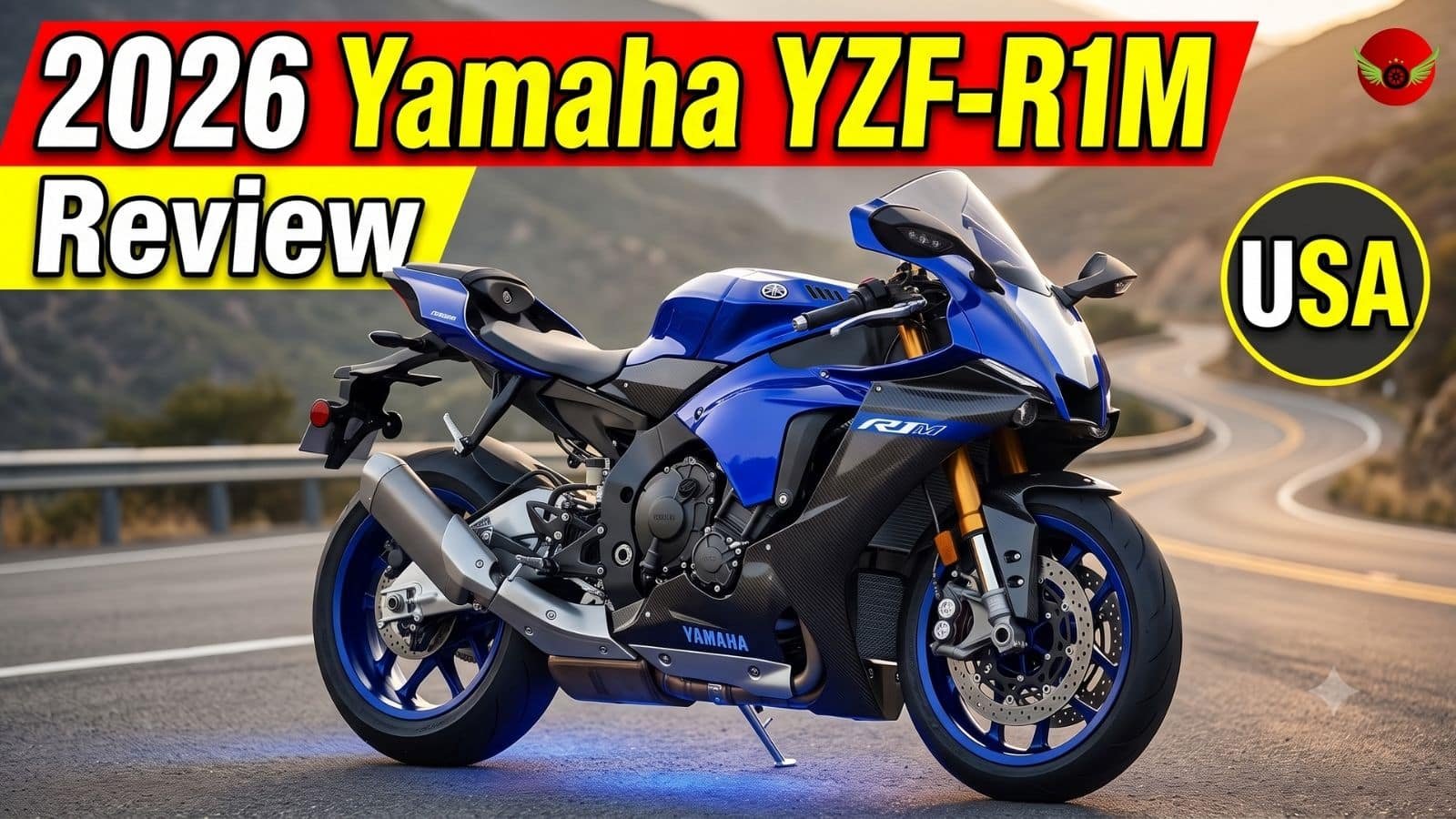
The Yamaha YZF-R1M is Yamaha’s most advanced production supersport, developed with technology derived from the company’s MotoGP racing program. For the 2026 model year, it combines a 998cc liquid-cooled CP4 inline-four engine, a lightweight aluminum Deltabox frame, Öhlins Electronic Racing Suspension (ERS), forged magnesium wheels, and carbon fiber bodywork with integrated aerodynamic winglets. Yamaha lists the official U.S. MSRP at $27,899, with a $775 destination charge.
Unlike a standard liter-class sportbike, this model is engineered for riders who want factory-installed track-focused components instead of aftermarket upgrades. The electronic package includes a six-axis IMU that manages traction control, slide control, lift control, launch control, brake control, and engine brake management in real time. Combined with Yamaha Chip Controlled Throttle (YCC-T) and Yamaha Chip Controlled Intake (YCC-I), these systems are designed to improve control during hard acceleration, braking, and cornering.
This Yamaha YZF-R1M review examines the official Yamaha YZF-R1M Price, verified specifications, factory equipment, and ownership considerations for buyers in the United States. Every section is based on manufacturer specifications and current U.S. model information, helping you evaluate whether this flagship supersport offers the performance, technology, and value that match your riding goals.
Yamaha YZF-R1M Price in the USA
The Yamaha YZF-R1M sits at the top of Yamaha’s supersport lineup and carries a premium price because of its factory-installed performance equipment. Unlike the standard R1, it includes Öhlins Electronic Racing Suspension (ERS), forged magnesium wheels, carbon fiber bodywork, and a six-axis IMU with advanced rider aids as standard equipment. In the U.S., Yamaha publishes a fixed MSRP, while the final out-the-door price varies by state taxes, registration, documentation charges, and dealer fees.
2026 Yamaha YZF-R1M Price and Availability
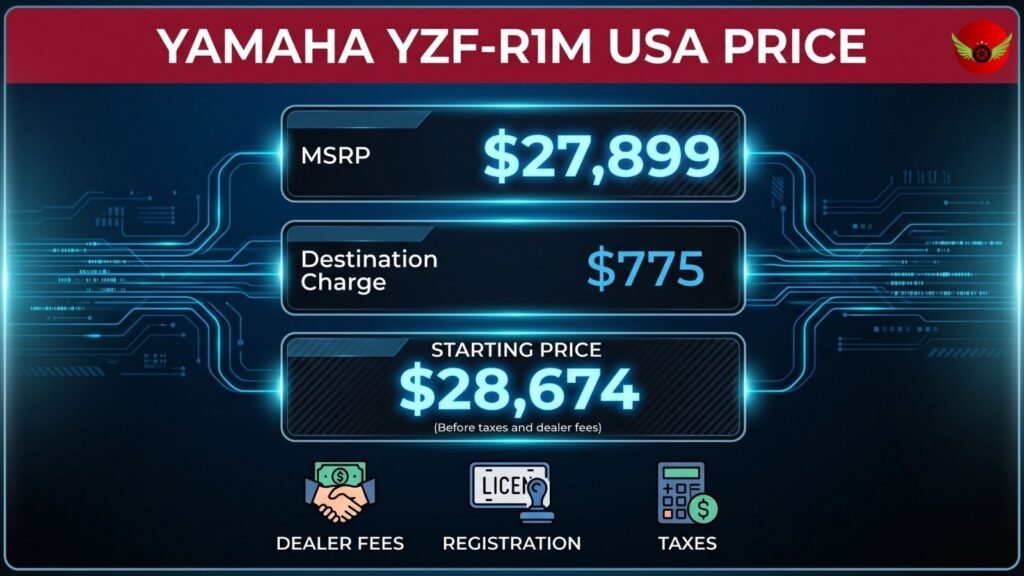
For 2026, the official U.S. MSRP of the Yamaha YZF-R1M is $27,899. Yamaha also charges a $775 destination fee, bringing the manufacturer’s suggested selling price to $28,674 before taxes, title, registration, and dealer-specific charges. Because the R1M is produced in lower volumes than the standard R1, inventory can vary throughout the year, and some dealerships may have limited stock.
Price Details | Amount (USD) |
MSRP | $27,899 |
Destination Charge | $775 |
MSRP + Destination | $28,674 (before taxes and dealer fees) |
Used Yamaha YZF-R1M Prices
Used Yamaha YZF-R1M prices depend primarily on the model year, mileage, service records, accident history, and whether the motorcycle remains in factory condition. Current U.S. marketplace listings show asking prices starting at approximately $18,890 for higher-mileage models, while clean, low-mileage examples are commonly listed between $23,000 and $27,899. Recently released models are less common in the used market, so pricing typically remains strong when well-maintained motorcycles become available.
Is the Yamaha YZF-R1M Worth the Price?
The Yamaha YZF-R1M offers good value for experienced riders who want factory-installed premium components instead of upgrading a standard superbike later. Features such as Öhlins ERS, forged magnesium wheels, carbon fiber bodywork, and IMU-based electronic rider aids are included from the factory and contribute significantly to the motorcycle’s overall cost. Riders who spend most of their time on public roads may find the standard YZF-R1 more cost-effective, while track-focused riders are more likely to benefit from the R1M’s additional equipment and technology.
Yamaha YZF-R1M Specs
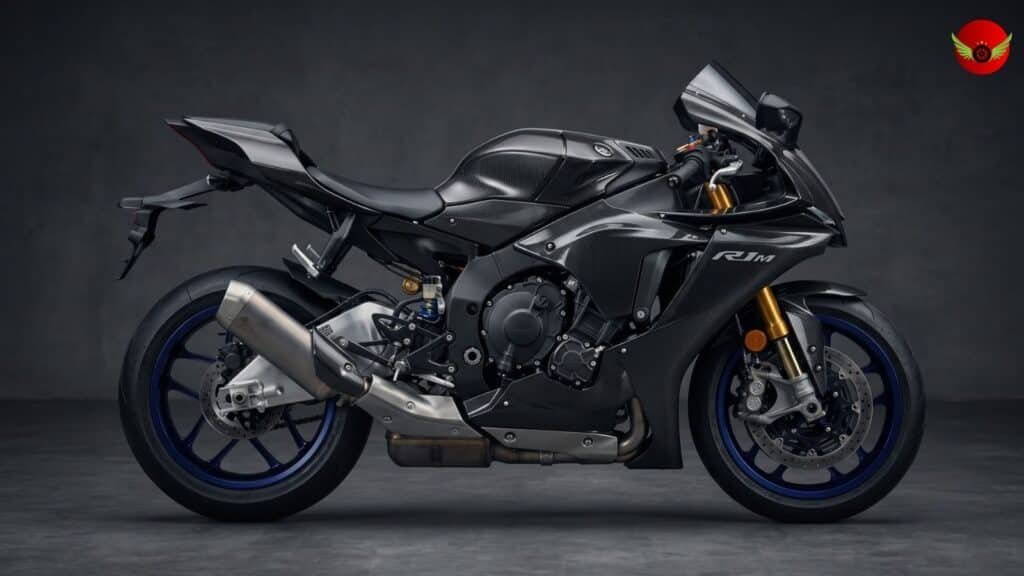
The Yamaha YZF-R1M is engineered around a race-focused platform that combines a high-revving CP4 engine, lightweight chassis, premium suspension, and advanced braking components. Rather than relying on engine performance alone, Yamaha integrates these systems to improve acceleration, cornering stability, and rider control. The specifications below are based on the official 2026 U.S. model.
Engine and Transmission
The Yamaha YZF-R1M is powered by a 998cc liquid-cooled DOHC inline-four engine featuring Yamaha’s signature crossplane crankshaft. The engine uses Yamaha Chip Controlled Throttle (YCC-T) and Yamaha Chip Controlled Intake (YCC-I) to deliver responsive throttle control throughout the rev range. A 6-speed constant-mesh transmission works with Yamaha’s assist-and-slipper clutch, providing smoother gear engagement while helping the motorcycle remain more stable during hard braking and rapid downshifts. Final drive is delivered through a chain system.
Specification | Value |
Engine Type | 998cc, liquid-cooled DOHC inline-four, 4 valves per cylinder |
Bore × Stroke | 79.0 × 50.9 mm |
Compression Ratio | 13.0:1 |
Fuel System | Fuel Injection with YCC-T & YCC-I |
Transmission | 6-speed constant mesh |
Clutch | Wet multi-plate assist & slipper clutch |
Final Drive | Chain |
Weight, Dimensions and Fuel Capacity
The chassis dimensions are designed to provide a balance between agility and high-speed stability. The motorcycle weighs 452 lb (205 kg) with all fluids, measures 55.3 inches (1,405 mm) between the axles, and has a 33.9-inch (861 mm) seat height. Fuel is stored in a 4.5-gallon (17 L) tank, offering adequate capacity for spirited road riding and extended track sessions.
Specification | Value |
Wet Weight | 452 lb (205 kg) |
Seat Height | 33.9 in (861 mm) |
Wheelbase | 55.3 in (1,405 mm) |
Fuel Capacity | 4.5 gal (17 L) |
Estimated Fuel Economy | 33 mpg |
Suspension and Brakes
One of the biggest upgrades on the Yamaha YZF-R1M is its factory-installed suspension package. The motorcycle comes equipped with 43 mm Öhlins Electronic Racing Suspension (NPX) front forks and an electronically controlled Öhlins rear shock, both fully adjustable to suit different riding conditions. Stopping power comes from dual 320 mm hydraulic front discs with Brembo radial-mount calipers, while a 220 mm rear hydraulic disc is supported by Yamaha’s ABS and Brake Control system for consistent braking performance.
Component | Specification |
Front Suspension | 43 mm Öhlins Electronic Racing Suspension (NPX), fully adjustable |
Rear Suspension | Öhlins Electronic Racing Suspension, fully adjustable |
Front Brakes | Dual 320 mm hydraulic discs with Brembo radial-mount calipers |
Rear Brake | 220 mm hydraulic disc |
ABS | Standard |
Front Tire | 120/70ZR17 Bridgestone Battlax Racing Street RS11F |
Rear Tire | 200/55ZR17 Bridgestone Battlax Racing Street RS11R |
Yamaha YZF-R1M Features
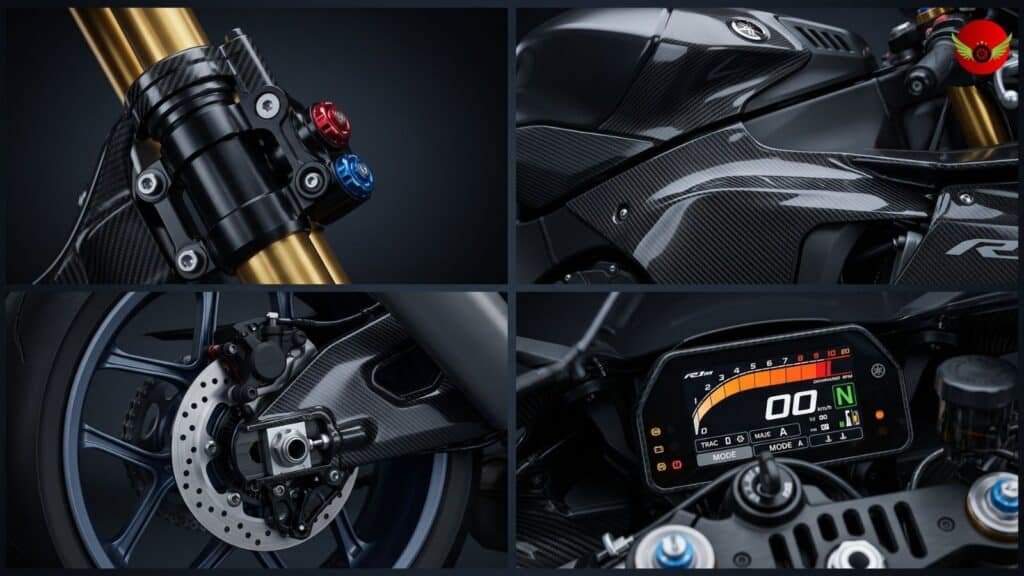
The Yamaha YZF-R1M stands apart from the standard R1 because of its factory-installed performance technology. Instead of relying on optional upgrades, Yamaha equips the motorcycle with premium suspension, advanced electronic control systems, and lightweight carbon fiber components from the factory. These features are designed to improve chassis feedback, rider confidence, and track performance while preserving the motorcycle’s street legality.
Öhlins Electronic Suspension
A defining feature of the Yamaha YZF-R1M is its Öhlins Electronic Racing Suspension (ERS). The system combines 43 mm NPX gas-charged front forks with an electronically controlled rear shock. Using information from the motorcycle’s six-axis IMU, the suspension control unit continuously adjusts damping characteristics to match acceleration, braking, and cornering forces. This allows the chassis to remain more composed across changing riding conditions without requiring manual suspension adjustments between sessions.
Electronics and Rider Aids
The electronics package is built around a six-axis Inertial Measurement Unit (IMU) that measures the motorcycle’s movement in real time. Data from the IMU is used to manage systems such as Traction Control (TCS), Slide Control (SCS), Lift Control (LIF), Launch Control (LCS), Brake Control (BC), Engine Brake Management (EBM), Quick Shift System (QSS), and selectable Power Delivery Modes (PWR). Working together, these technologies help the rider maintain control during acceleration, braking, and corner entry while allowing different settings for road or track use.
Carbon Fiber Bodywork
The Yamaha YZF-R1M uses factory-installed carbon fiber bodywork, including the front fairing, side panels, front fender, tail section, and aerodynamic winglets. Compared with conventional body panels, carbon fiber reduces weight while maintaining high structural strength. The aerodynamic design also helps direct airflow more efficiently at high speed, contributing to improved stability and a sharper front-end feel during aggressive riding.
Is the Yamaha YZF-R1M Worth Buying in 2026?
The Yamaha YZF-R1M is designed for experienced riders who want factory-installed race technology without relying on aftermarket upgrades. For the 2026 model year, it combines a 998cc CP4 crossplane engine, Öhlins Electronic Racing Suspension (ERS), forged magnesium wheels, carbon fiber bodywork, and a six-axis IMU with advanced rider assistance systems. With an official U.S. MSRP of $27,899, the motorcycle reflects the cost of its premium factory components and track-focused engineering rather than optional performance accessories.
Choosing the right motorcycle depends on how it will be used. Riders who regularly attend track days or want advanced chassis control are more likely to benefit from the R1M’s specialized hardware. For everyday commuting or casual weekend riding, many of its performance-focused technologies may not be fully utilized, making the standard YZF-R1 a more practical alternative for some buyers.
Pros and Cons
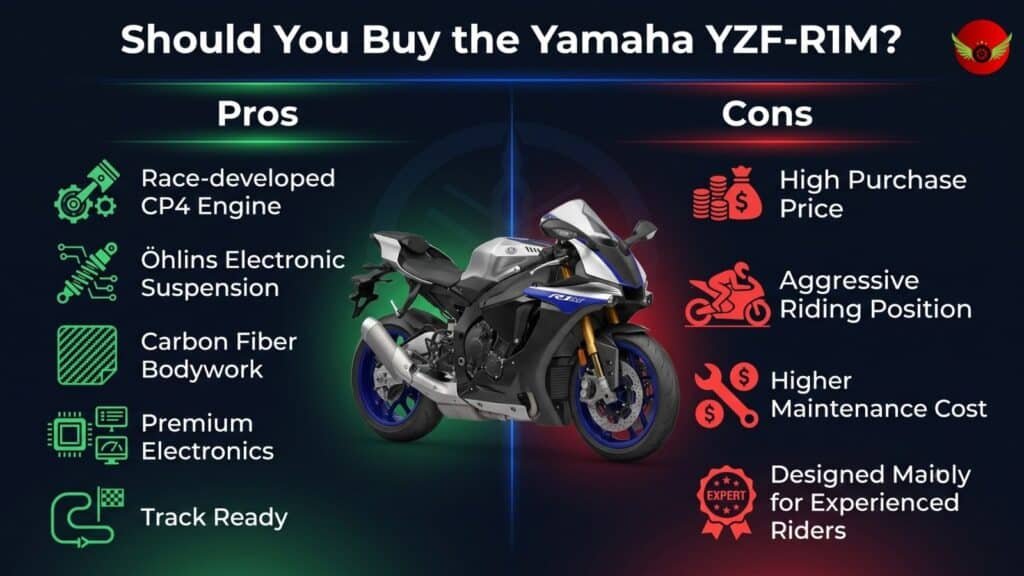
The Yamaha YZF-R1M offers a combination of premium hardware and advanced electronics that few production motorcycles provide directly from the factory.
Pros
- Factory-equipped Öhlins Electronic Racing Suspension (ERS) with electronic damping control.
- Lightweight carbon fiber bodywork and forged magnesium wheels reduce overall mass.
- Six-axis IMU supports traction control, slide control, lift control, launch control, brake control, and engine brake management.
- Proven 998cc CP4 crossplane engine delivers responsive power and predictable throttle feel.
- Requires fewer aftermarket performance upgrades because many premium components are included as standard.
Cons
- Higher purchase price than the standard YZF-R1.
- Aggressive riding position is less suitable for daily commuting and long-distance touring.
- Ownership costs, including insurance, premium tires, and replacement parts, are generally higher than those of middleweight sport motorcycles.
- Many of its advanced suspension and electronic systems are most beneficial during spirited riding or track use.
Who Should Buy the Yamaha YZF-R1M
The Yamaha YZF-R1M is a strong choice for experienced sportbike riders who want a motorcycle with factory-developed performance technology. It is particularly well suited for riders who participate in track days, value electronic suspension, and prefer premium components installed by the manufacturer instead of upgrading a standard model later.
New riders or those who mainly ride in urban traffic may not gain the full benefit of the R1M’s advanced chassis and electronics. In those situations, the standard YZF-R1 can provide similar core performance at a lower purchase cost while remaining more practical for everyday use.
Yamaha YZF-R1M Buying Guide FAQs
Choosing the Yamaha YZF-R1M involves more than comparing specifications. Buyers often want clear answers about pricing, features, ownership, maintenance, and everyday usability before making a purchase. The FAQs below address the most common questions using verified information and practical buying insights.
What is the official Yamaha YZF-R1M price in the USA?
The 2026 Yamaha YZF-R1M has an official U.S. MSRP of $27,899. Yamaha also applies a $775 destination charge, while taxes, registration, and dealer documentation fees vary by location.
What engine does the Yamaha YZF-R1M use?
The motorcycle is powered by a 998cc liquid-cooled DOHC inline-four CP4 engine with Yamaha’s crossplane crankshaft. It also features YCC-T, YCC-I, and a 6-speed constant-mesh transmission with an assist-and-slipper clutch.
What are the key features of the Yamaha YZF-R1M?
Key features include Öhlins Electronic Racing Suspension (ERS), forged magnesium wheels, carbon fiber bodywork, a six-axis IMU, lean-sensitive electronic rider aids, a Quick Shift System (QSS), and full LED lighting. These components are factory-installed to enhance performance and rider control.
What is the fuel tank capacity of the Yamaha YZF-R1M?
The Yamaha YZF-R1M has a 4.5-gallon (17-liter) fuel tank. Actual riding range depends on riding style, road conditions, and throttle use.
How much does a used Yamaha YZF-R1M cost?
Used prices vary according to the model year, mileage, maintenance history, and overall condition. Newer, low-mileage motorcycles generally retain stronger resale value than older or heavily used examples.
Is the Yamaha YZF-R1M suitable for everyday riding?
Yes, the motorcycle is fully street legal. However, its aggressive riding position, firm suspension, and track-focused ergonomics make it better suited to spirited riding and occasional commuting than daily urban use.
How expensive is Yamaha YZF-R1M maintenance?
Routine maintenance costs are higher than those of entry-level sport motorcycles because of premium tires, high-performance components, and manufacturer-recommended service requirements. Following Yamaha’s maintenance schedule is important for long-term reliability.
Is the Yamaha YZF-R1M worth buying in 2026?
The Yamaha YZF-R1M is worth buying if you want factory-installed premium suspension, lightweight construction, and advanced electronics for high-performance road riding or track days. Riders looking for a more affordable option with similar core performance may find the standard YZF-R1 a better fit for their budget.