This Yamaha FJR1300ES buying guide answers the questions that matter before money changes hands: what a used FJR1300ES actually costs in the USA by generation, what insurance and running costs look like, how to inspect the shaft drive and electronic suspension, which model year is worth paying extra for, and whether a used FJR still beats a new BMW or a lighter Yamaha in 2026. Every used price below is a real October 2026 US asking price; every new price is verified.
The short answer in this Yamaha FJR1300ES buying guide: a clean 2016-on six-speed ES with recall paperwork and a service file is the sweet spot. A 2014–2015 five-speed ES is the value pick if its price reflects the older gearbox. Walk away from any 2016–2021 bike without proof of the second-gear and ECU recalls, no matter how clean it looks.
Yamaha FJR1300ES Price and Market Availability
Any Yamaha FJR1300ES buying guide must start with the market reality: Yamaha no longer offers a new FJR in the USA, so nearly every purchase is used, and the few “new” bikes advertised are leftover 2024 stock.
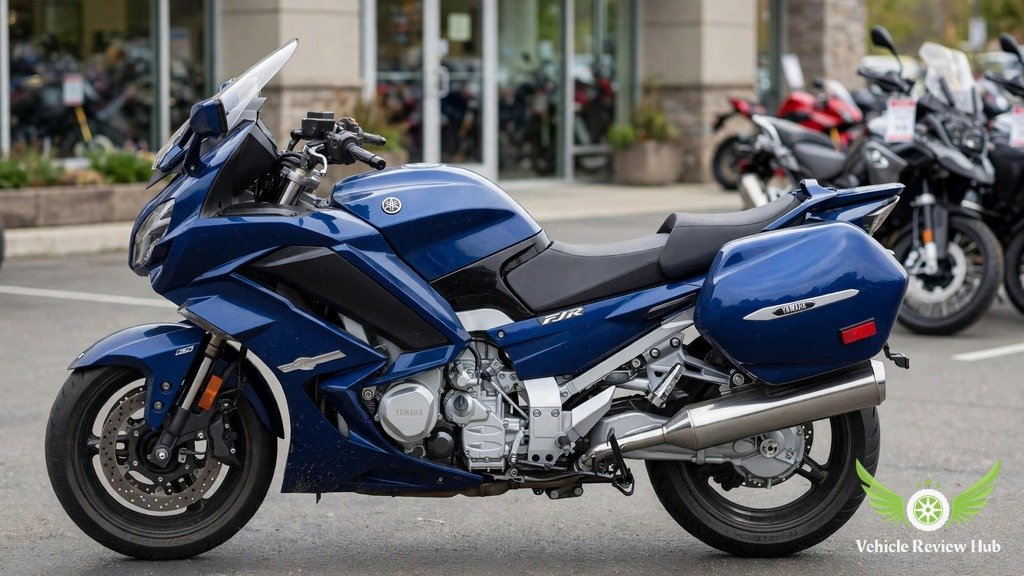
What Does a Used Yamaha FJR1300ES Cost in the USA by Generation?
In this Yamaha FJR1300ES buying guide, every used price below is an asking price from a real US listing checked in October 2026, not a sale price. Note the trim labels: ES examples are scarcer than base A examples, and an A price is not an ES price.
| Year and trim | Miles | Asking price | Seller and location |
|---|---|---|---|
| 2023 FJR1300ES | 7,451 | $15,495 | Cycle World of Athens, Athens, GA |
| 2021 FJR1300ES | 9,950 | $13,495 | Davis Motorsports of Delano, Delano, MN |
| 2018 FJR1300A (base, not ES) | 53,522 | $12,999 | Full Throttle Powersports, Lowell, NC |
| 2018 FJR1300A (base, not ES) | 22,109 | $9,960 | Dream Machines of Austin, Austin, TX |
The pattern in this Yamaha FJR1300ES buying guide is simple: low-mileage late-model ES bikes hold value because there is no new replacement, while high-mileage base models are the bargains. A 2023 ES at $15,495 sits only about $2,800 under its $18,299 original MSRP, while a 2020 example was reported between $10,000 and $13,000. Labelled as estimates, this Yamaha FJR1300ES buying guide expects $8,000–$11,000 for a 2014–2015 ES, $10,000–$13,500 for a 2016–2019 ES, and $12,000–$16,000 for a 2020–2024 ES.
New-bike prices anchor the top of the range in this Yamaha FJR1300ES buying guide. The ES launched in the USA for 2014 at $16,890, against $15,890 for the base A, both in Candy Red. The 2016 six-speed ES cost $17,990, the 2019 and 2020 ES each cost $17,999, the 2022 ES cost $18,199, and the 2023 and 2024 ES each cost $18,299. Those prices are the anchor for every used valuation in this Yamaha FJR1300ES buying guide. The full specification story behind those prices is covered in the FJR1300ES review.
Is the Yamaha FJR1300ES Still Available Through Official US Dealers?
The Yamaha FJR1300ES buying guide answer is: not as a current model, but leftover stock still appears. Yamaha’s last US model year was 2024, in Cobalt Blue only, at $18,299. No 2025 or 2026 US model exists, so a dealer cannot order you a new one. Dealers can still advertise unsold 2024 inventory — several were still listing 2024 bikes at $18,299 in October 2026, which is why this Yamaha FJR1300ES buying guide treats every ‘new’ listing as leftover stock. If a seller claims a “new 2025 FJR1300ES,” check the VIN: it does not match Yamaha’s US lineup.
Yamaha FJR1300ES Insurance and Ownership Costs
No Yamaha FJR1300ES buying guide is complete without running costs: on a 1,298cc sport-tourer, insurance and tires can matter more than fuel.
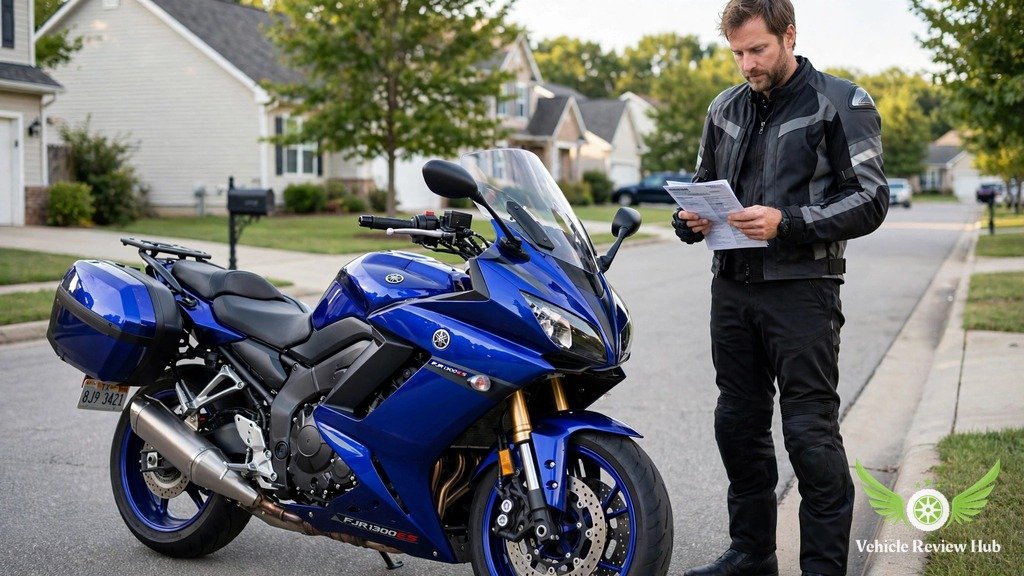
Why Insurers May Rate the FJR as a Sportbike and Premiums Vary Widely
For a Yamaha FJR1300ES buying guide, no single insurance figure fits every rider, so this guide invents no premium. Insurers price the bike’s class as much as the rider: a 1,298cc inline-four with around 145 horsepower sits in sport-touring territory, and some carriers rate it closer to a sportbike, which pushes premiums up. Age, record, location, mileage, storage, and financing all move the quote. The Yamaha FJR1300ES buying guide rule is practical: get three quotes before you buy, and ask whether the carrier classes the FJR as sport-touring or sport, because that classification alone can change the premium.
How to Estimate Fuel, Maintenance, Parts and Other Ownership Expenses
This Yamaha FJR1300ES buying guide uses verified figures where they exist; the rest are planning estimates. Yamaha’s official estimate, used throughout this Yamaha FJR1300ES buying guide, is 36 mpg with a 6.6-gallon tank, roughly 238 miles per tank on paper; period road tests averaged around 37 mpg.
| Annual cost item | Planning figure | Basis |
|---|---|---|
| Fuel (8,000 miles a year) | Roughly $750–$900 | Planning estimate at 36–40 mpg |
| Routine servicing | Around $150–$300 a year | Planning estimate; 4,000-mile interval |
| Tires (120/70ZR17, 180/55ZR17) | Roughly $350–$550 a set fitted | Planning estimate; rears wear first |
| Valve-clearance check | Budget $500–$1,000 at a dealer | Planning estimate; around 26,600 miles |
Two cost traps deserve a line in this Yamaha FJR1300ES buying guide. First, the electronic suspension is the one expensive ES-specific failure: a failed ES suspension unit can cost more to replace than the bike’s remaining value in the worst case. Second, tires are a real yearly bill on a 642-pound bike ridden hard — budget for a rear roughly every riding season.
How to Inspect a Used Yamaha FJR1300ES
In a Yamaha FJR1300ES buying guide, inspection matters more than price: a cheap FJR with undone recalls or a dead suspension unit is not cheap at all.
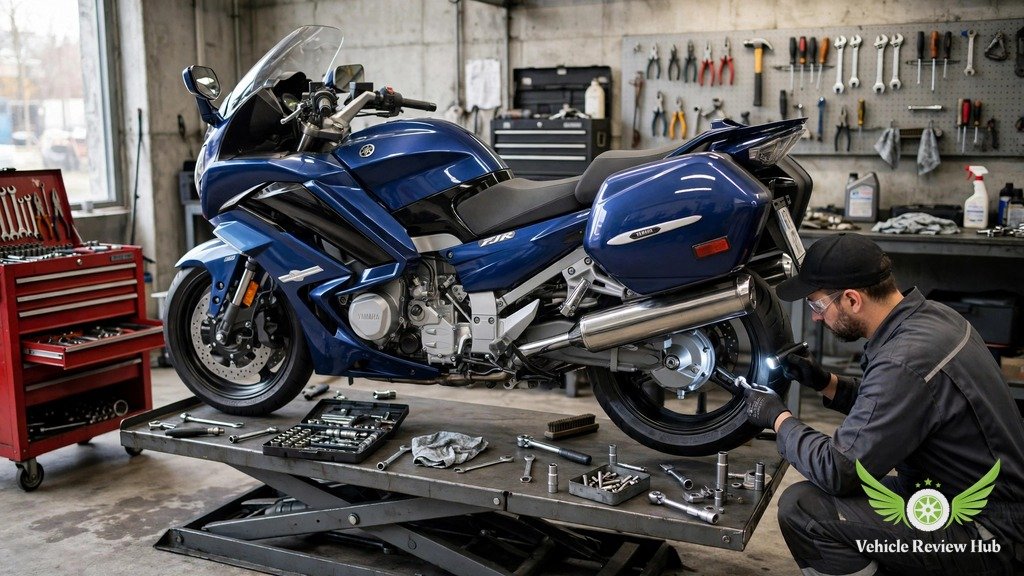
Checking the Engine, Cold Start, Service Records and Maintenance History
A Yamaha FJR1300ES buying guide inspection starts cold, so arrive early or ask the seller not to warm the bike up. A cold engine should start promptly and idle steadily, without smoke, rattles, or warning lights. Ride it through every gear: difficulty shifting or false neutrals are exactly the symptoms Yamaha’s recall documents associate with the second-gear problem, and they are a walk-away sign until a dealer has checked the bike. Service records are the real test: the US schedule calls for service every 4,000 miles, and a valve-clearance check around 26,600 miles on later models (check your own year’s manual; the interval is quoted as 26,000 to 26,600 miles). The Yamaha FJR1300ES buying guide test is blunt: a stamped book or dealer receipts beat a story, and a bike with no records should be priced as if the next major service is due.
Recall paperwork comes before everything else in this Yamaha FJR1300ES buying guide; all three campaigns are nationwide Yamaha Motor Corporation, USA filings. Campaign 20V813 (Yamaha #990141) covers certain 2016–2020 FJR1300A and FJR1300AE bikes — the AE code covers the ES — 2,285 units, because the second gear can crack and break under high-speed loads, locking the transmission and rear wheel. The remedy is inspection plus main-axle and drive-axle replacement and an ECU reprogram, a job Yamaha quotes at 14 hours. Campaign 21V865 (Yamaha #990152) covers certain 2016–2021 FJR1300 bikes, 2,462 units, because the ECU programming installed under 20V813 could prevent the engine from accelerating as intended; remedy: a free ECU reprogram, and bikes fixed under 20V813 must still return, per oemdtc’s 21V865 record. Campaign 20V814 (Yamaha #990140) is the front brake switch recall: it covers certain 2013–2020 FJR1300 bikes among seven Yamaha models, 18,203 units in total — never FJR-only — because silicon oxide can raise the switch’s resistance so the brake light stays on or cruise control cancels unexpectedly; remedy: a free switch replacement under an hour, per Asphalt & Rubber’s brake-switch coverage. Check all three by VIN with a Yamaha dealer or on the NHTSA recalls lookup before paying, and demand the paperwork, not the seller’s word.
Inspecting the Shaft Drive, Frame, Tires, Brakes and Electronic Suspension
If one inspection area deserves headline status in a Yamaha FJR1300ES buying guide, it is the ES suspension. Cycle through every electronic suspension setting — preload positions from solo to two-up with luggage, plus damping settings — and watch for a warning light, a setting that will not change, or a harsh, uncontrolled ride. Any of those means a dealer diagnosis before purchase — ES units are expensive. Next, the shaft drive: dealers sometimes call it maintenance-free, but that is not true — check the final-drive oil, look for leaks at the drive housing, and ask when the gear oil was last changed. Then the usual checks: both 320mm front discs and the 282mm rear disc for scoring, pad thickness, brake fluid color, and brake-light behavior — a light that stays on can be the 20V814 switch fault. Check the windscreen, the heated grips, cruise control, cornering lights, and both 30-litre cases for latches, keys, and crash damage.
Yamaha FJR1300ES Model Years and Features to Compare
Model-year choice is where a Yamaha FJR1300ES buying guide earns its keep, because the ES badge hides two different gearboxes.

Comparing 2013-2015 Five-Speed Models With 2016-On Six-Speed Versions
First, a correction this Yamaha FJR1300ES buying guide states plainly: there was no 2013 FJR1300ES. The ES — electronic suspension — arrived in the USA for 2014 at $16,890 in Candy Red, alongside the $15,890 base A. So the five-speed ES years are 2014 and 2015 only; a bike advertised as a “2013 ES” needs its year checked against its VIN. The 2016 update is the dividing line that matters in this Yamaha FJR1300ES buying guide: a six-speed gearbox with an assist-and-slipper clutch, LED lighting including lean-angle-sensitive cornering lights on the ES, and revised suspension damping. The FJR1300ES performance figures explain what that sixth gear does for highway cruising. From 2016 on, the bike barely changed mechanically, so condition and recalls matter more than model year after 2016.
| Feature | 2014–2015 ES (five-speed) | 2016–2019 ES (six-speed) | 2020–2024 ES (six-speed) |
|---|---|---|---|
| Gearbox | 5-speed, standard clutch | 6-speed, assist-and-slipper clutch | 6-speed, assist-and-slipper clutch |
| Electronic suspension | Yes, inverted fork | Yes, revised damping | Yes, revised damping |
| Cornering lights | No | Yes, LED lean-angle sensitive | Yes, LED lean-angle sensitive |
| New MSRP (USA) | $16,890 (2014) | $17,990 (2016) / $17,999 (2019) | $17,999 (2020) to $18,299 (2024) |
| Recall watch | Brake switch 20V814 (2014–2015 in scope) | 20V813 + 21V865 + 20V814 | 21V865 (2020–2021 in scope); 20V814 to 2020 |
Which Features Matter Most: ES Suspension, Cornering Lights and Cases?
This Yamaha FJR1300ES buying guide ranks features by daily-touring impact. The electronic suspension matters most, but only if it works: switching preload and damping for solo, two-up, and loaded riding is the ES’s whole reason to exist, and a broken unit turns the premium trim into a liability. The cornering lights matter second — the ES was the first Yamaha with lean-angle-sensitive LED lighting. The integrated 30-litre side cases matter third: color-matched, keyed to the ignition, and quick-release — but check both latches and both keys.
Yamaha FJR1300ES vs BMW R 1300 RT: Which One to Buy in the USA
The comparison every Yamaha FJR1300ES buying guide must make honestly is against BMW’s R 1300 RT.
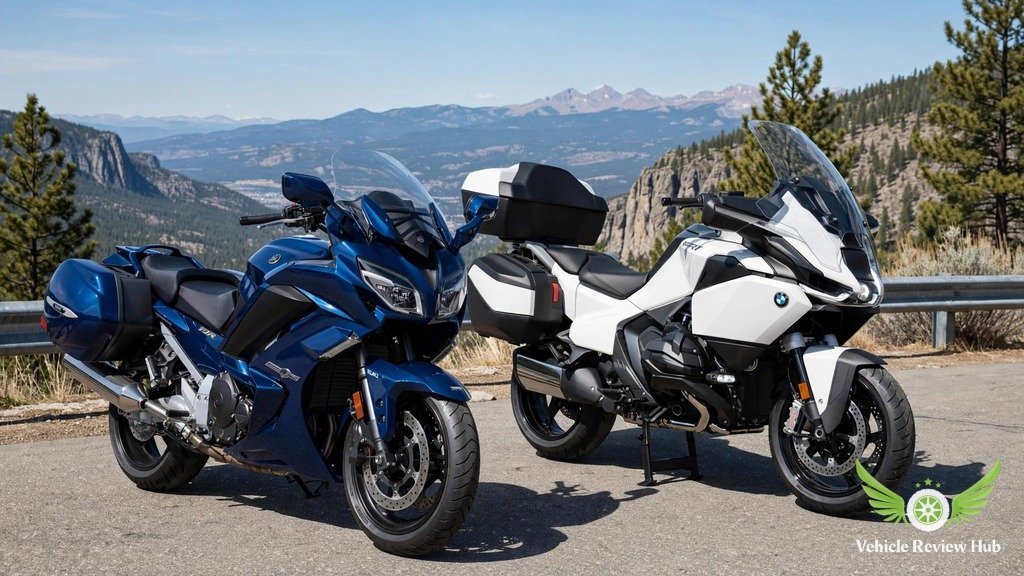
Used FJR Value Against a New R 1300 RT Starting Around $22,495
The headline math favors the used FJR by a wide margin in this Yamaha FJR1300ES buying guide. A new BMW R 1300 RT starts at $22,495 before destination and options, and typical dealer stock with packages runs well past $30,000 (one 2026 Triple Black example: $30,690). Against that, a clean 2023 FJR1300ES at $15,495 buys a fully equipped shaft-drive sport-tourer with luggage, cruise control, and electronic suspension for roughly half the price of a well-optioned RT. The BMW counters with modern electronics the FJR never got — a 10.25-inch TFT display, a 620-pound claimed wet weight against the FJR’s 642 pounds — plus a three-year, 36,000-mile warranty. For a buyer who tours 5,000-plus miles a year and values proven hardware over screens, the used FJR wins this Yamaha FJR1300ES buying guide comparison. For a buyer who wants the latest rider aids and a factory warranty, the RT justifies its premium — roughly double the used FJR’s price.
When a Chain-Drive Tracer 9 at $12,599 Makes More Sense in 2026
The other 2026 alternative in this Yamaha FJR1300ES buying guide is Yamaha’s own middleweight: the 2026 Tracer 9, priced from $12,599 with hard cases standard on US models and powered by the 890cc CP3 triple, per TotalMotorcycle’s 2026 specifications. It is chain-drive, not shaft, and a much lighter, more agile bike with less wind protection and smaller luggage — but it is brand new, with a warranty and modern electronics, at a price under a clean late-model used FJR. The Tracer 9 makes more sense for mostly solo riding under 300 miles a day on twisty roads; the FJR makes more sense for regular two-up, fully loaded, 500-mile days. The already-published Tracer 9 GT review covers that family in detail. The table below keeps this Yamaha FJR1300ES buying guide comparison honest.
| Bike | Engine and drive | Key advantage | Price in this guide |
|---|---|---|---|
| Used FJR1300ES (2023 example) | 1,298cc inline-four, shaft | Full touring kit, proven longevity | $15,495 asking (7,451 miles) |
| New BMW R 1300 RT | 1,300cc boxer twin, shaft | Modern electronics, factory warranty | $22,495 base; dealer stock $30,000-plus |
| New Yamaha Tracer 9 (2026) | 890cc triple, chain | New bike, lighter, agile | $12,599 MSRP |
Is Buying a Used Yamaha FJR1300ES Worth It?
So, is buying a used Yamaha FJR1300ES worth it? This Yamaha FJR1300ES buying guide says yes, with easy-to-check conditions.
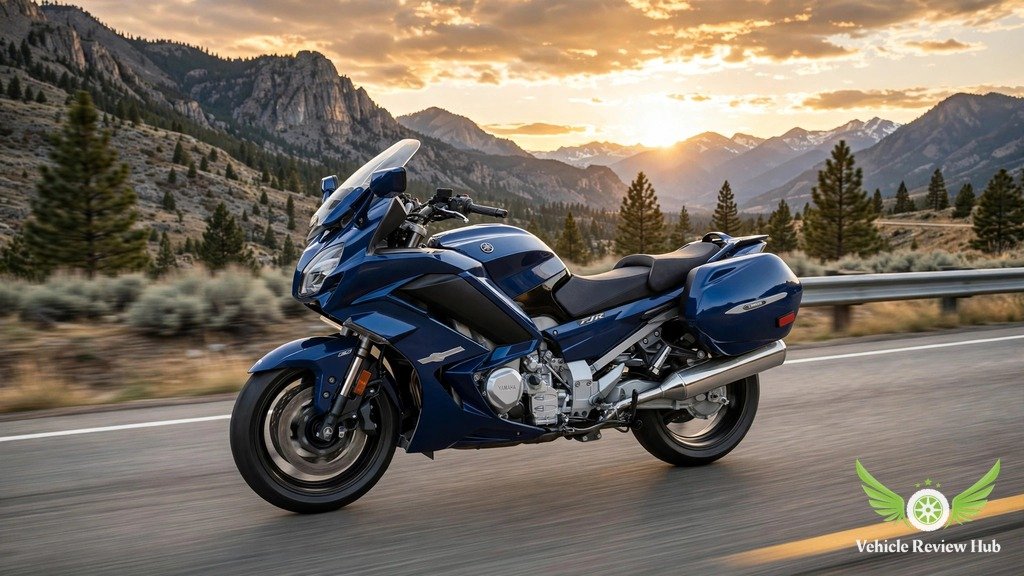
Benefits and Risks: Recall Completion Papers Are the First Thing to Check
The Yamaha FJR1300ES buying guide case for buying rests on three strengths. First, value: no other shaft-drive, luggage-equipped, cruise-controlled sport-tourer with this much power sells for $10,000–$16,000 used. Second, durability: the 1,298cc inline-four has a two-decade reputation for high mileage with routine care. Third, comfort: the adjustable seat and windscreen, the plush two-up perch, and the 6.6-gallon tank make it a genuine 500-mile-day machine. The risks are narrower but worth naming. Recall paperwork is first: a 2016–2021 bike without proof of 20V813 and 21V865 completion, or a 2013–2020 bike without 20V814 proof, is a bargaining chip at best and a safety problem at worst. Electronic suspension failure is second — the one repair that can exceed the bike’s value. Neglected shaft-drive oil, aged tires, and a dead windscreen motor are third — cheap to check, expensive to ignore.
Before you decide, watch this breakdown of which FJR1300 years to avoid and which ones last — a Yamaha FJR1300ES buying guide companion covering the whole FJR1300 family, not the ES alone. Note honestly: it complements rather than replaces the ES-specific checks in this Yamaha FJR1300ES buying guide.
US-Market Alternatives as the Sport Touring Class Shrinks
The sport-touring class is shrinking in the USA, which shapes this Yamaha FJR1300ES buying guide verdict. Kawasaki’s Concours 14 is discontinued, and Yamaha itself now points touring buyers at the Tracer 9 family instead of a big FJR successor. If you want a new bike with a warranty, this Yamaha FJR1300ES buying guide suggests the Tracer 9, the NT1100, or the BMW RT. If you want the most touring motorcycle per dollar in America in 2026, buy a documented used FJR1300ES, verify its recalls by VIN, test every electronic setting before paying, and budget for tires and valves. The FJR1300ES reliability and maintenance picture explains that ownership year by year. The Yamaha FJR1300ES buying guide verdict holds: in a shrinking class, a well-documented used ES is among the smartest big-tourer buys available.
Yamaha FJR1300ES Buying Guide FAQs
These Yamaha FJR1300ES buying guide FAQs answer buyers’ most common questions.
What is a fair price for a used Yamaha FJR1300ES in the USA?
Fair prices depend on year, mileage, and paperwork: this Yamaha FJR1300ES buying guide puts a clean 2023 ES near $15,495, a 2021 ES near $13,495, and most 2016–2019 ES bikes at $10,000–$13,500, per recent US listings.
Can I still buy a new Yamaha FJR1300ES in the USA?
Not as a current model. The last US model year was 2024 in Cobalt Blue at $18,299, and no 2025 or 2026 US model exists. Some dealers still advertise leftover 2024 stock at $18,299, but Yamaha cannot order you a new one — a key point of this Yamaha FJR1300ES buying guide.
Was there really no 2013 FJR1300ES?
Correct — and this Yamaha FJR1300ES buying guide stresses it because mislabelled listings are common. The ES arrived in the USA for 2014 at $16,890; the five-speed ES years are 2014 and 2015 only, so a bike advertised as a “2013 ES” needs its VIN checked.
Which FJR1300 recalls must I check before buying?
Three, all nationwide: 20V813 (second gear, 2016–2020, 2,285 units, Yamaha #990141), 21V865 (ECU reprogram, 2016–2021, 2,462 units, Yamaha #990152), and 20V814 (front brake switch, 2013–2020 FJR1300 among seven models, 18,203 units total, Yamaha #990140). Demand completion paperwork and verify by VIN, as this Yamaha FJR1300ES buying guide insists.
What is the difference between the FJR1300A and the FJR1300ES?
The ES adds electronically adjustable suspension and, from 2016, lean-angle-sensitive LED cornering lights. The base A has conventional suspension and otherwise shares the engine, shaft drive, luggage, cruise control, and traction control — and in this Yamaha FJR1300ES buying guide, A prices are never ES prices.
How much does Yamaha FJR1300ES insurance cost?
No single figure fits every rider, so this Yamaha FJR1300ES buying guide gives none. Some carriers rate the 1,298cc sport-tourer closer to a sportbike; age, record, location, storage, and coverage move the quote more than the bike. Get three quotes before buying.
How often does a Yamaha FJR1300ES need servicing?
Service every 4,000 miles with oil and filter changes under the US schedule, with a valve-clearance check around 26,600 miles on later models (check your own year’s manual).
Should I buy a used FJR1300ES or a new Tracer 9?
Buy the used FJR1300ES for two-up, fully loaded, long-distance touring — the core recommendation of this Yamaha FJR1300ES buying guide. Buy the new 2026 Tracer 9 at $12,599 for a lighter, warrantied, modern bike for mostly solo riding under 300 miles a day.