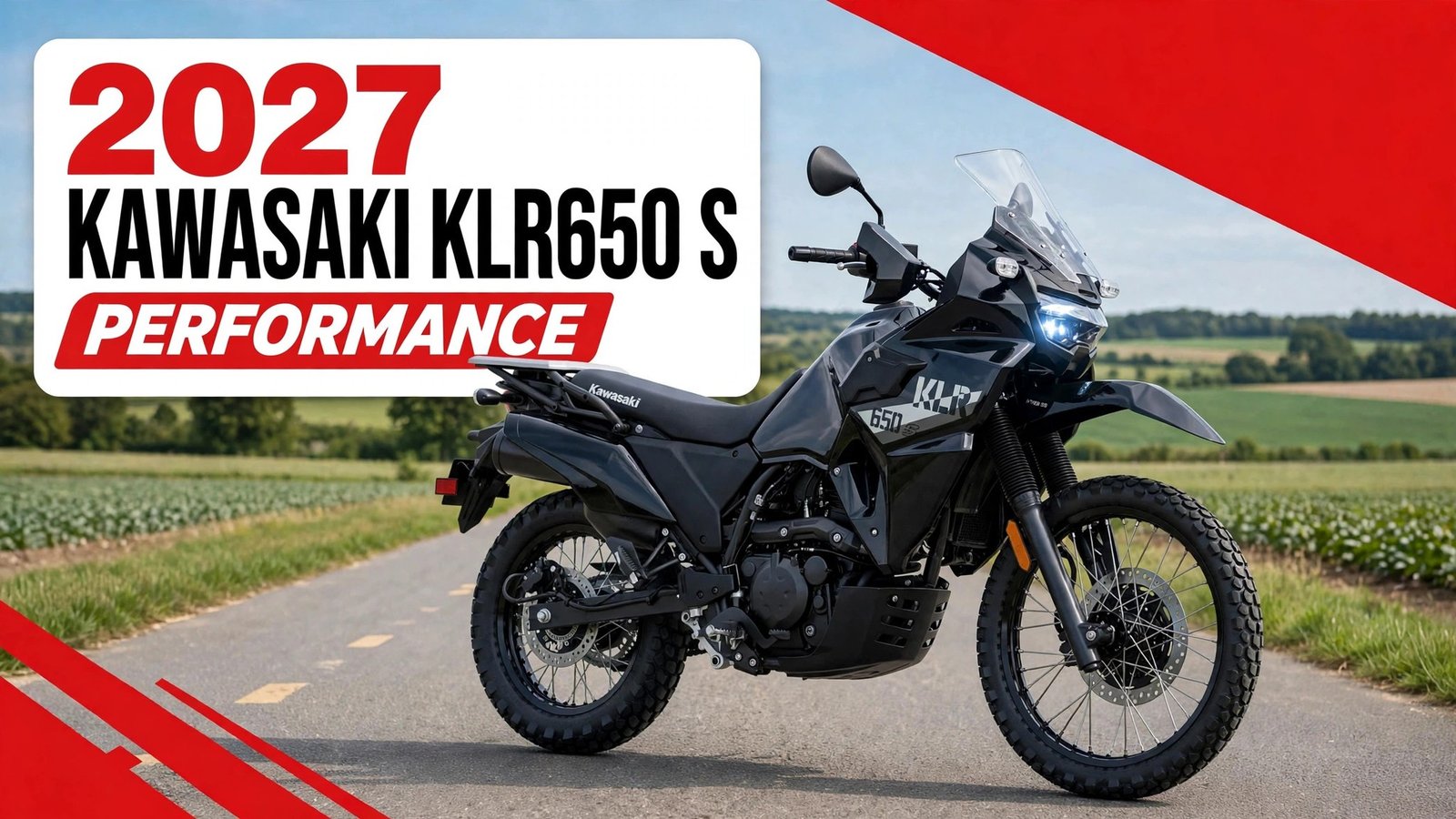
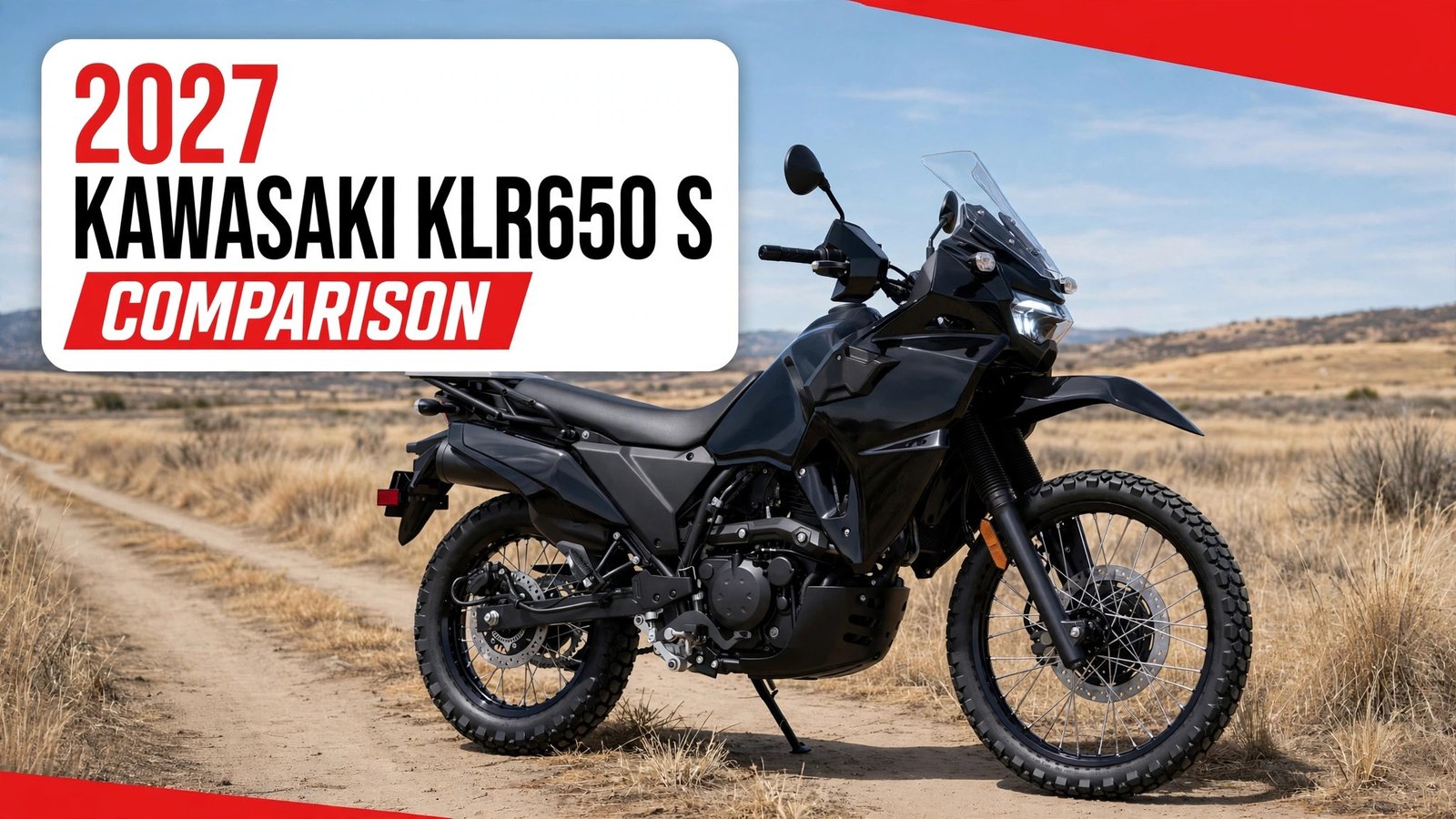
The 2027 Kawasaki KLR650 Adventure makes 34.61 horsepower at the rear wheel, tops out at 88 to 90 mph, and returns 49 mpg when ridden gently, bags packed, and those three numbers are the whole of this Kawasaki KLR650 Adventure performance guide. Kawasaki claims 40 hp at the crank, but the wheel figure is the honest one. On the road that means a bike that cruises at 75 mph and stretches a tank to nearly 300 miles.
The short answer is that the Adventure’s performance is adequate, not exciting. The same 652cc single that has powered the base KLR650 since 2022 sits in the Adventure, carrying 26.5 pounds of extra kit, and no test has measured what that weight costs. This Kawasaki KLR650 Adventure performance guide works through the dyno runs, the top speed, the fuel economy and the handling, with every figure tied to the test that produced it.
One thing to settle first: the Adventure is a trim, not a separate model, so its engine, gearbox and frame are identical to every other third-generation KLR650. Our companion KLR650 performance guide covers the base bike’s numbers, while this Kawasaki KLR650 Adventure performance guide focuses on the runs made on the Adventure itself and on what the extra luggage changes.
Kawasaki KLR650 Adventure Engine Performance and Power Delivery
The engine is the known quantity in this Kawasaki KLR650 Adventure performance story, because the Adventure shares its 652cc single with every other gen-3 KLR650. What is new here is that the dyno runs were made on the Adventure trim itself, cases and all.

Its Own Dyno: 34.61 Horsepower
Cycle World put a 2022 Adventure on its Dynojet 250i and measured 34.61 hp at 5,910 rpm and 33.52 lb-ft at 4,700 rpm. The test bike was the Adventure trim, cases and all. Cycle World called the delivery smooth and tractor-like from 2,000 rpm. Read the Cycle World dyno test for the full run.
Against Kawasaki’s claimed 40 hp at 6,000 rpm, the wheel figure is about 13 percent lower, a normal drivetrain loss for a chain-drive single. The claim carries an ISO 4106 footnote, and the torque claim is 39.1 lb-ft at 4,500 rpm against the measured 33.52. Neither gap is a defect; it is the difference between a crank figure and a wheel figure, and this Kawasaki KLR650 Adventure performance guide prints both so the comparison is honest.
| Test | Bike | Peak power | Peak torque |
|---|---|---|---|
| Cycle World 2022, Dynojet 250i | KLR650 Adventure | 34.61 hp @ 5,910 rpm | 33.52 lb-ft @ 4,700 rpm |
| Rider Magazine 2022 | KLR650 Adventure | 36.5 hp @ 6,100 rpm | 35.2 lb-ft @ 4,600 rpm |
| Cycle World 2023, Dynojet 250i | KLR650 S | 36.9 hp @ 6,080/6,100 rpm | 35.4 lb-ft @ 4,590/4,600 rpm |
Notes for this Kawasaki KLR650 Adventure performance dyno table: the three runs come from two dynos in two years, so the figures are not directly comparable.
The 36.86 Figure Is the S, Not This Bike
The highest number attached to this engine is 36.86 hp, and it belongs to the S, not the Adventure. Cycle World measured 36.9 hp on a 2023 KLR650 S, on the same Dynojet 250i it used for the Adventure run, and the precise figure behind the rounded 36.9 is 36.86. The S is the lowered-seat trim and shares the Adventure’s engine exactly, so the 2.3 hp gap is unexplained sample and year variance, not a trim difference, and no honest reading can credit the Adventure with the S figure. See the Cycle World S dyno test for the run itself.
The third run completes the picture. Rider Magazine’s road test measured 36.5 hp at 6,100 rpm on its own 2022 Adventure, with 35.2 lb-ft at 4,600 rpm. Two runs on the same 2022 Adventure read 34.61 and 36.5 hp, a 1.9 hp spread, which is why this Kawasaki KLR650 Adventure performance guide treats the wheel figure as roughly 35 to 36.5 hp rather than a single settled number.
Kawasaki KLR650 Adventure Top Speed and Acceleration
Top speed is the simplest question in this Kawasaki KLR650 Adventure performance guide: Kawasaki publishes no figure, and only one instrumented test exists.

88 to 90 MPH Was Tested on This Trim
Cycle News tested the top speed on the Adventure. Kit Palmer recorded 88 to 90 mph on level ground, in a full tuck, with no wind, and added that the bike did not feel as though it was straining. The same review calls 74 mph the magic number, the speed where the bike is most comfortable cruising, and Rider Magazine agrees, saying the Adventure happily cruises at 75 mph. Read the Cycle News review for the full test. It is the only instrumented top-speed figure, which is why this Kawasaki KLR650 Adventure performance guide treats it as the only one worth quoting.
No Official Top Speed Exists
Kawasaki publishes no top-speed figure for the KLR650 in any market, and no other publication has instrumented one for the gen-3 bike. The quarter mile is in the same position: Motorcyclist recorded 14.81 seconds at 85.97 mph for the gen-2 bike in 2008, a carbureted bike, and it says nothing about the fuel-injected Adventure. There is also no verified 0 to 60 time for the gen-3 bike, so this Kawasaki KLR650 Adventure performance guide prints none.
The gap is filled online by aggregator pages that print triple-digit top speeds, sometimes three different figures in the same article, and those numbers are invented. One site labels its own figures as AI-assisted, and another contradicts itself from one paragraph to the next. None of them cites a test, and none should be quoted. A listing that promises a triple-digit top speed is repeating an aggregator, not a measurement.
Kawasaki KLR650 Adventure Mileage and Fuel Economy
Fuel economy is where the Adventure earns its keep, and this Kawasaki KLR650 Adventure performance section has the best-tested numbers in the range, because both headline economy tests were made on this trim, bags packed.

Cycle News Measured 49 MPG, Bags Packed
Kit Palmer packed the Adventure’s side bags and rode home to Southern California after the launch, covering a little more than 1,000 miles in four days, mostly on paved back-country roads with a few off-road detours. He averaged 49 mpg on the ride home, nearly 300 miles from the 6.1-gallon tank, and 280-plus miles does not seem out of the question. The cases were fitted and packed for the whole test, which is why the 49 mpg figure belongs to the Adventure, not to a stripped base bike.
After more than 1,000 miles the oil sight window still showed full, which answers the old oil-burning story from 2008 and 2009. Cycle News’s 49 mpg is the best measured figure for this bike, measured the way most owners will ride it, loaded and on the road.
Motorcycle.com Saw 35.2 at Freeway Pace
The other end comes from Motorcycle.com’s first ride. After the two-day launch ride in New Mexico, the tester rode 800 miles home on the freeway at nearly full throttle for 13 hours, averaging 35.2 mpg, which should give just over 200 miles per tank. He managed 170 miles in one continuous stretch, on the Adventure-trim press bike, the same one Motorcycle.com weighed at 483 pounds against Kawasaki’s claimed 487. It is the low end of the range in this Kawasaki KLR650 Adventure performance guide.
The two figures are not a contradiction; they are two different rides. Cycle News rode back-country two-lane roads at a relaxed pace with the bags packed, while Motorcycle.com held the throttle wide open on the freeway. The 14 mpg gap between the two tests is the price of haste. Rider sits between them at 47 mpg, with an estimated range of 287 miles.
| Test | Riding | MPG | Range |
|---|---|---|---|
| Cycle News 2022 | Bags packed, back-country roads | 49 mpg | Nearly 300 mi |
| Rider Magazine 2022 | Mixed test riding | 47 mpg | 287 mi (estimated) |
| Motorcycle.com 2022 | Freeway, nearly full throttle | 35.2 mpg | Just over 200 mi |
| ADV Pulse 2022 | Deep sand, ran dry | 39.3 mpg | 239.6 mi |
Notes for this Kawasaki KLR650 Adventure performance economy table: the range figures are calculated from each test’s measured mpg and the 6.1-gallon tank, except Rider’s 287 miles, which is the magazine’s own estimate. The ADV Pulse figure is the off-road floor.
Kawasaki KLR650 Adventure Real-World Riding Experience
The numbers above come from tests, but the Adventure is bought for trips, and this Kawasaki KLR650 Adventure performance section turns them into range a rider can plan around.
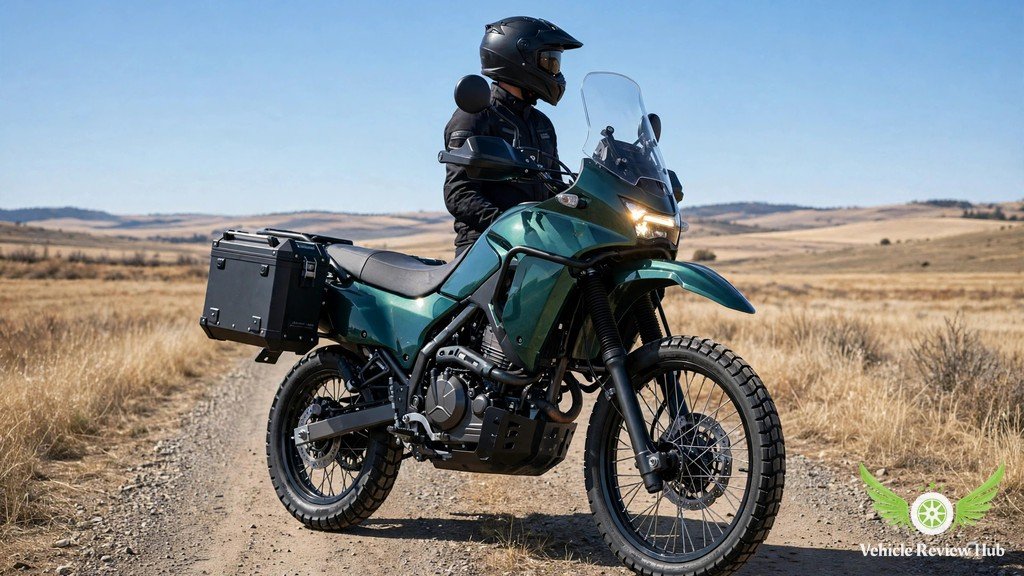
The film below is Kawasaki’s own press-launch footage from New Mexico, not a dyno test and not a top-speed run. It shows the 2022 KLR650 ridden on highway, mountain and gravel roads, and it is worth watching for the riding footage rather than for numbers. The dyno figures in this Kawasaki KLR650 Adventure performance guide live in the tables above, not in the film.
Range Bookends: 215 to 300 Miles
The honest range is 215 to 300 miles, and the arithmetic is simple. At 35.2 mpg, 35.2 times 6.1 gallons is 214.7 miles, call it 215, the worst case, a freeway blast at nearly full throttle. At 49 mpg, 49 times 6.1 is 298.9 miles, call it 300, the best case, a relaxed ride home, bags packed. Rider’s 47 mpg gives 287 miles, and Fuelly’s owner average of 48.56 mpg points to the same 300-mile neighbourhood. That is the range this Kawasaki KLR650 Adventure performance guide uses throughout.
The floor is lower off-road. ADV Pulse ran a KLR650 dry at 239.6 miles in deep sand, at 39.3 mpg, after a 450-mile first ride over two 12-hour days. Deep sand is the worst case for a heavy single, and a rider planning a desert crossing should plan on the low 200s rather than the headline 300.
No Back-to-Back Standard Test Exists
Nobody has dynoed a base KLR650 and an Adventure back to back on the same dyno, so the cost of the Adventure’s 26.5 pounds of kit has never been measured. The three runs in the table above come from two different dynos in two different years, and the base bike has no published run of its own. The weight sits high and wide, but whether it costs a horsepower or a mile per gallon is untested, and this Kawasaki KLR650 Adventure performance guide will not invent a number for it.
The extra weight does not change the engine, gearing or tank, so any performance difference is small. The cases are the reason to buy the trim, and the weight is the price. A rider who wants the lightest KLR650 should buy the base bike; a rider who wants to tour should accept the 26.5 pounds.
Kawasaki KLR650 Adventure Handling, Braking and Stability
Handling is where the Adventure’s weight shows up, and this Kawasaki KLR650 Adventure performance section keeps the two camps separate: composed on the road and capable off it, but heavy, and it asks for muscle in the technical sections.
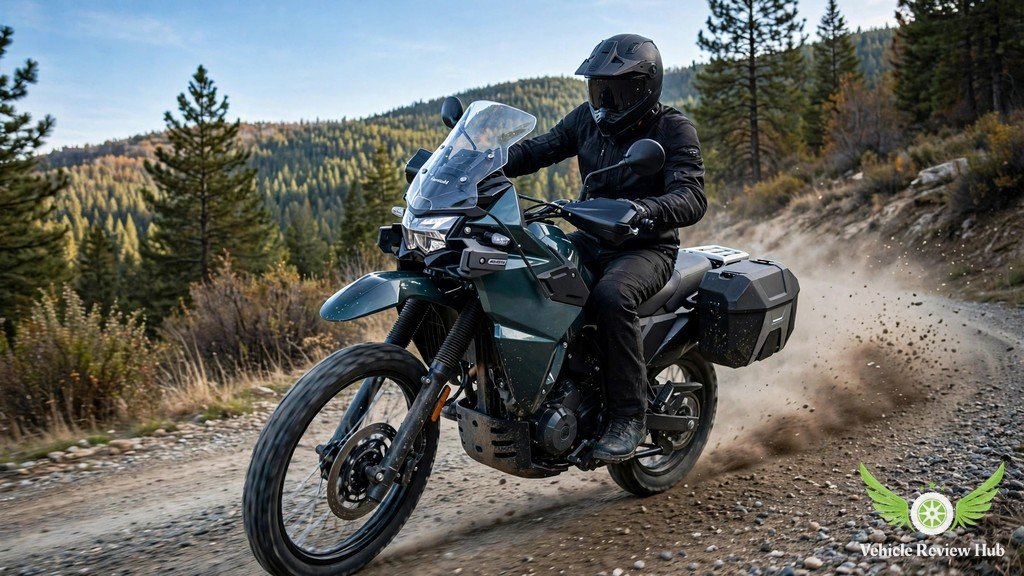
Handling, Braking and Stability Off-Road
On the road, Rider Magazine found the handling exceeded expectations, composed when accelerating through tight corners, though the semi-knobby Dunlop K750 tyres squirm a bit. Cycle News called the feel stable and planted, and both agreed the suspension is supple enough to come into its own off-road, where Rider called the rocky trails fantastic fun. The 41 mm fork carries 7.9 inches of travel, and the rear Uni-Trak shock adjusts for rebound and preload.
Off-road, the weight is the limit. Cycle News noted that it takes a little more muscle to negotiate technical sections, and that it does not take much speed over rough terrain to bottom the suspension, with the drain plug exposed. The brakes are modest for the weight: Motorcycle.com said so despite the larger 300 mm front disc, up from 280 mm on the second generation, and the ABS cannot be switched off from the handlebar, a known complaint off-road. The only workarounds are pulling a fuse or fitting an aftermarket kill switch. It is a real limit, and this Kawasaki KLR650 Adventure performance guide does not hide it.
Cycle News reports buzz at highway speed, while Rider says there is very little vibration and the bike happily cruises at 75 mph. The rubber-mounted bars, pegs and seat take the edge off, but a single still tingles the fingers on a long highway stint.
Rear Travel: Kawasaki’s Documents Conflict
The rear suspension travel is 8.0 inches on the current Kawasaki sheet, but Kawasaki’s own 2022 launch material printed 7.3 inches, and third-party listings still carry the older figure. Motorcycle.com’s launch spec table listed 7.3 inches, and ADV Pulse’s first ride repeated it, so the conflict is Kawasaki against Kawasaki. This Kawasaki KLR650 Adventure performance guide prints 8.0 inches, because the current sheet governs the bike on sale today, and it labels the split so a buyer who finds 7.3 inches elsewhere knows where it came from.
The front fork is not in dispute: 7.9 inches in every source. The Adventure carries the same suspension as every other gen-3 KLR650, and the 2027 DF ABS trim runs the same standard suspension despite one description claiming otherwise.
Kawasaki KLR650 Adventure Performance Compared With Other Dual-Sports
The comparison that matters most is inside the family, and this Kawasaki KLR650 Adventure performance section starts there, because the Adventure and the ABS trim are the same bike with one difference.
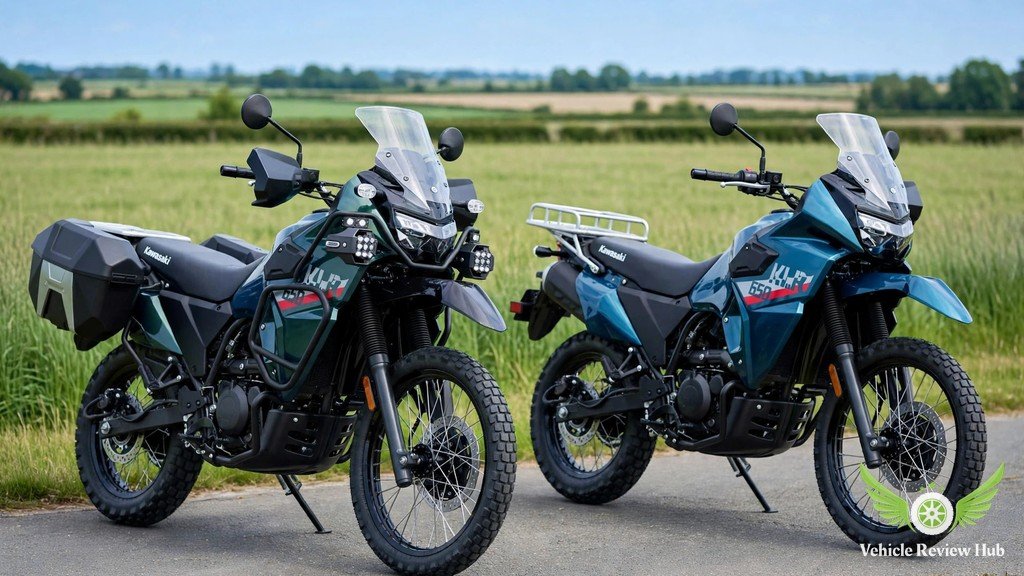
Kawasaki KLR650 Adventure vs KLR650 ABS
The Adventure and the KLR650 ABS share the same engine, dyno figures, top speed, 6.1-gallon tank and fuel economy, because they are the same motorcycle. The only performance difference is the 26.5 pounds of factory kit and the $900 premium, and neither has a measured cost in speed or range. A rider choosing between the two is choosing between luggage and lightness. Our Adventure review covers the kit and the price, and the KLR650 comparison puts the base bike against its rivals.
Against the carbureted rivals, the comparison is different. The Suzuki DR650S makes its power from a 644cc air-cooled single with a carburetor, and our DR650S performance guide has its dyno numbers, while the Adventure answers with fuel injection, a digital dash and a fuel gauge. The Royal Enfield Himalayan 450 is the modern rival, a 452cc liquid-cooled single with ride modes and a TFT dash, but its 40 hp is a crank claim, and it must not be compared against the Adventure’s 34.61 wheel horsepower as if the two were the same measurement. The Himalayan is lighter at 432 pounds wet, but its 4.5-gallon tank gives up range to the KLR650. The smaller Kawasaki twin is a different answer; our Versys 650 performance guide has its numbers.
| Item | KLR650 Adventure | KLR650 ABS |
|---|---|---|
| Engine | 652cc liquid-cooled single | 652cc liquid-cooled single |
| Claimed power | 40 hp @ 6,000 rpm | 40 hp @ 6,000 rpm |
| Measured wheel power | 34.61 to 36.5 hp | No published run |
| Top speed (tested) | 88 to 90 mph | Same bike, no separate test |
| Fuel economy (best test) | 49 mpg | Same bike, no separate test |
| Tank and range | 6.1 gal, 215 to 300 mi | 6.1 gal, 215 to 300 mi |
| Curb weight | 487.1 lb | 460.6 lb |
| Delivered price (2027) | $8,884 | $7,984 |
Notes for this Kawasaki KLR650 Adventure performance comparison table: the two bikes share the same engine, gearbox and tank, so power, top speed and range are the same for both. The only measured differences are the 26.5 pounds of kit and the $900 premium. No publication has dynoed the base or ABS bike.
Is the Kawasaki KLR650 Adventure Suitable for Beginner Riders?
Dork in the Road, who owns a 2022 Adventure, calls it a great bike for beginners because the KLR650 is easy to ride and handle. The case is simplicity: one cylinder, five gears, no ride modes, and power Cycle World called smooth and tractor-like from 2,000 rpm.
The case against is the size. The seat is 34.3 inches high, with no low-seat Adventure variant, while the S trim sits at 32.1 inches. The curb weight is 487.1 pounds, heavy to pick up after a drop off-road, and the brakes are modest for the weight. On balance, this Kawasaki KLR650 Adventure performance guide agrees with the owner: a tall beginner who is honest about the weight will be fine, and a shorter beginner should sit on the bike first, or look at the S trim.
Kawasaki KLR650 Adventure Performance: Frequently Asked Questions
These are the questions buyers ask most often, and each answer comes from the same tests as the rest of this Kawasaki KLR650 Adventure performance guide.
How Much Horsepower Does the Adventure Make?
Kawasaki claims 40 hp at 6,000 rpm, with an ISO 4106 footnote, and 39.1 lb-ft at 4,500 rpm. At the rear wheel, Cycle World measured 34.61 hp and Rider 36.5, so this Kawasaki KLR650 Adventure performance guide treats the wheel figure as roughly 35 to 36.5 hp.
What Is the Top Speed of the KLR650 Adventure?
The only instrumented figure is 88 to 90 mph, measured by Cycle News on the Adventure in 2022, on level ground in a full tuck, no wind. Kawasaki publishes no official top speed, and this Kawasaki KLR650 Adventure performance guide prints no aggregator figure. Comfortable cruising is 74 to 75 mph.
How Many Miles Per Gallon Does the Adventure Get?
It depends on how it is ridden. Cycle News averaged 49 mpg with the bags packed on back-country roads, Rider recorded 47 mpg, and Motorcycle.com averaged 35.2 mpg on an 800-mile freeway run at nearly full throttle. The honest range in this Kawasaki KLR650 Adventure performance guide is 35 to 49 mpg.
How Far Can the Adventure Go on a Tank?
Between 215 and 300 miles. At 35.2 mpg the 6.1-gallon tank gives 214.7 miles, and at 49 mpg it gives 298.9 miles. Rider’s 47 mpg works out to 287 miles, and this Kawasaki KLR650 Adventure performance guide uses those bookends throughout.
Is the Adventure Slower Than the Base KLR650?
No test has measured a difference. The Adventure carries 26.5 pounds of extra kit, but nobody has dynoed a base KLR650 and an Adventure back to back, so the cost of the weight is untested. The two bikes share the same engine, gearbox and tank, and this Kawasaki KLR650 Adventure performance guide will not invent a number for it.
Does the Adventure Have a Dyno Run of Its Own?
Yes. Cycle World put a 2022 Adventure on its Dynojet 250i and measured 34.61 hp at 5,910 rpm and 33.52 lb-ft at 4,700 rpm, and Rider measured 36.5 hp at 6,100 rpm on its own Adventure. The 36.86 figure sometimes quoted belongs to the S trim, and this Kawasaki KLR650 Adventure performance guide keeps the two separate.
What Is the Quarter-Mile Time?
There is no instrumented quarter-mile time for the gen-3 KLR650. The only published figure is Motorcyclist’s 14.81 seconds at 85.97 mph for the gen-2 bike in 2008, a carbureted bike. No verified 0 to 60 time exists either, so this Kawasaki KLR650 Adventure performance guide prints neither.
Does the Adventure Vibrate at Highway Speed?
Testers split. Cycle News reports buzz at highway speed, while Rider says there is very little vibration and the bike happily cruises at 75 mph. The rubber-mounted bars, pegs and seat take the edge off, but a single still tingles the fingers on a long stint, and this Kawasaki KLR650 Adventure performance guide reports both camps.
How Much Does the Adventure Weigh?
The Adventure weighs 487.1 pounds ready to ride, 26.5 pounds more than the KLR650 ABS at 460.6 pounds. Motorcycle.com put its Adventure test bike on its own scales and recorded 483 pounds, close to Kawasaki’s 487. The extra weight sits high and wide, in the cases and the lights, and this Kawasaki KLR650 Adventure performance guide puts it first because a rider feels it.
What Is the Rear Suspension Travel?
The current Kawasaki sheet says 8.0 inches, but Kawasaki’s own 2022 launch material printed 7.3 inches, and older listings still carry 7.3 inches. This Kawasaki KLR650 Adventure performance guide prints 8.0 inches with the split labelled. The front fork carries 7.9 inches in every source.
Can the ABS Be Switched Off?
No. ABS is the only rider aid on the KLR650, and it cannot be switched off from the handlebar. The only workarounds are pulling a fuse or fitting an aftermarket kill switch. It is a handling limit off-road, and this Kawasaki KLR650 Adventure performance guide notes it plainly.
Is the Adventure Good for Beginners?
For a tall beginner, yes. The power delivery is smooth and tractor-like from 2,000 rpm, there are no ride modes to learn, and owner Dork in the Road calls it a great beginner bike. The limits are the 34.3-inch seat, the 487.1-pound curb weight and the modest brakes, so a shorter beginner should sit on the bike first, and this Kawasaki KLR650 Adventure performance guide agrees.