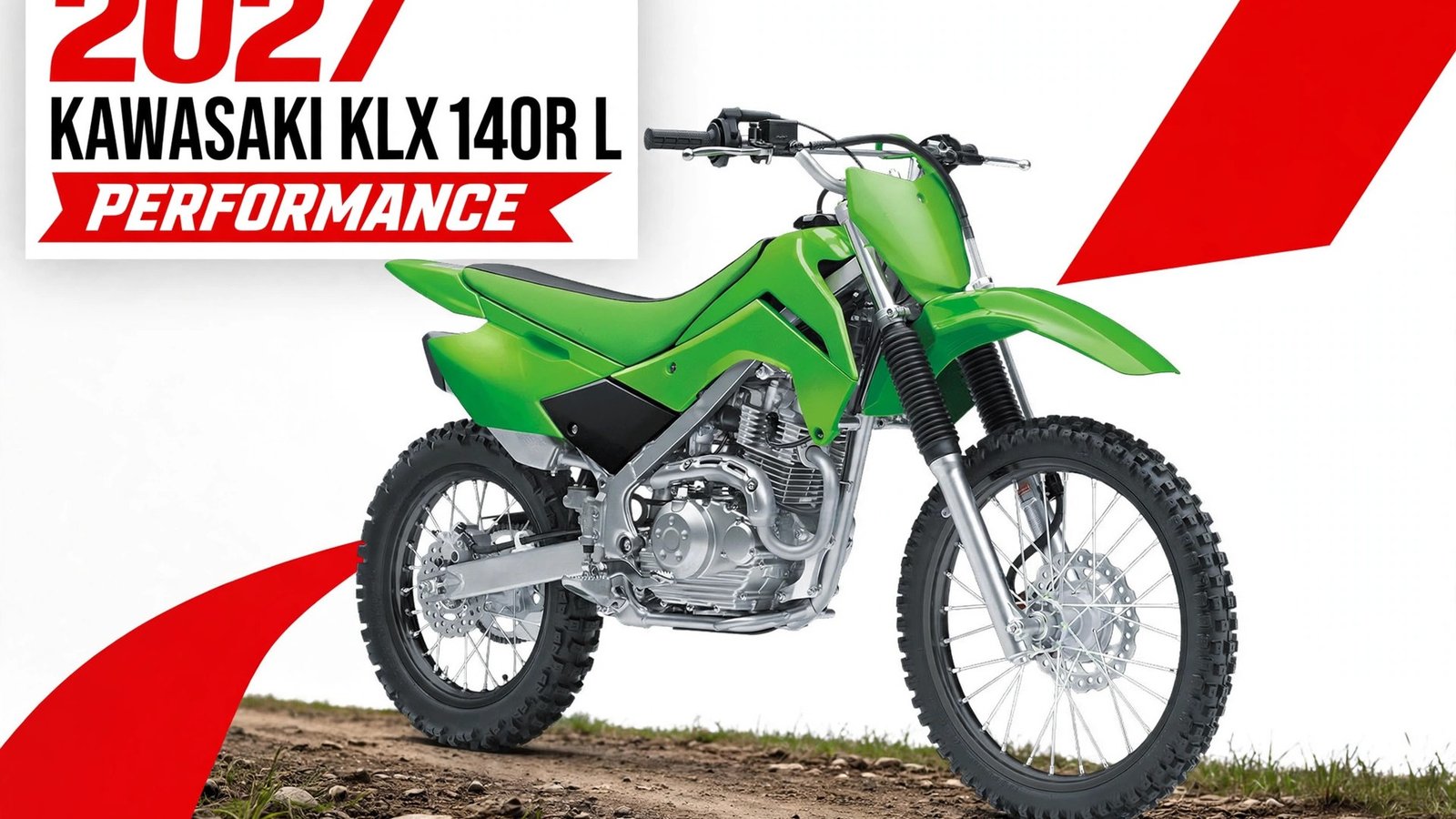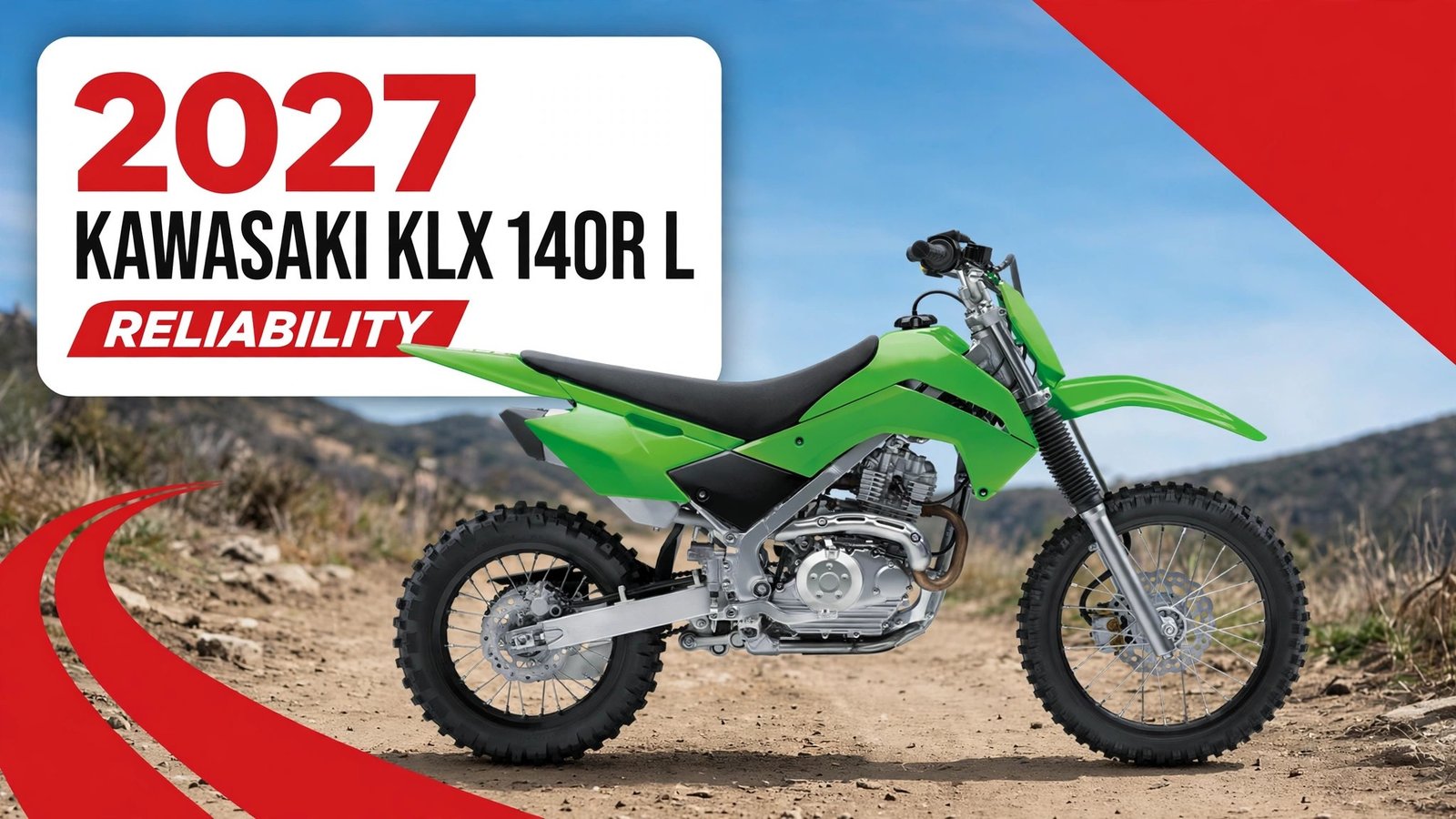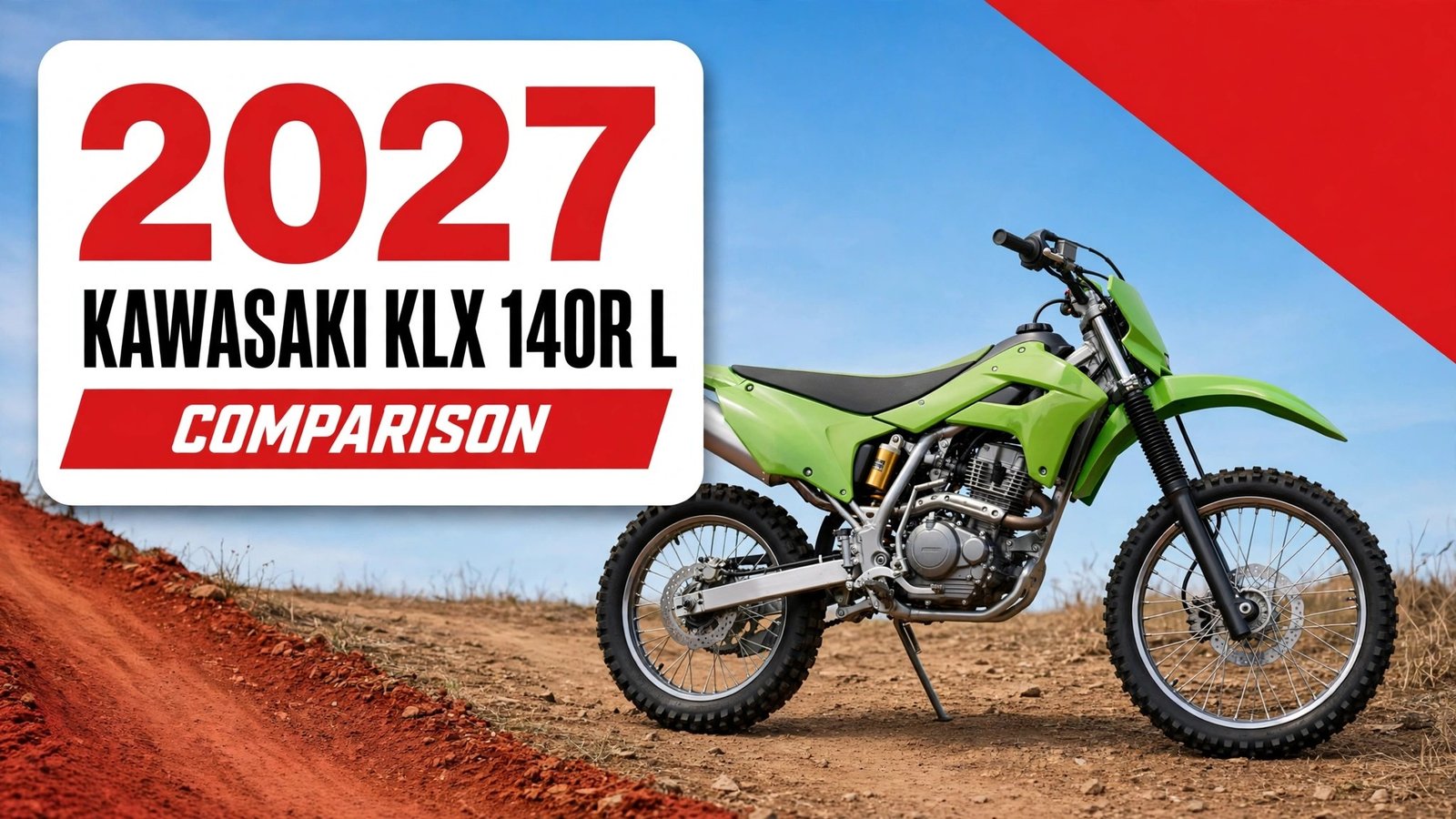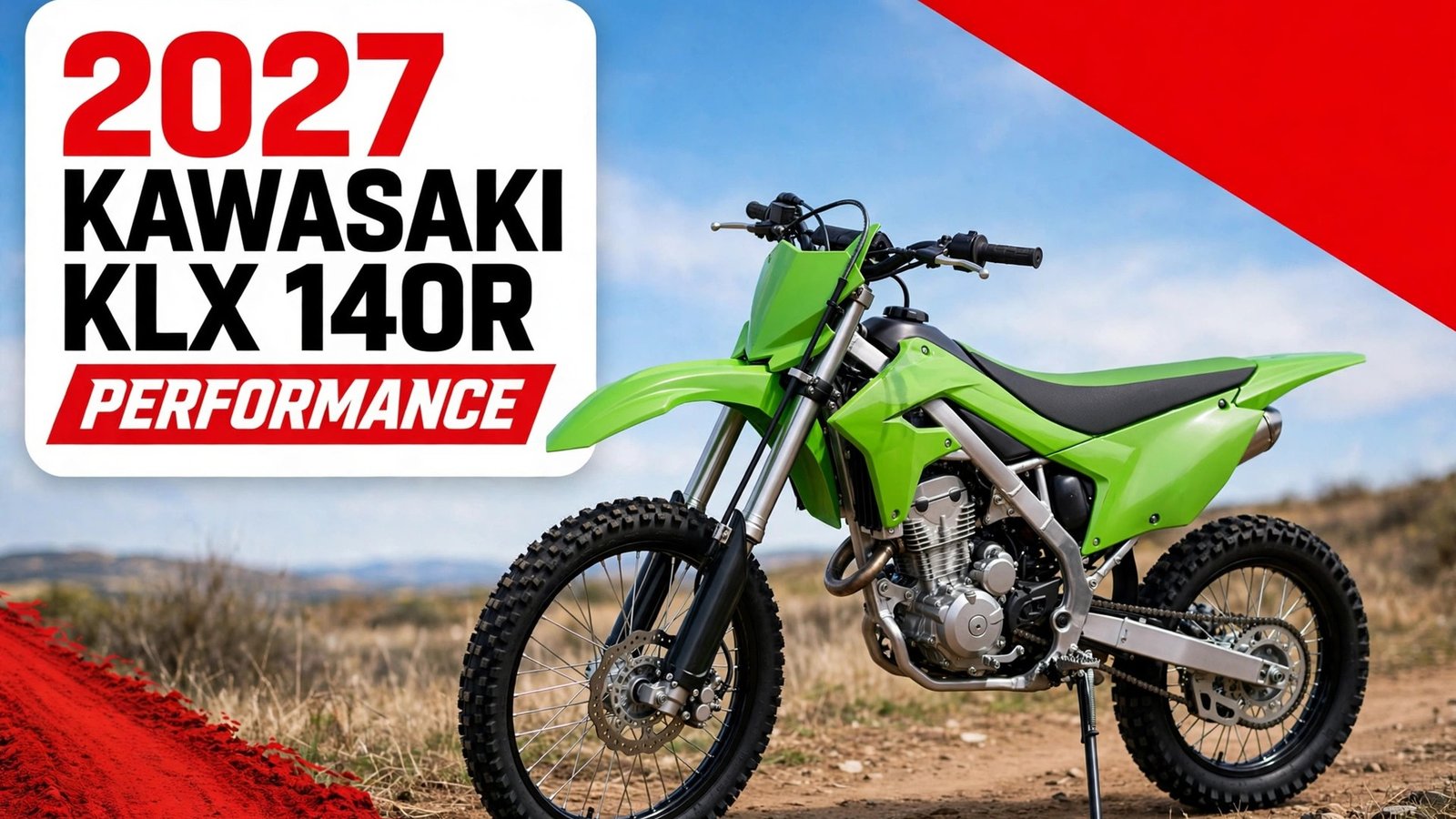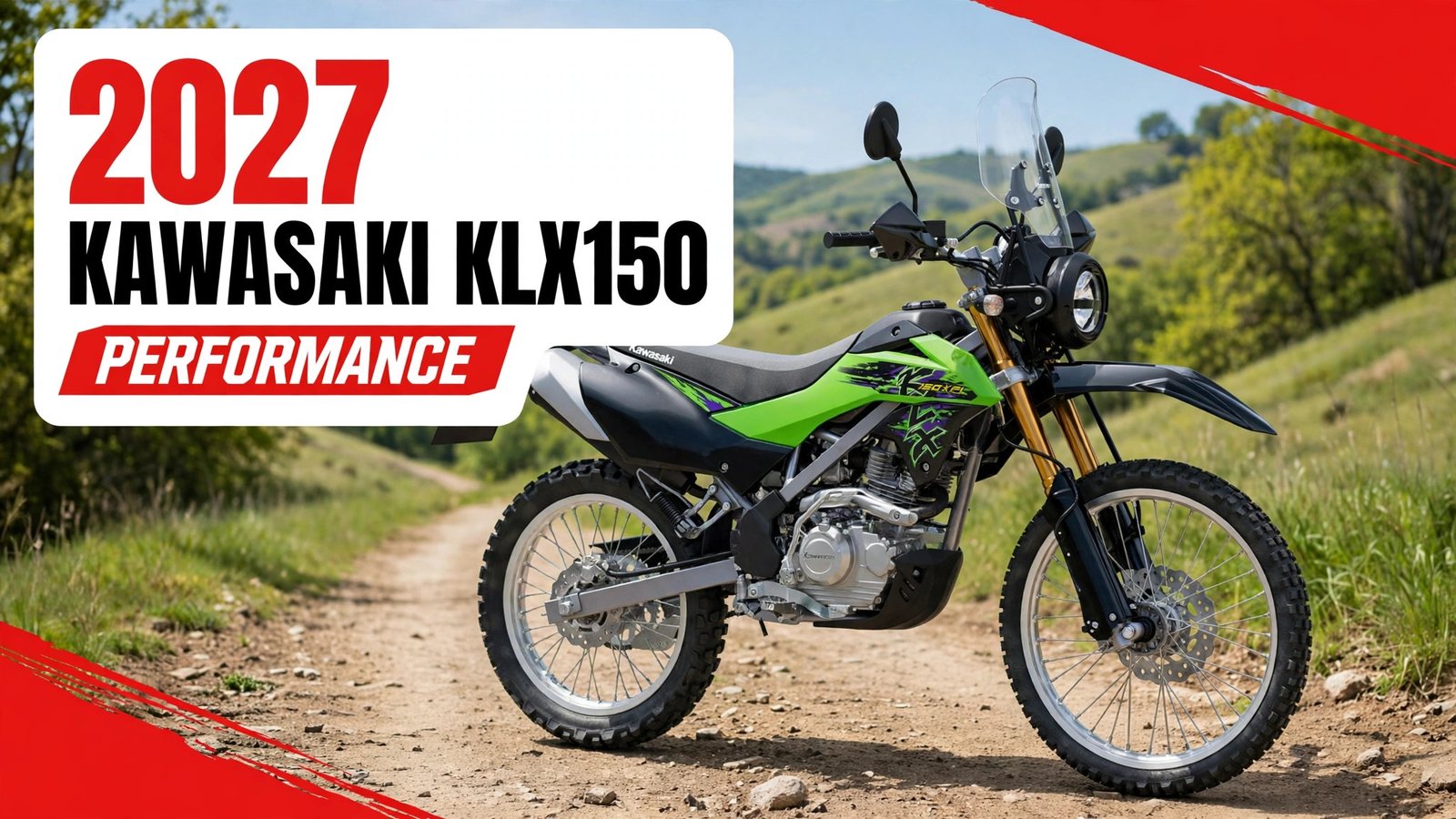
The Kawasaki KLX150 is not a fast bike, and this Kawasaki KLX150 performance guide starts with that fact instead of hiding it. The Indonesian-built dual sport was never sold in the United States, so no American magazine has ever tested it, and every performance figure in this guide comes from one instrumented Indonesian test, plus owner reports that are labelled as such. The numbers are modest: 12 PS claimed, a Racelogic top speed of 104.1 km/h, and a tested 31.8 km per litre that makes it the thirstiest bike in its class. This Kawasaki KLX150 performance guide judges those numbers on their own terms, explains why the bike is slow and thirsty, and says plainly where it still does its job well.
There is no dyno figure for the KLX150 from any outlet, no American test of any kind, and no instrumented braking test. What exists is Otomotif’s 2015 Racelogic test of the KLX 150BF SE, a same-test three-bike comparison against the Honda CRF150L and Yamaha WR155R, and several thousand kilometres of owner riding in Bangladesh and Indonesia.
Kawasaki KLX150 Engine Performance and Power Delivery
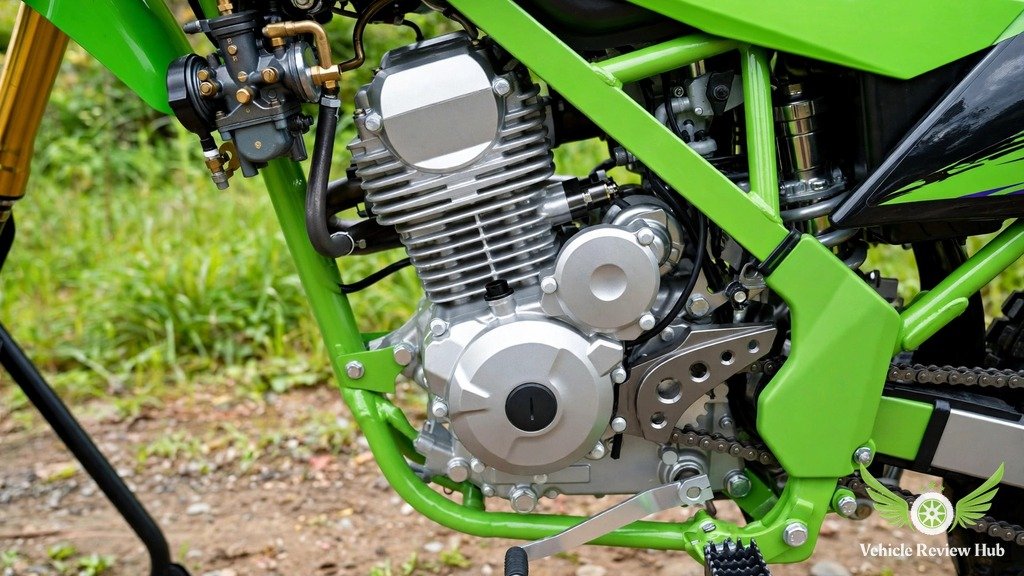
The engine is the first thing to understand about the KLX150, because everything else in this Kawasaki KLX150 performance guide follows from it. The 144cc air-cooled single is a simple, carburetted unit that has been in production since 2009, and its power delivery is gentle, predictable, and honest about its limits.
12 PS Claimed by Kawasaki Indonesia
Kawasaki Motor Indonesia claims 8.6 kW, or 12 PS, at 8,000 rpm, with 11.3 Nm of torque at 6,500 rpm. That is the only power figure this Kawasaki KLX150 performance guide can print, because no outlet has ever put the bike on a dynamometer. The figure is quoted in PS exactly as Kawasaki states it, and 12 PS is about 11.8 hp, so readers who see “12 BHP” in Bangladeshi sources are looking at the same claim rounded differently. Power reaches the rear wheel through a five-speed manual gearbox and a wet multi-disc clutch, with a final drive of 3.286 (46/14) on the current bike. The engine breathes through a Keihin NCV24 carburettor, and there is no fuel-injected version of the KLX150 in any market.
On the road, the claimed figure feels about right. The 7,000 km owner review reports a bike that cruises happily at 85 to 90 km/h and feels strained above 90, which is exactly what 12 PS in a 118 kg bike should feel like.
No Dyno From Any Outlet Found
No dyno chart or rear-wheel power figure exists for the KLX150 from Cycle World, Rider, Ultimate Motorcycling, Motorcycle.com, Dirt Bike Magazine, Otomotif, or any other outlet searched for this guide. That gap is the honest core of this Kawasaki KLX150 performance guide: the claimed 12 PS is a manufacturer figure, and the power the rear wheel actually sees has never been measured by anyone.
| Item | Kawasaki KLX150 (standard, 2026) |
|---|---|
| Engine | 144cc air-cooled 4-stroke SOHC 2-valve single |
| Bore x stroke | 58.0 x 54.4 mm |
| Compression | 9.5:1 |
| Fuelling | Keihin NCV24 carburettor |
| Power claimed | 8.6 kW (12 PS) at 8,000 rpm |
| Torque claimed | 11.3 Nm at 6,500 rpm |
| Gearbox | 5-speed manual, wet multi-disc clutch |
| Final drive | 3.286 (46/14), chain |
| Start | Electric and kick |
Notes: the figures in this Kawasaki KLX150 performance table come from Kawasaki Motor Indonesia’s official 2026 pages for the standard KLX150. Power is quoted in PS exactly as Kawasaki Indonesia states it; 12 PS is about 11.8 hp, and no dyno figure from any outlet exists. The 2015 test bike’s final drive was described as 52/14, which differs from the current 46/14 specification.
Kawasaki KLX150 Top Speed and Acceleration
Top speed is the number most readers ask about first, and the top-speed section of this Kawasaki KLX150 performance guide has exactly one honest answer. Otomotif measured 104.1 km/h with a Racelogic GPS unit in its 2015 test of the KLX 150BF SE, and no other outlet has instrumented-tested the bike since.
104.1 km/h, Racelogic, Indonesian Test
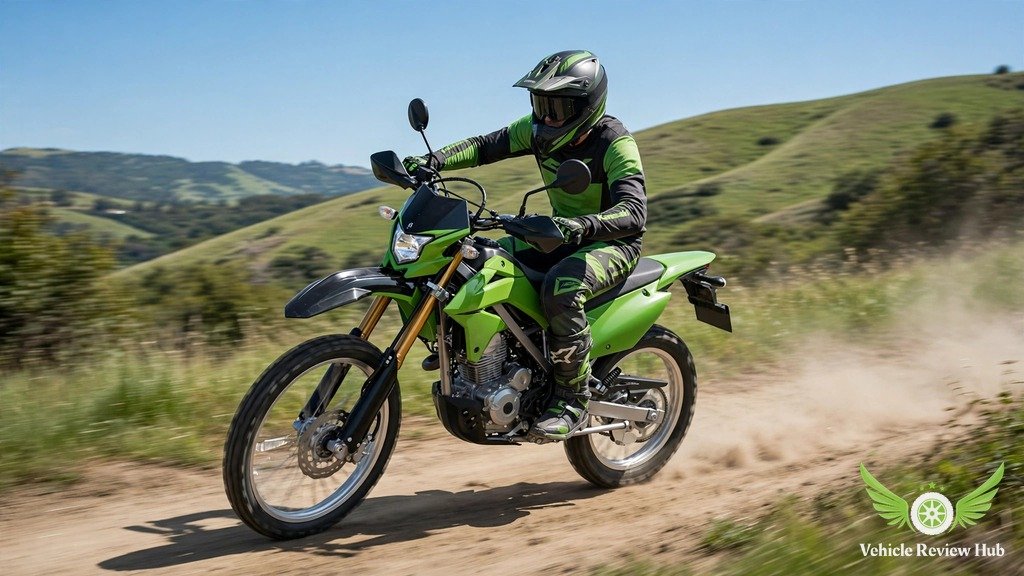
The only instrumented top-speed figure for the KLX150 is 104.1 km/h, measured by Racelogic in Otomotif’s 2015 test of the KLX 150BF SE, with the speedometer reading 105 km/h at the same moment. The test bike was the BF SE variant, not the standard, but it shares the same 144cc engine, so the figure is the best available measure of what the standard bike can do. In miles per hour, 104.1 km/h is about 64.7 mph. That is the only instrumented figure this Kawasaki KLX150 performance guide uses, and it is the number every other top-speed claim should be checked against.
Owner reports line up with the instrumented figure. BikeBD’s 3,500 km test of the KLX 150BF recorded 110 km/h on the speedometer, and a 7,000 km owner review reports a maximum of 105 km/h on the street, with the bike cruising sweetly at 85 to 90 km/h and vibrating hard above 90.
115 to 120 Claims Are Aggregator Fiction
Claims of 115 to 120 km/h and above for the KLX150 come from aggregator spec boxes, not from any test, and this Kawasaki KLX150 performance guide names them so readers can spot them. BikeBD’s own spec box says 120 km/h (Approx), mybdprice says 120 km/h, deshibiker prints 130+ km/h in its spec box and 117 km/h in its own price table on the same page, contradicting itself, and accio claims 130 km/h. None of these figures was measured by anyone.
| Test | Result (Racelogic) |
|---|---|
| 0 to 60 km/h | 5.8 seconds |
| 0 to 80 km/h | 10.8 seconds |
| 0 to 100 km/h | 21.7 seconds |
| 0 to 100 m | 8.1 seconds (70.3 km/h) |
| 0 to 201 m | 12.8 seconds (83.6 km/h) |
| 0 to 402 m | 20.9 seconds (95.5 km/h) |
| Top speed (speedometer) | 105 km/h |
| Top speed (Racelogic) | 104.1 km/h |
Notes: all figures in this Kawasaki KLX150 performance table are from Otomotif’s 2015 Racelogic test of the KLX 150BF SE (65 kg tester, RON 92 fuel). No 0 to 60 mph time and no quarter-mile time were measured, and no other outlet has instrumented-tested the KLX150.
Kawasaki KLX150 Mileage and Fuel Economy
Fuel economy is where this Kawasaki KLX150 performance guide gets uncomfortable for the bike. The KLX150 is the thirstiest small dual sport in its Indonesian comparison set, returning 31.8 km per litre in the only instrumented test, against 42.3 for the Honda CRF150L and 48.3 for the Yamaha WR155R in the same test.
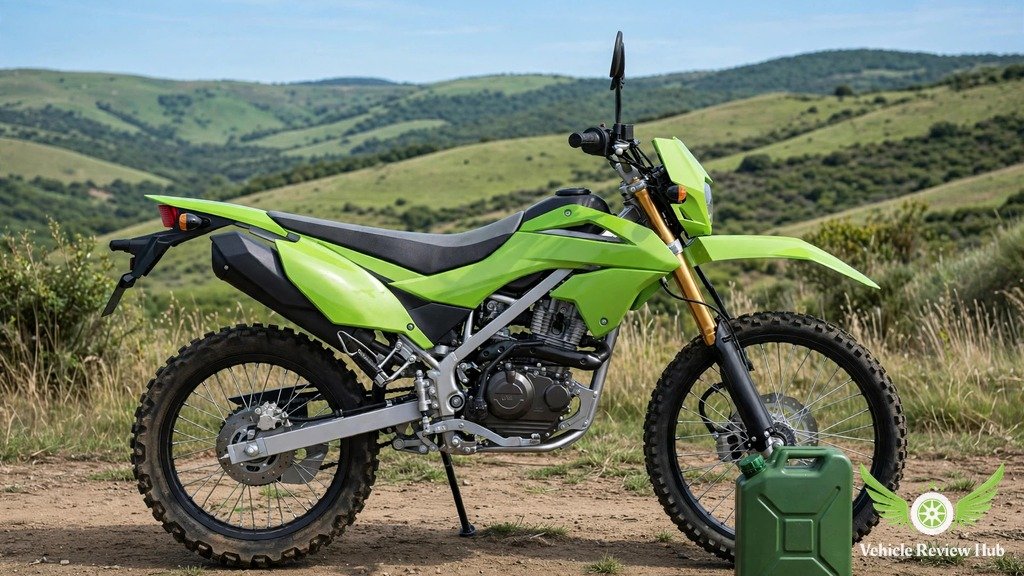
31.8 km per Litre, Tested in Indonesia
Otomotif’s instrumented test returned 31.8 km per litre over combined dirt and asphalt riding, with a 65 kg tester and RON 92 fuel. That is the tested figure this Kawasaki KLX150 performance guide stands on, and two independent sources corroborate it: the Australian first ride of the KLX150L measured 3.1 litres per 100 km, which works out to 32.3 km per litre, and a 7,000 km owner review reports 32 km per litre in normal use. The honest tested range for the bike is about 32 km per litre. With a 6.9-litre tank, that works out to roughly 219 km of range, a figure this guide states as arithmetic from the tested consumption, not as a measured range test.
BikeBD’s 3,500 km test reported a higher figure, 38 km per litre on average and 32 off-road, but that is an owner-measured figure rather than an instrumented one, and Otomotif’s Racelogic-backed 31.8 is the authority.
Honda Rival Returns 40 Plus km per Litre
The Honda CRF150L returns over 40 km per litre by every measure that exists, and the gap this Kawasaki KLX150 performance guide measures is the price of the KLX150’s carburettor. Honda claims 39.3 km per litre under the EURO 3 test and 43.03 under EURO 2; Otomotif measured 42.3 in the same test that gave the KLX150 its 31.8, and real-world daily riding reports 39.5 to 43.2. The Yamaha WR155R does better still at 48.3 km per litre in the same test. Both rivals are fuel injected, while the KLX150 still runs a Keihin NCV24 carburettor, and that technology gap is the main reason for the difference.
| Bike | Fuel (same test) | Top speed (Racelogic) |
|---|---|---|
| Yamaha WR155R | 48.3 km per litre | 109.9 km/h |
| Honda CRF150L | 42.3 km per litre | 103 km/h |
| Kawasaki KLX150BF SE | 31.8 km per litre | 104.1 km/h |
Notes: all figures in this Kawasaki KLX150 performance table are from Otomotif’s three-bike comparison of the WR155R, CRF150L and KLX150BF SE, tested under the same conditions at Hambalang, Bogor. The KLX150 is the thirstiest of the three by a wide margin and splits its rivals on top speed.
Kawasaki KLX150 Real-World Riding Experience
Real-world riding is where Kawasaki KLX150 performance is felt rather than measured, and the picture from owners is consistent: a light, simple bike that is easy to ride on trails and honest about its limits on the road.
The video below is event trail-riding footage of a KLX150L at the Kembara Raub Megatrail 2026 in Malaysia, filmed by Sirmat on his first off-road event. It is not a measured test: there is no top speed, no timing, and no dyno in it.
Short Gearing Blamed for Thirst
Otomotif ties the KLX150’s thirst directly to its gearing, and the thirst this Kawasaki KLX150 performance guide records has a named cause. The test report says the bike’s fuel use follows from the carburettor and the very light final ratio, describing the test bike’s 52/14 sprockets as chosen to make heavy trails easier. Short gearing means the engine spins faster at any given road speed, and a faster-spinning carburetted engine drinks more. The current bike’s final drive is 3.286 (46/14) per Kawasaki Motor Indonesia, while the 52/14 figure belongs to the 2015 test bike only, so the two numbers should not be mixed.
0 to 100 km/h Took 21.7 Seconds
The slowest figure this Kawasaki KLX150 performance guide prints is the 0 to 100 km/h time of 21.7 seconds, measured by Racelogic in Otomotif’s 2015 test. The same test recorded 0 to 60 km/h in 5.8 seconds and 0 to 80 in 10.8, so the bike gets away from a standstill well enough and then runs out of breath as the speed climbs. The 0 to 402 m run took 20.9 seconds at 95.5 km/h. These are the only acceleration figures that exist for the bike, and they describe a machine that is quick enough on a trail, where speeds are low and the gaps are short, and slow on the open road, where 100 km/h takes a long straight.
Kawasaki KLX150 Handling, Braking and Stability
Handling is the strongest card in this Kawasaki KLX150 performance guide. At 118 kg with a 865 mm seat and a 35 mm inverted fork, the standard bike is light, tall, and easy to place on a trail, and the suspension and brakes are simple parts that do a simple job well.

Handling, Braking and Stability on the Road
The honest limit of this Kawasaki KLX150 performance guide is that no instrumented braking test exists, so no stopping distance is printed here. What is verified is the hardware: a 240 mm petal disc at the front with a twin-piston caliper and a 190 mm petal disc at the rear with a single-piston caliper, with no ABS on any variant. The 21/18 wheels carry knobby tyres sized 2.75-21 at the front and 4.10-18 at the rear, and the 300 mm of ground clearance means the bike clears ruts and rocks that would stop a road bike.
Inverted Fork Came With the BF
The inverted fork story this Kawasaki KLX150 performance guide tells starts in 2015, when the KLX150BF arrived with a 35 mm upside-down fork and 21/18 wheels, replacing the telescopic fork of the earlier bike. Otomotif’s 2015 first ride records the BF fork at 175 mm of travel, while the current standard bike’s inverted fork travels 185 mm per Kawasaki Motor Indonesia, so the figure to use for a 2026 bike is 185 mm. The rear is a Uni-Trak single shock with preload adjustment only and 192 mm of travel. The low S variant keeps the older 33 mm telescopic fork, which is one more reason never to mix S figures into standard copy.
Kawasaki KLX150 Performance Compared With Other Dual Sports
The comparison section of this Kawasaki KLX150 performance guide puts the bike against the machines its buyers actually cross-shop: its American platform sibling, the KLX140R, and its Indonesian rivals, the Honda CRF150L and the Yamaha WR155R. The KLX150 is the weakest on paper and the thirstiest at the pump.
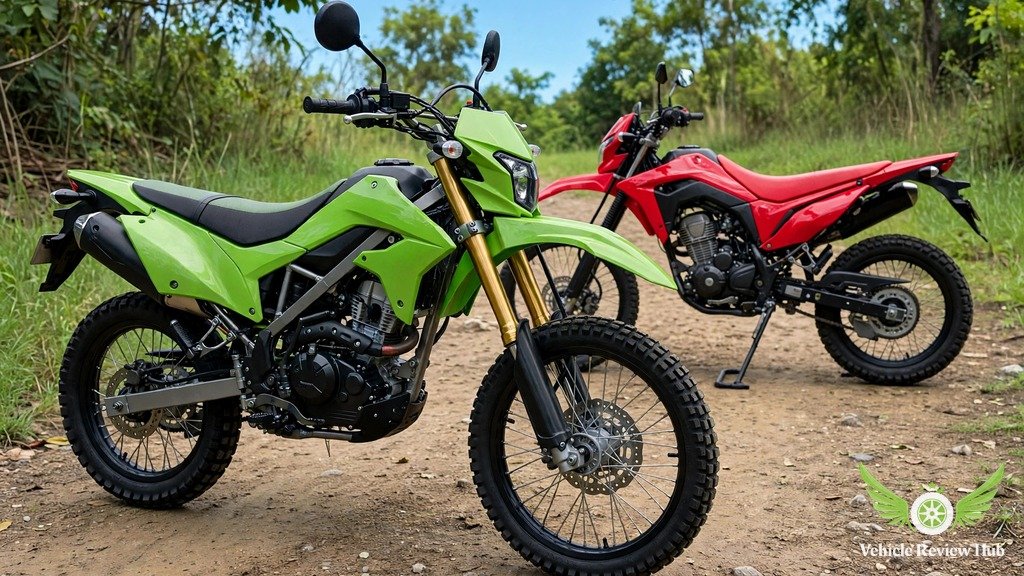
Kawasaki KLX150 vs Kawasaki KLX140R
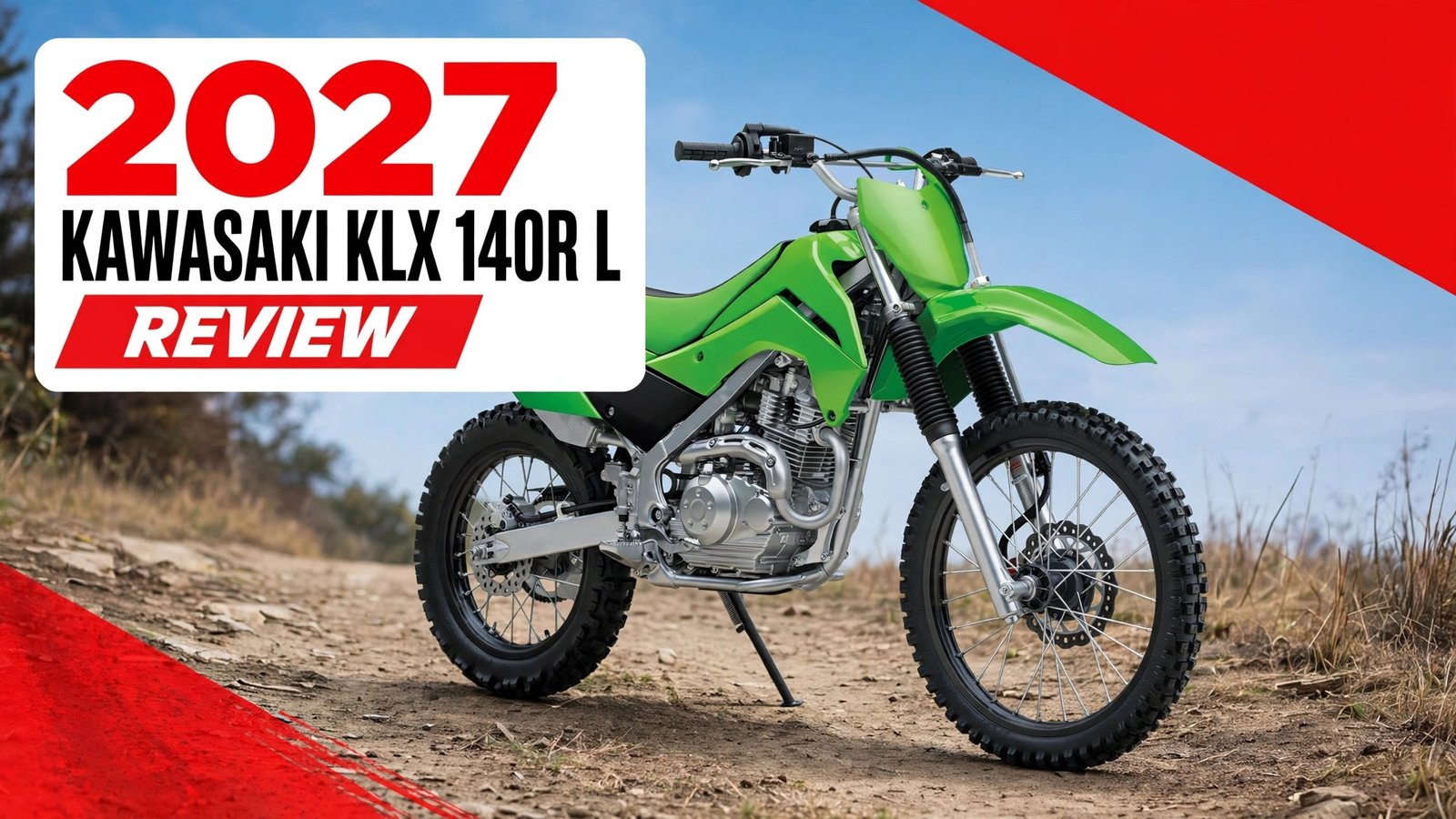
The comparison this Kawasaki KLX150 performance guide draws with the KLX140R is a family one, because the two bikes share the same 144cc engine architecture, the same bore and stroke, and the same five-speed manual gearbox. The 150 is road-legal, with a headlight, mirrors, indicators, a tail light, a plate holder, and a kick starter beside its electric start, while the 140R is an off-road-only trail bike with none of those and electric start only. The 150 runs a Keihin NCV24 carburettor against the 140R’s PB20, brakes of 240/190 mm against 220/186 mm, and 21/18 wheels against 17/14. The paper power gap is 12 PS against 11 PS, and it has never been tested head to head. The Kawasaki KLX 140R performance guide shows what the American bike does with the same engine family when the road equipment is stripped away, and the KLX 140R L performance page covers the taller-wheeled L version. An American reader cannot buy the 150, so the 140R is the bike to look at instead, and the Kawasaki KLX150 review explains the full split between the two.
Is the Kawasaki KLX150 Suitable for Beginner Riders?
Yes, with a fit caveat, and the verdict this Kawasaki KLX150 performance guide gives beginners is a careful one. The bike is an entry-level dual sport: light at 118 kg, with predictable carburetted power, electric and kick starting, and a five-speed manual gearbox to learn on. The caveats are real. The 865 mm seat is tall for short riders, and the honest answer for them is the S variant at 830 mm. There is no ABS, the carburettor needs more attention than the rivals’ fuel injection, and a 104 km/h top speed means no highway comfort. A beginner who fits the seat and rides trails and town roads will find the KLX150 forgiving. A beginner who needs highway speed or the shortest possible seat should look at the S, or at the Honda rival.
| Item | KLX150 standard | KLX140R (USA) | CRF150L | WR155R |
|---|---|---|---|---|
| Engine | 144cc single, NCV24 carb | 144cc single, PB20 carb | 149.15cc single, PGM-FI | 155cc single, fuel injected |
| Power claimed | 12 PS at 8,000 rpm | 11 PS at 8,000 rpm | 12.91 PS at 8,000 rpm | 16.7 PS at 10,000 rpm |
| Start | Electric and kick | Electric only | Electric | Electric |
| Wheels | 21/18 in | 17/14 in | 21/18 in | 21/18 in |
| Seat height | 865 mm | 30.7 in (780 mm) | 869 mm | 880 mm |
| Curb weight | 118 kg | 205.0 lb (93 kg) | 122 kg | 134 kg |
| Fuel (same test) | 31.8 km per litre | Not tested | 42.3 km per litre | 48.3 km per litre |
| Top speed (Racelogic) | 104.1 km/h | Not tested | 103 km/h | 109.9 km/h |
Notes: the figures in this Kawasaki KLX150 performance table come from Kawasaki Motor Indonesia, the verified C64 cluster for the KLX140R, Honda’s published CRF150L figures, Yamaha’s published WR155R figures, and Otomotif’s same-test comparison for fuel and top speed. The KLX140R has no tested fuel or top-speed figure. The CRF150L seat height of 869 mm and curb weight of 122 kg are Indonesian manufacturer figures, not test results; the Philippine-market CRF150L lists 863 mm for the seat.
Kawasaki KLX150 Performance: Frequently Asked Questions
The questions riders ask most about the KLX150’s speed, mileage and handling, answered with the tested figures above, and this Kawasaki KLX150 performance guide labels the gaps where no test exists.
What is the top speed of the Kawasaki KLX150?
The only instrumented figure is 104.1 km/h, measured by Racelogic in Otomotif’s 2015 test of the KLX 150BF SE, with a speedometer reading of 105 km/h. Claims of 115 to 120 km/h and above come from aggregator spec boxes and are not instrumented, and this Kawasaki KLX150 performance guide uses only the tested figure.
How much power does the Kawasaki KLX150 make?
Kawasaki Indonesia claims 8.6 kW, or 12 PS, at 8,000 rpm, with 11.3 Nm of torque at 6,500 rpm. No dyno figure from any outlet exists, so no rear-wheel power number can be printed, and this Kawasaki KLX150 performance guide quotes the claim in PS exactly as Kawasaki states it.
Has the Kawasaki KLX150 ever been dyno tested?
No. No dyno chart or rear-wheel figure exists from any outlet searched, including Cycle World, Rider, Motorcycle.com and Otomotif. The claimed 12 PS is a manufacturer figure, and the acceleration data in this Kawasaki KLX150 performance guide is the closest measured evidence of what the bike actually does.
What fuel economy does the Kawasaki KLX150 return?
Otomotif’s instrumented test returned 31.8 km per litre over combined dirt and asphalt riding. Two owner sources corroborate it at about 32 km per litre, and this Kawasaki KLX150 performance guide treats roughly 32 km per litre as the honest tested range for the bike.
How far can the Kawasaki KLX150 go on a tank?
With a 6.9-litre tank and the tested 31.8 km per litre, the range works out to roughly 219 km. That is arithmetic from the tested consumption, not a measured range test, and this Kawasaki KLX150 performance guide labels it as such.
Why is the Kawasaki KLX150 so thirsty?
Two reasons, both named by Otomotif: the Keihin NCV24 carburettor, where its rivals use fuel injection, and short final gearing that keeps the engine spinning fast. The test bike ran 52/14 sprockets, while the current bike’s final drive is 46/14, and this Kawasaki KLX150 performance guide notes that the gearing is short by design for trail work.
How fast is the Kawasaki KLX150 from 0 to 100 km/h?
It took 21.7 seconds in Otomotif’s Racelogic test, with 0 to 60 km/h in 5.8 seconds and 0 to 80 in 10.8. The bike gets away well enough and then runs out of breath as speed climbs, which is the acceleration picture this Kawasaki KLX150 performance guide records.
Does the Kawasaki KLX150 have a kick starter?
Yes. The KLX150 has both an electric starter and a kick lever, which is one of its clearest differences from the American KLX140R, a bike that is electric start only.
Does the Kawasaki KLX150 have ABS?
No. Braking is by a 240 mm front petal disc and a 190 mm rear petal disc with no ABS on any variant, which is one of the honest limitations recorded in this Kawasaki KLX150 performance guide.
Is the Kawasaki KLX150 faster than the Honda CRF150L?
On top speed, barely: the KLX150 measured 104.1 km/h against the Honda’s 103 km/h in the same Otomotif test, while the Yamaha WR155R was fastest at 109.9. On fuel, the Honda wins by a wide margin at 42.3 km per litre against the KLX150’s 31.8, which is the trade-off this Kawasaki KLX150 performance guide measures.
Is the Kawasaki KLX150 good for beginners?
Yes, with a fit caveat. It is light at 118 kg, with gentle power and a five-speed manual gearbox to learn on, but the 865 mm seat is tall for short riders, who should look at the S variant at 830 mm. There is no ABS and the carburettor needs more attention than fuel injection, and this Kawasaki KLX150 performance guide says so plainly.
Should I buy the Kawasaki KLX150 for performance, or the Yamaha WR155R?
For performance alone, the Yamaha wins: 16.7 PS against 12, a 109.9 km/h top speed against 104.1, and 48.3 km per litre against 31.8 in the same test. The Kawasaki answers with a kick starter, simpler maintenance, and the deepest parts network in Indonesia. A buyer who values speed and economy takes the Yamaha, and a buyer who values simplicity and trail hardware takes the KLX150.