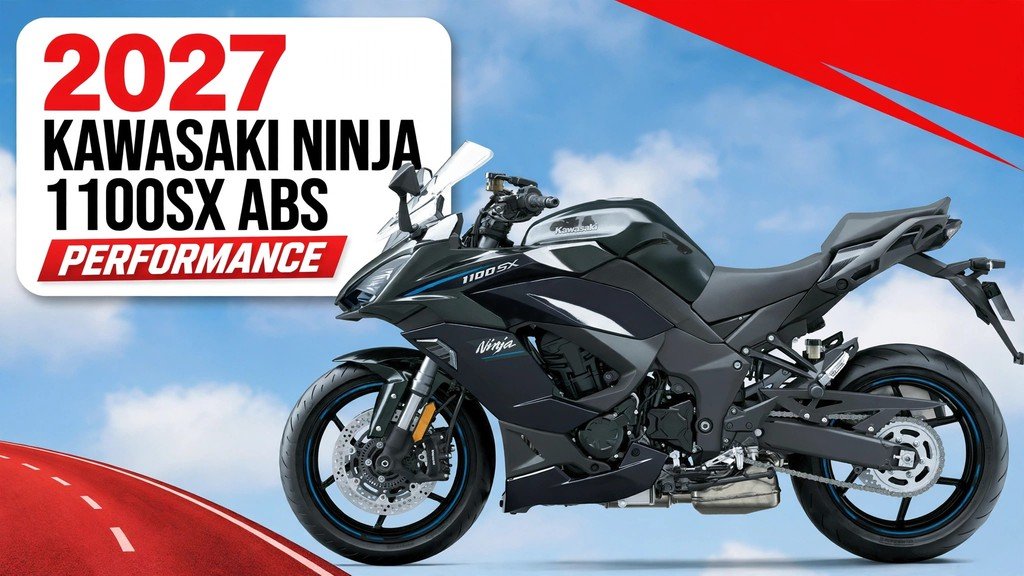
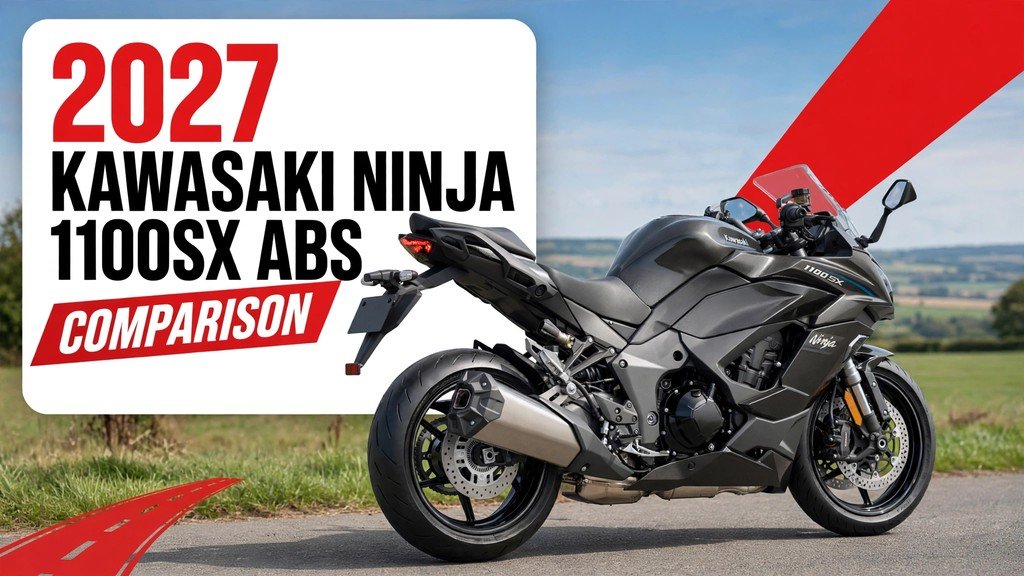
The Kawasaki Ninja 1100SX ABS is Kawasaki’s litre-class sport-tourer for 2025, 2026 and 2027, and it replaced the Ninja 1000SX outright. The standard bike costs $14,199 before destination for 2027, or $15,039 delivered, with a 1,099cc inline-four claiming 134 hp, cornering electronics built around a six-axis IMU, and a 32.3-inch seat. This Kawasaki Ninja 1100SX ABS review finds a bike that trades a little peak power for a fatter midrange: the standard bike is the value pick, and the SE is the one to buy for Brembo brakes, an Öhlins shock and heated grips.
Kawasaki stroked the old 1,043cc engine to 1,099cc, kept the bore at 77.0 mm, and fitted milder cams and a heavier flywheel. The result is 134 hp at 9,000 rpm and 83.2 lb-ft at 7,600 rpm, against the old bike’s 140 hp and 81.7 lb-ft. This Kawasaki Ninja 1100SX ABS review covers the prices year by year, the engine, the standard-versus-SE kit, the riding position and the warranty, to help you choose between the new 1100SX and a used 1000SX.
Kawasaki Ninja 1100SX ABS Overview and Model-Year Updates
The 1100SX arrived for 2025 as a new model, not a facelift. The frame, electronics and bodywork carry over, and the SE trim is new. 2026 and 2027 brought colours only, so a 2025 bike is mechanically the same machine as a 2027 one.
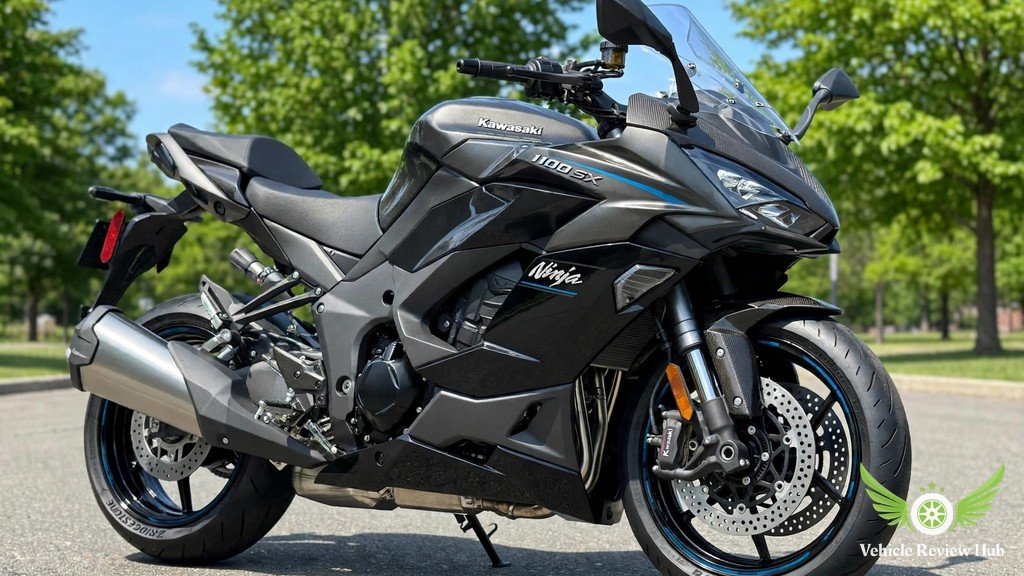
Same Launch Price as the Bike It Replaced
The 2025 standard bike launched at $13,699, exactly the same MSRP as the final-year 2024 Ninja 1000SX. The delivered prices differ, because the destination charge rose: the 2025 1100SX costs $14,514 delivered, while the 2024 1000SX cost $14,174. The RevZilla first look lists the same figures, $13,699 and $15,399, and the SE price is worth remembering: a discounted dealer listing once advertised a 2025 SE at $13,999, but that figure is the 2026 base price, not the 2025 SE price.
Colors Only for 2026 and 2027
Nothing mechanical changed after launch. The 2025 pair came in Metallic Carbon Gray and Emerald Blazed Green, the 2026 pair in Metallic Brilliant Golden Black and Metallic Deep Blue, and the 2027 pair in Metallic Carbon Gray and Plasma Lime Green. A buyer choosing between model years is choosing a colour and a price, not a different motorcycle.
The video below is Ray Bowden’s 2027 first ride of the bike, with chapters on first impressions, the TFT and the engine. It is the clearest video look at the bike in this Kawasaki Ninja 1100SX ABS review. Its title calls the bike a “world premier” and “the best”, but that is the creator’s wording: the 2027 changes are colours only.
Kawasaki Ninja 1100SX ABS Engine and Specifications
The engine is the story of this bike: Kawasaki stroked the 1000SX’s 1,043cc inline-four to 1,099cc and tuned it for midrange rather than peak power. This Kawasaki Ninja 1100SX ABS review treats that trade as the right one for a sport-tourer, because touring lives between 4,000 and 7,000 rpm.

1,099cc by Stroke Alone, Bore Unchanged
The stroke increase is 3.0 mm, not 3.3 mm. 59.0 minus 56.0 is 3.0, and two sources that print 3.3 mm are wrong. The extra stroke adds 56cc, taking displacement from 1,043cc to 1,099cc, with milder cams, a heavier flywheel and a rev limit 500 rpm lower than the 1000SX’s. The midrange from 4,000 to 7,000 rpm is 6 to 8 bhp stronger than the old bike’s, and the old bike is only ahead past 7,000 rpm. This Kawasaki Ninja 1100SX ABS review notes that trade openly, because a buyer who rides mostly above 7,000 rpm would have been better served by the old bike, and almost nobody tours that way.
Kawasaki USA Publishes 134 Horsepower
Kawasaki USA claims 134 hp at 9,000 rpm and 83.2 lb-ft at 7,600 rpm, and the horsepower figure is measured to the ISO 4106 standard, which Kawasaki’s footnote says may read higher than an SAE figure. The global claim is 136 PS, or 100.0 kW, with 113 Nm of torque. The Kawasaki USA 2025 spec sheet carries both claims. The only dyno run found is Motorcycle.com’s test of a 2025 SE: 124.6 hp at 9,200 rpm and 77.4 lb-ft at 7,600 rpm at the rear wheel, SE-only, since no standard-bike dyno exists. There is also no measured top speed for the 1100SX, and the 154 mph figure in aggregator tables belongs to the old 1000SX, as the 1000SX performance guide records. This Kawasaki Ninja 1100SX ABS review prints no top speed for this bike, because none has been measured.
| Item | Standard ABS | SE ABS |
|---|---|---|
| Engine | 1,099cc liquid-cooled inline-four | 1,099cc liquid-cooled inline-four |
| Bore x stroke | 77.0 x 59.0 mm | 77.0 x 59.0 mm |
| Compression ratio | 11.8:1 | 11.8:1 |
| Claimed power | 134 hp @ 9,000 rpm (ISO 4106) | 134 hp @ 9,000 rpm (ISO 4106) |
| Claimed torque | 83.2 lb-ft @ 7,600 rpm | 83.2 lb-ft @ 7,600 rpm |
| Curb weight | 518.2 lb | 516.0 lb |
| Seat height | 32.3 in | 32.3 in |
| Fuel capacity | 5.0 gal | 5.0 gal |
| Wheelbase | 56.7 in | 56.7 in |
| Warranty | 12-month limited | 12-month limited |
Notes for this Kawasaki Ninja 1100SX ABS review table: the 134 hp claim is an ISO 4106 figure, and the dyno figure of 124.6 hp is SE-only.
Kawasaki Ninja 1100SX ABS Price and Market Availability
The price story has three model years and two trims, and every figure below is year-tagged. The headline price is the 2027 one: $14,199 before destination, $15,039 delivered. This Kawasaki Ninja 1100SX ABS review lists all six prices for buyers comparing model years.
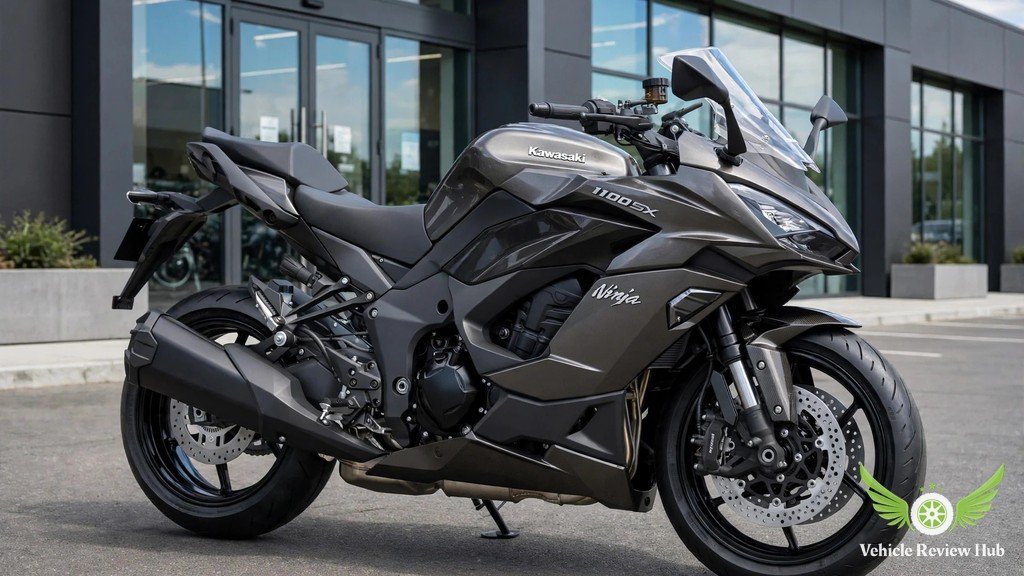
Kawasaki Ninja 1100SX ABS Price in the USA: $14,199
The 2027 standard bike costs $14,199 MSRP, and the 2027 SE costs $15,999 MSRP. The year-by-year MSRPs are $13,699 for 2025, $13,999 for 2026 and $14,199 for 2027. The 2025 SE figure deserves a warning, because one discounted dealer listing advertised a new 2025 SE at $13,999, and that price has been copied into price tables as if it were the MSRP. It is not. Kawasaki’s own 2025 SE spec sheet says $15,399, and RevZilla, Motorcycle.com and Ultimate Motorcycling all print the same figure. This Kawasaki Ninja 1100SX ABS review uses the manufacturer’s figure, and a buyer who sees a 2025 SE advertised near $13,999 should treat it as a discount, not the list price.
Destination $840, Total $15,039
The 2027 destination charge is $840, so the 2027 standard bike costs $15,039 delivered and the 2027 SE costs $16,839 delivered. The destination charge was $815 for 2025 and $840 for 2026 and 2027, so the 2025 delivered prices are $14,514 and $16,214, and the 2026 prices are $14,839 and $16,639. Leftover 2025 bikes have been advertised near $12,500, against a $13,699 MSRP. This Kawasaki Ninja 1100SX ABS review prints no used-market price, because the only first-year used listing found was a single 2025 base bike with 3,226 miles asking $10,899, and one listing is not a market.
| Year / trim | MSRP | Destination | Delivered |
|---|---|---|---|
| 2025 standard | $13,699 | $815 | $14,514 |
| 2025 SE | $15,399 | $815 | $16,214 |
| 2026 standard | $13,999 | $840 | $14,839 |
| 2026 SE | $15,799 | $840 | $16,639 |
| 2027 standard | $14,199 | $840 | $15,039 |
| 2027 SE | $15,999 | $840 | $16,839 |
Notes for this Kawasaki Ninja 1100SX ABS review table: delivered prices are MSRP plus destination, before tax, title and dealer fees; the destination charge was $815 for 2025 and $840 after.
Kawasaki Ninja 1100SX ABS Design, Features and Technology
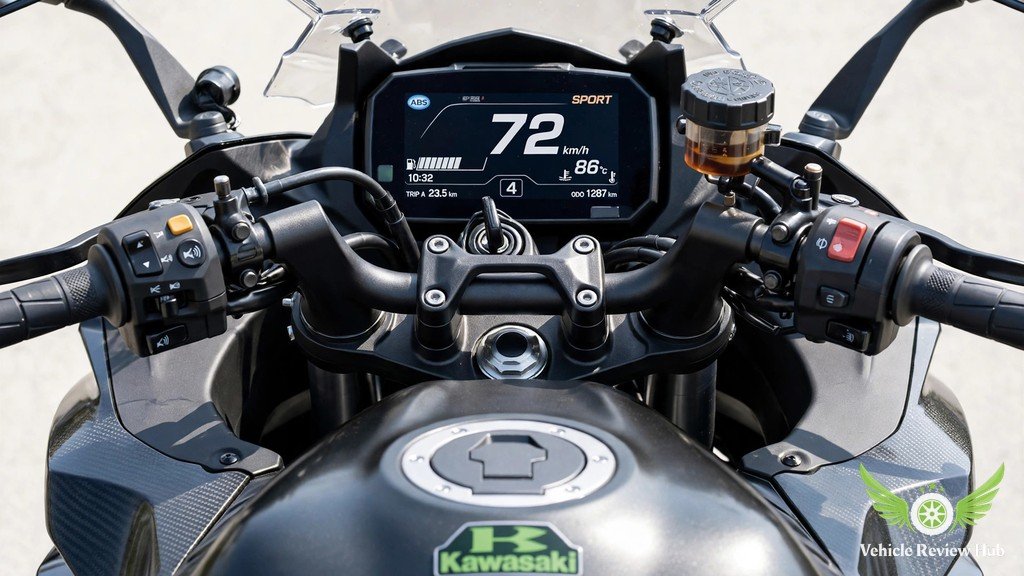
The 1100SX is a fully faired sport-tourer with an upright riding position, a 4.3-inch TFT display, and cornering electronics built around a Bosch six-axis IMU. The brakes, rear shock and heated grips are split between the two trims. This Kawasaki Ninja 1100SX ABS review separates what every buyer gets from what only SE buyers get.
Standard Bike Gets No Brembo, No Öhlins
The standard bike gets no Brembo calipers, no Öhlins shock and no heated grips. Its front brakes are dual 300 mm discs with radial-mount four-piston monobloc calipers and cornering ABS, and the rear is a 260 mm round disc with a single-piston caliper, not the 250 mm petal disc one spec table still prints from the old bike. The front suspension is a 41 mm inverted Showa fork with compression, rebound and preload adjustment and 4.7 inches of travel, and the rear shock has rebound and remote preload and 5.6 inches of travel, not the 5.4 inches the same wrong table prints. The SE adds Brembo M4.32 calipers, a Brembo master cylinder, Brembo discs and steel-braided lines, plus an Öhlins S46 rear shock with rebound and remote preload, and heated grips. The Kawasaki USA 2025 SE spec sheet lists the Brembo and Öhlins kit, and the standard bike’s caliper brand is not printed here because the sources disagree: one says Tokico and another says Nissin. Every buyer gets the same electronics: the six-axis IMU, cornering ABS, lean-sensitive traction control, a quickshifter from 1,500 rpm, cruise control, four ride modes and all-LED lighting. There is no electronic suspension on either trim, no keyless ignition and no centre stand. This Kawasaki Ninja 1100SX ABS review counts the electronics as the standard bike’s strongest card, because the Suzuki GSX-S1000GT+, its closest rival, has no IMU and no cornering ABS or traction control at all.
Panniers Cost $1,128.96 Extra
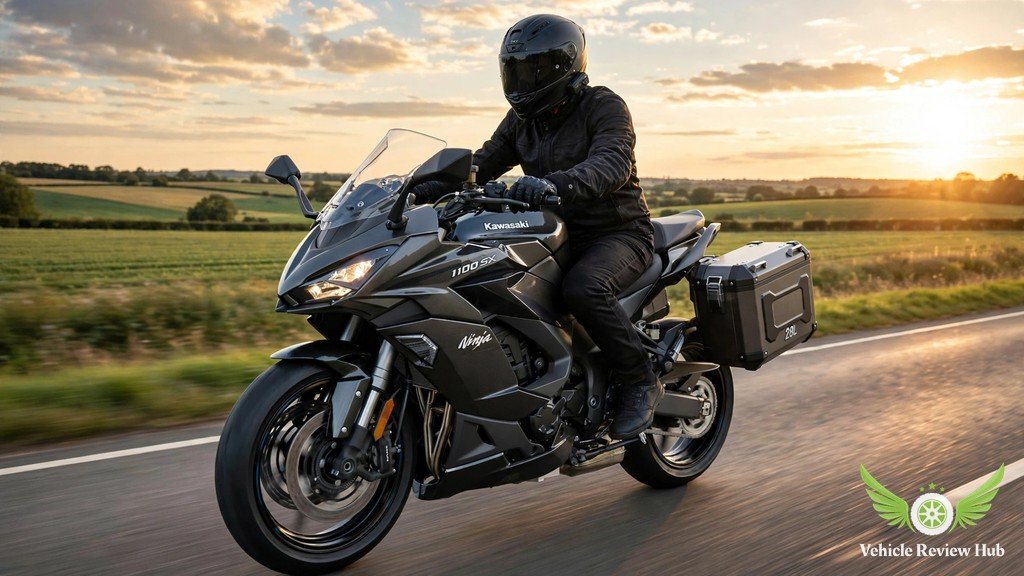
The 28-litre panniers cost $1,128.96 a pair, and they are an accessory on both trims, never standard on either. They are keyed and colour-matched, and hold 28 litres each. A buyer who wants the bike ready for touring on day one should add that figure to the delivered price: a 2027 standard bike with bags costs $16,167.96, and a 2027 SE with bags costs $17,967.96. Heated grips are standard on the SE and a paid accessory on the standard bike. The tyres are Bridgestone Battlax S23s, 120/70-17 front and 190/50-17 rear. The multi-position windscreen divides testers, and this Kawasaki Ninja 1100SX ABS review records both sides: RevZilla calls it style over function, and Motorcycle.com says it deflects well without buffeting.
Kawasaki Ninja 1100SX ABS Riding Experience and Comfort
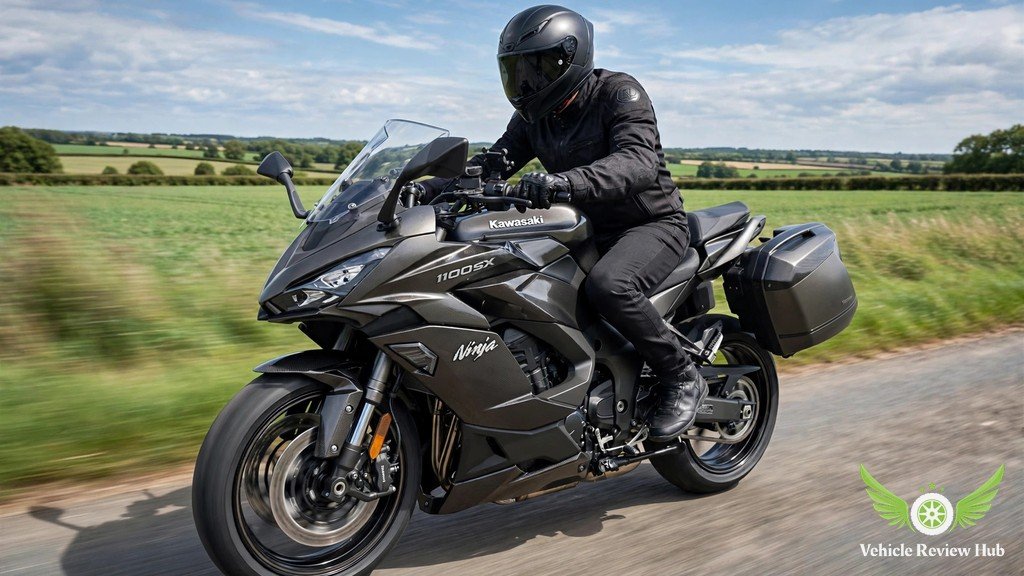
The riding position is upright and relaxed for a faired litre bike, the bars are wide, and the seat is low enough for most riders to flat-foot at a stop. The taller gearing keeps the revs down on the highway, and the quickshifter works from 1,500 rpm. This Kawasaki Ninja 1100SX ABS review finds the comfort story honest rather than spectacular: the bike is easy to live with, the screen divides opinion, and the mirrors are small.
Second-Lowest Seat of the Japanese Three
The document outline for this blog called this the lowest seat of the Japanese three. That heading was wrong, and it is corrected here: the Suzuki GSX-S1000GT+ seat is 31.9 inches, which is lower than this bike’s 32.3 inches, and the Yamaha Tracer 9 sits at 33.3 inches, so the Ninja is second-lowest of the three, not lowest. The seat is 32.3 inches in the US (820 mm), not the European 835 mm. The GSX-S1000GT review records the Suzuki’s 31.9-inch seat and its 498 lb weight, and the half-inch gap is real but small. This Kawasaki Ninja 1100SX ABS review also notes the gearing: taller gearing puts the bike at 70 mph at 4,200 rpm in sixth, about 300 rpm lower than the 2020 1000SX, and the quickshifter now works from 1,500 rpm instead of 2,500 rpm.
518.2 Pounds Is the Standard Bike’s Figure
The standard bike weighs 518.2 lb ready to ride, and the SE weighs 516.0 lb, which is 2.2 lb lighter despite its extra kit. The 5.0-gallon tank gives the bike a useful range, and SE testers saw 38.5 mpg from RevZilla over three tanks, 39 mpg from Ultimate Motorcycling, and over 40 mpg from Motorcycle.com on long hauls, for more than 170 miles per tank. Kawasaki claims 50 mpg, but that is a claim, not a test result. The wheelbase is 56.7 inches, and the bike carries its weight low enough that 518.2 lb feels lighter than it reads once moving. This Kawasaki Ninja 1100SX ABS review counts the weight as fair for the class: the Suzuki GT+ is lighter at 498 lb, the Yamaha Tracer 9 is lighter still at 483 lb, and the Ninja answers with the IMU electronics neither Japanese rival fully matches.
Kawasaki Ninja 1100SX ABS Review: Pros, Cons and Verdict
The verdict is simple: this is the better touring bike and the slightly slower motorcycle, and most buyers will take that trade. The midrange is stronger, the electronics are the best in the Japanese trio, the price did not rise at launch, and the SE trim is one of the best value upgrades in the class. The other side is real too: peak power fell, no top speed has been measured, and the panniers and heated grips cost extra on the standard bike. This Kawasaki Ninja 1100SX ABS review recommends the standard bike to a buyer who wants the cheapest way into the class with cornering electronics, and the SE to a buyer who will ride it hard enough to feel the Brembo brakes and the Öhlins shock.
Main Advantages and Limitations of the Kawasaki Ninja 1100SX ABS
The advantages start with the engine. The stroked 1,099cc four makes more torque lower down, and the midrange gain of 6 to 8 bhp between 4,000 and 7,000 rpm is where a touring rider lives. The cornering electronics are the second advantage: the six-axis IMU, cornering ABS and lean-sensitive traction control come standard, and the Suzuki GT+ has none of them. The third advantage is the price: the 2025 launch price matched the old bike’s $13,699, and the 2027 bike at $14,199 is still the cheapest Japanese litre sport-tourer with an IMU. The limitations, which this Kawasaki Ninja 1100SX ABS review lists plainly, start with peak power, down 6 hp from the old bike, and continue with the missing top-speed figure, the small mirrors, the windscreen that some testers call style over function, and the panniers that cost $1,128.96 extra. The Motorcycle.com SE review backs the riding verdict with the only dyno run in existence, 124.6 hp at the rear wheel from the SE. This Kawasaki Ninja 1100SX ABS review puts the balance this way: the bike gives up a little speed at the top and gains a better motorcycle everywhere else.
| Strengths | Limitations |
|---|---|
| Stronger midrange, 6 to 8 bhp up from 4,000 to 7,000 rpm | Peak power down 6 hp to 134 hp |
| IMU cornering ABS and traction control standard | No measured top speed exists yet |
| Same $13,699 launch price as the bike it replaced | Panniers $1,128.96 extra on both trims |
| SE trim adds Brembo, Öhlins and heated grips | Windscreen divides testers; mirrors are small |
| Zero NHTSA recalls and zero complaints, 2025 to 2027 | Valve interval conflict unresolved at 15,000 vs 26,250 miles |
| Quickshifter from 1,500 rpm, cruise and TFT standard | 12-month warranty is short next to BMW’s three years |
Notes for this Kawasaki Ninja 1100SX ABS review table: the midrange gain is MCN’s long-term dyno finding, and the valve interval figures are an unresolved conflict, not an official interval.
12 Month Limited Warranty
The warranty is a 12-month limited warranty, and it is the shortest in the class. BMW gives three years on the R 1300 RS. That is balanced by the recall record: the NHTSA lists zero recalls and zero complaints for the 1100SX in 2025, 2026 and 2027, and the NHTSA recalls search is the place to check that record for yourself. The owner record is still thin because the bike launched for 2025, as the 1000SX reliability guide notes for the shared platform, and the only long-term evidence is MCN’s fleet bike, which was mechanically solid over about 5,000 miles with only small niggles. A buyer shopping used should check that the seller is not passing off a standard bike as an SE: the SE has Brembo calipers, an Öhlins rear shock with a remote preload adjuster, heated grips and the SE colours, and the 2025 codes are ZX1100HSFNL (standard) and ZX1100JSFAL (SE). The succession fact closes this Kawasaki Ninja 1100SX ABS review: the 1100SX is the current new bike, the 1000SX is now a used buy, the Ninja 1000SX review is the guide to the old bike, and the 1000SX comparison shows how it stacks up against its rivals.
Kawasaki Ninja 1100SX ABS Review: Frequently Asked Questions
Direct answers to the Kawasaki Ninja 1100SX ABS review questions buyers ask most.
How much does the Kawasaki Ninja 1100SX ABS cost?
The 2027 standard bike costs $14,199 before destination, or $15,039 delivered, and the 2027 SE costs $15,999, or $16,839 delivered. The 2025 prices were $13,699 and $15,399, and the 2026 prices were $13,999 and $15,799, and this Kawasaki Ninja 1100SX ABS review lists all three years.
What is the difference between the standard bike and the SE?
The SE adds Brembo M4.32 calipers, a Brembo master cylinder, steel-braided lines, an Öhlins S46 rear shock with remote preload, heated grips and its own colours. The standard bike has none of those parts. This Kawasaki Ninja 1100SX ABS review counts the SE as good value at $1,800 over the standard bike for 2027.
How much power does the Kawasaki Ninja 1100SX ABS make?
Kawasaki claims 134 hp at 9,000 rpm and 83.2 lb-ft at 7,600 rpm, measured to the ISO 4106 standard. The only dyno run found is Motorcycle.com’s test of an SE, which made 124.6 hp at the rear wheel, and this Kawasaki Ninja 1100SX ABS review labels that run SE-only because no standard-bike dyno exists.
Is the Kawasaki Ninja 1100SX ABS good for touring?
Yes, with one extra purchase. The panniers cost $1,128.96 a pair and are an accessory on both trims, the 5.0-gallon tank gives more than 170 miles per fill on SE tester figures, with cruise control, the quickshifter and the TFT standard. This Kawasaki Ninja 1100SX ABS review rates it a genuine tourer once the bags are fitted.
What is the seat height of the Kawasaki Ninja 1100SX ABS?
The US seat height is 32.3 inches, which is 820 mm, and that makes it the second-lowest seat of the Japanese three: the Suzuki GSX-S1000GT+ is 31.9 inches and the Yamaha Tracer 9 is 33.3 inches. This Kawasaki Ninja 1100SX ABS review corrected the document heading here: the original called it the lowest, and that was wrong.
Does the Kawasaki Ninja 1100SX ABS have cornering ABS?
Yes. It has a Bosch six-axis IMU, cornering ABS, lean-sensitive traction control and cornering management, all standard on both trims. This Kawasaki Ninja 1100SX ABS review notes that the Suzuki GSX-S1000GT+ has no IMU and no cornering ABS or traction control, which is the single biggest technical gap between the two bikes.
What is the top speed of the Kawasaki Ninja 1100SX ABS?
No measured top speed exists for this bike. The 154 mph figure found in aggregator tables belongs to the old Ninja 1000SX, and this Kawasaki Ninja 1100SX ABS review does not carry it over, because the new bike has different gearing and a lower rev limit.
What MPG does the Kawasaki Ninja 1100SX ABS get?
SE testers saw 38.5 mpg (RevZilla), 39 mpg (Ultimate Motorcycling) and over 40 mpg (Motorcycle.com) on long hauls. Kawasaki claims 50 mpg, but that is the manufacturer’s claim, not a test result, and this Kawasaki Ninja 1100SX ABS review labels every MPG figure.
Is the Kawasaki Ninja 1100SX ABS reliable?
So far, yes. The NHTSA lists zero recalls and zero complaints for the bike in 2025, 2026 and 2027, and MCN’s fleet bike was mechanically solid over about 5,000 miles. This Kawasaki Ninja 1100SX ABS review adds the caveat that the bike launched for 2025, so the owner record is still too thin for failure patterns.
What is the valve service interval?
That is unresolved. The platform figure is 15,000 miles, and a figure of 26,250 miles circulates without a verified 1100SX source, so this Kawasaki Ninja 1100SX ABS review prints neither as the bike’s official US interval.
Should I buy a new 1100SX or a used 1000SX?
Buy the new 1100SX if you want the stronger midrange, the current model and a warranty, and buy a used 1000SX if you want more peak power for less money. The old bike makes 140 hp against the new bike’s 134 hp, and this Kawasaki Ninja 1100SX ABS review treats the two as a choice between peak power and midrange.
Is the Kawasaki Ninja 1100SX ABS suitable for beginner riders?
No. It makes 134 hp, weighs 518.2 lb and is a litre-class sport-tourer, and no part of that suits a new rider. This Kawasaki Ninja 1100SX ABS review points beginners toward a smaller bike first.