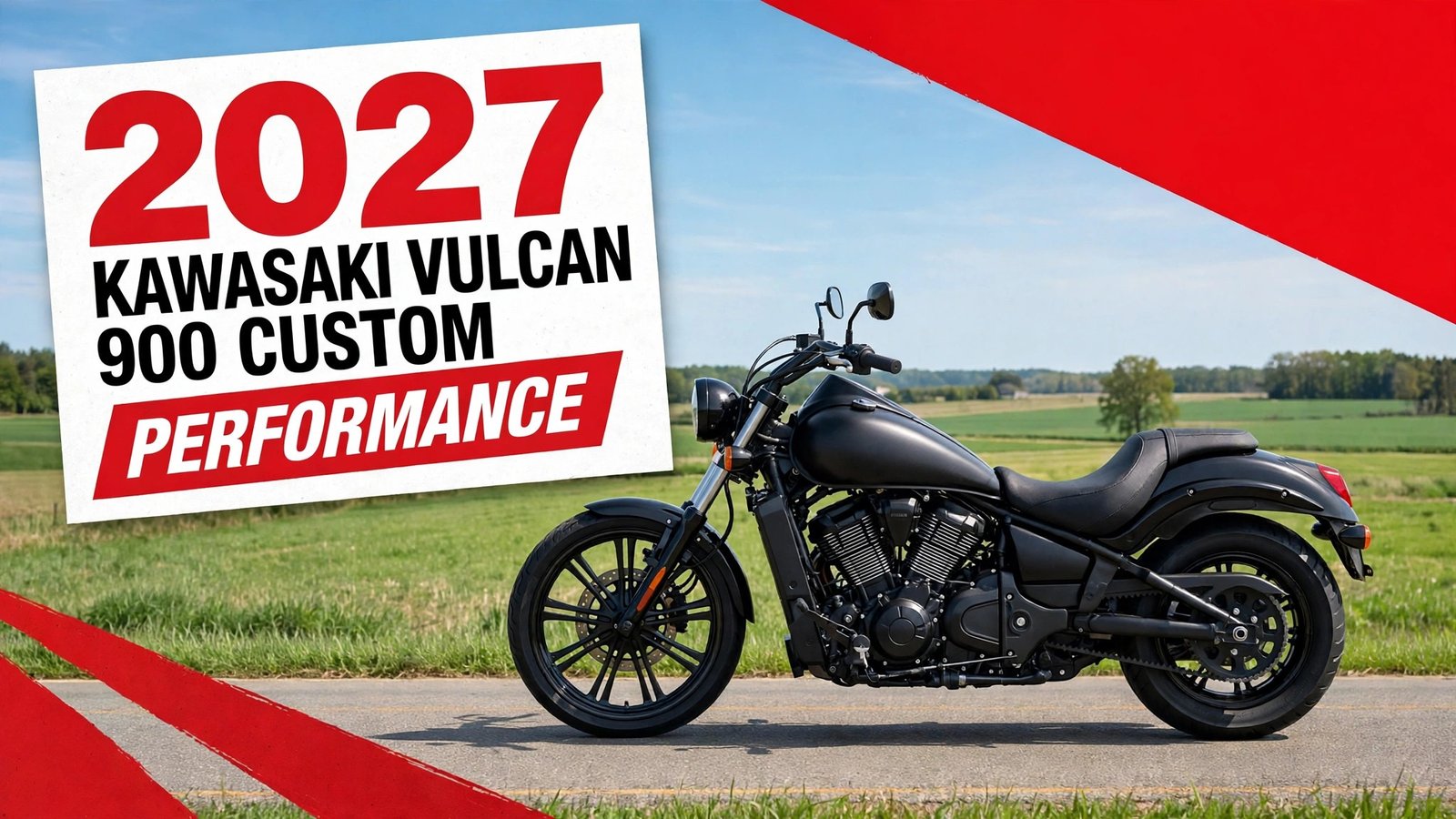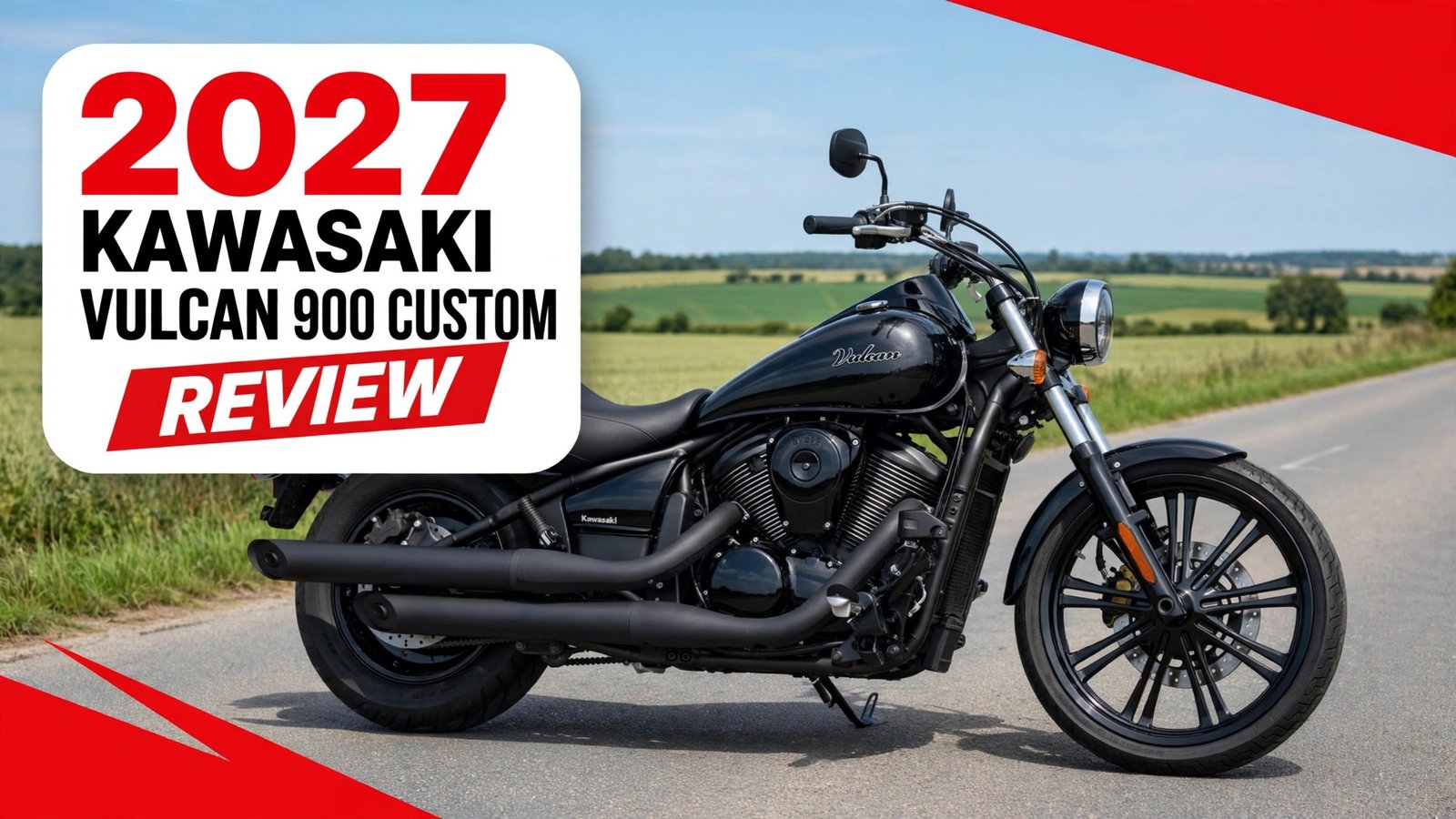
The short answer is that the Kawasaki Vulcan 900 Custom is still here, still new, and still the same bike it was twenty years ago. The 2027 Kawasaki Vulcan 900 Custom review starts from one fact: Kawasaki still lists the Custom live on its USA site at $10,099, plus an $840 destination charge, for $10,939 delivered. It is a 903cc liquid-cooled V-twin with 51 horsepower, a belt drive, a 5-speed gearbox and no ABS — openly so, in Kawasaki’s own words. Nothing about the formula has changed since the 2009 update, and this Kawasaki Vulcan 900 Custom review will show why that cuts both ways.
Kawasaki Vulcan 900 Custom Overview and Model-Year Updates
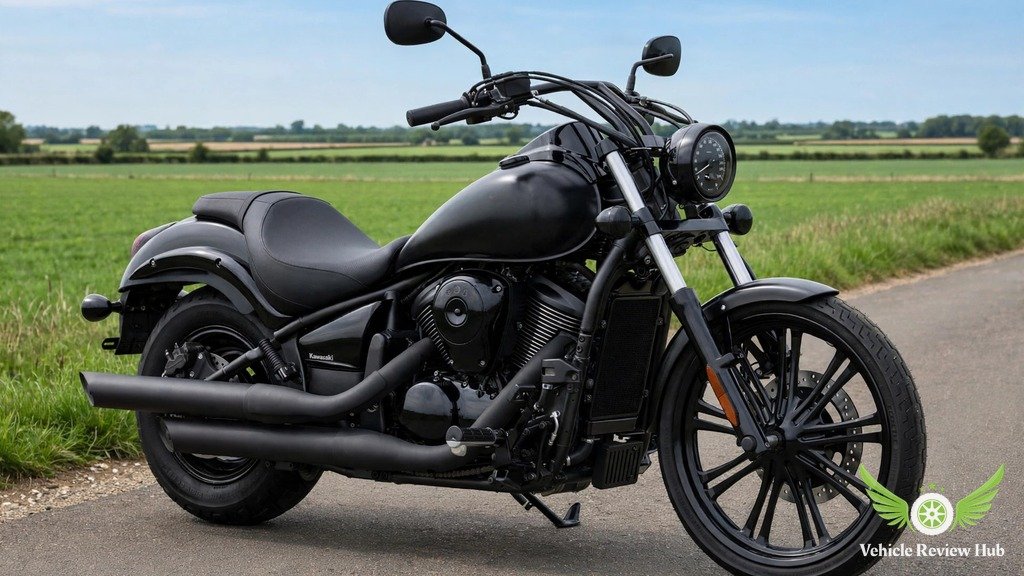
The Custom is the sporty trim of Kawasaki’s mid-size V-twin cruiser line, and this Kawasaki Vulcan 900 Custom review treats it as what it is: a long, low, deliberately simple cruiser that has outlived almost every bike launched against it. The 21-inch front wheel, drag handlebars and forward controls are the whole idea — a factory custom look on a middleweight budget.
Not Discontinued: 2027 Listed Live
The rumour that the Vulcan 900 Custom died years ago is wrong. Kawasaki’s own 2027 page lists the Custom live at $10,099, model code VN900FVFAL, in Metallic Spark Black only. Kawasaki’s 2027 Custom page is the authority here, and the 2027 street lineup coverage from Powersports Business in October 2026 confirms the Vulcan 900 range is still in production — the same two sources this Kawasaki Vulcan 900 Custom review relies on. The Custom is not a leftover or a dealer-only special — it is a current model you can order new, twenty years after launch.
Twenty Years, Colours and Paint Only
The Custom launched for model year 2007 at $7,349, and the bike on sale in 2027 is mechanically the same machine. The only real update came in 2009, when Kawasaki revised the exhaust; since then the changes have been colours and paint only. That is the consistent finding across the bike’s coverage, including a HotCars look at the line. Twenty years on sale with one mechanical revision explains why used Customs are everywhere and parts are easy to find — and why the bike’s biggest weakness is a 2007 design competing in 2027 against bikes with ABS, traction control and six-speed gearboxes that this Kawasaki Vulcan 900 Custom review shows the Custom simply does not have.
The film below is one rider’s first-impressions video of a 2024 Vulcan 900 Custom, not an instrumented test — the bike on screen is the Custom trim, with its tall 21-inch front wheel, drag handlebars and forward controls. The measured figures in this Kawasaki Vulcan 900 Custom review come from Kawasaki’s own spec sheet and the launch reviews, not from the film.
Kawasaki Vulcan 900 Custom Engine and Specifications
The engine is the whole point of this bike, and this Kawasaki Vulcan 900 Custom review starts the spec section with it: a 903cc liquid-cooled 55-degree V-twin, fuel-injected, with a five-speed gearbox and a Kevlar-reinforced belt — the same combination Kawasaki has sold since 2007, because it works and is cheap to keep running.
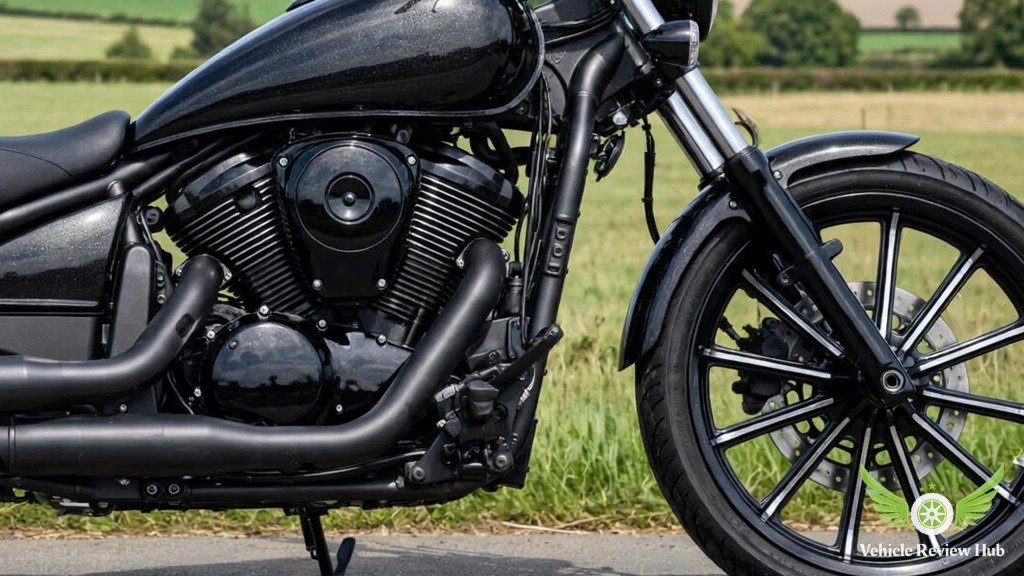
903cc V-Twin, Belt Drive, 51 Horsepower
The numbers are modest and honest, and this Kawasaki Vulcan 900 Custom review prints them as Kawasaki does: 51 horsepower at 5,500 rpm and 58.3 lb-ft of torque at 3,500 rpm, both to the ISO 4106 standard. The torque figure has a small split — older published figures read 58.2 lb-ft — but 58.3 is the live Kawasaki USA figure. The power figure has a similar split: the US bike is rated 51 horsepower, the European version 50 at 5,700 rpm, the difference coming from the measurement standard. The engine is a single-overhead-cam eight-valve twin, 88.0 mm by 74.2 mm, 9.5:1 compression, with 34 mm throttle bodies and digital fuel injection. The five-speed gearbox has Kawasaki’s Positive Neutral Finder for easy neutral at a stop, and the final drive is a Kevlar-reinforced belt — quiet, clean and nearly maintenance-free, with no shaft-drive weight penalty. Cycle World’s 2007 quick ride praised exactly this combination at launch, calling the fuelling near-perfect and the powerband incredibly broad — and nothing about the engine has changed since.
Front Tyre Is 80/90-21, Not 90/90
One detail worth getting right, because listings get it wrong — and this Kawasaki Vulcan 900 Custom review gets it right: the Custom’s front tyre is an 80/90-21, not a 90/90-21. The tall, narrow 21-inch front wheel is the Custom’s signature, separating it from the Classic at a glance — the Classic runs a 16-inch front wheel. The rear is a fat 180/70-15. Kawasaki gave the Custom its own frame geometry for that tall wheel: one extra degree of rake and 0.9 inches more trail than the Classic, for 33 degrees and 7.2 inches. Per the launch reviews, the result is a bike that steers light at low speed and stays stable at highway speed, until the forward footpegs touch down at relatively modest lean angles, like most cruisers.
| Item | 2027 Vulcan 900 Custom |
|---|---|
| Engine | 903cc liquid-cooled 55-degree V-twin |
| Bore x stroke | 88.0 x 74.2 mm |
| Compression ratio | 9.5:1 |
| Power | 51 hp @ 5,500 rpm (ISO 4106) |
| Torque | 58.3 lb-ft @ 3,500 rpm |
| Transmission | 5-speed with Positive Neutral Finder |
| Final drive | Kevlar-reinforced belt |
| Front tyre | 80/90-21 |
| Rear tyre | 180/70-15 |
| Front brake | Single 300 mm disc, 2-piston caliper |
| Rear brake | Single 270 mm disc, 2-piston caliper |
| ABS | None — Kawasaki lists the bike as “Non-ABS” |
| Seat height | 27.0 in |
| Curb weight | 610.8 lb |
| Fuel capacity | 5.3 gal |
| Wheelbase | 64.8 in |
| Length | 94.7 in |
| Warranty | 12-month limited |
Notes for this Kawasaki Vulcan 900 Custom review spec table: every figure is from Kawasaki’s live 2027 Custom page. The rear disc is 270 mm per Kawasaki USA — one older review spec box prints 272 mm, and this review follows Kawasaki. The European version is rated 50 horsepower at 5,700 rpm.
Kawasaki Vulcan 900 Custom Price and Market Availability
Price is where this Kawasaki Vulcan 900 Custom review has its best news. Twenty years of production have not made the bike expensive: the 2027 Custom costs $10,099 before destination, and the used market is full of clean, low-mileage examples for far less, because the bike barely changes year to year.
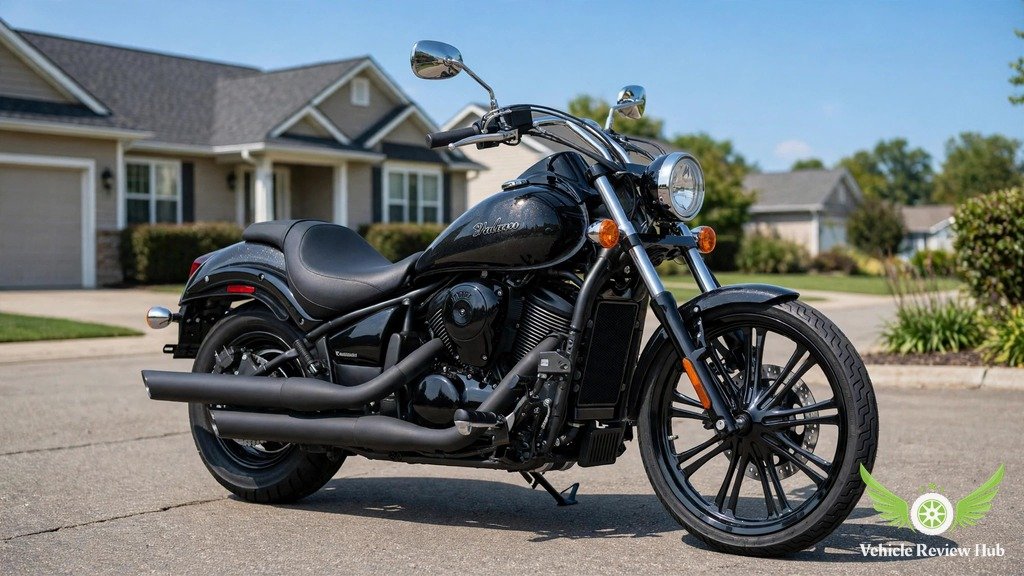
Kawasaki Vulcan 900 Custom Price in the USA: $10,099
The 2027 Custom is $10,099, plus an $840 destination charge, for $10,939 delivered. It comes in one colour, Metallic Spark Black, model code VN900FVFAL. That puts it within a few hundred dollars of its closest rivals — the Suzuki Boulevard C50 and Honda Shadow Phantom both listed at $9,299 for 2025 — while undercutting the touring-equipped Classic LT at $10,599 to $10,699. Third-party listings vary, and at least one spec database wrongly shows $10,999 for the 2027 Custom; Kawasaki’s own page is the authority at $10,099, and this Kawasaki Vulcan 900 Custom review uses that figure throughout. The destination charge has climbed — $345 in 2015, $360 in 2017, $800 in 2025, $840 in 2026 and 2027 — so the delivered price has risen faster than the MSRP.
Launch Price Was $7,349 in 2007
When the Custom launched for 2007 it cost $7,349 — exactly the same as the Classic that year, which Cycle World’s March 2007 quick ride called the best thing Kawasaki did not change. The price climbed through the early years, then jumped: 2013 spiked to $9,199, confirmed by three separate sources, before falling $700 to $8,499 in 2014 — both moves are real. The price then sat at $8,499 from 2014 through 2020, with only the 2021 step to $8,699 breaking the run, before climbing again: $9,499 in 2023, $9,899 in 2024 and 2025, $9,999 in 2026, $10,099 in 2027. In twenty years the Custom has gone up $2,750, or about 37 percent — modest against two decades of inflation, and one reason this Kawasaki Vulcan 900 Custom review calls it good value. Ultimate Motorcycling’s 2007 review found the bike an unexpected pleasure at the launch price, and the same words still fit: the Custom remains a lot of motorcycle for the money.
| Year | MSRP | Destination | Delivered |
|---|---|---|---|
| 2007 | $7,349 | — | — |
| 2008 | $7,399 | — | — |
| 2009 | $7,699 | — | — |
| 2010 | $8,349 | — | — |
| 2011 | $8,549 | — | — |
| 2012 | $8,699 | — | — |
| 2013 | $9,199 | — | — |
| 2014 | $8,499 | — | — |
| 2015 | $8,499 | $345 | $8,844 |
| 2016 | $8,499 | — | — |
| 2017 | $8,499 | $360 | $8,859 |
| 2018–2020 | $8,499 | — | — |
| 2021 | $8,699 | — | — |
| 2022 | $8,999 | — | — |
| 2023 | $9,499 | — | — |
| 2024 | $9,899 | — | — |
| 2025 | $9,899 | $800 | $10,699 |
| 2026 | $9,999 | $840 | $10,839 |
| 2027 | $10,099 | $840 | $10,939 |
Notes for this Kawasaki Vulcan 900 Custom review price table: MSRP figures are verified year by year from Kawasaki’s own pages, dealer brochures and launch reviews. Delivered prices are shown only where that year’s destination charge was verified — $345 in 2015, $360 in 2017, $800 in 2025, $840 in 2026 and 2027 — because the charge changes year to year and must never be carried across years. The 2013 spike and the 2014 drop are both real.
Kawasaki Vulcan 900 Custom Design, Features and Technology
The Custom’s design is a factory take on the pro-street look: long, low, blacked out and clean, with no windscreen, saddlebags or floorboards to soften it. This Kawasaki Vulcan 900 Custom review reads the design the same way the launch reviewers did — as a cruiser that wants to look fast standing still.
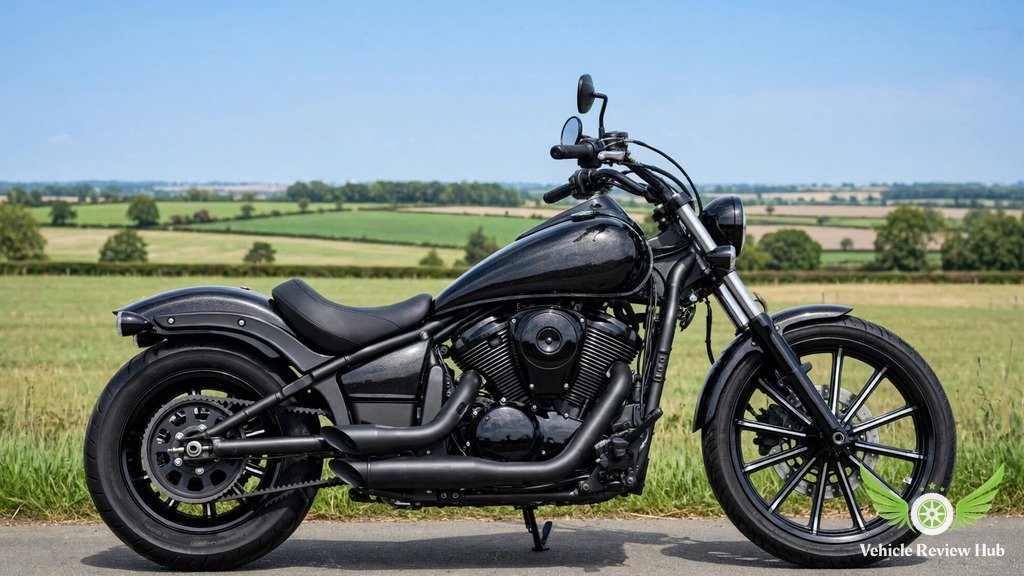
Openly Non-ABS, in Kawasaki’s Words
The most honest thing about the Custom’s design is what it leaves out. Kawasaki’s own feature list says the bike is “Non-ABS”, and ABS has never been offered on any Vulcan 900, in any year or market. That is unusual in 2027 — the smaller Vulcan S does offer ABS, as the Kawasaki Vulcan S ABS review shows — and this Kawasaki Vulcan 900 Custom review names the missing ABS the single biggest reason a new buyer should think twice before choosing the Custom over a rival with ABS. There is no ABS option, trim or dealer-fit kit; the brakes are a single 300 mm front disc with a two-piston caliper and a single 270 mm rear disc, and managing both is the rider’s job. Riders who ride in the rain or in traffic, or who want the safety net, should weigh that against the Custom’s price and looks.
Solid-Look Cast Rear Wheel, Kawasaki’s Wording
The wheels tell the Custom apart from the Classic at a glance, and this Kawasaki Vulcan 900 Custom review uses them as the quickest way to tell the two trims apart. Up front is a twin-spoke cast wheel carrying that tall 21-inch tyre; at the back is a solid-look cast wheel — Kawasaki’s exact phrase — which gives the bike its clean, uncluttered rear end. The Classic, by contrast, runs 16-inch spoked wheels with a front tyre that looks half the Custom’s height. The rest follows the same blacked-out theme: dark engine, exhaust and running gear, slash-cut pipes low on the right, and a single round headlight with a small analogue speedometer and LCD inset on the drag bars. The tank carries the Vulcan badge, the rear fender is long and low, and the gunfighter-style solo seat is narrow enough to let short riders flat-foot the bike. Nothing extra — that is the point.
Kawasaki Vulcan 900 Custom Riding Experience and Comfort
On the road the Custom feels bigger than its 903cc suggests, and smaller than its 611 pounds suggests. This Kawasaki Vulcan 900 Custom review leans on the launch reviews here, because the bike has not changed since they were written — a 2007 ride report still describes the 2027 bike.
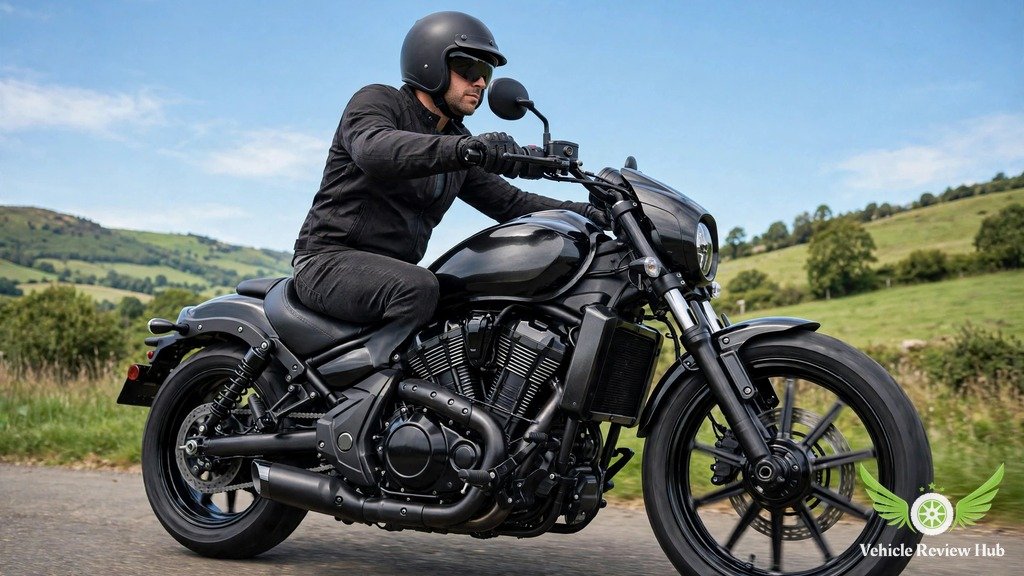
Big-Bike Looks, Seat 27.0 Inches
The Custom is 94.7 inches long with a 64.8-inch wheelbase, so it looks like a big cruiser — until the 27.0-inch seat height does its work. Women Riders Now’s 2007 review found a 5-foot-6.5-inch rider could flat-foot it — the low seat is why shorter riders keep choosing this bike. The handling is where the Custom surprises people, and this Kawasaki Vulcan 900 Custom review says so plainly: the tall front wheel and extra rake make it stable at speed, while the low centre of gravity keeps it manageable at parking-lot speeds. The launch reviewers agreed the bike feels lighter than its 610.8-pound curb weight once it is moving. The trade-off is ground clearance: the forward footpegs touch down early, and the soft suspension lets rough roads through. Vibration splits the reviews: some call the engine smooth and relaxed, others note a buzz at highway speed. No single verdict — a test ride at 70 mph will tell any buyer more than any review can.
Built in Akashi, Japan
The Custom is built in Akashi, Japan, where Kawasaki’s cruisers have been made for decades, as the VIN decodes confirm. A bike built in the same factory, on the same line, for twenty years tends to have its manufacturing problems solved — and the Vulcan 900’s reputation is exactly that: well-built and simple, with no known frame, gearbox or engine weakness. The 2009 exhaust revision is the only production change of note, and the parts catalogue for a 2007 bike and a 2027 bike is largely the same — one more reason this Kawasaki Vulcan 900 Custom review treats the used market as a genuine option, since a clean 2015 Custom is, mechanically, the same motorcycle as a new 2027 one.
Kawasaki Vulcan 900 Custom Review: Pros, Cons and Verdict
Twenty years in, the Custom is easy to judge, and this Kawasaki Vulcan 900 Custom review ends where it began: with a bike that is honest about what it is — a good-looking, comfortable, belt-drive V-twin cruiser for $10,099, and also a 2007 motorcycle being sold in 2027, without ABS and without a sixth gear.
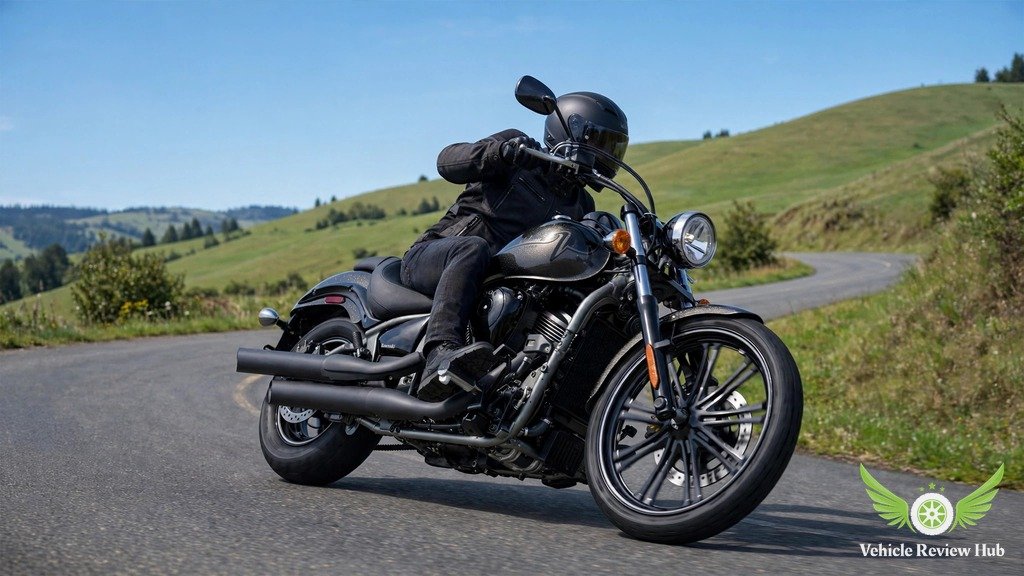
Main Advantages and Limitations of the Kawasaki Vulcan 900 Custom
The pros start with the price: $10,099 for a new 903cc V-twin cruiser is fair value, and the used market makes it cheaper still. The belt drive is quiet and clean, the torque is generous at 58.3 lb-ft, the 27.0-inch seat suits shorter riders, and the long, low pro-street shape looks far more expensive than it is — more so than the smaller 650 in the Kawasaki Vulcan S Cafe review. The cons are just as clear: no ABS, and that alone will rule the bike out for some buyers. The five-speed gearbox is one gear short of modern rivals, the 610.8-pound curb weight is heavy for the class, and the single front disc is modest by 2027 standards. Reliability has one owner-documented item: the stator, tested at more than 70 volts AC per leg at 4,000 rpm, with the regulator checked alongside it. The recall record is real, not clean: two recalls name this model — 08V-114 (March 2008, fuel-hose connector) and 08V-473 (September 2008, filler-neck and cap-gasket leak), both on NHTSA’s recall search — with a possible third, 10V-507, still needing a VIN check. Any used Custom should be checked against those campaign numbers first. The closest rival on price is the Suzuki Boulevard C50 review at $9,299 — shaft drive and a lower seat, but the same era of design and the same absence of modern electronics, which is why this Kawasaki Vulcan 900 Custom review keeps the two together.
12 Month Limited Warranty
Every new Custom carries a 12-month limited warranty — short by modern standards, since many rivals offer two years — but it matches the bike’s simple, proven design. The warranty covers defects in materials and workmanship, and with a design in production for twenty years, few surprises are left for a dealer to find. The more useful number is not the warranty length but the parts supply: twenty years of one design means spares, accessories and aftermarket parts are plentiful, and any independent shop has seen a Vulcan 900. Buy the Custom, this Kawasaki Vulcan 900 Custom review concludes, if you want a classic-looking, belt-drive V-twin cruiser, a low seat and a fair price, and if you are comfortable riding without ABS. Buy something else if ABS, a sixth gear or modern electronics are non-negotiable.
Kawasaki Vulcan 900 Custom Review FAQs
The questions below cover what buyers ask most — price, power, ABS, seat height and the recall record — answered from the same verified figures as this Kawasaki Vulcan 900 Custom review.
Is the Kawasaki Vulcan 900 Custom still made for 2027?
Yes. Kawasaki lists the Custom live on its USA site for 2027 at $10,099, model code VN900FVFAL, in Metallic Spark Black only, and the 2027 street lineup coverage confirms the range is still in production. This Kawasaki Vulcan 900 Custom review treats the bike as a current model, not a leftover — twenty years on sale and still orderable new.
How much does the 2027 Vulcan 900 Custom cost?
The 2027 Custom is $10,099 before destination, plus an $840 destination charge, for $10,939 delivered — the figure on Kawasaki’s own page, used throughout this Kawasaki Vulcan 900 Custom review. Some third-party listings wrongly show $10,999; Kawasaki’s own page is the authority.
How much horsepower does the Vulcan 900 Custom make?
The Vulcan 900 Custom makes 51 horsepower at 5,500 rpm and 58.3 lb-ft of torque at 3,500 rpm, both to the ISO 4106 standard. This Kawasaki Vulcan 900 Custom review prints 51, not the European 50 horsepower figure, which comes from a different measurement standard.
Does the Vulcan 900 Custom have ABS?
No. The Vulcan 900 Custom has never had ABS in any year or market, and Kawasaki’s own feature list describes the bike as “Non-ABS”. This Kawasaki Vulcan 900 Custom review flags that as the bike’s biggest weakness in 2027 — no ABS option, trim or dealer-fit kit, so riders who want ABS should look elsewhere.
What is the seat height of the Vulcan 900 Custom?
The seat height is 27.0 inches, low enough for most riders to flat-foot the bike — a 5-foot-6.5-inch rider flat-footed it in Women Riders Now’s 2007 review. This Kawasaki Vulcan 900 Custom review counts the low seat as one of the bike’s best features for shorter riders, helped by the narrow solo seat.
How heavy is the Vulcan 900 Custom?
The curb weight is 610.8 pounds — heavy for a 903cc cruiser, more than 100 pounds heavier than the smaller Vulcan S. This Kawasaki Vulcan 900 Custom review notes the weight is felt at parking-lot speeds, though the low centre of gravity keeps it manageable once moving.
Is the Vulcan 900 Custom belt drive or chain drive?
The Vulcan 900 Custom is belt drive, with a Kevlar-reinforced belt and a five-speed gearbox with Positive Neutral Finder. This Kawasaki Vulcan 900 Custom review counts the belt as a genuine plus: quiet, clean and nearly maintenance-free, with no shaft-drive weight penalty.
What is the difference between the Vulcan 900 Custom and the Classic?
The Custom has a 21-inch front wheel with an 80/90-21 tyre, drag handlebars, forward controls and a solid-look cast rear wheel, while the Classic has a 16-inch spoked front wheel, pullback bars, floorboards and a windscreen. This Kawasaki Vulcan 900 Custom review treats the two as the same 903cc bike in different clothes — same engine and frame family, different stance and look.
How far can the Vulcan 900 Custom go on a tank?
Kawasaki publishes no range figure, and no instrumented mileage test exists for the Custom. The 5.3-gallon tank times the 41.3 mpg Motorcycle.com tested on the sibling Classic LT gives about 219 miles, while Kawasaki’s own 45 mpg estimate gives about 239 miles — both are arithmetic, not tests, and this Kawasaki Vulcan 900 Custom review prints neither as a verified range.
Is the Vulcan 900 Custom a good beginner bike?
It can be, with reservations. The 27.0-inch seat, predictable low-end torque and simple belt-drive design suit new riders, and the price is fair. But this Kawasaki Vulcan 900 Custom review adds two warnings for beginners: no ABS, and 610.8 pounds is heavy to pick up and manage at walking speed.
What are the common problems with the Vulcan 900 Custom?
The owner-documented item is the stator, tested at more than 70 volts AC per leg at 4,000 rpm, regulator checked alongside it. This Kawasaki Vulcan 900 Custom review also records two recalls that name the model: 08V-114 (March 2008, fuel-hose connector) and 08V-473 (September 2008, filler-neck and cap-gasket leak).
Is the Vulcan 900 Custom worth buying in 2027?
Yes, for the right buyer: someone who wants a classic-looking, belt-drive V-twin cruiser with a low seat and a fair price, and who is comfortable riding without ABS. This Kawasaki Vulcan 900 Custom review says no for buyers who want ABS, a sixth gear or modern electronics — the Custom is a 2007 motorcycle, and twenty years of production has not changed that.