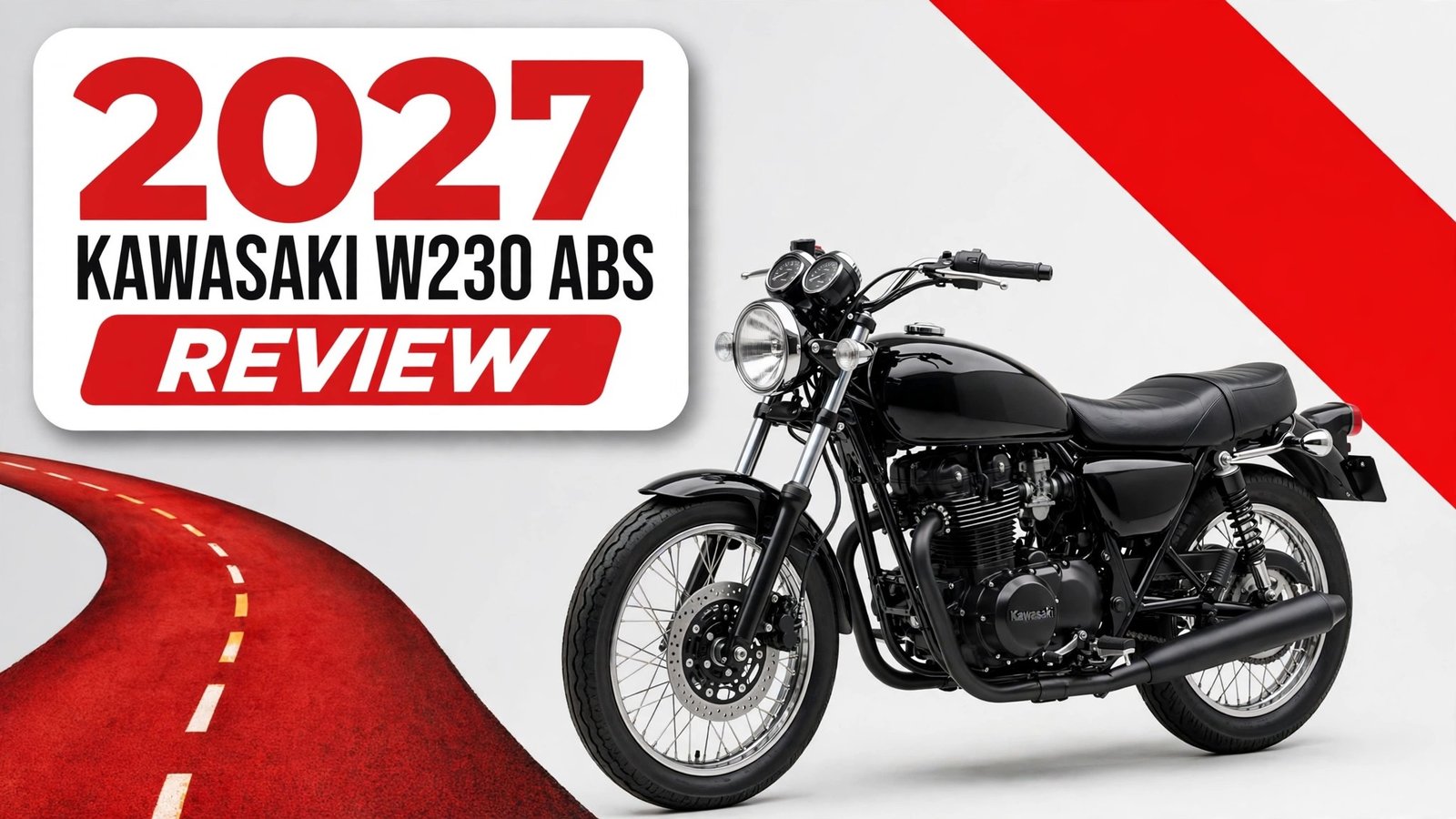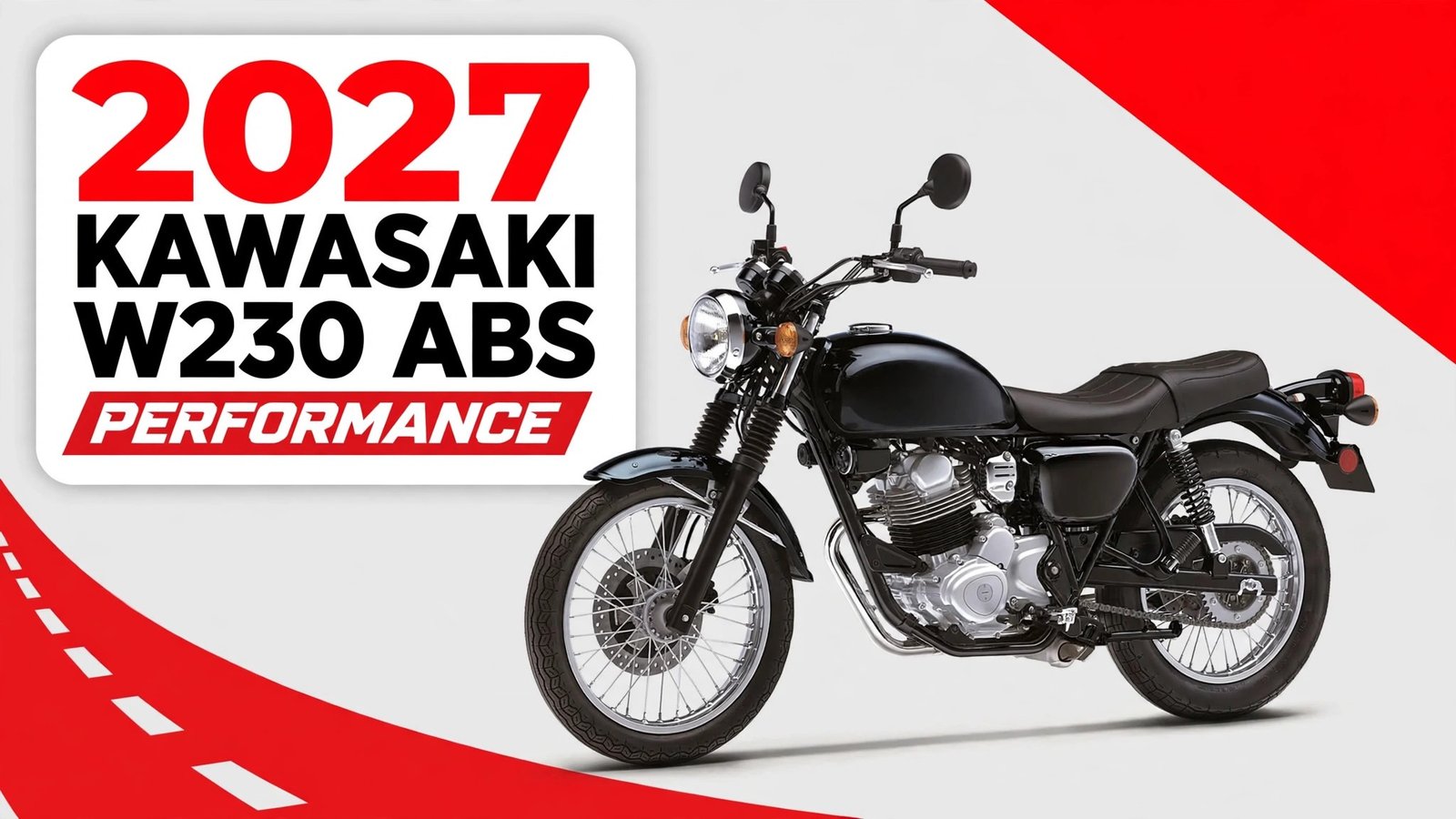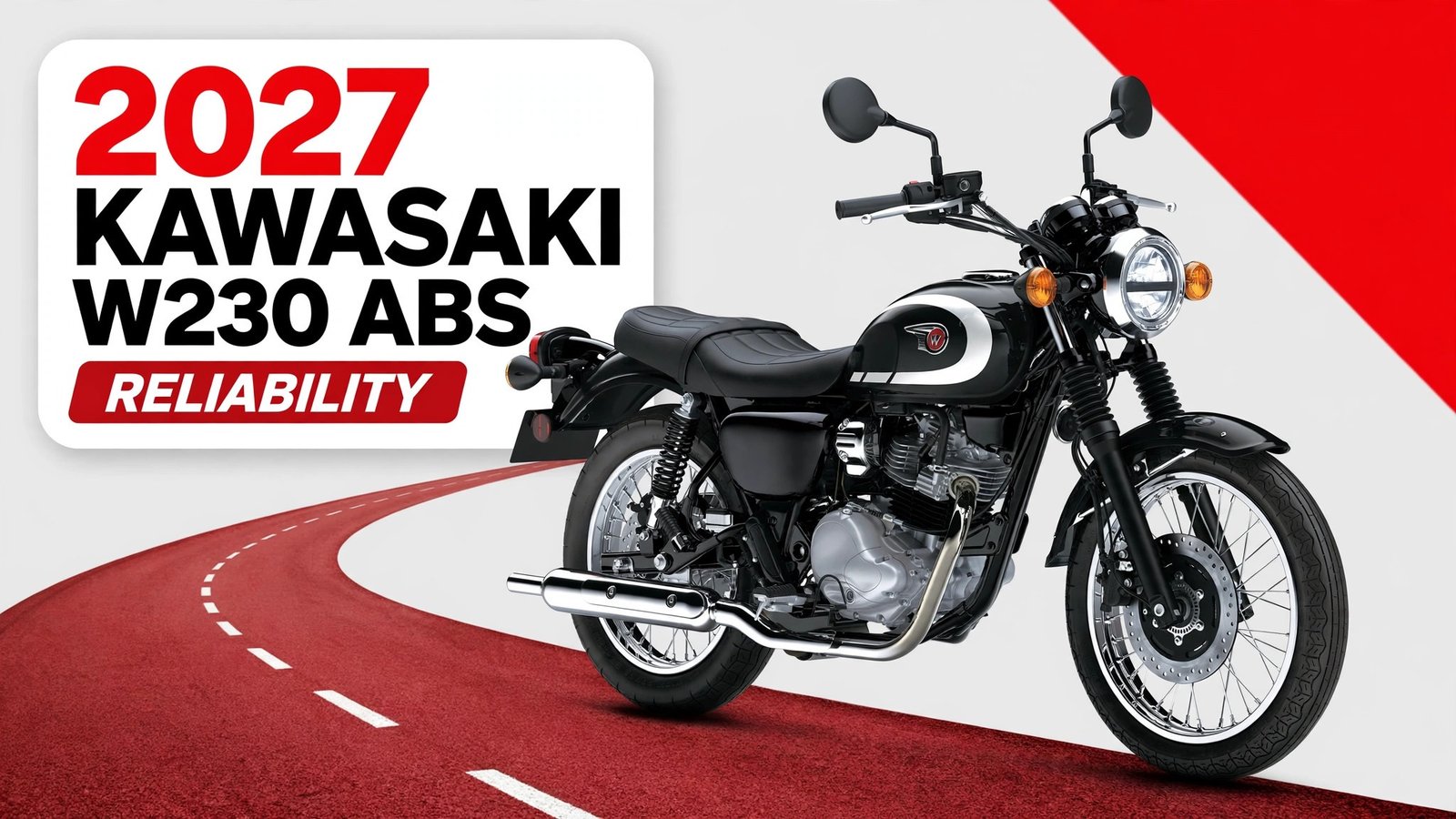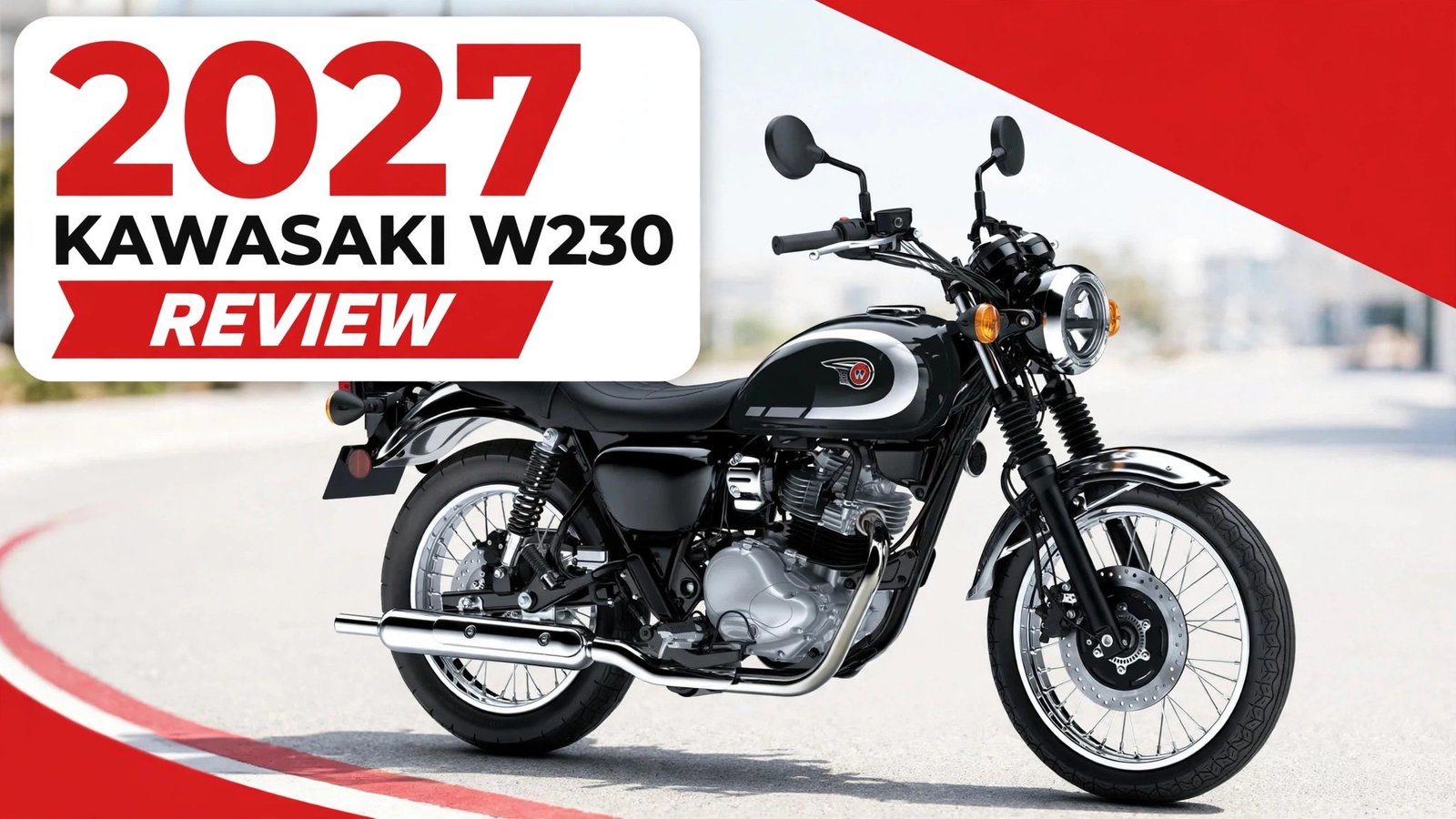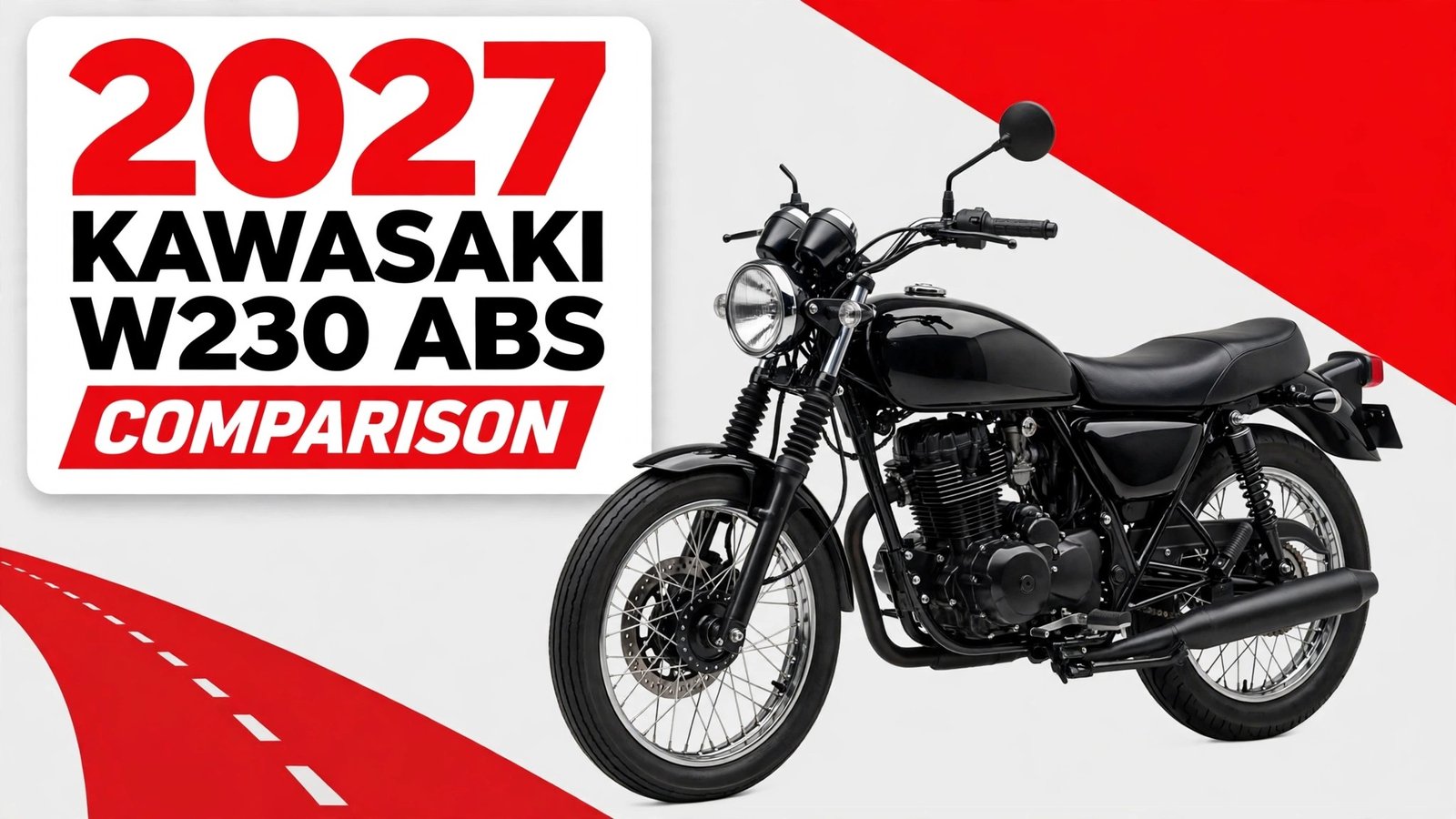
Four bikes, one safety net, and a $1,490 spread between cheapest and dearest delivered — that is the shape of this Kawasaki W230 ABS comparison. The W230 ABS is the lightest bike in the group and the weakest, the only one with a 6-speed gearbox and a retro W-series badge, and the only one whose ABS is a naming fact rather than a trim choice: there is no non-ABS W230 anywhere in the world, so the ABS carries no premium at all. This Kawasaki W230 ABS comparison measures it against the three rivals US buyers actually cross-shop — the Royal Enfield Hunter 350, the Triumph Speed 400 and the Honda Rebel 300 — on the manufacturers’ published figures, with every gap labelled.
In short: the Hunter 350 is the cheapest by a wide margin; the Speed 400 is the quickest by a long way and costs almost exactly what the W230 costs; the Rebel 300 is the lowest and the only one with a gear indicator and a fuel gauge; and the W230 ABS is the lightest and the simplest, with one electronic rider aid. This Kawasaki W230 ABS comparison works through the four bikes side by side, each rival on its own terms, the prices with destination included, and the gaps labelled.
Kawasaki W230 ABS Overview and Its Closest Rivals

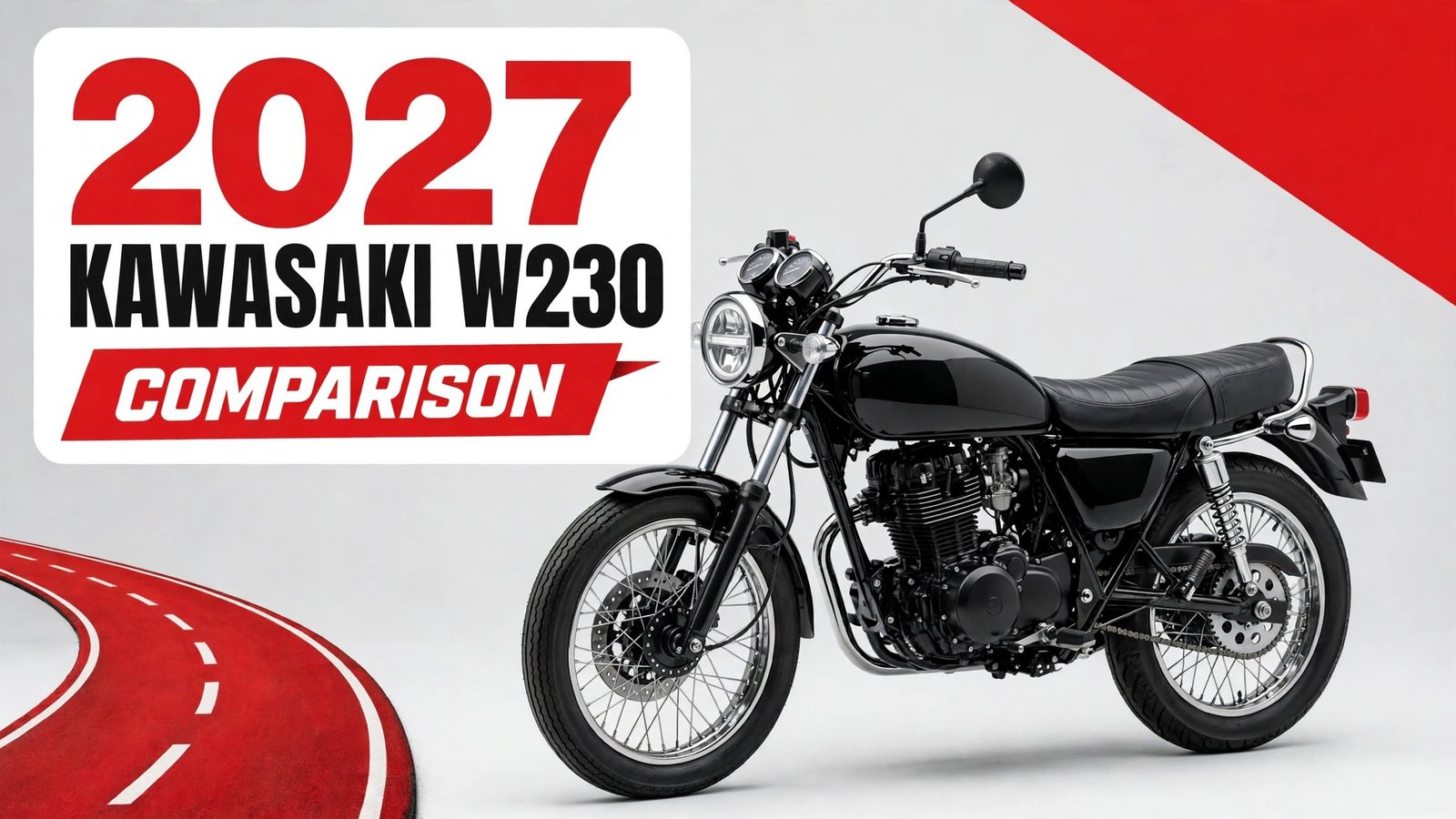
The four bikes in this Kawasaki W230 ABS comparison are all small singles with standard ABS, aimed at new and returning riders and priced between $4,299 and $5,899 before destination. The differences are in power, weight, seat height and character. The W230 ABS is the retro one — a 233cc air-cooled single with a round headlight, analog dials and a stepped black seat — and the lightest and least powerful of the four. The full specification record is in the Kawasaki W230 ABS review.
Same Safety Net, $1,490 Less
The heading’s arithmetic is exact for one pair only, and this Kawasaki W230 ABS comparison names the pair: the 2027 W230 ABS, delivered, costs $6,334 ($5,899 MSRP + $435 destination), and the 2026 Hunter 350, delivered, costs $4,844 ($4,299 MSRP + $545 destination) — a gap of $1,490 exactly. The ‘safety net’ is ABS, standard on both wheels: the W230 on 265 mm front and 220 mm rear discs, the Hunter on 300 mm front and 270 mm rear discs with dual-channel ABS. No other delivered-price pair in the group gives $1,490 — the like-for-like gaps are $1,290 in both cases (2026 against 2026: $6,134 − $4,844; 2027 against 2027: $6,334 − $5,044, since the 2027 Hunter is $4,499 plus $545).
The W230 ABS has no non-ABS version to price against, and the Hunter 350 is ABS-only in the United States, so neither maker charges a premium for the system. The table below sets out the ABS setup on all four bikes in this Kawasaki W230 ABS comparison.
| Bike | ABS setup | ABS premium |
|---|---|---|
| Kawasaki W230 ABS | Standard, both wheels, only trim | None — no non-ABS version exists |
| Royal Enfield Hunter 350 | Dual-channel, standard | None — ABS-only in the US |
| Triumph Speed 400 | Front + rear, standard | None — ABS-only in the US |
| Honda Rebel 300 | Front + rear, standard, one trim | None — one E-Clutch trim |
Note: Every bike in this Kawasaki W230 ABS comparison carries ABS as standard with no premium — the contrast is Kawasaki’s own KLX230 S, which charges $300 for ABS (verdict section).
How the Four Bikes Differ at a Glance
The four bikes split two ways — the W230 ABS and the Hunter 350 are the retro, air-cooled pair, and the Speed 400 and the Rebel 300 are the liquid-cooled pair — and the power spread is far wider than the price spread. The Speed 400 makes 39.5 hp, more than double the W230’s 17 hp; the Hunter makes 20.2 bhp; the Rebel 300’s power is about 27 hp from secondary databases. The W230 ABS is the lightest by a clear margin — 315.3 lb curb against 375 lb for the Speed 400, 379 lb for the Rebel 300 and 399 lb for the Hunter 350 — and the only one with a 6-speed gearbox. The table below is the whole of this Kawasaki W230 ABS comparison on one page.
| Specification | Kawasaki W230 ABS | Royal Enfield Hunter 350 | Triumph Speed 400 | Honda Rebel 300 |
|---|---|---|---|---|
| MSRP (2026) | $5,699 | $4,299 | $5,495 | $5,349 |
| Delivered (2026) | $6,134 | $4,844 | $6,095 | $5,949 |
| Engine | 233cc air-cooled single | 349cc air/oil-cooled single | 398cc liquid-cooled single | 286cc liquid-cooled single |
| Power | 17 hp @ 7,000 rpm | 20.2 bhp @ 6,100 rpm | 39.5 hp @ 8,000 rpm | Honda publishes no figure (~27 hp, secondary databases) |
| Transmission | 6-speed | 5-speed | 6-speed | 6-speed + E-Clutch |
| Brakes / ABS | 265 mm / 220 mm discs, ABS both wheels | 300 mm / 270 mm discs, dual-channel ABS | ABS front + rear, standard | 296 mm / 240 mm discs, ABS front + rear |
| Curb weight | 315.3 lb | 399 lb | 375 lb wet | 379 lb |
| Seat height | 29.3 in | 31.1 in | 31.1 in | 27.2 in |
| Fuel capacity | 3.1 gal | 3.4 gal | 3.4 gal | 3.0 gal |
Note: All figures are 2026 manufacturer figures unless marked. The W230 ABS’s 2027 price is $5,899 + $435 = $6,334 delivered; the 2027 Hunter is $4,499 + $545 = $5,044. This Kawasaki W230 ABS comparison uses delivered prices throughout.
One video covers two of the bikes in this group — but it is not a test of either of them. The Motizzando roundup below is an Italian-made ranked list of twelve new motorcycles chosen for having the least electronics (November 9, 2026), originally narrated in Italian: the W230 is number four, at 10:57, and the Hunter 350 number five, at 09:59. YouTube offers an English auto-dub (and English captions), and the dub mangles the spoken price — so take the €4,999 W230 figure from the video’s own description, not from the audio: it is an Italian list price, not a US price; the Speed 400 does not appear at all, and the Rebel in it is the Rebel 500, not the Rebel 300. It earns its place in this Kawasaki W230 ABS comparison because it is the only video that features two of the four bikes together. Watch it as a roundup, not a head-to-head — no head-to-head video of these two bikes exists.
Kawasaki W230 ABS vs Royal Enfield Hunter 350

The Hunter 350 is the rival this Kawasaki W230 ABS comparison keeps coming back to: the cheapest bike in the group and the closest in spirit, a retro-styled single with standard ABS. The two bikes differ by $1,290 like-for-like on delivered price, by 3.2 bhp on power and by 84 lb on weight.
Engine, Specs and Performance Side by Side
The Hunter’s engine is the bigger one in this Kawasaki W230 ABS comparison: a 349cc air/oil-cooled single making 20.2 bhp at 6,100 rpm and 19.9 lb-ft at 4,000 rpm, against the W230’s 233cc air-cooled single at 17 hp and 14.0 lb-ft. The Hunter is heavier by 84 lb (399 lb curb against 315.3 lb) and taller at 31.1 in against 29.3 in. Neither bike has a dyno figure or a tested top speed; the Hunter’s figures are the manufacturer’s claims. The W230’s one advantage is its 6-speed against the Hunter’s 5-speed — but on claimed power the Hunter is quicker.
The brakes are the closest match in this Kawasaki W230 ABS comparison. The Hunter runs a 300 mm front disc and a 270 mm rear disc with dual-channel ABS; the W230 runs a 265 mm front disc with a two-piston caliper and a 220 mm rear disc with a single-piston caliper, both under ABS. Neither bike has a measured braking distance published anywhere — the only braking figures in print for the W230 are Maxabout’s, unsourced on a page that fails basic spec checks, and this Kawasaki W230 ABS comparison does not print them — and the only ridden verdict on the W230’s brakes is one beginner tester’s sentence: “The brakes are great, though with a quick response, so I have to be careful not to squeeze the lever too hard or too fast.” Full Hunter specification is on Royal Enfield’s Hunter 350 page.
Price, Equipment and Which Suits Which Rider
On price the Hunter wins outright in this Kawasaki W230 ABS comparison. The 2026 Hunter 350 is $4,299 plus $545 destination — $4,844 delivered — against the 2026 W230 ABS at $5,699 plus $435, or $6,134 delivered: $1,290 less, like-for-like. The gap is $1,490 only when the 2027 W230 ($6,334 delivered) is set against the 2026 Hunter; when both are 2027 bikes it is the same $1,290 ($6,334 against $5,044). Neither bike has a gear indicator or fuel gauge; the Hunter carries the bigger engine and the lower price. The W230’s counter is weight and height: 84 lb lighter, 1.8 in lower, with a 6-speed.
Which suits which rider follows from that in this Kawasaki W230 ABS comparison. Buy the Hunter 350 if the budget is the deciding factor or the extra 3.2 bhp matters more than weight — it is the value pick of this Kawasaki W230 ABS comparison, and the only rival that undercuts the W230 by more than $1,000. Buy the W230 ABS if lightness, a seat 1.8 in lower than the Hunter’s, and the retro Kawasaki badge matter more than power: at 315.3 lb it is the lightest bike here, and its single electronic rider aid — ABS, standard, no premium — is the whole of its electronics. Neither bike is the quick one; that is the Speed 400’s job.
Kawasaki W230 ABS vs Triumph Speed 400
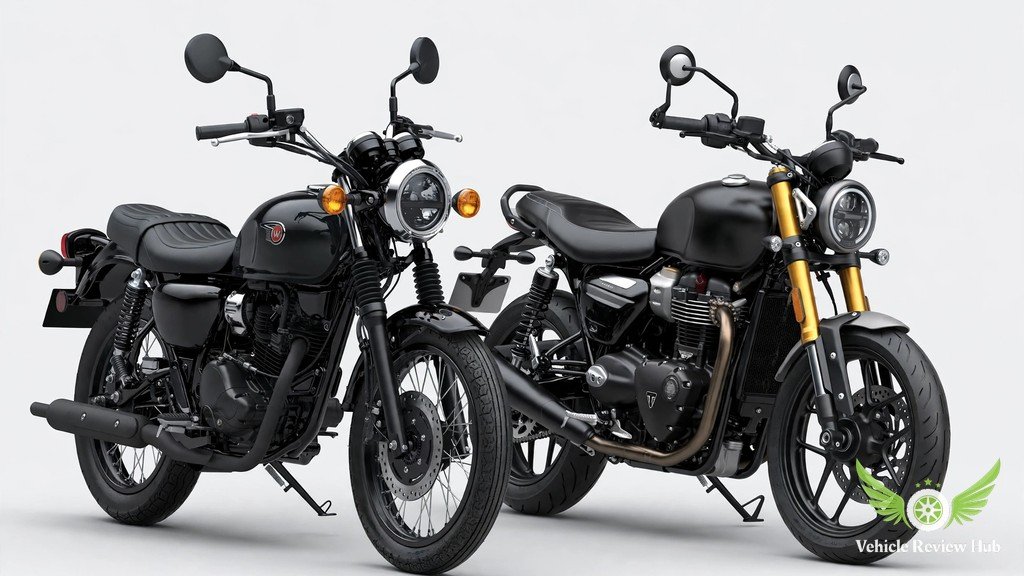
The Speed 400 is the odd one out in this Kawasaki W230 ABS comparison: $39 less delivered than the W230 in 2026, and more than twice the power. It changes the question to “how much power do you actually need?”, because on claimed figures the Triumph is in a different class.
Engine, Specs and Performance Side by Side
The numbers are not close in this Kawasaki W230 ABS comparison: the Speed 400’s 398cc liquid-cooled single makes 39.5 hp at 8,000 rpm and 27.7 lb-ft at 6,500 rpm, against the W230’s 17 hp and 14.0 lb-ft — a gap of 22.5 hp on claimed figures. The Triumph is heavier and taller, but 60 lb does not close the gap. Neither bike has a head-to-head test, and the W230 has no dyno figure at all — the closest measured data is the sibling KLX230R’s 17.9 hp on Cycle World’s Dynojet — the KLX230R’s figure, not the W230’s. The Kawasaki W230 ABS performance guide covers the W230’s missing test figures in full.
Price, Equipment and Which Suits Which Rider
On price the two bikes are effectively tied in this Kawasaki W230 ABS comparison: the 2026 Speed 400 is $5,495 plus $600 ($6,095 delivered) against the 2026 W230 ABS at $5,699 plus $435 ($6,134 delivered) — the Triumph is $39 cheaper. Against the 2027 W230 ($6,334 delivered) the gap is $239. One figure needs care: some dealer listings show the Speed 400 at $5,595 — Triumph’s $5,495 plus a $100 Pearl Metallic White colour upcharge, not a mid-year increase or a different trim. The equipment story is the same tie: power and a modern chassis against lighter weight, a lower seat and the retro badge. Triumph’s own page is the Speed 400 page.
Which suits which rider is the easiest call in this Kawasaki W230 ABS comparison. Buy the Speed 400 if power matters at all — 39.5 hp against 17 hp is not marginal, and it costs $39 less delivered than the 2026 W230. Buy the W230 ABS if the retro look, the lighter weight and the simplest electronics are the priority, and if 17 hp is enough for town, back roads and short runs — where the beginner tester who rode it called it “super fun and easy to ride”. The Speed 400 is the better motorcycle on the numbers; the W230 is the better retro object.
Kawasaki W230 ABS vs Honda Rebel 300

The Rebel 300 is the rival that changes the shape of the bike entirely: a low-slung cruiser with a 27.2 in seat — the lowest in this Kawasaki W230 ABS comparison by 2.1 in — a 286cc liquid-cooled single, and Honda’s E-Clutch. It is the only rival with a gear indicator and a fuel gauge, and the only one whose maker publishes no power figure.
Engine, Specs and Performance Side by Side
Honda publishes no power figure for the Rebel 300, so this Kawasaki W230 ABS comparison labels the comparison carefully: secondary databases put it at about 27 hp, roughly 10 hp stronger than the W230’s claimed 17 hp — a database figure, never Honda’s. What Honda does publish is the engine: a 286cc liquid-cooled single, DOHC four-valve, with a 6-speed manual gearbox and Honda’s E-Clutch as standard, which operates the clutch automatically and acts as a quick-shifter. The Rebel is heavier by 64 lb (379 lb curb against 315.3 lb) and lower by 2.1 in at the seat. Its brakes are 296 mm front and 240 mm rear discs, ABS front and rear standard. The Cycle News E-Clutch review is the ridden source for the clutch and the ABS confirmation. Honda’s own page is the Rebel 300 page.
Price, Equipment and Which Suits Which Rider
On price, in this Kawasaki W230 ABS comparison, the Rebel 300 undercuts the W230 by a small margin: the 2026 Rebel 300 is a single E-Clutch trim at $5,349 plus $600 ($5,949 delivered) against the 2026 W230 ABS at $6,134 delivered — $185 less. Against the 2027 W230 ($6,334 delivered) the gap is $385. Ignore the $5,149 non-ABS Rebel price in some coverage: that is the 2024 price, and the 2026 bike is one E-Clutch trim with ABS front and rear as standard. The 2025 Rebel 300, the last non-E-Clutch year, was $4,849 plus $600 ($5,449 delivered) — $500 cheaper and 15 lb lighter.
Which suits which rider comes down to position and technology in this Kawasaki W230 ABS comparison. Buy the Rebel 300 if the lowest seat in the group, the cruiser position and the E-Clutch matter — it is the easiest bike here for a shorter rider. Buy the W230 ABS if the upright roadster position, the lighter weight and the retro look matter more, and if a conventional clutch and a single electronic aid — ABS, standard, no premium — are the whole of the technology you want. The Rebel is the more modern machine; the W230 is the simpler one. This Kawasaki W230 ABS comparison calls it a draw on value and a clear split on character.
Kawasaki W230 ABS Price and Value Compared
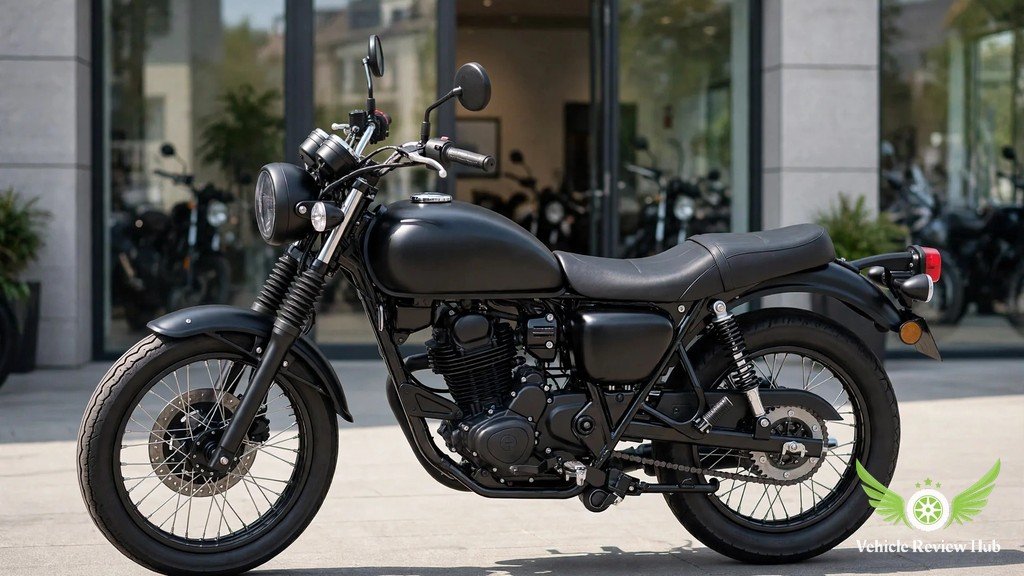
Purchase price is only the first number in this Kawasaki W230 ABS comparison — destination charges, leftover pricing and running costs decide what the bike actually costs to own. Every figure below is labelled by its source, and the ones that could not be verified are named as unverified rather than filled in.
Leftover 2025s From $3,599
The cheapest way into a new W230 ABS was never the list price: leftover new 2025 bikes were advertised from $3,599 in late 2025 (lowest verified $3,584) in a Cycle Trader snapshot dated December 13, 2025. That is late-2025 clearance pricing, not a current price: no live listing at $3,599 could be confirmed in November 2026. Against the 2025 list price of $5,599, a $3,599 leftover is $2,000 off the MSRP before destination. Buyers hunting a leftover should check what is left at a dealer now, and check both recalls by VIN first. The full recall record is in the Kawasaki W230 ABS reliability guide.
Running Costs and Resale Value Compared
Running costs are where this Kawasaki W230 ABS comparison has to admit its limits. Fuel is the one running cost with real numbers: the US EPA figures as republished by MotorcycleDB are 89.1 mpg for 2025 and 88.8 mpg for 2026, and the one US owner with two fills recorded 84 and 94 mpg during break-in; the maker’s 40.0 km/L converts to 94.1 US mpg and the Japanese WMTC figure is 95.3 US mpg. The 94 mpg figure TopSpeed prints is the 40.0 km/L conversion, not the WMTC figure. No servicing cost is verified for any of the four bikes — the W230’s US owner’s manual has not been found — and no used W230 price was verified, so no resale figure is printed here. The table below is the purchase-price comparison.
| Bike (model year) | MSRP | Destination | Delivered |
|---|---|---|---|
| Kawasaki W230 ABS (2025) | $5,599 | $420 | $6,019 |
| Kawasaki W230 ABS (2026) | $5,699 | $435 | $6,134 |
| Kawasaki W230 ABS (2027) | $5,899 | $435 | $6,334 |
| Royal Enfield Hunter 350 (2026) | $4,299 | $545 | $4,844 |
| Triumph Speed 400 (2026) | $5,495 | $600 | $6,095 |
| Honda Rebel 300 (2026) | $5,349 | $600 | $5,949 |
Note: Destination charges are the manufacturers’ published figures except the Hunter 350’s $545, which is dealer-published. All three W230 ABS model years are mechanically identical. This Kawasaki W230 ABS comparison uses delivered prices throughout. The W230 ABS figures are from the 2027 spec sheet.
Kawasaki W230 ABS Comparison Verdict and US Alternatives

Four bikes, one safety net, and no wrong answer — but this Kawasaki W230 ABS comparison does have a verdict: the ABS is standard, not special.
Verdict: Standard, Not Special
The verdict is the least surprising sentence in this Kawasaki W230 ABS comparison: ABS is standard on all four bikes, both wheels, with no premium on any of them. The W230 ABS carries ABS in its name because there is no non-ABS version anywhere — a naming fact, not a trim level — and the Hunter 350, the Speed 400 and the Rebel 300 are all ABS-only in the United States as well. Nothing in the system is special to the W230: its pump is 16082-0928, its sensor rotors 21007-0683 front and rear, and Kawasaki names no supplier. What decides between the four is everything except the ABS: the Speed 400’s power, the Hunter’s price, the Rebel’s seat and E-Clutch, and the W230’s lightness and character. Buy the W230 ABS for the lightest, simplest retro single in the group; buy any of the other three for the thing it does better.
KLX230 S Has a Real Premium
The contrast that proves the verdict is Kawasaki’s own KLX230 S: unlike the W230 ABS, it sells ABS as a paid option — $4,999 without ABS against $5,299 with ABS in 2025, and $5,199 against $5,499 in 2026, a $300 premium in both years, delivered as well as MSRP. The ABS model also gets a larger front disc: 265 mm petal against 240 mm. The KLX230 S shares the W230 family’s 233cc single, but it is a dual-sport with a 33.3 in seat and a different job. The point for this Kawasaki W230 ABS comparison is the price structure: Kawasaki knows how to charge for ABS, and on the W230 it does not, because there is no cheaper non-ABS W230 to sell.
Kawasaki W230 ABS Comparison FAQs
The answers below stick to verified figures, and this Kawasaki W230 ABS comparison labels every gap.
Which bike is cheapest in this comparison?
The Royal Enfield Hunter 350: $4,299 MSRP, $4,844 delivered. The Rebel 300 is $5,349 ($5,949 delivered); the Speed 400 is $5,495 ($6,095 delivered); the W230 ABS is $5,699 for 2026 ($6,134 delivered) or $5,899 for 2027 ($6,334 delivered).
Which bike is the most powerful?
The Triumph Speed 400 by a long way: 39.5 hp at 8,000 rpm. The Hunter 350 makes 20.2 bhp; the Rebel 300 is about 27 hp from secondary databases; the W230 ABS makes 17 hp — the weakest in this Kawasaki W230 ABS comparison.
Which bike is the lightest?
The W230 ABS, at 315.3 lb curb — the lightest bike in this Kawasaki W230 ABS comparison, ahead of the Speed 400 at 375 lb wet, the Rebel 300 at 379 lb curb and the Hunter 350 at 399 lb curb.
Is the W230 ABS’s ABS special?
No. ABS is standard and premium-free on all four bikes in this Kawasaki W230 ABS comparison. The contrast is Kawasaki’s own KLX230 S, which charges a $300 premium for ABS ($5,199 without it against $5,499 with it in 2026).
W230 ABS or Hunter 350 — which suits which rider?
The Hunter is $1,290 cheaper like-for-like (2026 against 2026, delivered) and makes 20.2 bhp against 17 hp; the $1,490 figure is the 2027-W230-against-2026-Hunter delivered gap. The W230 ABS is 84 lb lighter, 1.8 in lower at the seat and has a 6-speed against the Hunter’s 5-speed. Buy the Hunter for value and power in this Kawasaki W230 ABS comparison; buy the W230 ABS for lightness and heritage.
Can I still buy a new 2025 W230 ABS cheap?
Leftover 2025s were advertised from $3,599 in late 2025 (lowest verified $3,584) — late-2025 pricing, not a current price. Check a dealer for what is left now, and check both recalls — 25V363 and 26V387 — by VIN before buying.