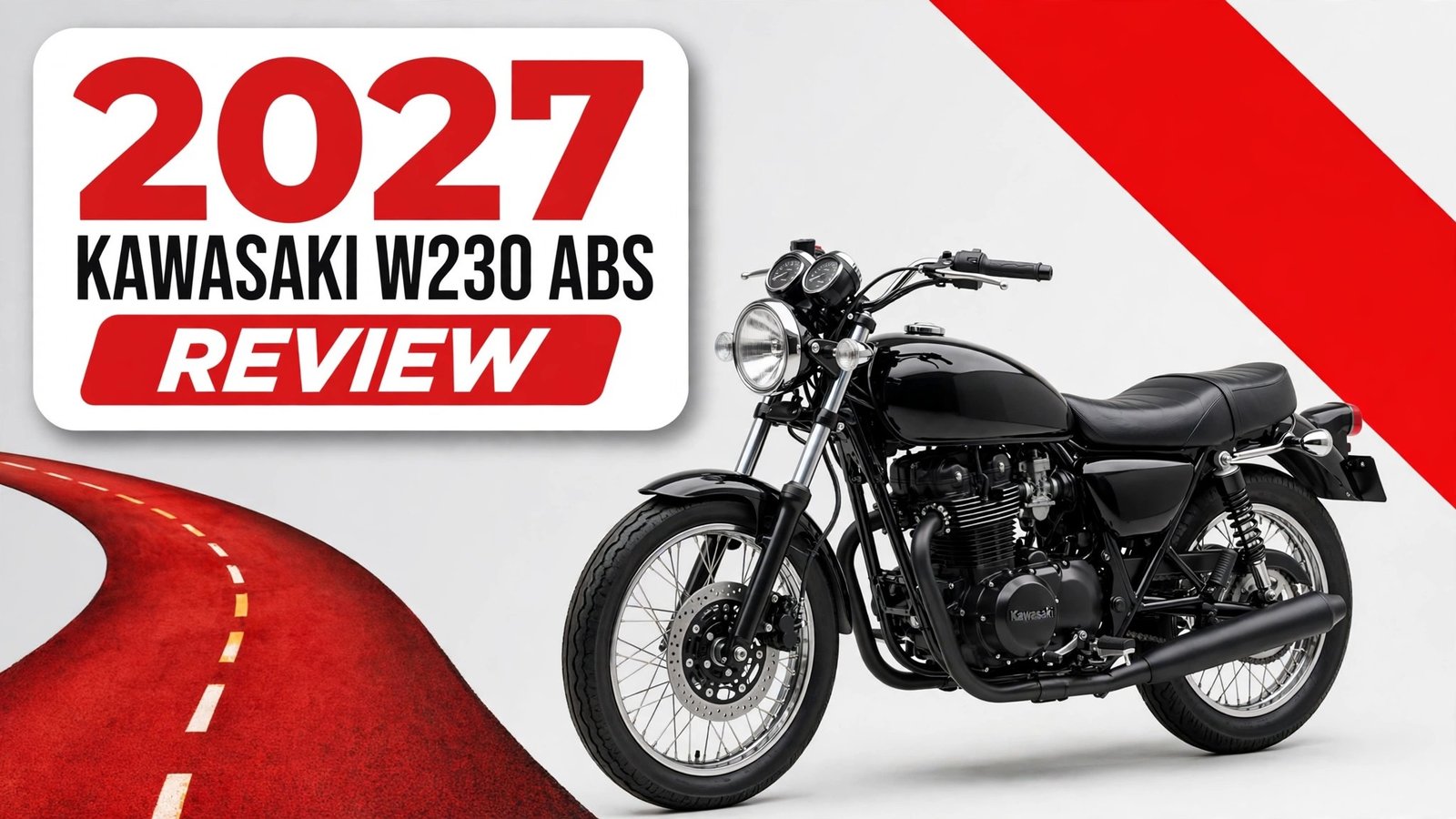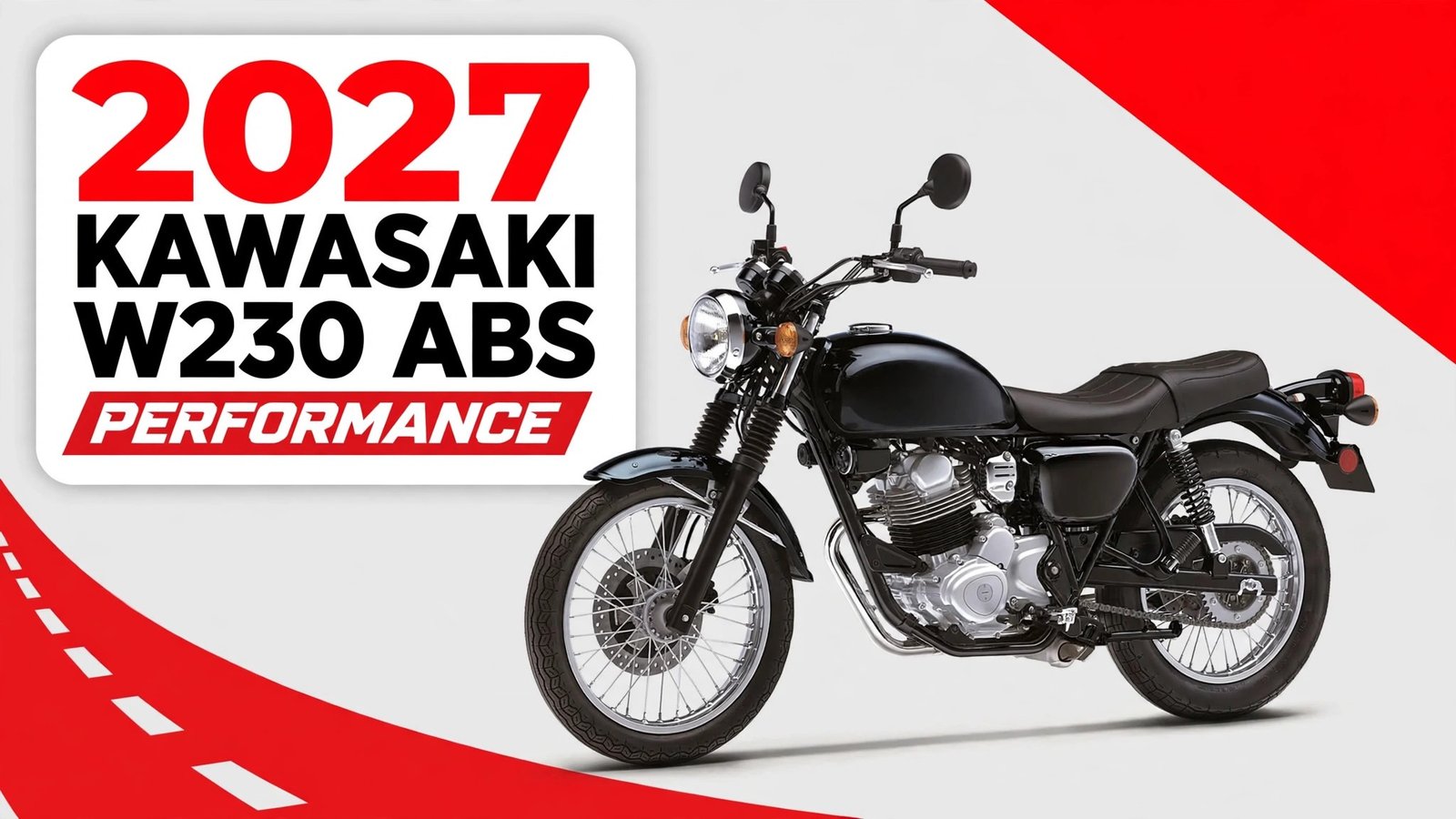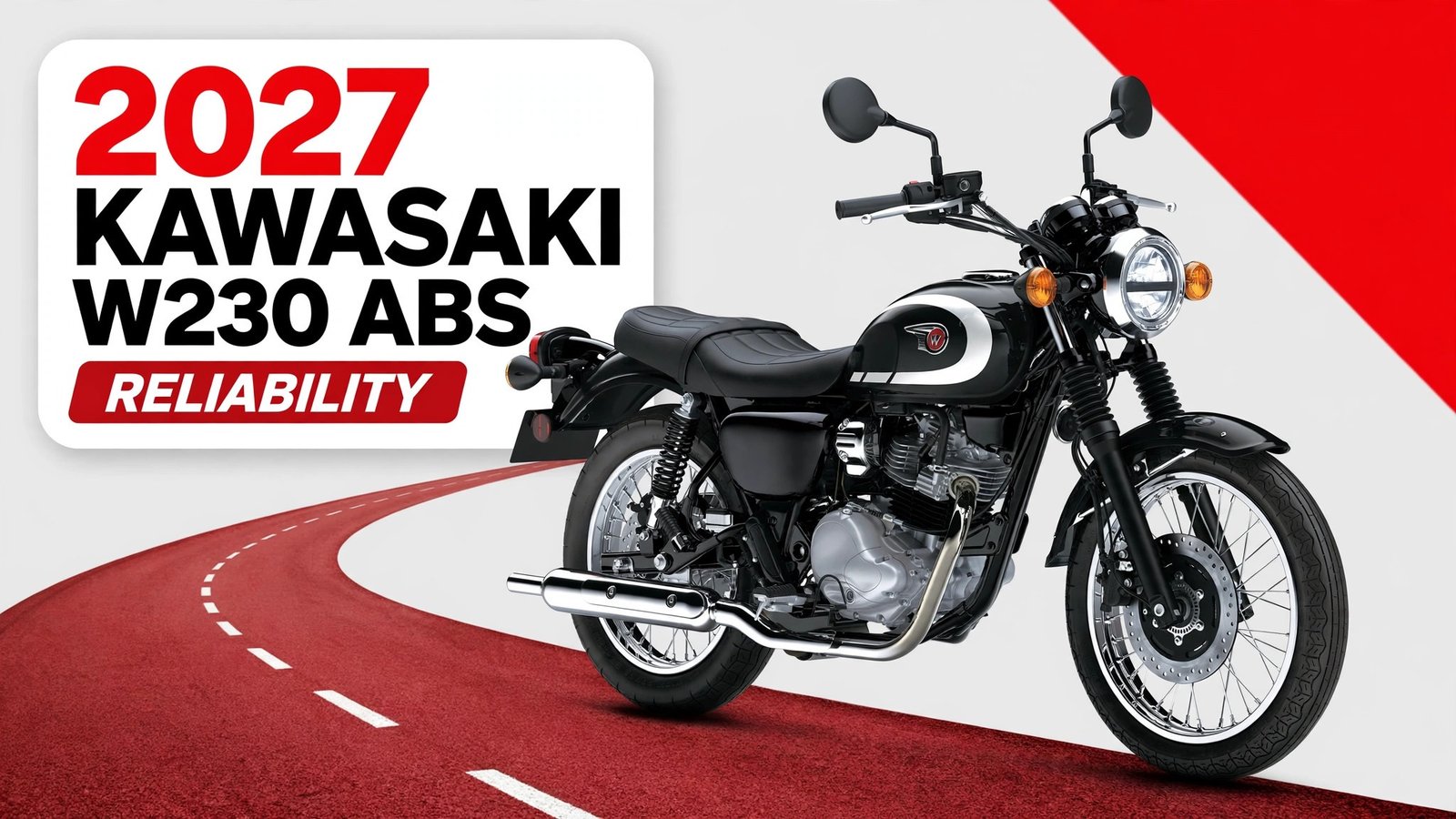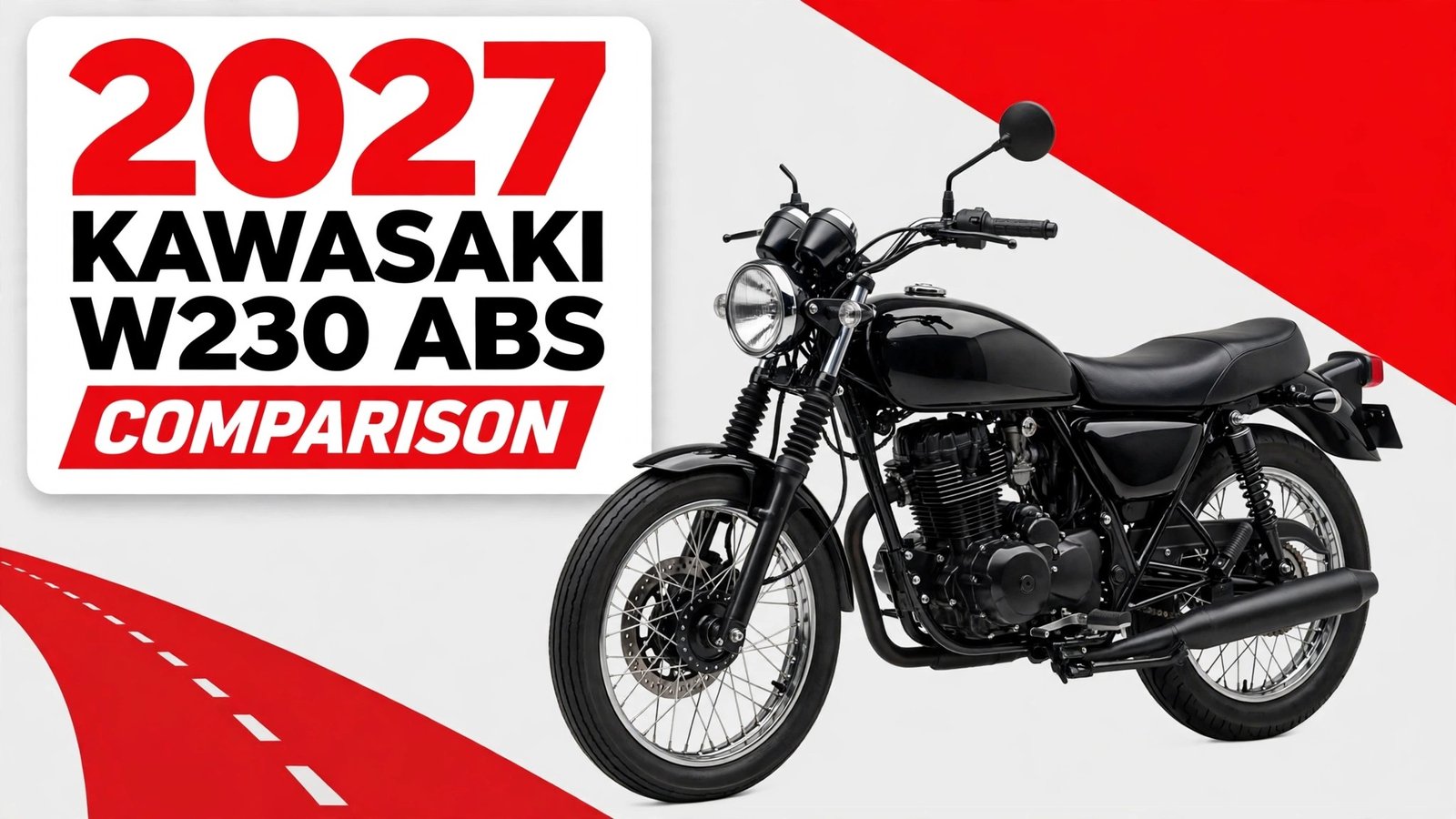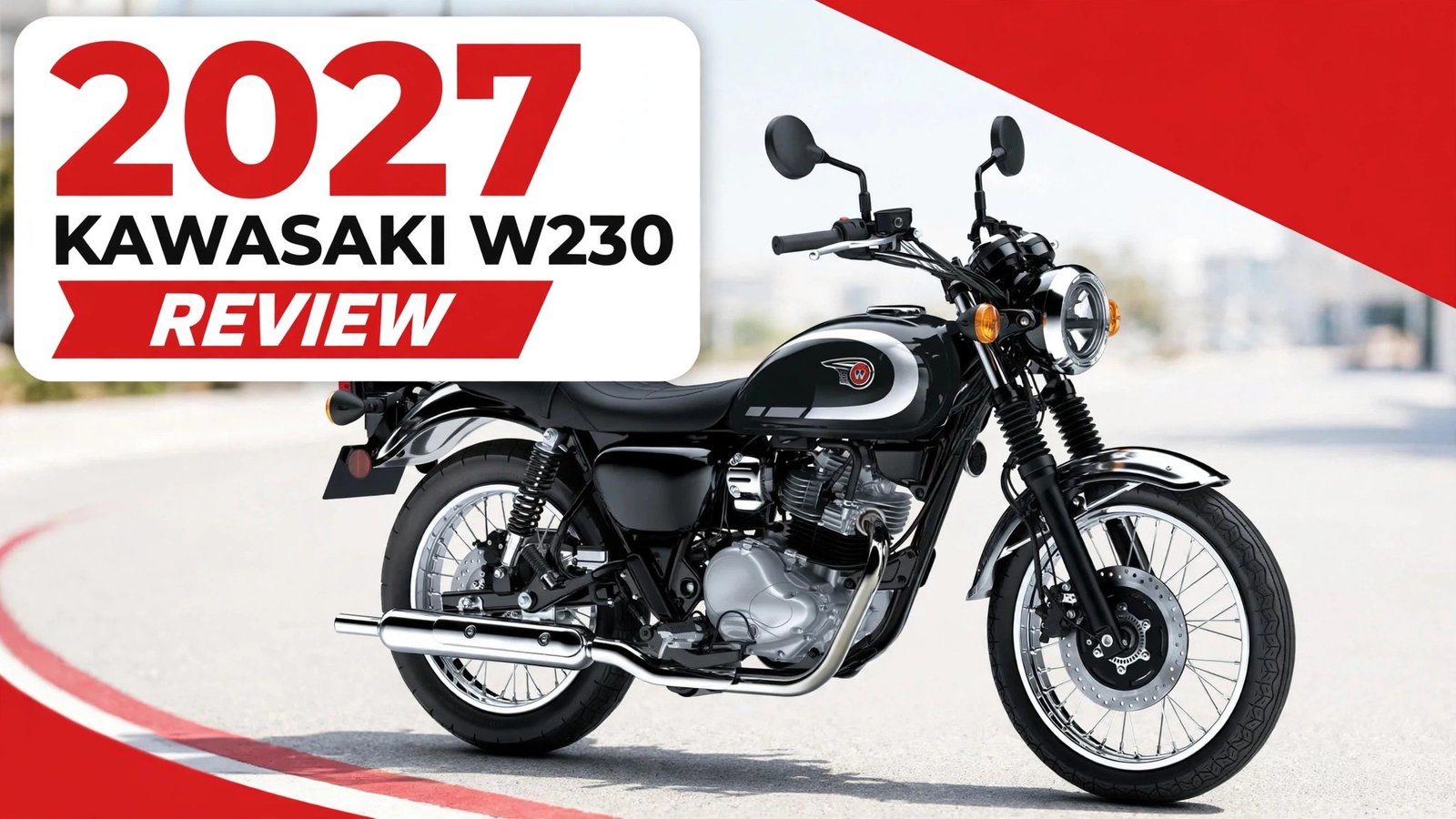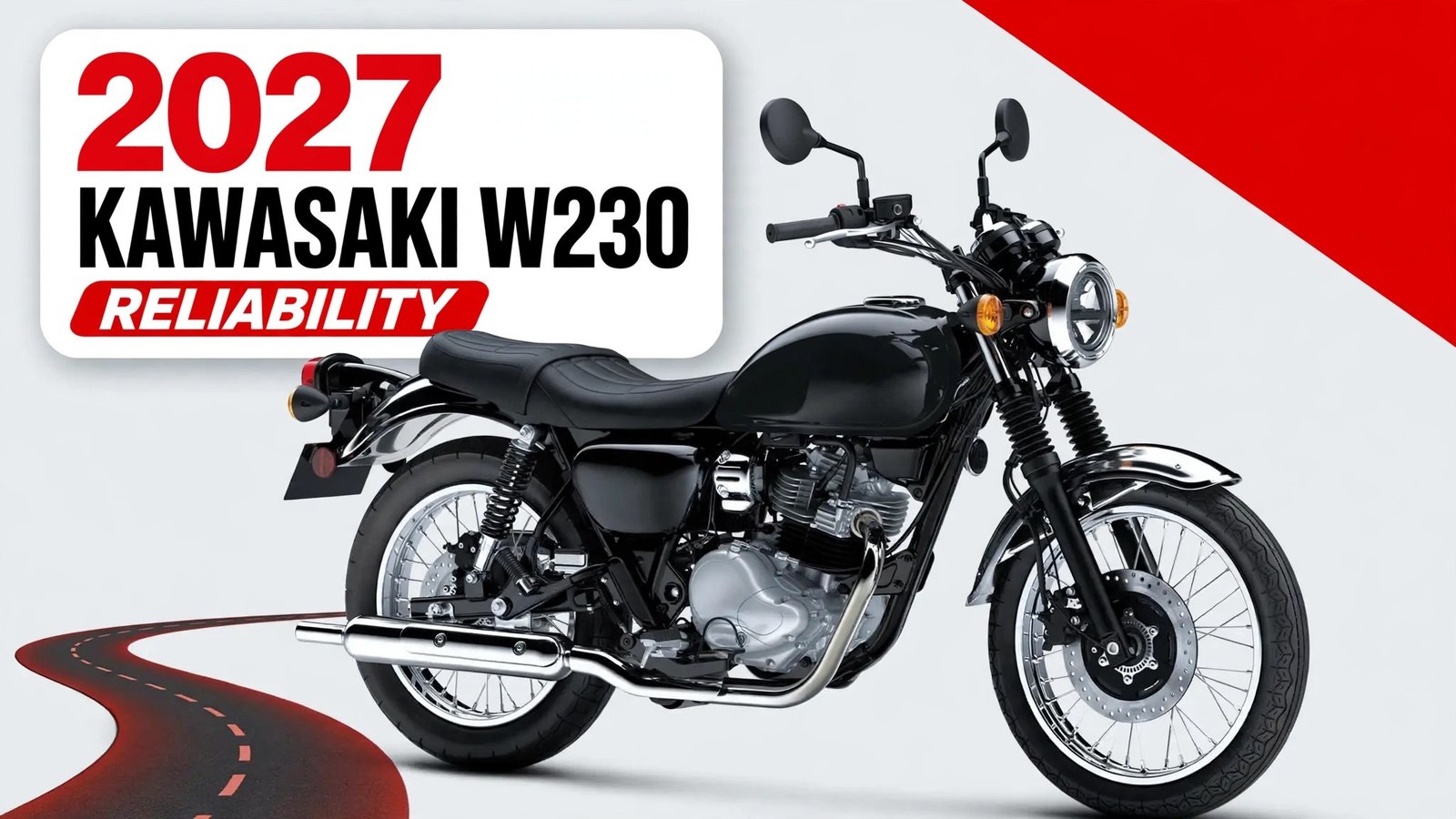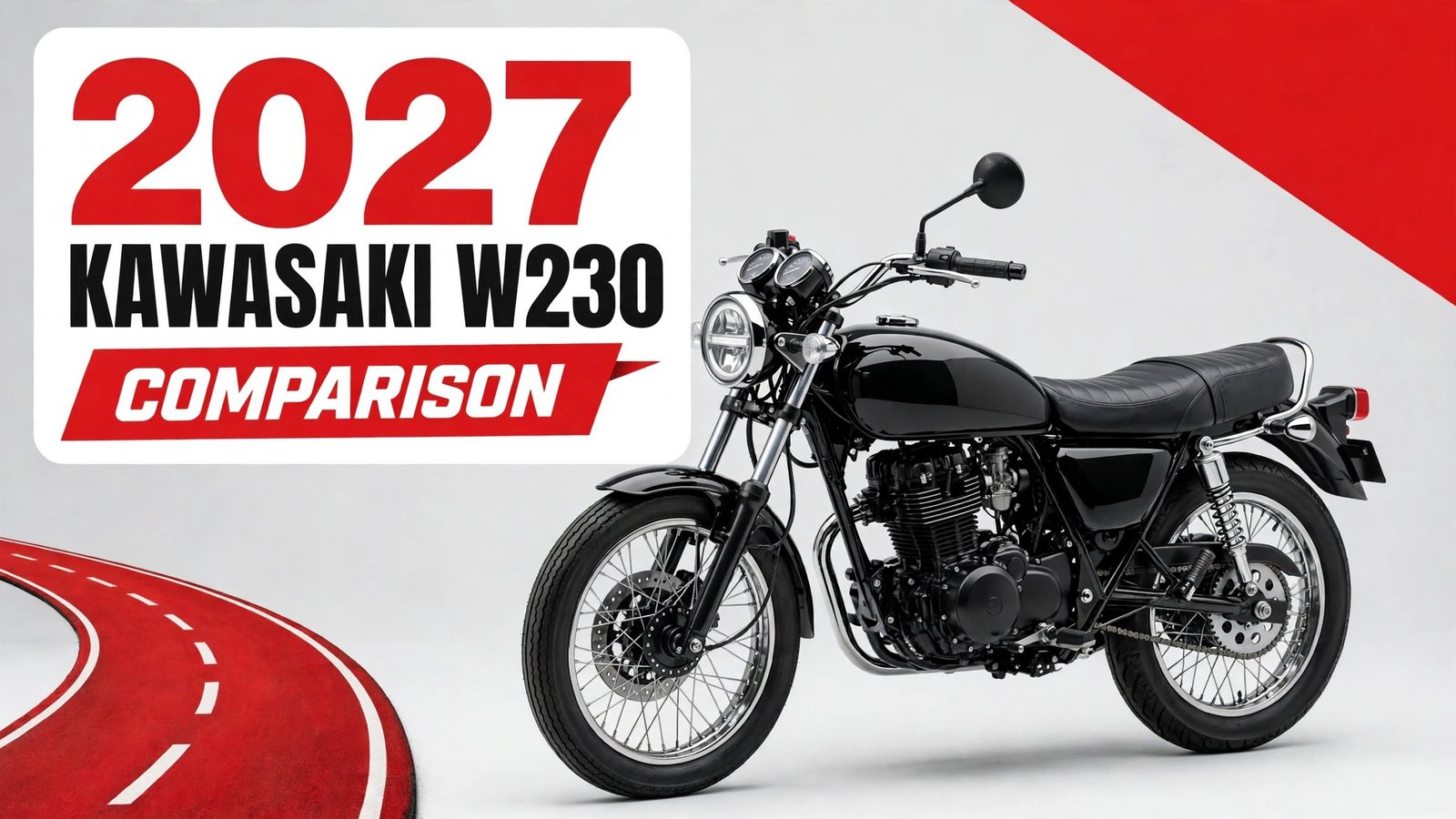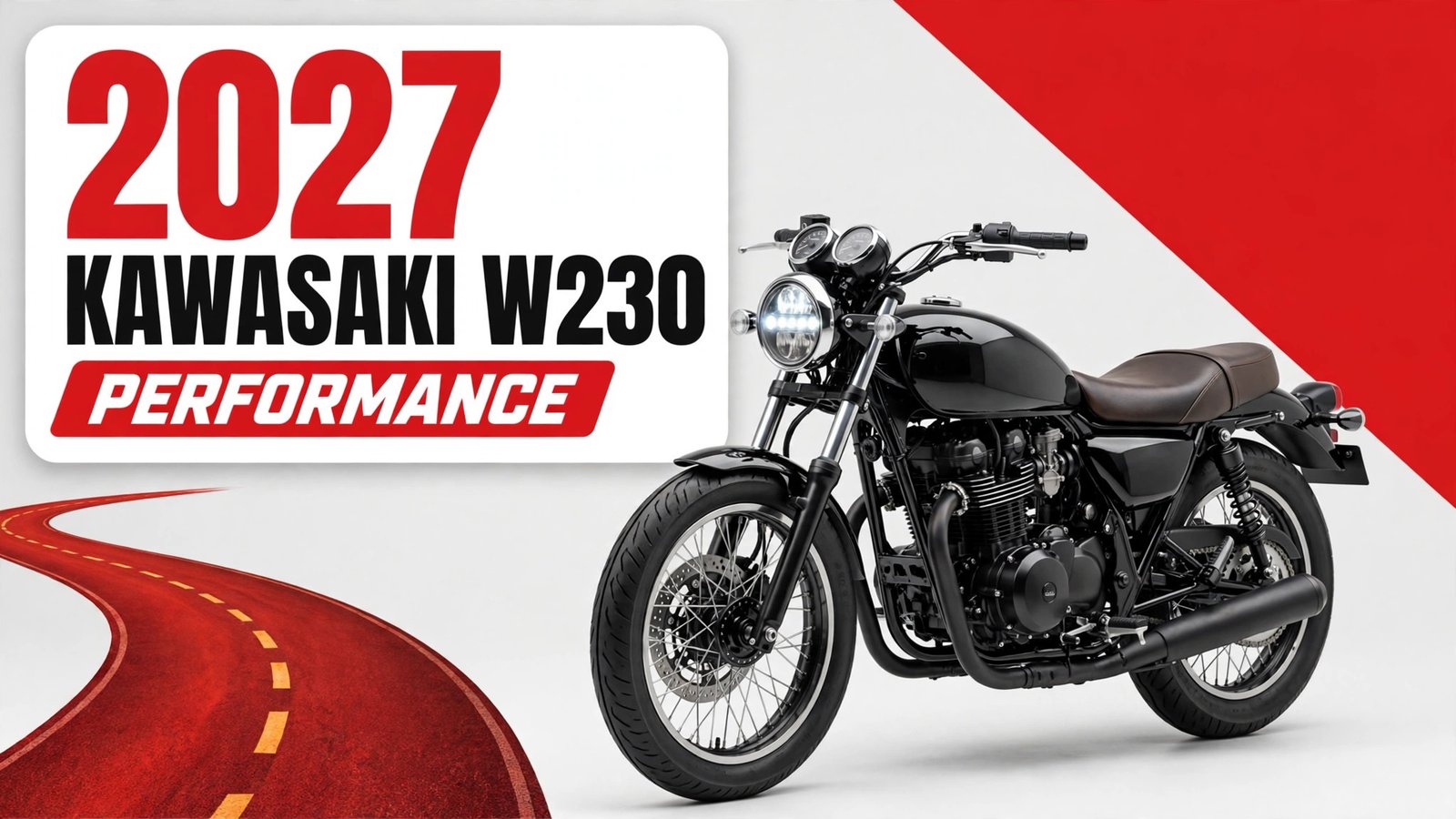
The Kawasaki W230 makes 17 hp, and that single number shapes everything about how it performs. No magazine has dyno-tested it, no publication has timed it, and no GPS top-speed run exists — so this Kawasaki W230 performance guide labels every number for what it is: a Kawasaki claim, a sibling’s measured figure, a Japanese rating, or an owner’s fill-up. What follows in this Kawasaki W230 performance guide is the honest picture: a light, low, gentle motorcycle, quick enough for city streets and back roads, and no quicker than that.
Kawasaki claims 17 hp at 7,000 rpm and 14.0 lb-ft of torque at 5,800 rpm, measured to ISO 4106. The US EPA rates it at 89.1 mpg for 2025 and 88.8 mpg for 2026. And it weighs 315.3 lb at the curb with a 29.3-inch seat — one of the lightest street motorcycles Kawasaki sells. This Kawasaki W230 performance guide works through power, speed, mileage, riding, handling and the Speed 400 comparison in that order.
Kawasaki W230 Engine Performance and Power Delivery
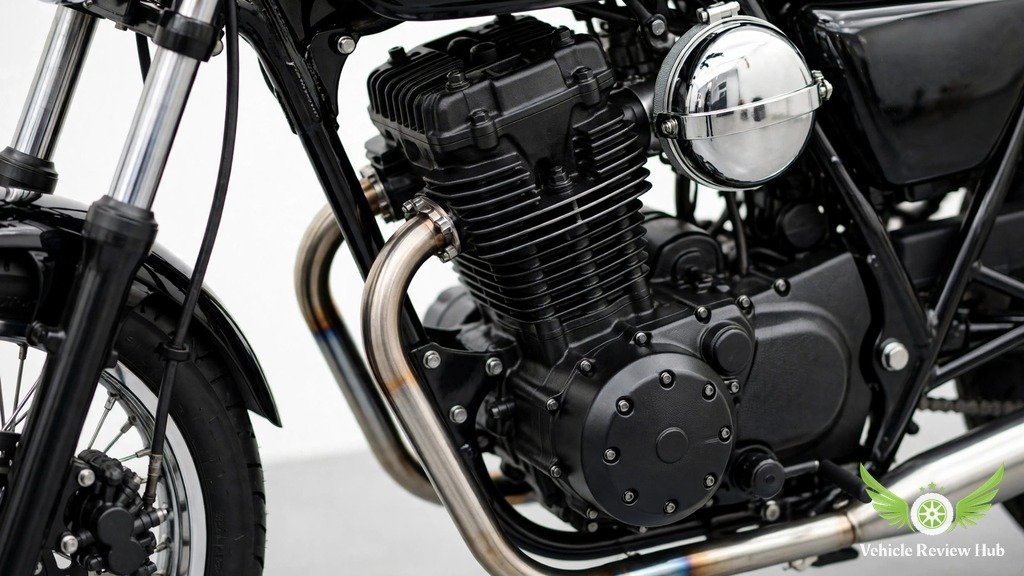
The engine is a 233cc air-cooled single with two valves, a 32mm throttle body and a six-speed gearbox — about as simple as a new motorcycle gets in 2027. This Kawasaki W230 performance section starts with the claimed figures, then explains why no measured figure exists, and what the closest sibling data actually shows.
No Dyno of the W230 Exists
Four targeted searches found no dyno run for the W230 — or for its twin, the Meguro S1. That means the only power figures this Kawasaki W230 performance guide can print as the bike’s own are Kawasaki’s crank claims, from Kawasaki USA’s 2027 spec sheet: 17 hp at 7,000 rpm and 14.0 lb-ft at 5,800 rpm, measured to ISO 4106. Any website quoting a W230 rear-wheel horsepower number is inventing it, and this Kawasaki W230 performance guide does not.
KLX230R Dyno Is Sibling Data
The closest real data belongs to the KLX230R, the W230’s off-road sibling, and this Kawasaki W230 performance guide labels it as the KLX230R’s every time it appears. Cycle World ran a 2022 KLX230R on a Dynojet 250i and measured 17.9 hp at 7,700 rpm and 14.4 lb-ft at 6,100 rpm at the rear wheel. Both sit close to the W230’s 17 hp claim — but they are not the W230’s figures. The W230 engine differs from the KLX230R’s — heavier flywheel, different cams and exhaust tuning, different cases — according to Ultimate Motorcycling’s buyer’s guide. The 2025-and-later KLX230R engine has no dyno at all. So the sibling numbers suggest the W230’s rear-wheel output lands in the mid-teens, and this Kawasaki W230 performance guide leaves it at that — a suggestion, not a measurement.
| Item | Figure | Source / label |
|---|---|---|
| Claimed power | 17 hp @ 7,000 rpm (ISO 4106) | Kawasaki USA |
| Claimed torque | 14.0 lb-ft @ 5,800 rpm | Kawasaki USA |
| Japan / EU rating | 18 PS @ 7,000 rpm / 18.6 Nm @ 5,800 rpm | Home-market figures, not US |
| Engine | 233cc air-cooled single, SOHC, 2 valves | Kawasaki USA spec sheet |
| Transmission | 6-speed, return shift, sealed chain, Positive Neutral Finder | Kawasaki USA spec sheet |
| W230 dyno | None exists | Four searches + Cycle World / MCN sweep |
| KLX230R dyno (sibling) | 17.9 hp @ 7,700 rpm / 14.4 lb-ft @ 6,100 rpm, Dynojet 250i | Cycle World, 2022 KLX230R — sibling data |
Note: The W230 has no dyno figure of its own — the KLX230R row is the sibling’s measured data, never the W230’s. All claimed figures in this Kawasaki W230 performance table are Kawasaki USA’s, measured to ISO 4106.
Kawasaki W230 Top Speed and Acceleration
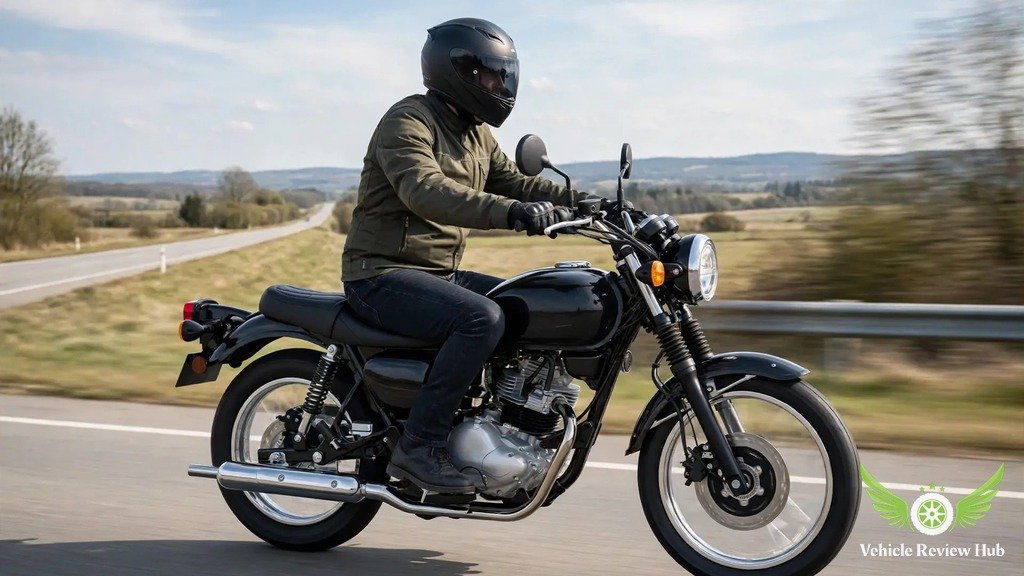
Top speed is the question every buyer asks first about a small bike, and for the W230 it has no tested answer: no GPS top-speed test, no timed 0–60 run, and no quarter-mile figure exists. This Kawasaki W230 performance section says what is known, what is only estimated, and what the closest sibling managed — and stops there.
No Tested Top Speed Yet
As of this writing, no GPS top-speed test, no timed 0–60 mph run and no quarter-mile time exists for the W230 — and this Kawasaki W230 performance guide found none. Cycle World has a first ride and MCN only a social-media post — neither carries a figure. The only owner who addressed speed at all, writing on the Bob Is The Oil Guy forum in April 2025 after about 700 miles, said he had not done a top-speed test but the bike “does 55 60 no problem”. That is the entire tested record: 55–60 mph, no problem. Any article printing a W230 0–60 time or quarter-mile is working from an estimate or a different bike, and this Kawasaki W230 performance guide does not repeat those numbers as facts.
75 to 80 mph Is an Estimate
The 75–80 mph figure that appears in W230 coverage traces to exactly one place: Wikipedia’s Kawasaki W230 infobox, which lists “Top speed 121–129 km/h (75–80 mph) (est.)”. The “(est.)” is Wikipedia’s own label, and the figure carries no citation. So this Kawasaki W230 performance guide prints it only as Wikipedia lists 75–80 mph as an estimate (uncited) — never as a tested top speed. The number is plausible: the plated street sibling, the KLX230, topped out at 77 mph on its speedometer in Motorcycle.com’s 2020 first ride. For a buyer, the honest reading is that the W230 will hold highway speeds but has little in reserve above them, and the exact top speed is still unmeasured — this Kawasaki W230 performance guide will not guess it.
Kawasaki W230 Mileage and Fuel Economy
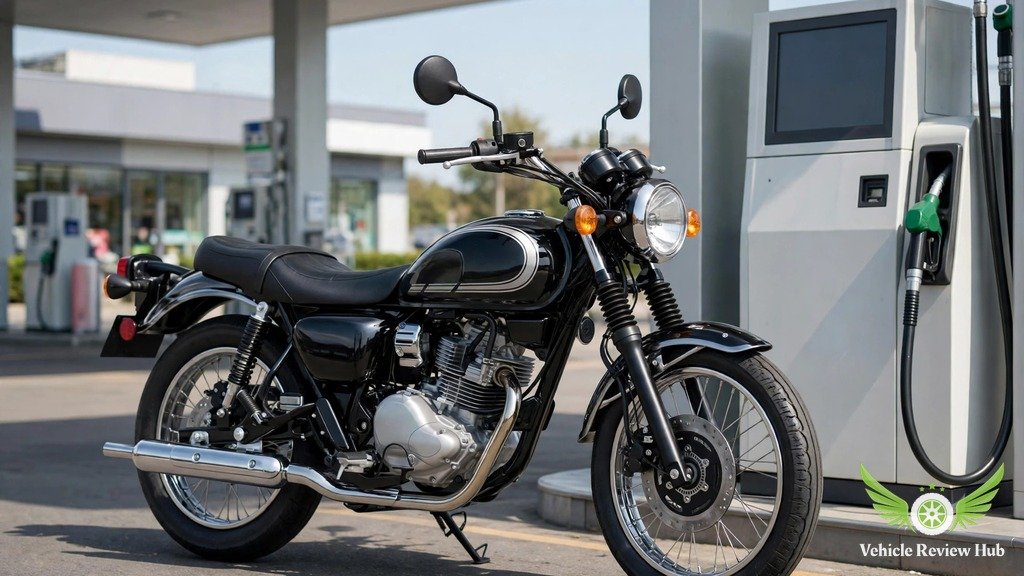
Mileage is where the W230’s numbers need the most care, because the same “94 mpg” can mean three different things depending on the gallon and the test. This Kawasaki W230 performance section labels every figure by source, gallon and method — so the reader always knows which miles per gallon is being quoted.
94 mpg Is a Japanese Figure
Japan’s Kawasaki spec sheet carries two fuel-economy figures: the WMTC mode value of 40.5 km/L, or 95.3 US mpg, and the constant-speed value of 48.4 km/L at 60 km/h with two passengers, or 113.8 US mpg. TopSpeed’s widely quoted “94 miles per gallon” is the US-gallon conversion of 40.0 km/L — a rounded figure, not Japan’s 40.5 km/L WMTC number. Bennetts’ “113mpg claimed” is the same 40.0 km/L figure in Imperial gallons, and it must never be quoted as US mpg. The US figures are different again: the EPA rates the 2025 W230 at 89.1 US mpg and the 2026 bike at 88.8 US mpg — the figures this Kawasaki W230 performance guide prints as the US ratings. So the buyer gets three honest answers: about 95 US mpg on the Japanese WMTC cycle, about 89 US mpg on the US EPA test, and 113.8 US mpg only at a steady 60 km/h with two aboard. This Kawasaki W230 performance guide prints all three with their labels attached, and treats “94 mpg” as what it is — a rounded conversion of a Japanese figure.
Owners Report 84 to 94
The only owner fill-up data found anywhere comes from one American owner, “faltic” on the Bob Is The Oil Guy forum: two break-in fills of 84 mpg and 94 mpg, over roughly 300 miles. That is the honest owner range for this Kawasaki W230 performance guide — 84 to 94 mpg, one owner, two fills, during break-in — and it sits neatly between the EPA’s 89.1 and the Japanese WMTC’s 95.3. The “78 mpg” in some coverage is not a W230 figure at all: it is the same owner’s KLX230, which returned 74 mpg and then 78 mpg after an oil change — and this Kawasaki W230 performance guide does not print it as one. One owner and two fills is thin evidence: the W230 looks like a 90-mpg motorcycle, but the owner record is a single data point, not a survey.
| Figure | Value | Source, gallon and method |
|---|---|---|
| Japan WMTC | 40.5 km/L = 95.3 US mpg | Kawasaki Japan, WMTC mode, 1 occupant |
| Japan constant-speed | 48.4 km/L = 113.8 US mpg | Kawasaki Japan, 60 km/h, 2 passengers |
| TopSpeed “94 mpg” | 40.0 km/L = 94.1 US mpg | Rounded conversion, not the WMTC number |
| Bennetts “113 mpg” | 40.0 km/L = 113.0 Imp mpg | Imperial gallons — NOT a US figure |
| US EPA 2025 | 89.1 US mpg | EPA cert SKAXC.233AAC-022-R01, 2.64 L/100 km |
| US EPA 2026 | 88.8 US mpg | EPA cert TKAXC.233AAC-003, 2.65 L/100 km |
| Owner fills | 84 mpg and 94 mpg | One owner, two break-in fills (BITOG) |
Note: Every figure in this Kawasaki W230 performance table is labelled by source, gallon and test method. “94 mpg” is a rounded conversion of a Japanese figure; “113 mpg” as quoted by Bennetts is Imperial gallons. The US ratings are the EPA’s 89.1 mpg (2025) and 88.8 mpg (2026).
Kawasaki W230 Real-World Riding Experience

With no magazine road test carrying figures, the real-world record rests on two sources: a beginner tester who rode the bike for Ultimate Motorcycling in San Luis Obispo, and an owner who logged around 700 miles. Both agree on the bike’s shape — light, low, gentle, easy — and name the same flaws. This Kawasaki W230 performance section reports what they said, attributed.
Ride with Warro takes his 2026 W230 off the road in this 6:20 video from October 27, 2026, tackling a rough 4WD track in the Australian bush. He worries about grounding the bike on loose rock and calls the climb a fairly hairy ride. This is no top-speed test — it shows what the light W230 does on rough ground, in English throughout.
The Riding Experience Buyers Actually Talk About
Ultimate Motorcycling’s beginner tester, Allison, rode the W230 around San Luis Obispo and came away warm: “Buzzing around San Luis Obispo, the W230 is super fun and easy to ride.” The lightness did the work — she said the bike’s light weight and its IRC Grand High Speed GS-11 tyres gave her the confidence to lean it over farther than she thought she could. The owner with around 700 miles agrees from the other side of the experience curve: the engine is “pretty old school smooth and torquey for what it is”, the brakes are “a little on the soft side but if you get into them they will let you stop on a dime”, and the bike “does 55 60 no problem” on the road. That is the W230’s real-world character in this Kawasaki W230 performance guide: fun because it is light and simple, not because it is fast.
Stiff Throttle, Firm Seat
The same two riders name the same caveats, which a buyer should hear before the purchase, not after. Allison found the throttle stiff — “I have to put in more effort to turn it to get to the power” — the seat firm and not very comfortable, the suspension “a bit stiff, making for a ‘hard’ ride”, and the clutch late to engage, which gave her trouble shifting at first. She also praised the brakes as “great, though with a quick response, so I have to be careful not to squeeze the lever too hard or too fast”. The owner agrees on the seat: “The seat looks comfy but after 20 minutes you’ll rethink.” He adds a break-in quirk of his own — shifting that felt gritty after the first 200 miles, which eased with an oil change, and two or three occasions of failing to accelerate when shifting into fifth or sixth. None of this is a defect pattern — the bike has zero NHTSA complaints on file — but it is the consistent owner record: a short-ride motorcycle with a firm seat and a stiff throttle, best enjoyed around town. The recall record and the full reliability picture are covered in the Kawasaki W230 reliability guide.
Kawasaki W230 Handling, Braking and Stability
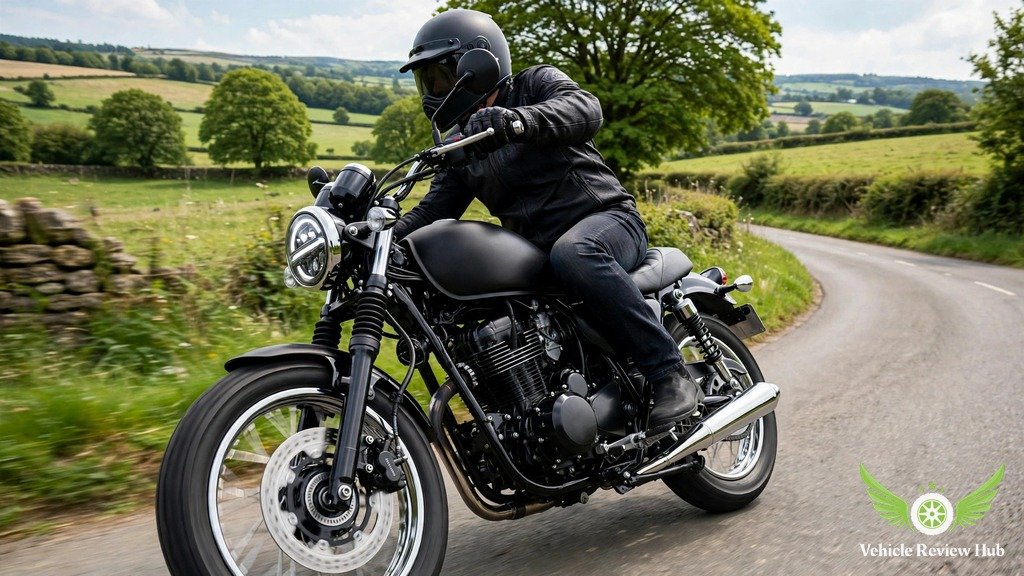
Handling is the W230’s strongest performance card, and it comes from the spec sheet, not from a test: 315.3 lb at the curb, a 29.3-inch seat, a 55.7-inch wheelbase and disc brakes with ABS at both ends. Light weight forgives a lot in a motorcycle, and the W230 has the least of it in its class. This Kawasaki W230 performance section covers the chassis, the brakes, and how the bike behaves on real roads.
Both Ends Run Disc Brakes
The W230 carries a single 265mm front disc with a two-piston caliper and a single 220mm rear disc with a one-piston caliper, with ABS on both wheels every model year. Older retro singles often ran rear drums, and some early coverage assumed this one did too — it does not; the rear disc is confirmed on all three years’ Kawasaki spec sheets. No other rider aids appear on any sheet: no traction control, no riding modes, no slipper clutch. The chassis is equally straightforward — a 37mm telescopic fork with 4.6 inches of travel, twin preload-adjustable rear shocks with 3.7 inches, a steel semi-double-cradle frame, and 27.0 degrees of rake with 3.7 inches of trail. The tyres are a 90/90-18 front and 110/90-17 rear, named by Ultimate Motorcycling as the IRC Grand High Speed GS-11. For a 315 lb motorcycle with 17 hp, that is honest, adequate equipment — though this Kawasaki W230 performance guide notes the gap too: the Speed 400’s front brake is a 300mm disc with a four-piston radial caliper, a step up the W230 does not match.
Handling, Braking and Stability on Real Roads
On real roads, the W230’s lightness is the handling story. Allison, the beginner tester, said the bike’s lightness gave her the confidence to lean it over farther than she thought she could — the clearest handling verdict the bike has. The short wheelbase and low seat make it easy to place in a corner and easy to catch. The stiff suspension cuts both ways: composed on smooth roads, harder on broken pavement, and the firm seat limits how long a rider wants to stay in the saddle. Braking drew praise from both riders — “great, with a quick response” from Allison, “stop on a dime” from the owner — with the shared caution that the brakes are strong enough to demand a gentle hand. Stability at speed is the open question: with no tested top speed and a light, upright motorcycle, this Kawasaki W230 performance guide can only say the bike is stable and willing at the speeds owners actually ride it, and unproven above them.
Kawasaki W230 Performance Compared With Other Sport Bikes

The comparison that matters most is the Triumph Speed 400: the two bikes sit within $204 of each other on MSRP and could not be further apart on performance. The Hunter 350 is the cheaper rival — $4,299 against the W230’s $5,699 for 2026 — and it too makes more power, at 20.2 bhp. This Kawasaki W230 performance section puts the claimed figures side by side.
Kawasaki W230 vs Triumph Speed 400
On claimed figures the Speed 400 is far quicker than the W230, and the gap is not close. The Triumph’s 398cc liquid-cooled single makes 39.5 hp at 8,000 rpm and 27.7 lb-ft at 6,500 rpm, against the W230’s 17 hp at 7,000 rpm and 14.0 lb-ft at 5,800 rpm — more than twice the power and nearly twice the torque. The Speed 400 is heavier, at 375 lb wet against the W230’s 315.3 lb curb, but 60 lb cannot close a 22.5 hp gap. The Triumph also brings modern hardware the W230 lacks: ride-by-wire, a 300mm front disc with a four-piston radial caliper, and a liquid-cooled DOHC four-valve head. The W230 answers with lightness, a lower seat (29.3 in against 31.1 in) and the retro W-series look. On price, Triumph’s own US site lists the Speed 400 from $5,495, with $600 freight for $6,095 delivered — against the 2026 W230 at $5,699 plus $435, or $6,134 delivered. Four 2026 dealer listings show the Speed 400 at $5,595 instead; this Kawasaki W230 performance guide prints Triumph’s figure as the manufacturer’s price and discloses the dealer figure in the same paragraph. On delivered prices the W230 is the dearer bike by $39 — $6,134 against $6,095 — while making less than half the power. No head-to-head test of the two bikes exists, so the comparison rests on claimed figures — and on those figures, the Speed 400 is the performance pick and the W230 is the character pick. The full four-bike price and value comparison is in the Kawasaki W230 comparison.
Is the Kawasaki W230 Suitable for Beginner Riders?
Yes — with the same caveats this Kawasaki W230 performance guide has printed throughout. The case for beginners is the spec sheet: 17 hp, 315.3 lb at the curb, a 29.3-inch seat, ABS on both wheels, a six-speed gearbox and Positive Neutral Finder. Ultimate Motorcycling’s beginner tester called the bike “super fun and easy to ride” and said its lightness gave her the confidence to lean it over farther than she thought she could. The caveats are hers too: a stiff throttle that demands more effort, a firm seat, a stiff suspension and a clutch that engages late. A new rider who accepts those quirks gets one of the most approachable motorcycles Kawasaki sells; a new rider who wants a softer throttle and a plusher seat should look at the Hunter 350, which is also $1,400 cheaper on MSRP. The full beginner verdict, with the review’s price and heritage context, is in the Kawasaki W230 review.
| Item | 2026 Kawasaki W230 ABS | 2026 Triumph Speed 400 |
|---|---|---|
| Engine | 233cc air-cooled single, SOHC, 2 valves | 398.15cc liquid-cooled DOHC single, 4 valves |
| Claimed power | 17 hp @ 7,000 rpm | 39.5 hp @ 8,000 rpm |
| Claimed torque | 14.0 lb-ft @ 5,800 rpm | 27.7 lb-ft @ 6,500 rpm |
| Transmission | 6-speed, return shift, Positive Neutral Finder | 6-speed, ride-by-wire |
| Weight | 315.3 lb curb | 375 lb wet |
| Seat height | 29.3 in | 31.1 in |
| Fuel capacity | 3.1 gal | 3.43 gal |
| Front brake | Single 265mm disc, 2-piston caliper, ABS | 300mm disc, 4-piston radial caliper, ABS |
| MSRP | $5,699 | $5,495 (Triumph; dealers show $5,595) |
| Delivered | $6,134 ($435 destination) | $6,095 ($600 freight) |
Note: All figures in this Kawasaki W230 performance table are the manufacturers’ claimed figures — no head-to-head test of the two bikes exists. On delivered prices the W230 is $39 dearer than the Speed 400 ($6,134 against $6,095) while making less than half its power; the Speed 400’s $5,495 is Triumph’s own figure, with four dealer listings showing $5,595 disclosed here.
Kawasaki W230 Performance FAQs
The questions below cover what buyers ask about most in this Kawasaki W230 performance guide: top speed, the dyno question, real MPG, highway ability, beginner suitability and the Speed 400 comparison. Every answer labels its figures for what they are.
What is the Kawasaki W230’s top speed?
No tested top speed exists. Wikipedia lists 75–80 mph as an estimate (uncited), and the closest sibling data is the KLX230’s 77 mph on its speedometer. This Kawasaki W230 performance guide prints no tested figure for the W230.
Has anyone dyno-tested the W230?
No. The closest data is the sibling KLX230R: 17.9 hp at 7,700 rpm on Cycle World’s Dynojet 250i (2022 bike) — labelled as the KLX230R’s, never the W230’s. Kawasaki’s own claim for the W230, as this Kawasaki W230 performance guide prints it, is 17 hp at 7,000 rpm.
What MPG does the W230 get?
US EPA: 89.1 mpg (2025) and 88.8 mpg (2026). Japan WMTC: 40.5 km/L, or 95.3 US mpg. One US owner recorded 84 and 94 mpg over two break-in fills. This Kawasaki W230 performance guide labels every figure by source and gallon.
Is the W230 fast enough for the highway?
It has no tested top speed, so the honest answer is limited. The only owner who addressed it said it “does 55 60 no problem” and never tested the top speed. The sibling KLX230 topped out at 77 mph on its speedometer in Motorcycle.com’s 2020 first ride. On the evidence in this Kawasaki W230 performance guide, the W230 will hold highway speeds; how much it has in reserve is unmeasured.
Is the W230 suitable for beginner riders?
Yes, with caveats. The 17 hp, 315.3 lb curb weight and 29.3-inch seat suit beginners, and Ultimate Motorcycling’s beginner tester called the W230 “super fun and easy to ride” — but she also found a stiff throttle, a firm seat and a late-engaging clutch. This Kawasaki W230 performance guide recommends it to new riders who accept those quirks.
W230 or Triumph Speed 400 — which is quicker?
On claimed figures the Speed 400 is far quicker: 39.5 hp at 8,000 rpm against the W230’s 17 hp at 7,000 rpm, and 375 lb wet against 315.3 lb curb. No head-to-head test exists, so the comparison in this Kawasaki W230 performance guide rests on the manufacturers’ claims — and on those, the Speed 400 wins on speed while the W230 wins on lightness and character.