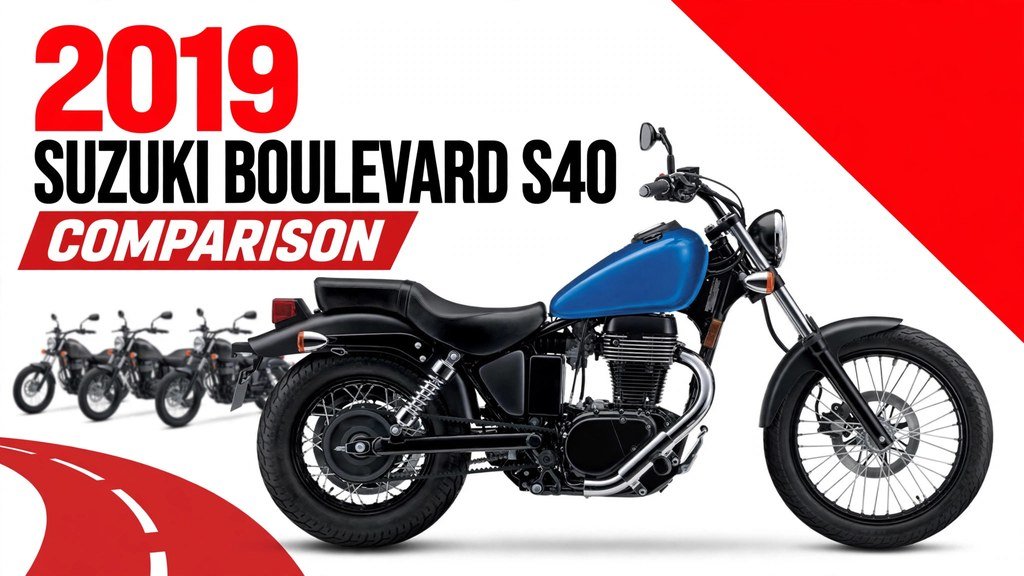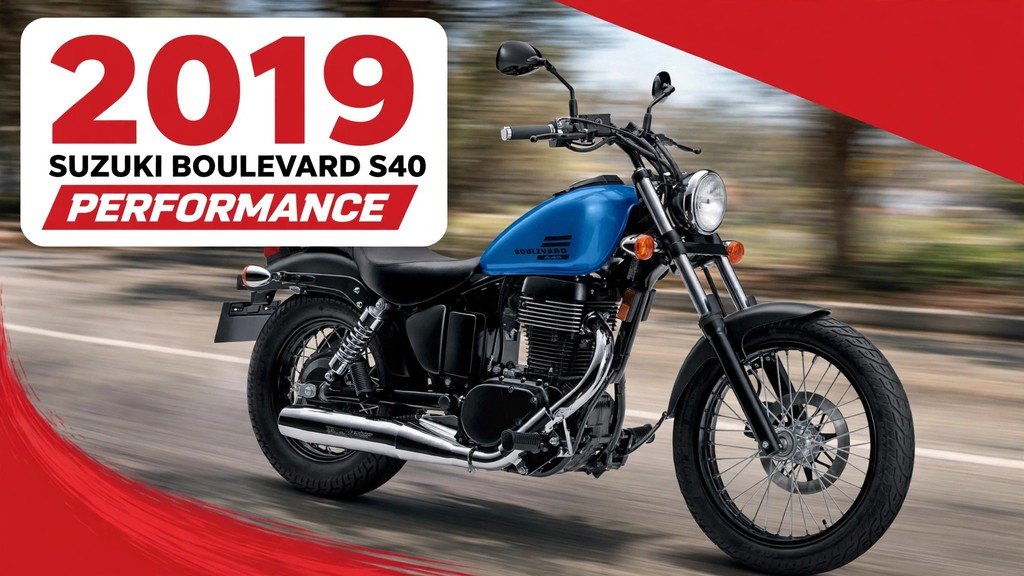
The short answer in this Suzuki Boulevard S40 performance guide is that the bike is slow by every modern measure: a 652cc air-cooled single that made 31 horsepower at the rear wheel on a 1996 dyno, ran the quarter mile in 15.3 seconds that year and 16.35 seconds in a 2006 retest, and returned 52.9 miles per gallon in the later test. There is no instrumented top-speed test, no horsepower figure from Suzuki itself, and no 0–60 time from a magazine — and this Suzuki Boulevard S40 performance guide prints exactly what the tests did measure and labels everything else as an estimate.
Suzuki Boulevard S40 Engine Performance and Power Delivery
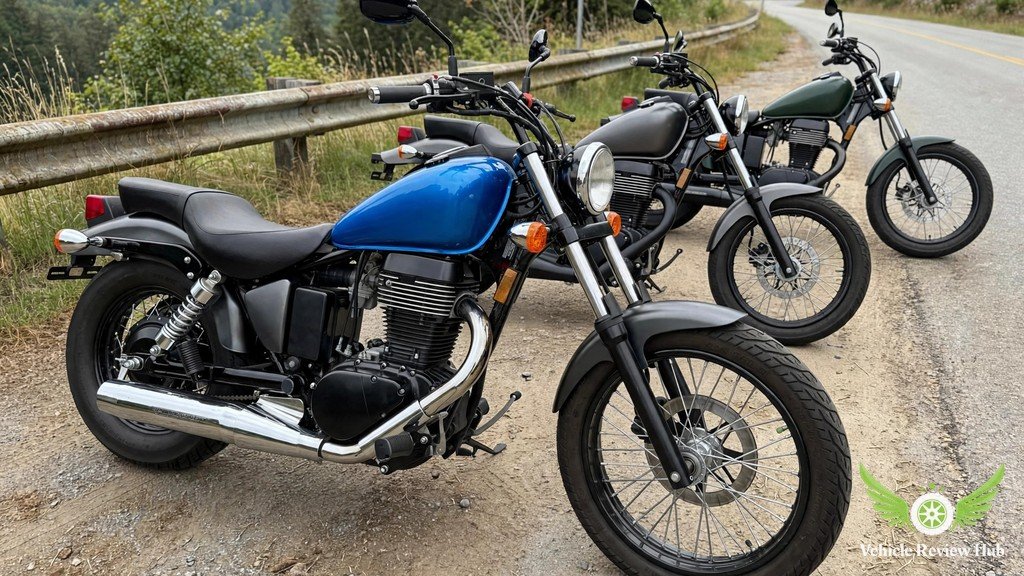
The S40’s engine is a 652cc air-cooled single with one overhead camshaft, four valves, an 8.5:1 compression ratio and a Mikuni BS40 carburetor, driving the rear wheel through a five-speed gearbox and a belt. It is the simplest engine in Suzuki’s Boulevard line and the largest single-cylinder cruiser the company ever built, whose power delivery is the whole story of this Suzuki Boulevard S40 performance guide: a soft, low-revving single that pulls cleanly from idle and runs out of breath long before the road does. Full specification: the archived Suzuki USA 2019 S40 page; history: Wikipedia’s Suzuki Boulevard S40 article.
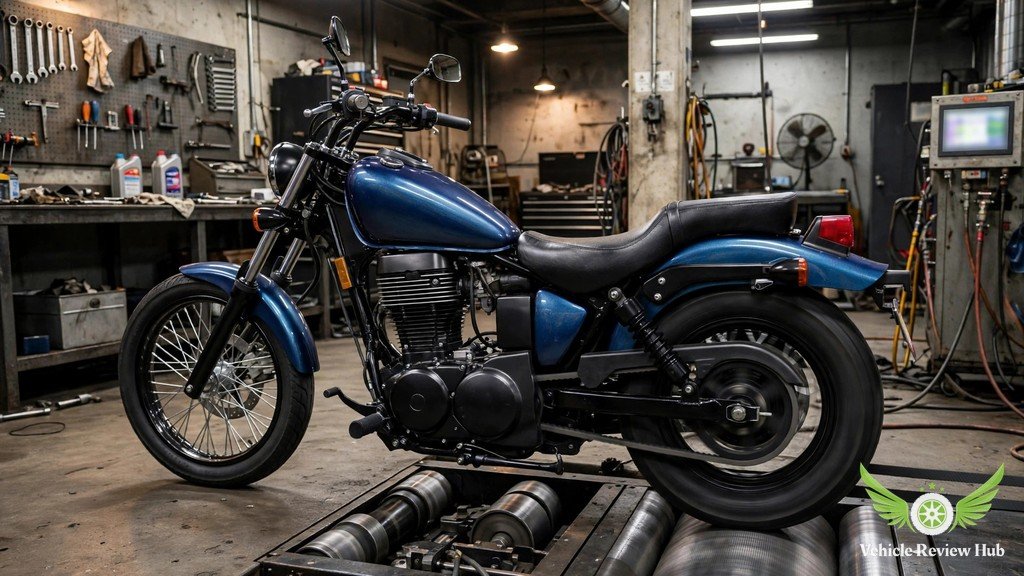
1996 Test: 31 HP at the Rear Wheel
The only measured power figure for the S40 comes from Motorcycle Consumer News in 1996, which put an LS650 Savage on a dyno and recorded 31 horsepower at the rear wheel with 30.5 lb-ft of rear-wheel torque. That is a measured figure, not a factory claim — and Suzuki USA never published a horsepower or torque number for the S40 on any US page. At 60 mph the same test recorded the engine spinning 3,940 rpm. That sets the scale: 31 horsepower at the wheel, moving 381 pounds, is enough for city streets and back roads and not enough for a fast interstate.
Claimed 31 HP Figures Are Database Numbers
The “31 hp at 5,400 rpm and 37 lb-ft at 3,400 rpm” figures that appear in spec listings are database-circulated numbers, not a Suzuki USA publication — and this Suzuki Boulevard S40 performance guide keeps the two things strictly separate. The database claim says 31 horsepower at 5,400 rpm with 50 Nm (37 lb-ft) of torque at 3,400 rpm; the measured figure says 31 horsepower at the rear wheel with 30.5 lb-ft of rear-wheel torque. The horsepower numbers happen to match, which invites confusion, but they are different kinds of numbers: one is a circulated claim that cannot be traced to a Suzuki USA page, the other is a test result from a named magazine in a named year. Any listing that presents the database claim as “Suzuki claims 31 hp” is overstating its source. Other numbers floating around are worse — 42 at 6,800 rpm, 30 at 5,500 rpm, 33 at 3,400 rpm — none traceable to Suzuki, and none appears in this Suzuki Boulevard S40 performance guide as a fact.
| Figure | Value | Source and status |
|---|---|---|
| Rear-wheel horsepower | 31 hp at the rear wheel | Motorcycle Consumer News, 1996 dyno — measured |
| Rear-wheel torque | 30.5 lb-ft at the rear wheel | Motorcycle Consumer News, 1996 dyno — measured |
| Quarter mile, 1996 | 15.3 seconds at 81.1 mph | Motorcycle Consumer News, 1996 — instrumented |
| Quarter mile, 2006 | 16.35 seconds at 77.2 mph | Motorcycle Cruiser, 2006 — instrumented |
| Fuel economy, 1996 | 55 mpg average | Motorcycle Consumer News, 1996 — tested |
| Fuel economy, 2006 | 52.9 mpg average | Motorcycle Cruiser, 2006 — tested |
Suzuki Boulevard S40 Top Speed and Acceleration
Acceleration is where Suzuki Boulevard S40 performance can actually be measured, and the two instrumented quarter-mile runs are the only acceleration figures this Suzuki Boulevard S40 performance guide treats as tested facts. Top speed, by contrast, has no instrumented figure at all — no magazine ever published a GPS or timed top-speed test — so this section states that plainly and labels every speed number that follows as an owner estimate. The Suzuki Boulevard S40 review covers the bike’s history and pricing.
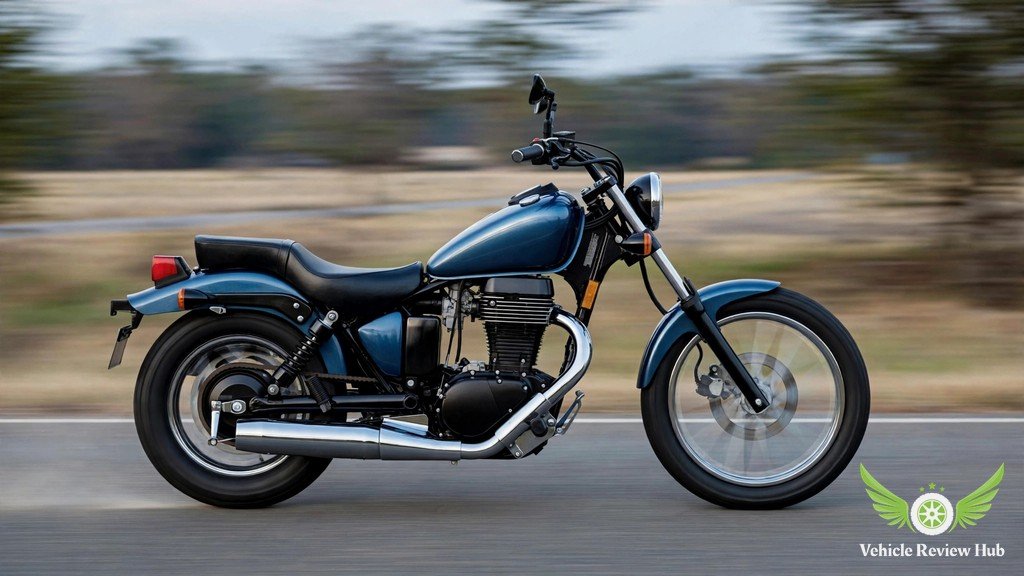
The video below is SRK Cycles’ “Suzuki S40 0 to 60” — an owner’s 0–60 run on an S40, not a magazine test. Watch it for what the bike looks and sounds like under full throttle; the run is not presented here as a tested figure.
Quarter Mile 15.3 in 1996, 16.35 in 2006
Two instrumented quarter-mile figures exist for the S40, and both stand: 15.3 seconds at 81.1 mph (Motorcycle Consumer News, 1996) and 16.35 seconds at 77.2 mph (Motorcycle Cruiser, 2006). The 2006 bike was slower than the 1996 bike — different bikes, different days, different testers — and this Suzuki Boulevard S40 performance guide does not smooth the two into one figure or “correct” the slower one toward the faster one. Together they describe a range, roughly a mid-15 to mid-16 second quarter mile at 77 to 81 mph, for a stock S40. The trap speed matters too: 81.1 mph in 1996 is the speed the bike was travelling as it crossed the finish line, and some websites have lifted that number and printed it as a top speed — it is a trap speed, not a top speed. For 0–60, no magazine test exists; owner pages quote around 7.0 seconds, a secondary figure.
No Instrumented Top-Speed Test Was Ever Found
No instrumented or GPS top-speed test for Suzuki Boulevard S40 performance was ever published in any named source, and this Suzuki Boulevard S40 performance guide says so plainly rather than filling the gap with a borrowed number. Owner estimates commonly run 81–85 mph — labelled here as owner estimates only — and the low end of that range is the same 81 mph as the 1996 quarter-mile trap speed. An AI-written page claims a top speed of 85 mph and a sub-seven-second 0–60 time as if both were measured; neither is sourced, and neither is a fact. The practical truth is narrower: the bike runs out of breath at 65 mph, as Motorcycle Cruiser put it in 2006, so its absolute top speed is not a speed the bike is happy holding.
Suzuki Boulevard S40 Mileage and Fuel Economy
Fuel economy is where Suzuki Boulevard S40 performance genuinely shines: two named, tested figures, both over 50 miles per gallon, from two magazines ten years apart. The 2.8-gallon tank is small, so the range is modest even at those figures.
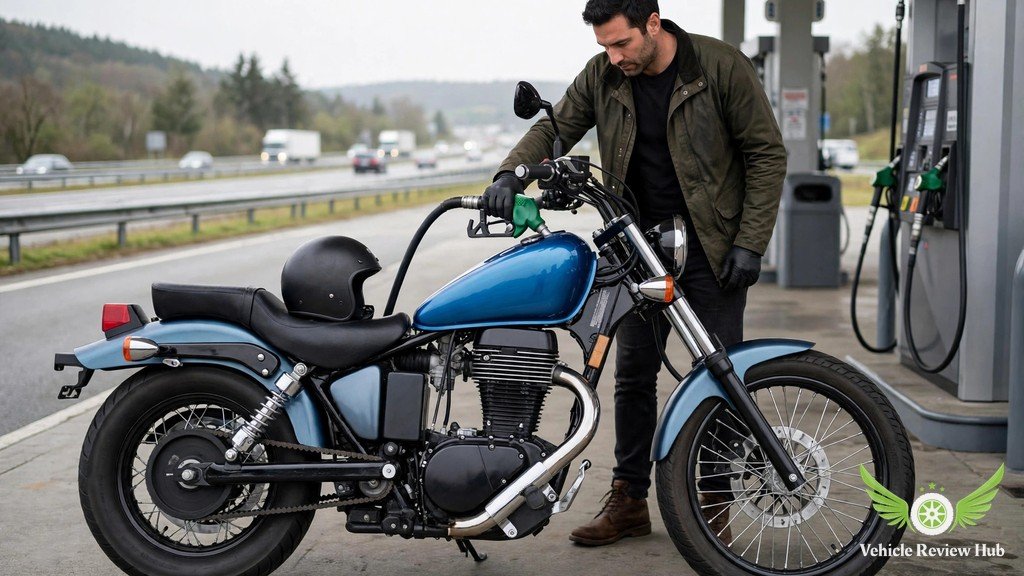
Cruiser Tested 52.9 MPG Back in 2006
Motorcycle Cruiser averaged 52.9 miles per gallon in its 2006 test of the S40, and Motorcycle Consumer News averaged 55 miles per gallon in 1996 — the only two named, tested fuel-economy figures that exist for the bike. On the 2006 figure, the 2.8-gallon tank gives roughly 148 miles of range (2.8 × 52.9 = 148.1), and on the 1996 figure about 154 miles; either way, the reserve is a petcock position, not a warning light, so the rider tracks fuel by the trip meter. The economy comes from the obvious places: a 652cc single that makes only 31 horsepower, a 381-pound motorcycle, and a five-speed gearbox that lets the engine loaf at 3,940 rpm. They are test averages, not a guarantee for any individual bike. Owner reports of 55–60 mpg exist, but those are owner-reported, never tested figures, and this Suzuki Boulevard S40 performance guide does not print them as results.
Suzuki Never Published an MPG Figure
Suzuki USA publishes no fuel-economy figure for the S40 on any US page, and this Suzuki Boulevard S40 performance guide does not fill that gap with an aggregator number. AI-written buying guides print “60+ mpg” and “55 mpg” as if Suzuki claimed them; Suzuki claimed neither. The distinction matters: a buyer comparing the S40 with a fuel-injected rival will find the rival’s manufacturer figure beside the S40’s test figures — but the test figures are the better evidence. At over 50 mpg in both named tests, the S40 costs very little to run, and the small tank — not the economy — is the limit on range.
Suzuki Boulevard S40 Real-World Riding Experience
On the road, the S40 feels like what it is: a light, low, narrow single that is happiest below highway speed. The testers said so in 2006, the owners say the same now — the bike’s charm and its limit are the same thing.

Out of Breath at 65, Said Motorcycle Cruiser
Motorcycle Cruiser’s 2006 test put it plainly: the S40 feels “a bit out of breath at 65 mph” and “doesn’t shake with anything like the ferocity of an unbalanced 650cc single”, adding that “if you don’t plan to cruise at 75 mph, there is enough power.” The balance shaft and high-mass crankshaft tame the single’s shake. Around town the power is enough: the single pulls cleanly from idle, the five-speed gearbox is easy, and the 381-pound weight makes the bike simple to manage. The same test noted the bike’s narrowness lets short legs reach the ground easily, while larger riders — over 5 feet 10 inches with a 32-inch inseam — feel confined, and two-up riding overloads the little single. None of that is this Suzuki Boulevard S40 performance guide’s own ride impression: the quotes are Motorcycle Cruiser’s, from 2006.
Unhappy on the Interstate, Happy Everywhere Else
The same 2006 test concluded the S40 is “not particularly happy out on a wide-open interstate” — the honest limit of this Suzuki Boulevard S40 performance guide. The bike has enough power below 75 mph, in the testers’ words, but sustained fast highway work asks more of it than it has to give. Everywhere else the bike is in its element — back roads, boulevards, commuting, errands. The Boulevard C50 performance guide covers a bigger Boulevard that holds highway speed with far less effort. A rider whose daily ride is a 75 mph commute should look at something bigger; a rider on 45 mph back roads has bought the right bike.
Suzuki Boulevard S40 Handling, Braking and Stability
Handling is where the bike’s light weight pays off most directly: 381 pounds, a 58.3-inch wheelbase and a 27.6-inch seat make a motorcycle that is easy to steer, easy to stop and easy to hold up at a standstill. The brakes are modest — a single 240mm front disc and a rear drum, with no ABS in any year.

Modest Brakes Matched to a Light Bike
The S40 stops with a single 240mm front disc and a rear drum brake — modest hardware by modern standards, and adequate because there is so little weight to stop. No ABS was ever fitted to any S40 or Savage in any year or any market, so the rider is the anti-lock system. The front fork and rear swingarm are simple, non-adjustable and durable, and the full S40 service chart from the manual covers their inspection at 600, 7,500 and 14,500 miles. The Boulevard M109R performance guide shows the other end of the Boulevard scale, a 764-pound bike with dual 310mm front discs; the S40 needs none of that, because it carries half the weight. Stability at speed is adequate rather than planted — the light, narrow bike moves around in crosswinds more than a heavier cruiser would.
Final Drive, Tires, Fork Seals, Brakes and Electrical Checks
The S40’s final drive is a belt, inspected every 2,000 miles with no scheduled change interval — the belt is inspected, not replaced on a timetable — and the belt axle nut torques to 65 Nm (47 lb-ft). That is the whole final-drive story — and the opposite of a chain-drive bike. The tyres are spoked-wheel tube types — 100/90-19 front, 140/80-15 rear — with pressures of 29 psi front and 33–36 psi rear. Fork seals and rear suspension are inspected at 600, 7,500 and 14,500 miles, brake fluid (DOT 4) is replaced every two years, brake hoses every four years, and the annual checklist covers throttle cable play, idle speed, clutch free play, steering-head bearings and chassis bolts. The electrical side is as simple as the rest: a single analogue speedometer, no tachometer, no fuel gauge, and a vacuum petcock that owners report can fail and starve the engine. Oil, filter and valve clearances are all serviced at every interval (600, 4,000, 7,500, 11,000 and 14,500 miles) — the S40’s own rule, and the opposite of the bigger Boulevard V-twins, where the filter is replaced only at 600 and 11,000 miles.
Suzuki Boulevard S40 Performance Compared With Other Beginner Cruisers
Against its beginner-cruiser rivals, Suzuki Boulevard S40 performance is the oldest and the slowest on paper — and the cheapest to run. The comparison below uses each bike’s verified figures: the S40’s last new price from 2019 against 2026 prices for the rivals, with the Rebel 500 figures from Honda’s own Rebel 500 page.
| Item | S40 (2019, last sold) | Rebel 500 (2026) | Rebel 300 E-Clutch (2026) | Meteor 350 (2026) |
|---|---|---|---|---|
| MSRP | $5,799 | $6,799 base / $6,999 SE | $5,349 | $4,899 |
| Engine | 652cc air-cooled single, carbureted | 471cc liquid-cooled parallel twin | 286cc liquid-cooled single | 349cc air/oil-cooled single |
| Power | 31 hp at the wheel (dyno, 1996) | 46 hp at 8,500 rpm | About 27–30 hp | 17.86 hp at 6,070 rpm (dyno) |
| Torque | 30.5 lb-ft at the wheel (dyno, 1996) | 31.9 lb-ft at 6,000 rpm | Not verified for 2026 | 18.21 lb-ft at 2,800 rpm (dyno) |
| Weight | 381 lb curb | 408 lb wet | About 364 lb (2020 figure) | 421 lb curb |
| Seat / tank | 27.6 in / 2.8 gal | 27.2 in / 3.0 gal | 27.2 in / about 2.9–3.0 gal | 30.1 in / 4.0 gal |
| Final drive | Belt, 5-speed | Chain, 6-speed | Chain, 6-speed, E-Clutch | Chain, 5-speed |
| ABS | None, ever | SE trim; base trim unconfirmed | Not verified for 2026 | Dual-channel standard |
Suzuki Boulevard S40 vs Honda Rebel 300 and 500
The Rebel 500 is the faster bike by a clear margin: its 471cc liquid-cooled parallel twin makes 46 horsepower at 8,500 rpm with 31.9 lb-ft at 6,000 rpm, against the S40’s 31 horsepower at the rear wheel, and its six-speed gearbox and slipper clutch give it a highway gear the S40 does not have. It also costs $1,000 more than the S40’s last MSRP — $6,799 base, $6,999 SE, plus $600 destination and a $300 tariff surcharge — and it weighs 408 pounds wet, 27 pounds more than the S40. The Rebel 300 E-Clutch is the closer match: a 286cc liquid-cooled single at $5,349 plus $600 destination and the same $300 tariff surcharge, with clutchless E-Clutch shifting, at about 364 pounds on a 2020 figure not re-verified for 2026. Its power is roughly 27–30 horsepower, a spec-database figure rather than a verified 2026 manufacturer number, so this Suzuki Boulevard S40 performance guide prints it as an approximate range. Against both Rebels, the case for Suzuki Boulevard S40 performance is simplicity and weight: a carbureted single with a belt drive and no electronics, 381 pounds, and a used price of $2,500–$4,500. Against the Meteor 350, the case is different again: the Meteor’s 349cc single makes a claimed 20.2 bhp and a Cycle World dyno figure of 17.86 horsepower at 6,070 rpm with 18.21 lb-ft at 2,800 rpm — less than the S40 on the dyno — but the Meteor is a current new bike at $4,899 plus $495 freight, with dual-channel ABS and a three-year warranty, and at 421 pounds it is bigger and heavier than the S40. One thing to state plainly: whether the 2026 Rebel 500 base trim carries ABS could not be confirmed from Honda’s published 2026 material — ABS is listed on the SE trim, and the base-trim status is unconfirmed, not assumed. The Rebel 300’s 2026 ABS status and torque figure are likewise marked as not verified in the table above.
Is the Suzuki Boulevard S40 Suitable for Beginner Riders? Yes
Yes — with the one honest limit this Suzuki Boulevard S40 performance guide keeps coming back to. The S40’s 381-pound weight, 27.6-inch seat, gentle single-cylinder power and low used price make it one of the easiest cruisers to learn on, and its simple carbureted engine is cheap to keep running. The power delivery is forgiving: the single pulls cleanly from idle, the five-speed gearbox is easy, and there is nothing electronic to confuse a new rider — but also nothing electronic to save one. Compared with the Rebel 300 E-Clutch, the S40 is simpler and lighter but older and carbureted; compared with the Rebel 500, it is slower and cheaper; compared with the Meteor 350, it is lighter and lower but discontinued, so every S40 a beginner buys is a used one. That is the verdict of this Suzuki Boulevard S40 performance guide: a beginner bike by weight, seat height and manners, with a highway limit a beginner should understand before buying. Run any used example’s VIN through the NHTSA recalls lookup before handing over money.
Suzuki Boulevard S40 Performance: Frequently Asked Questions
Direct answers to the questions riders ask about Suzuki Boulevard S40 performance — the dyno figures, the quarter-mile times, the fuel economy and the highway limit.
How much horsepower does the Suzuki Boulevard S40 have?
Suzuki USA never published a horsepower figure. The database-circulated claim is 31 horsepower at 5,400 rpm; the only measured figure is Motorcycle Consumer News’ 1996 dyno test: 31 horsepower at the rear wheel with 30.5 lb-ft of rear-wheel torque.
What is the top speed of the Suzuki Boulevard S40?
No instrumented or GPS top-speed test for Suzuki Boulevard S40 performance was ever published. Owner estimates run 81–85 mph, labelled as estimates only. Note that 81 mph is also the 1996 quarter-mile trap speed, which some sites mislabel as a top speed.
How fast is the Suzuki Boulevard S40 in the quarter mile?
Two instrumented figures exist and both stand: 15.3 seconds at 81.1 mph (Motorcycle Consumer News, 1996) and 16.35 seconds at 77.2 mph (Motorcycle Cruiser, 2006) — different bikes, different days, different testers.
What MPG does the Suzuki Boulevard S40 get?
The two named, tested figures for Suzuki Boulevard S40 performance are 55 mpg (Motorcycle Consumer News, 1996) and 52.9 mpg (Motorcycle Cruiser, 2006). Suzuki never published an MPG figure, and on the 52.9 mpg figure the 2.8-gallon tank gives roughly 148 miles of range.
How long does the Suzuki Boulevard S40 take to reach 60 mph?
No magazine ever published a tested 0–60 time for the S40. Owner pages quote around 7.0 seconds — a secondary figure, never a tested result.
Is the Suzuki Boulevard S40 faster than a Honda Rebel 500?
No. The Rebel 500’s 471cc parallel twin makes 46 horsepower at 8,500 rpm against the S40’s 31 at the rear wheel, and its six-speed gearbox gives it a highway gear the S40 does not have. The S40 is lighter and simpler, but the Rebel 500 is faster.
Does the Suzuki Boulevard S40 have ABS?
No. No ABS was ever fitted to any S40 or Savage in any year or any market.
Is the Suzuki Boulevard S40 good on the highway?
Not really — and that is the honest limit of Suzuki Boulevard S40 performance. Motorcycle Cruiser’s 2006 test said the bike feels “a bit out of breath at 65 mph” and is “not particularly happy out on a wide-open interstate” — it has enough power below 75 mph, but sustained fast highway work is its honest limit.
How heavy is the Suzuki Boulevard S40 compared with the Rebel 500?
The S40 is lighter: 381 pounds at the curb against the Rebel 500’s 408 pounds wet, and lighter than the Meteor 350 at 421 pounds curb — but heavier than the Rebel 300 E-Clutch at about 364 pounds on a 2020 figure.
What is the Suzuki Boulevard S40’s fuel range on a full tank?
About 148 miles on the tested 52.9 mpg figure, and about 154 miles on the 1996 figure of 55 mpg — both from the 2.8-gallon tank including reserve, which is a petcock position, not a warning light.
Why is the 2006 quarter-mile time slower than the 1996 time?
Different bikes, different days, different testers: Motorcycle Consumer News ran 15.3 seconds at 81.1 mph in 1996; Motorcycle Cruiser ran 16.35 seconds at 77.2 mph in 2006. Neither figure is wrong, and this Suzuki Boulevard S40 performance guide does not “correct” the slower one toward the faster one.
Is the Suzuki Boulevard S40 suitable for a beginner rider?
Yes, with one honest limit on Suzuki Boulevard S40 performance. Its 381-pound weight, 27.6-inch seat, gentle single-cylinder power and low used price make it one of the easiest cruisers to learn on — but it runs out of breath around 65 mph, so a rider commuting at 75 mph every day should look at something bigger.