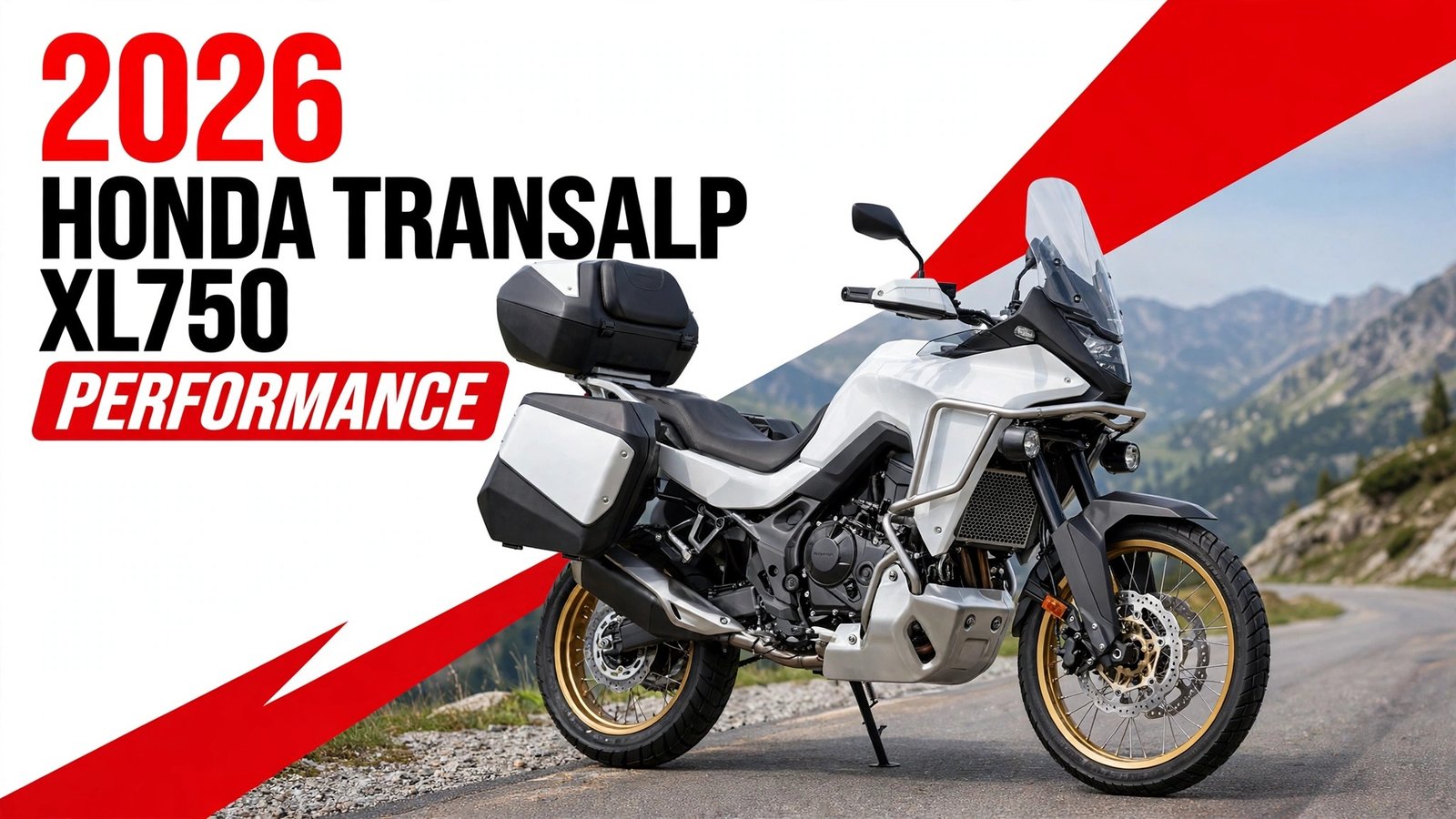
Yes, it is quick enough for any legal road use, and its real strength is how easily it covers distance. This guide to Honda Transalp XL750 performance gives the direct answers first: the 755cc twin claims 90.5 horsepower at the crankshaft and measured 70.58 at the rear wheel, Honda USA publishes no MPG figure, and no instrumented 0–60, quarter-mile or top-speed test from a major US outlet exists. Honda Transalp XL750 performance really means a rev-happy twin, tall gearing, a 4.4-gallon tank, and — from 2026 — an E-Clutch that removes clutch work without removing the lever.
This Honda Transalp XL750 performance guide separates measured facts from internet estimates, and keeps crankshaft claims, rear-wheel dyno runs and owner fuel logs in their own lanes.
Honda Transalp XL750 Engine Performance and Power Delivery
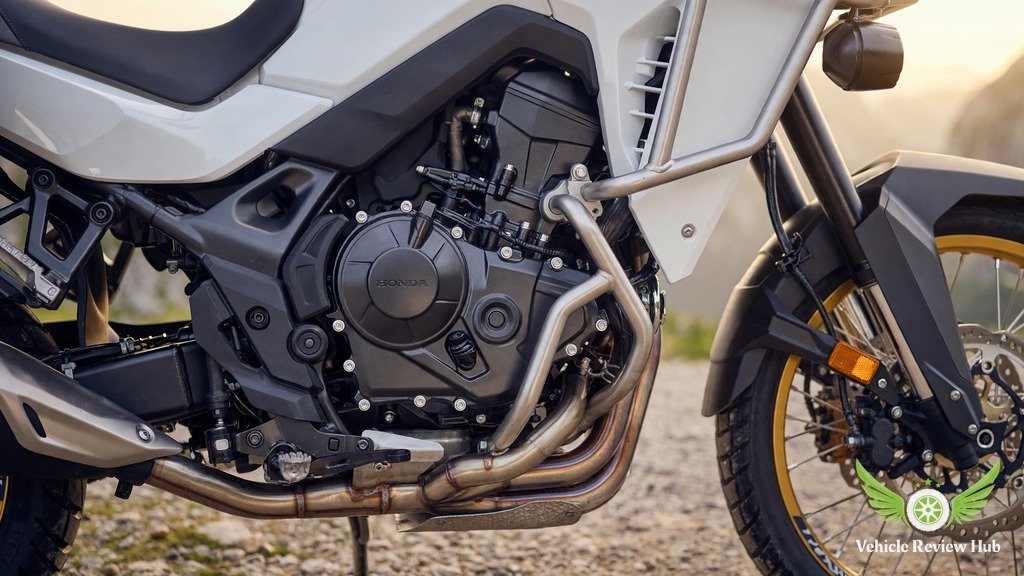
Honda Transalp XL750 performance starts with an engine that likes revs. The 755cc Unicam twin uses a 270-degree crank, 87.0mm bore, 63.5mm stroke and 11.0:1 compression ratio, and makes its power high in the rev range.
Cycle World Dyno 70.58 HP at 8,530 RPM and EU Claim 90.5 HP Explained
The two power figures quoted for Honda Transalp XL750 performance measure different things. Honda’s European claim — 90.5 horsepower at 9,500 rpm (67.5 kW) and 75 Nm (55.3 lb-ft) at 7,250 rpm — is a crankshaft figure, before gearbox, chain and wheel losses. Cycle World’s dyno run of the 2024 Transalp measured what reaches the ground: 70.58 horsepower at 8,530 rpm and 47.01 lb-ft at 7,270 rpm at the rear wheel.
That gap is normal drivetrain loss, not a weak engine — on the same Cycle World dyno the Transalp sits between its rivals, ahead of the Tenere 700 at 61.68 horsepower and just behind the V-Strom 800DE at 72.21. Cycle World also noted a torque dip around 3,500 rpm, but power holding near peak to the 10,000-plus rpm redline. For Honda Transalp XL750 performance, the honest summary is a strong top end with a soft spot low down: below 3,500 rpm the twin feels polite, above 6,000 rpm it comes alive. The official Honda USA Transalp E-Clutch page lists the current 755cc specification.
| Figure | Value | Measured where |
|---|---|---|
| Claimed power | 90.5 hp at 9,500 rpm (67.5 kW) | Crank (EU) |
| Dyno power | 70.58 hp at 8,530 rpm | Rear wheel (Cycle World) |
| Dyno torque | 47.01 lb-ft at 7,270 rpm | Rear wheel (Cycle World) |
Six-Speed Gearbox, E-Clutch Shifting and Power Delivery
Every Transalp uses a six-speed gearbox and chain drive, but clutch operation changed for 2026. The 2024 and 2025 bikes used a conventional cable clutch with assist-and-slipper function plus an optional bidirectional quickshifter, the reference for Honda Transalp XL750 performance on earlier bikes. For 2026, Honda made E-Clutch standard on the US Transalp — the only version offered — at $10,199 plus $600 destination, $200 more than the 2025 bike’s $9,999.
E-Clutch is not an automatic gearbox and not Honda’s DCT: it lets you pull away, stop and shift without the clutch lever, while the lever still works whenever you want it, and it doubles as a quickshifter for clutchless full-throttle changes. Motorcyclist’s 2026 E-Clutch coverage confirms the system, price and July 2026 US arrival. For Honda Transalp XL750 performance in traffic, E-Clutch removes the old bike’s one chore — constant clutch work — without changing the engine’s character. Power delivery runs through four preset ride modes plus two User modes from 2025, four power levels, five traction-control levels plus off, and three engine-braking levels. With no IMU, cornering ABS or cruise control on any year, Honda Transalp XL750 performance electronics stay deliberately simple.
Honda Transalp XL750 Top Speed and Acceleration
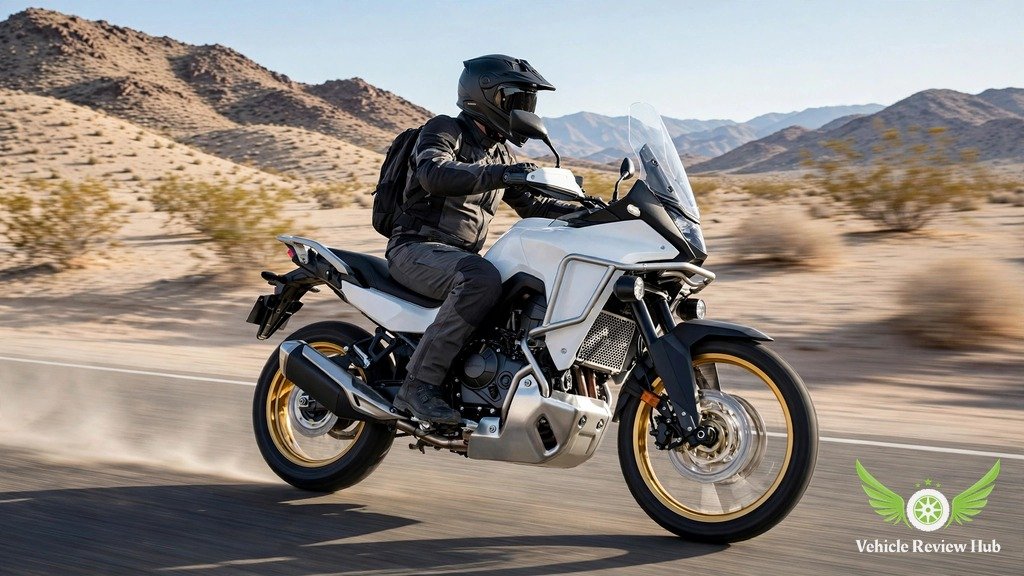
Honda Transalp XL750 performance has one honest gap buyers should know: no instrumented acceleration or top-speed test for this bike exists from a major US outlet.
Why No US Instrumented 0-60, Quarter Mile or Top Speed Test Exists
Major American outlets have dyno-tested the Transalp and ridden it extensively, but none has published an instrumented 0–60, quarter-mile or GPS-verified top-speed run. Honda Transalp XL750 performance coverage concentrates on touring, economy and suspension instead. Until a publication measures it, this guide will not quote a 0–60 or quarter-mile figure.
What can be said honestly about Honda Transalp XL750 performance acceleration is that the gearing is tall and the power top-weighted: it pulls cleanly from low revs but needs revs to hurry.
UK and Aggregator Figures From 121 to 135 MPH Labelled as Estimates
Online Honda Transalp XL750 performance top-speed figures run from about 121 mph to about 135 mph, and the spread itself tells you none is a measured US result. The low end is Honda’s own 2026 specification table: 195 km/h (121 mph). The high end is aggregator listings quoting 215 km/h (about 134 mph) and around 135 mph, plus one long-term UK test noting gearing for over 130 mph. A genuine measured top speed would not vary by 14 mph between listings.
Treat all of them as unverified estimates: the Transalp cruises at any legal highway speed with reserve. For Honda Transalp XL750 performance shoppers, the useful number is not a top speed at all — it is the 70 mph cruising rpm, covered below.
Honda Transalp XL750 Mileage and Fuel Economy
Honda Transalp XL750 performance on fuel is a genuine strength: a small tank, but an engine frugal enough for touring range. Honda USA publishes no MPG figure, so this section rests on tester logs, not a factory rating.
Honda USA Publishes No MPG Figure and the 4.4-Gallon Tank
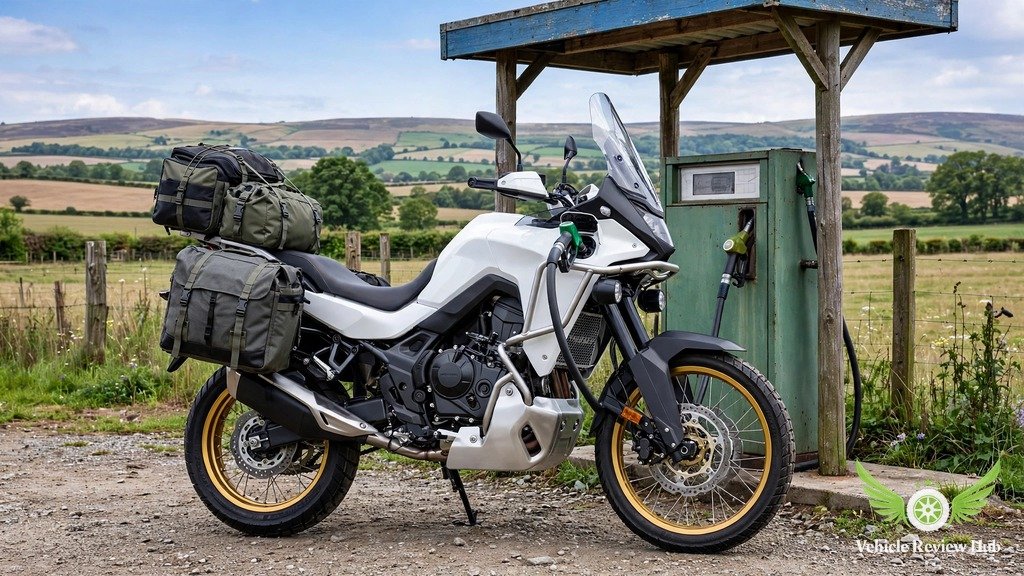
Honda USA’s specification page gives the Transalp a 4.4-gallon capacity (16.9 litres) and no MPG rating, leaving Honda Transalp XL750 performance buyers dependent on tester data. The honest way to talk about range is tested MPG multiplied by 4.4 gallons, labelled as arithmetic. Some outlets round the tank to 4.5 gallons, which is why you occasionally see larger range claims — the difference is rounding, not a different tank.
At 45 mpg the Transalp covers about 198 miles per tank; at 55 mpg, about 242 miles. That 200-to-240-mile planning band is the right way to think about Honda Transalp XL750 performance range.
RevZilla Tested 55 MPG on Road and 51 MPG Off-Road, Range 200 to 240 Miles
The two most useful Honda Transalp XL750 performance fuel logs come from RevZilla’s 2025 two-part test. On the road leg, Lance Oliver averaged 55 mpg on 87-octane gas over 1,732 miles of city and highway riding, as RevZilla’s road test reports. On the off-road leg, Spurgeon averaged 51 mpg, with the fuel light at an indicated 197 miles and a calculated range of about 230 miles, as RevZilla’s off-road test reports.
Those two figures bracket real Honda Transalp XL750 performance economy well: 55 mpg on road implies about 242 miles, 51 mpg off-road about 224 miles, both inside the 200-to-240-mile band once reserve is respected. Other logs agree: about 53 mpg mixed, 45–54 mpg on the computer.
| Tested economy | Range on 4.4 gal (arithmetic) | Source |
|---|---|---|
| 55 mpg, road | About 242 miles | RevZilla road test, 1,732 miles |
| 51 mpg, off-road | About 224 miles | RevZilla off-road test |
| Ranges are arithmetic on the 4.4-gallon tank, not tank-to-empty tests. | ||
Honda Transalp XL750 Real-World Riding Performance
On the road, Honda Transalp XL750 performance feels less like a dirt bike that can tour, more like a road bike that tolerates dirt. Tall gearing, an upright position and 459-to-468-pound weight make it easy to ride all day, while the 21-inch wheel and long-travel suspension keep dirt roads in reach.
City Riding, Traffic Performance and Everyday Acceleration
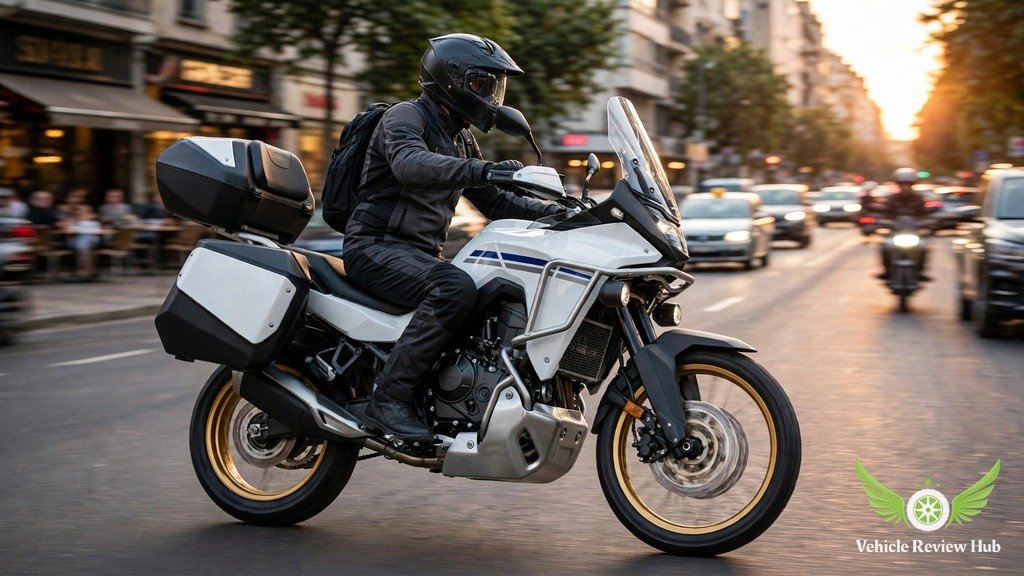
Around town, Honda Transalp XL750 performance is defined by weight, seat height and throttle manners more than outright speed. At 459 pounds claimed for 2024 and 468 for the 2026 E-Clutch bike, the Transalp is light for the class, and its 33.7-inch seat (optional 32.6-inch accessory seat) lets most riders reach the ground. The twin pulls cleanly from low revs, and from 2026 E-Clutch removes clutch work at stops and in queues — where Honda Transalp XL750 performance in daily riding improves most.
Everyday acceleration is where Honda Transalp XL750 performance earns its keep for commuters: the midrange covers traffic gaps and short on-ramps without double downshifts, while the soft spot below 3,500 rpm only shows if you lug it.
Highway Riding, Overtaking Ability and Long-Distance Limitations
On the highway, Honda Transalp XL750 performance settles into its natural habitat. Sixth gear is tall and relaxed: RevZilla’s road tester recorded about 4,200 rpm at an indicated 70 mph and about 4,900 rpm at 80 mph, well below the 10,000 rpm redline. Overtaking is a roll-on exercise — the 55.3 lb-ft torque peak at 7,250 rpm sits above cruising revs, so a drop to fifth wakes the bike up on slower highways, and testers found fifth often better than sixth on two-lane roads.
A week-long Honda Transalp XL750 performance test covering freeways and rough Mexican dirt roads shows how it carries speed.
Long-distance Honda Transalp XL750 performance has two honest limitations. First, the non-adjustable windscreen sent airflow high on RevZilla’s 5-foot-11 tester’s forehead, with a calm pocket only when slouching — taller riders should budget for an aftermarket screen. Second, the seat, though broader than most adventure seats, was the same tester’s weakest point on a long day. Neither stops the Transalp touring, but both explain why some owners change screen and seat first. If you regularly tour two-up with full luggage, the bigger Africa Twin Adventure Sports ES performance package is the natural step up; solo touring is the Transalp’s home ground.
Honda Transalp XL750 Handling, Braking and Stability
Honda Transalp XL750 performance in corners comes from a chassis favoring stability over sharpness: a steel diamond frame, a 21-inch front wheel, and suspension travel absorbing rough pavement without feeling tall or unwieldy.
Showa Suspension, Fully Adjustable for 2026, Tires and Cornering
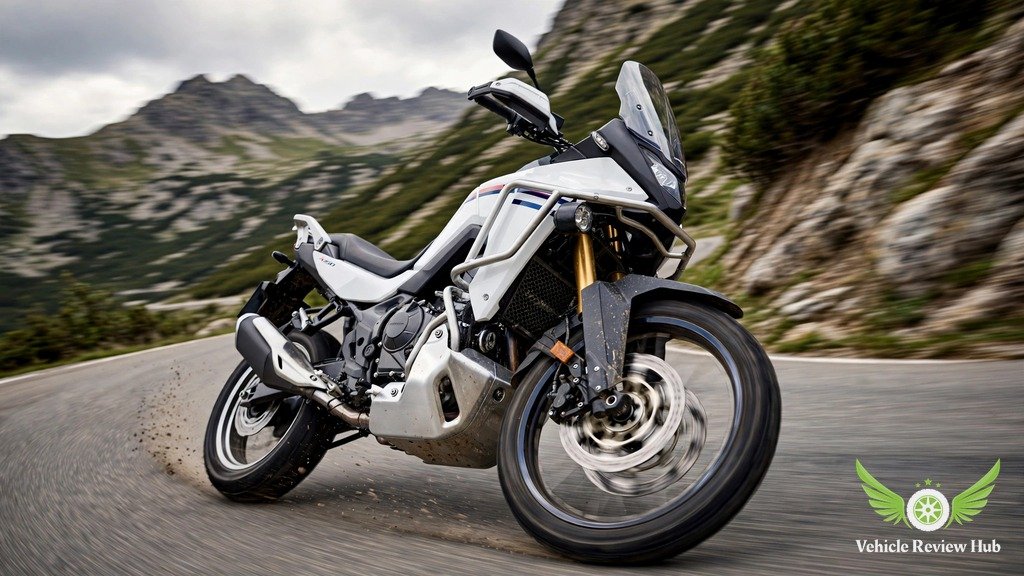
A 43mm Showa SFF-CA fork (7.9 inches) and Pro-Link Showa shock (7.5 inches) carry the Transalp; the year decides how much you can adjust. On 2024 and 2025 bikes, adjustment is spring preload only, and testers consistently called the setup soft — fine on road, marginal on rough back roads even at maximum preload, the rear shock the main complaint. Honda retuned damping for 2025 without adding adjusters, improving matters without fixing the limitation.
For 2026, both ends became fully adjustable for compression and rebound damping, alongside the new aluminum skid plate — the biggest Honda Transalp XL750 performance chassis upgrade in its short history, as ADV Pulse’s 2026 Transalp coverage confirms. Tires: 90/90-21 front and 150/70-18 rear on tubed spoked wheels, Dunlop Trailmax stock on early bikes, 8.3 inches of clearance. In corners it feels planted and neutral rather than quick-steering, as a 459-to-468-pound bike with a 21-inch front wheel should — see the full Transalp review for riding position.
Dual 310mm Front Discs, Two-Level ABS and Rear ABS Off in User Mode
Dual 310mm front discs with two-piston calipers and a single 256mm rear disc give strong, progressive stopping power, and Honda Transalp XL750 performance braking is backed by Road and Off-road ABS settings plus rear ABS off in User mode. Note the reset behavior: switch off rear ABS and traction control in a User mode and both revert at the next start, while power and engine-braking settings stay put.
With no cornering ABS and no IMU, Honda Transalp XL750 performance braking stays conventional: predictable and strong on pavement, with the rear-off option doing the off-road job. A puncture off-road means a tube change, not a plug — the practical price of spoked wheels. The Transalp reliability guide covers brake and tire maintenance in detail.
Honda Transalp XL750 Performance Compared With Other Middleweight ADV Bikes
Honda Transalp XL750 performance looks different depending on the rival parked next to it. Against the Tenere 700 it is stronger and better equipped; against the V-Strom 800DE it is slightly down on power but cheaper and lighter. The Transalp wins on value while losing on dirt focus to the Yamaha and on power to the Suzuki.
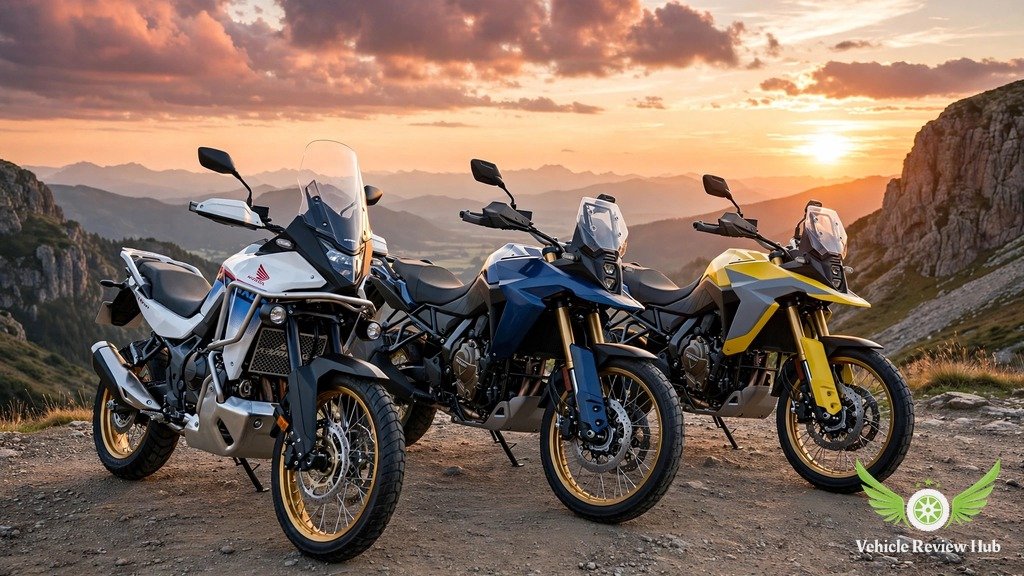
Honda Transalp XL750 vs Yamaha Tenere 700 and Suzuki V-Strom 800DE
The Yamaha Tenere 700 is the dirt benchmark: a 689cc twin, 21-inch front wheel, minimal electronics, $10,999 for 2026 — $800 more than the Transalp E-Clutch. On Cycle World’s dyno it made 61.68 horsepower against the Transalp’s 70.58, so the Honda is measurably stronger, but the Yamaha is simpler off-road. The Suzuki V-Strom 800DE is the power pick: a 776cc twin making about 84 horsepower, $11,799 plus $700 destination for 2026 — $1,600 more than the Transalp — with Cycle World dyno power of 72.21 horsepower, just ahead of the Honda. Torquepedia’s 2026 V-Strom 800DE specification summary confirms the Suzuki’s price and destination charge.
| Bike (2026) | Price | Claimed power | Dyno power (Cycle World) | Tank |
|---|---|---|---|---|
| Honda Transalp XL750 E-Clutch | $10,199 + $600 dest | 90.5 hp | 70.58 hp | 4.4 gal |
| Yamaha Tenere 700 | $10,999 | 72 hp (approx.) | 61.68 hp | 4.2 gal |
| Suzuki V-Strom 800DE | $11,799 + $700 dest | ~84 hp | 72.21 hp | 5.3 gal |
| Dyno figures from Cycle World’s same-dyno comparison. | ||||
The Transalp gives up about 2 dyno horsepower to the Suzuki and gains about 9 over the Yamaha, while costing $800 less than the Yamaha and $1,600 less than the Suzuki. If dirt ability matters most, the Yamaha wins; if power matters most, the Suzuki wins; on value and road comfort, Honda Transalp XL750 performance is the rational pick — 70.58 rear-wheel horsepower suffices for loaded touring. The Transalp buying guide covers used prices and inspection for pre-owned buyers.
Is the Honda Transalp XL750 Suitable for Touring and Dirt Riders?
For touring riders, Honda Transalp XL750 performance is close to ideal in this class: a smooth rev-happy twin, tall gearing, 200-to-240-mile range, comfortable ergonomics, a price thousands below flagships. For dirt riders, it is capable rather than class-leading: the 21-inch wheel, 8.3 inches of clearance and long-travel suspension handle graded dirt and light trails, but soft preload-only suspension on 2024–2025 bikes, tubed tires and weight argue against hard off-road use, and the 2026 bike’s adjustable suspension plus skid plate narrow that gap.
The right buyer for Honda Transalp XL750 performance is the rider whose miles are mostly pavement with regular dirt-road detours. Pure dirt riders should buy the Tenere 700; pure road tourers may prefer a street-biased middleweight.
Honda Transalp XL750 Performance: Frequently Asked Questions
Direct answers on Honda Transalp XL750 performance: dyno numbers, fuel range, top speed and rivals.
How much horsepower does the Honda Transalp XL750 make?
Honda claims 90.5 horsepower at 9,500 rpm at the crankshaft; Cycle World measured 70.58 at 8,530 rpm at the rear wheel. Compare the rear-wheel figure against rivals measured the same way.
What is the top speed of the Honda Transalp XL750?
No verified top speed exists from a major US outlet. Honda’s own specification lists 195 km/h (121 mph), while aggregator listings run to about 134–135 mph. Treat Honda Transalp XL750 performance top-speed figures online as estimates, not measured results.
What is the 0–60 time of the Honda Transalp XL750?
No instrumented 0–60 time exists from a major US outlet. Any Honda Transalp XL750 performance 0–60 figure online is an estimate, and this guide does not quote one.
What MPG does the Honda Transalp XL750 get?
Honda USA publishes no MPG figure. RevZilla tested 55 mpg on road over 1,732 miles and 51 mpg off-road; Honda Transalp XL750 performance range math on the 4.4-gallon tank gives roughly 200 to 240 miles.
What is the fuel range of the Honda Transalp XL750?
Plan on 200 to 240 miles per tank: 55 mpg on road implies about 242 miles, 51 mpg off-road about 224 miles on the 4.4-gallon tank, before reserve. Honda Transalp XL750 performance range varies with speed, load and surface.
What is Honda E-Clutch and is it worth it?
E-Clutch lets you pull away, stop and shift without the clutch lever, while the lever still works whenever you want it. Standard on the 2026 Transalp for $200 more than the 2025 bike, it suits commuters and tourers; Honda Transalp XL750 performance is unchanged mechanically, but daily riding is easier.
Does the Transalp XL750 have cruise control or cornering ABS?
No. The Transalp has no IMU, cornering ABS or cruise control on any year. Honda Transalp XL750 performance electronics cover ride modes, traction control, engine braking and switchable rear ABS, not lean-sensitive systems.
How does the Transalp compare to the Tenere 700 on power?
The Transalp is stronger on the same dyno: 70.58 rear-wheel horsepower against the Tenere 700’s 61.68. Honda Transalp XL750 performance also brings ride modes and a TFT display the simpler Yamaha lacks, at $800 less.
Is the Transalp XL750 suspension adjustable?
It depends on the year. On 2024 and 2025 bikes, adjustment is spring preload only; for 2026, fork and shock are fully adjustable for compression and rebound damping. Honda Transalp XL750 performance off-road improves most on the 2026 bike.
Is the Transalp XL750 good for highway touring?
Yes, with two caveats: the non-adjustable windscreen buffets taller riders, and the seat feels firm on very long days. Tall sixth-gear cruising at about 4,200 rpm at 70 mph and 200-to-240-mile range make Honda Transalp XL750 performance well suited to highway touring.
Can the Transalp XL750 handle dirt roads?
Yes for graded dirt and light trails: a 21-inch front wheel, 8.3 inches of clearance and long-travel suspension. Hard off-road use exposes soft early suspension, tubed tires and weight, so Honda Transalp XL750 performance off-road is capable, not class-leading.