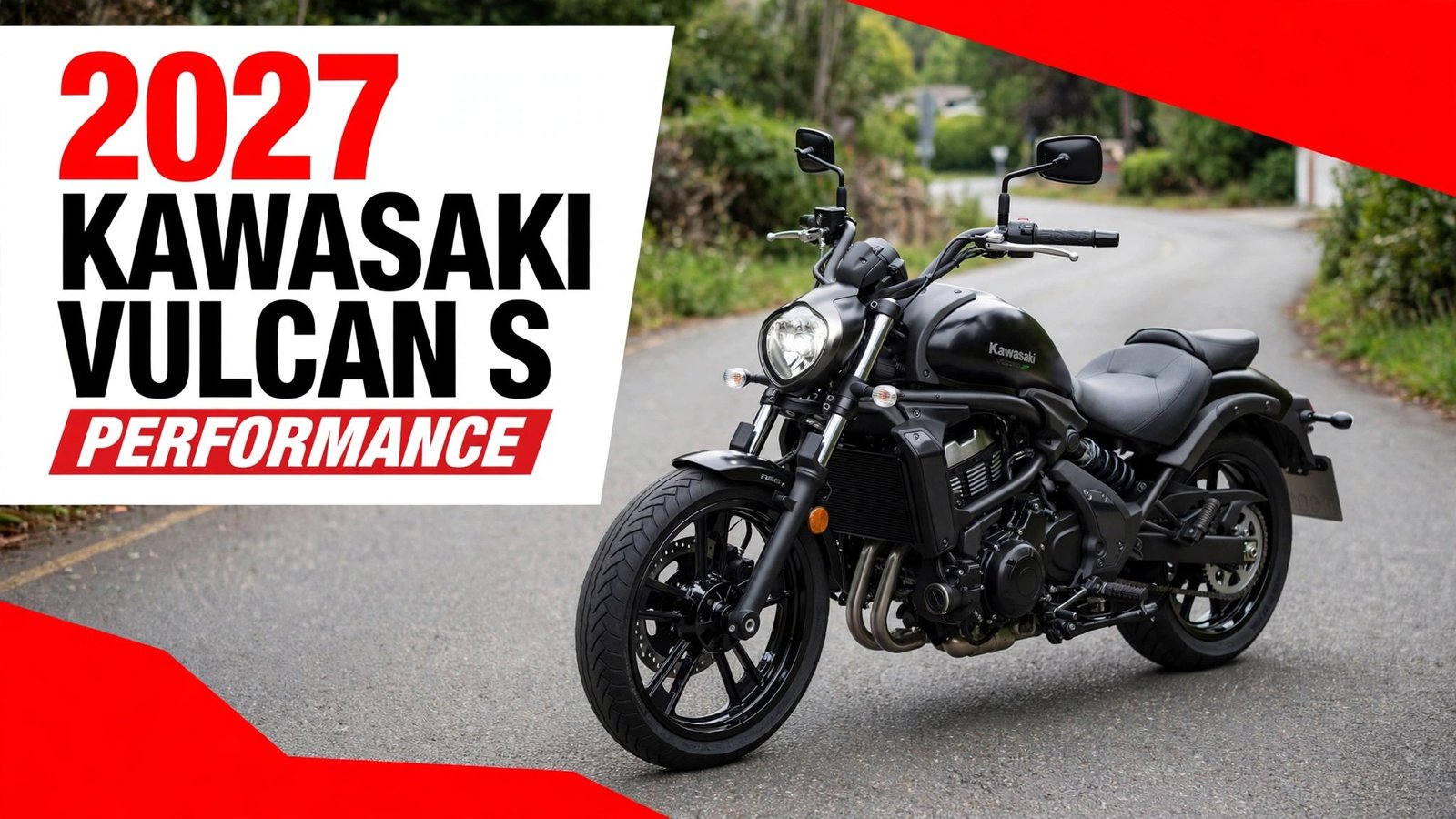
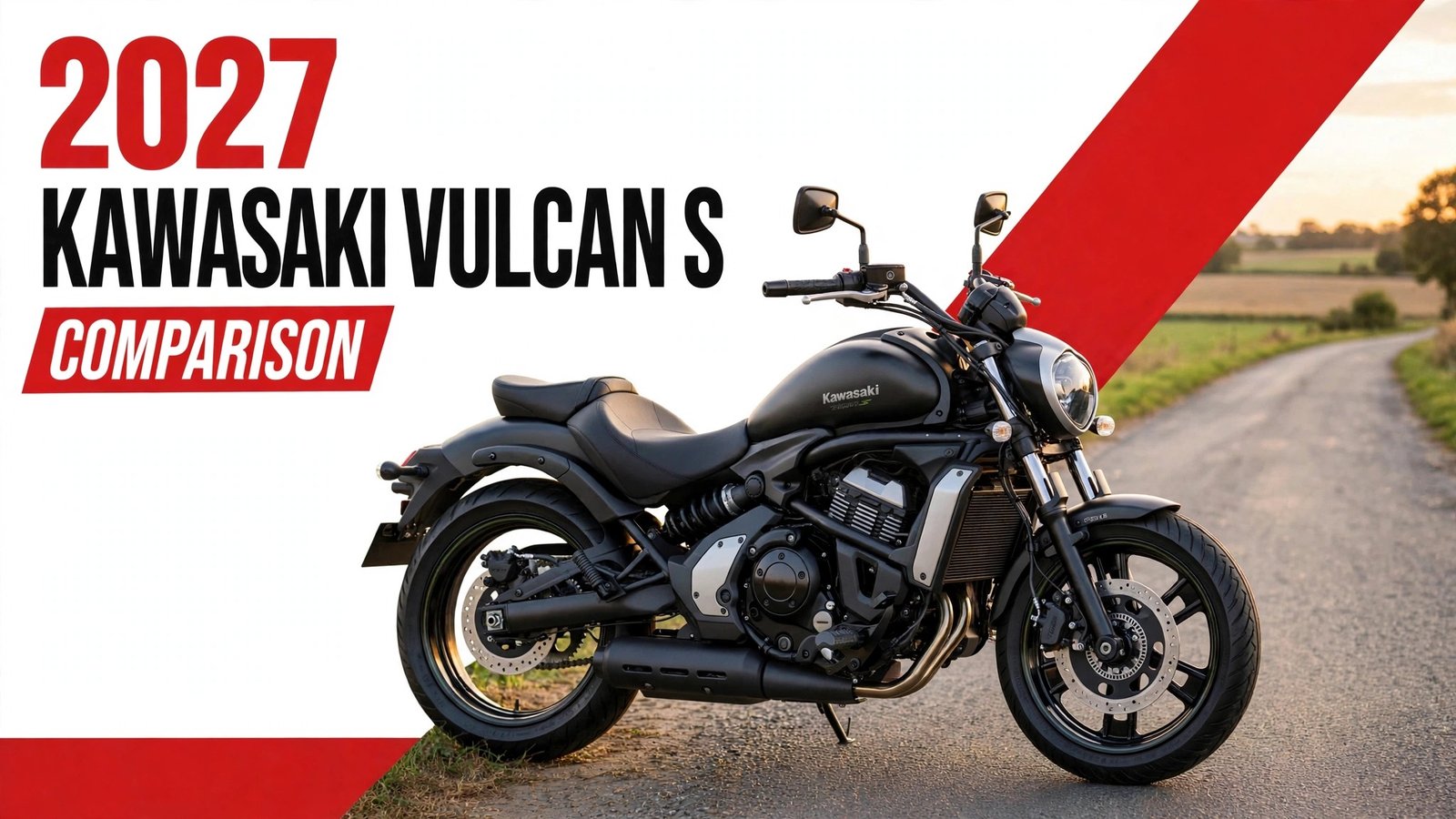
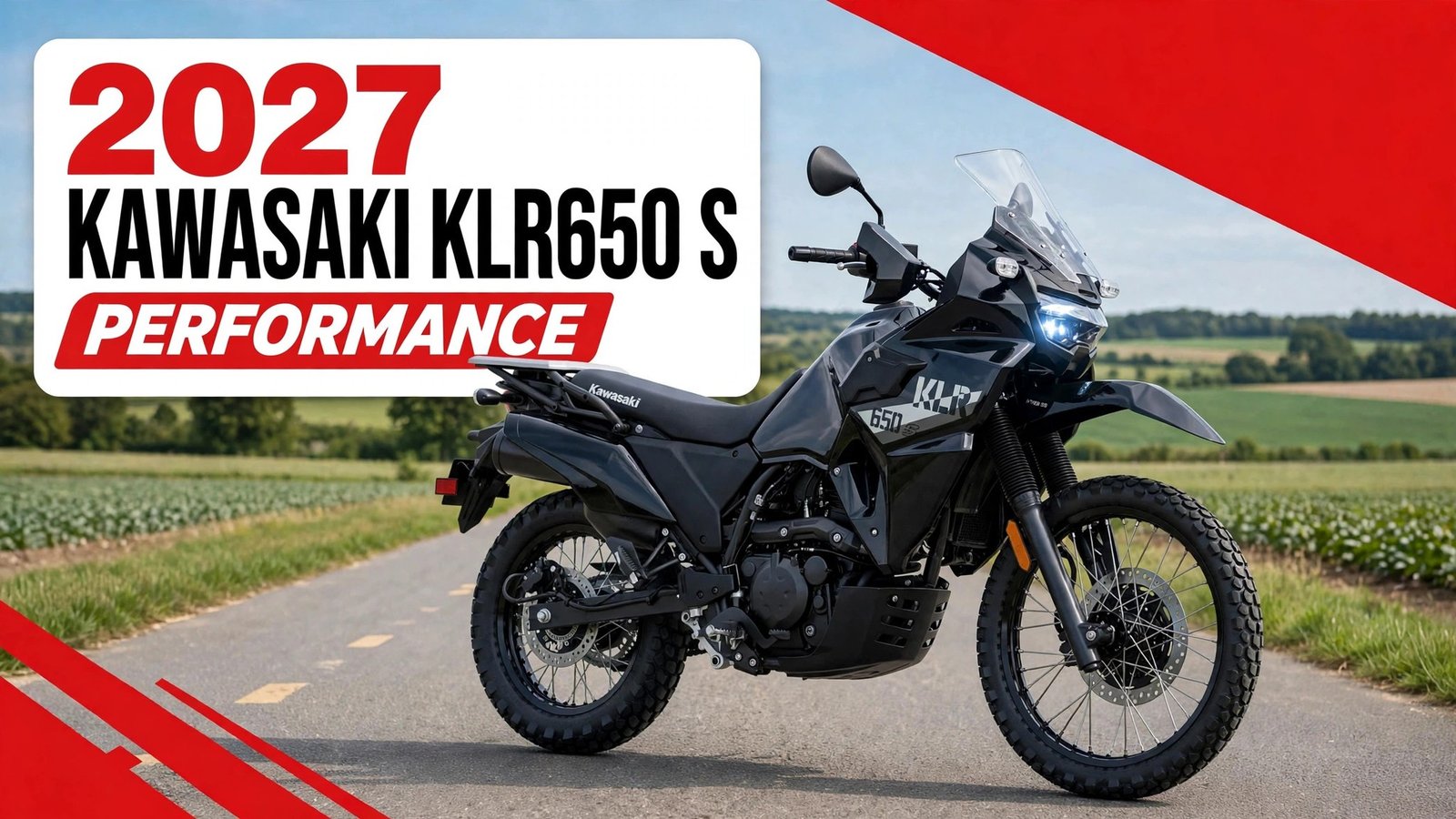
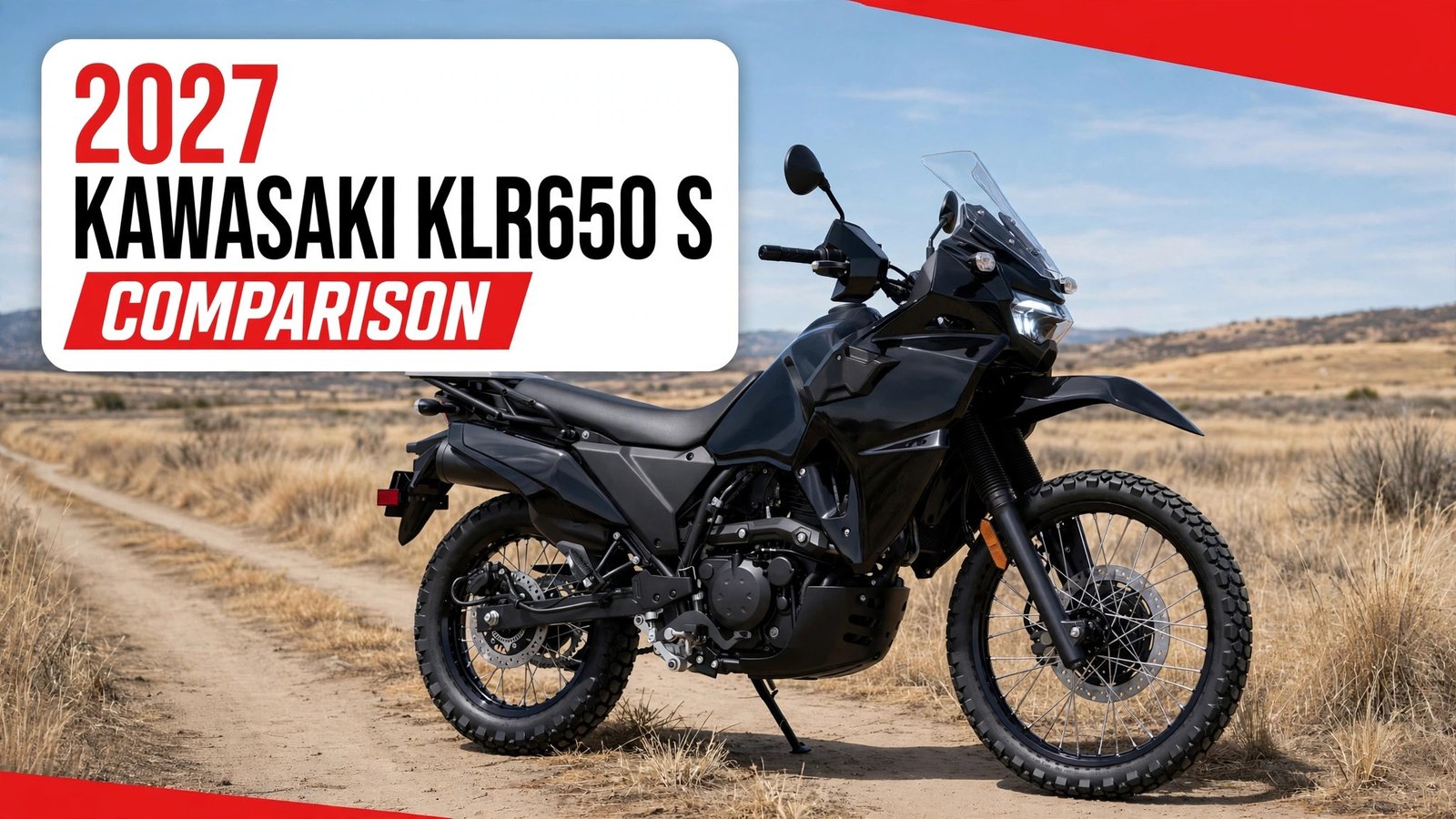
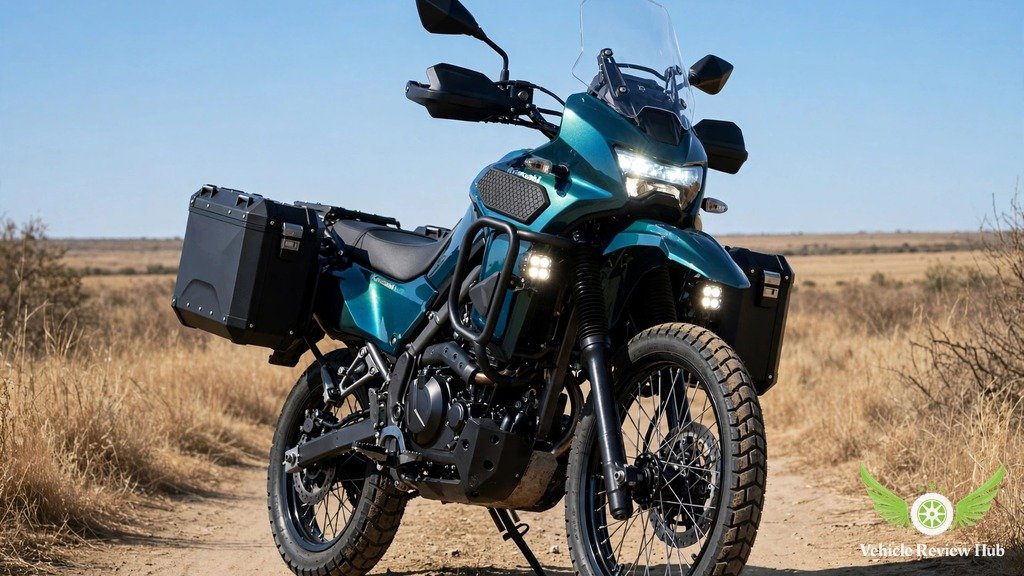
The 2027 Kawasaki KLR650 Adventure costs $8,884 delivered, and the question this Kawasaki KLR650 Adventure comparison answers is whether the factory luggage is worth $900 over the standard KLR650 ABS, and worth $2,390 over the Himalayan 450 and $1,785 over the CRF300L Rally. The short answer: the Adventure is the only one of the four that leaves the showroom with hard luggage fitted.
This Kawasaki KLR650 Adventure comparison tests the Adventure against its sibling, the modern rival and the lightweight rival on price, performance, range and running costs. The Adventure is a trim, not a separate model: the same 652cc single, the same 6.1-gallon tank, the same 40 hp. The differences are the kit, the weight and the money.
Kawasaki KLR650 Adventure Overview and Its Closest Rivals
Four bikes, one job: a dual-sport that rides to the trail, carries a weekend of gear and rides home. This Kawasaki KLR650 Adventure comparison starts with the rivals.
Why These Three Rivals: Sibling, Modern, Lightweight
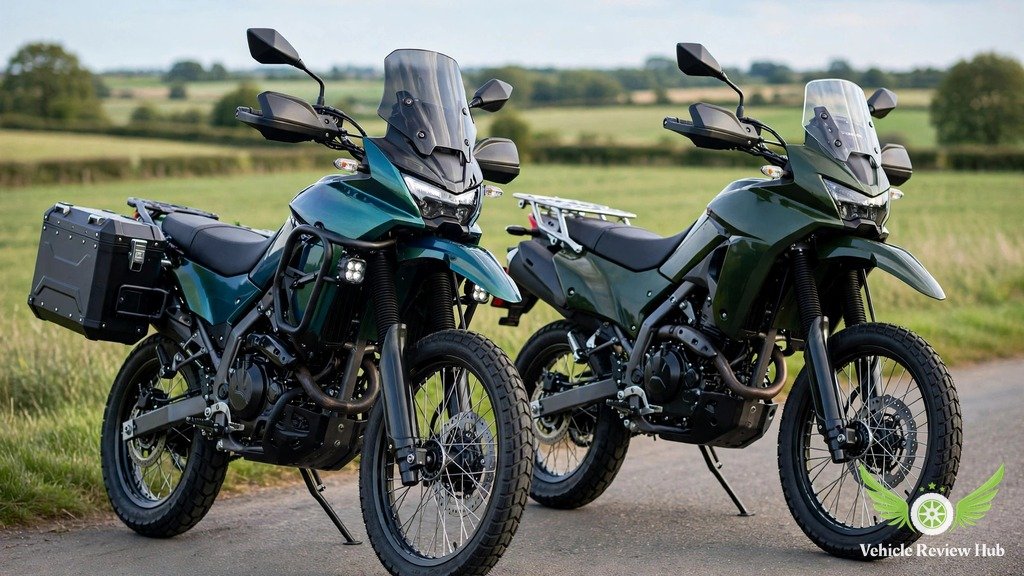
The sibling is the KLR650 ABS, the same bike minus the kit: the only honest baseline, with the same engine, tank, seat and brakes. The modern rival is the Himalayan 450, a 452cc single with ride-by-wire, ride modes, switchable ABS and a TFT display with navigation. The lightweight rival is the CRF300L Rally, a 286cc trail bike with a fairing, built for riders who want the lightest machine.
How the Four Bikes Differ at a Glance
| Bike | Engine | Claimed power | Curb weight | Tank | Seat | Delivered price |
|---|---|---|---|---|---|---|
| KLR650 Adventure ABS | 652cc single, EFI, 5-speed | 40 hp @ 6,000 rpm | 487.1 lb | 6.1 gal | 34.3 in | $8,884 |
| KLR650 ABS | 652cc single, EFI, 5-speed | 40 hp @ 6,000 rpm | 460.6 lb | 6.1 gal | 34.3 in | $7,984 |
| Himalayan 450 | 452cc Sherpa single, EFI, 6-speed | 40 hp (crank) | 432 lb wet | 4.5 gal | 32.5 in | $6,494 |
| CRF300L Rally | 286cc single, EFI, 6-speed | About 27 hp | About 331 lb wet | 3.4 gal | 35.2 in | $7,099 |
Notes for this Kawasaki KLR650 Adventure comparison at-a-glance table: all prices are US delivered for 2026 or 2027 as labelled; the Adventure price is the green bike, camo $100 more. The Himalayan power figure is a crank claim, not a wheel figure, so it cannot be compared with the KLR650 dyno numbers.
The film below is Cross Training Adventure’s 2027 roundup of midweight adventure bikes, not a head-to-head of these three rivals. It covers the KLR650 and the Himalayan 450 among a dozen bikes, with no CRF300L Rally in it. Watch it for the class context; the numbers in this Kawasaki KLR650 Adventure comparison live in the tables.
Kawasaki KLR650 Adventure vs Kawasaki KLR650 ABS
The sibling comparison is the easiest one in this Kawasaki KLR650 Adventure comparison: the two bikes are the same machine, and the only question is whether the kit is worth $900.
Engine, Specs and Performance Side by Side
Nothing separates the two bikes on performance, because nothing is different underneath. The same 652cc liquid-cooled single makes 40 hp at 6,000 rpm on Kawasaki’s spec sheet, with an ISO 4106 footnote, and 39.1 lb-ft at 4,500 rpm. The same 5-speed gearbox, 6.1-gallon tank, 34.3-inch seat, 41 mm fork, Uni-Trak rear shock and single 300 mm front disc with non-switchable ABS.
The dyno numbers belong to both bikes. Cycle World’s 2022 Adventure run made 34.61 hp at 5,910 rpm and 33.52 lb-ft at 4,700 rpm. Rider Magazine’s 2022 Adventure made 36.5 hp at 6,100 rpm, and Cycle World’s 2023 S made 36.9 hp. The gap between the two Adventure runs is dyno-to-dyno variance, not a trim difference, and no publication has dynoed the two trims back to back. Our Adventure performance guide works through all three runs.
Top speed and economy match too in this Kawasaki KLR650 Adventure comparison. Cycle News tested 88 to 90 mph on the Adventure, and Kawasaki publishes no official top-speed figure for either trim. Cycle News measured 49 mpg with the bags packed, Rider Magazine 47 mpg, and Motorcycle.com 35.2 mpg on an 800-mile freeway blast, so the range bookends are 215 to 300 miles: 35.2 mpg times 6.1 gallons is 214.7 miles, and 49 mpg times 6.1 gallons is 298.9 miles. The 26.5-pound kit has no measured performance cost.
Price, Equipment and Which Suits Which Rider
The 2027 numbers are simple. The Adventure ABS is $8,199 plus $685 destination, or $8,884 delivered. The KLR650 ABS is $7,299 plus $685, or $7,984 delivered. The premium is $900. It was $1,000 in 2022, and $1,200 against the non-ABS base at $7,684 delivered. The 2027 DF ABS sits exactly $500 below the Adventure, at $8,384 delivered, with no luggage either.
What the $900 buys in this Kawasaki KLR650 Adventure comparison is the factory kit: 21-litre side cases on both sides, LED auxiliary lights, engine guards, a tank pad, a DC power outlet and a USB socket, all fitted by Kawasaki. The cases are SHAD-developed, top-opening and weekend-sized, per our Adventure review. Neither trim includes a top case or a centre stand.
Buy the ABS if you already own luggage, ride mostly without bags, or want the lightest and cheapest KLR650. Buy the Adventure if you would buy the kit anyway: hard luggage alone runs $600 to $1,000, auxiliary lighting $200 to $400, before fitting, guards, the tank pad and the outlets. The service chart is identical for both trims, as our KLR650 reliability guide shows: oil and filter every 7,500 miles and valves every 15,000 miles, with a 12-month warranty.
Kawasaki KLR650 Adventure vs Royal Enfield Himalayan 450
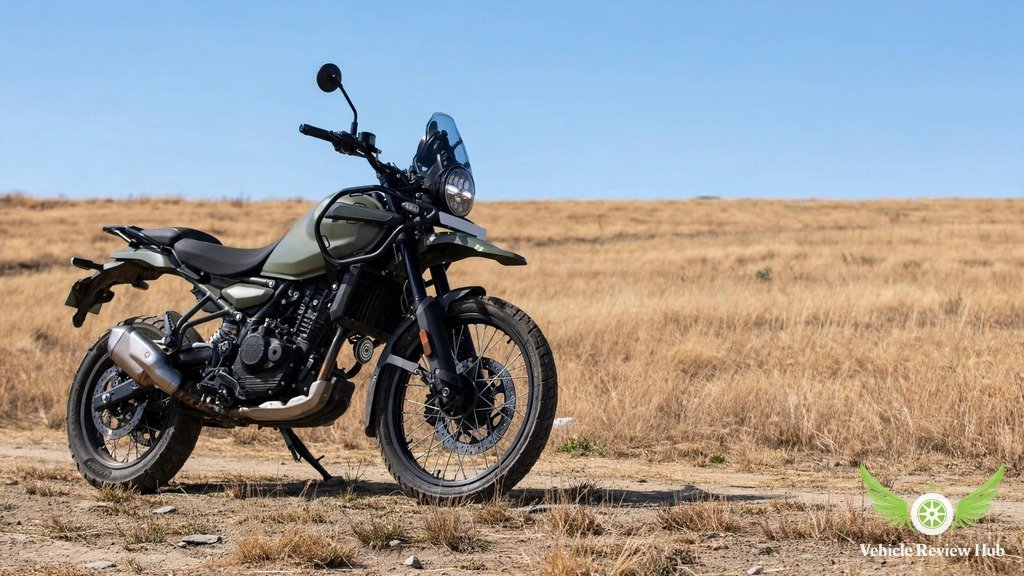
The Himalayan 450 is the modern rival: a newer engine, more technology, a lighter bike and a lower price. This Kawasaki KLR650 Adventure comparison tests whether modern beats proven, and the answer depends on how far you ride.
Engine, Specs and Performance Side by Side
On paper the two engines tie at 40 hp. The Himalayan 450’s 40 hp is a crank claim for its 452cc liquid-cooled Sherpa single, with 40 Nm of torque, ride-by-wire, ride modes, switchable ABS and a TFT display with navigation. The KLR650’s 40 hp at 6,000 rpm carries an ISO 4106 footnote, and its measured wheel figure is 34.61 hp. Never compare the Himalayan’s 40 hp crank claim against the KLR650’s 34.6 hp wheel figure; they are measured in different places.
The real differences are weight, seat and tank. The Himalayan 450 weighs 432 pounds wet, 55 pounds lighter than the Adventure’s 487.1-pound curb weight, and its seat is 32.5 inches, nearly two inches lower. Its suspension travels 200 mm at both ends. The KLR650 answers with a 652cc single making 39.1 lb-ft at 4,500 rpm, a 6.1-gallon tank against the Himalayan’s 4.5 gallons, and a dealer network in small towns across the United States. The KLR650 has no tachometer, no ride modes, no traction control and no TFT display.
Range is where the tank decides the argument in this Kawasaki KLR650 Adventure comparison. The Adventure’s worst tested economy, 35.2 mpg, still gives 215 miles from 6.1 gallons, and its best, 49 mpg, gives nearly 300 miles. The Himalayan’s 4.5-gallon tank cannot match that. On a trail, the Himalayan’s lighter weight and switchable ABS are the better tools. On a highway, the KLR650’s bigger engine wins, and Cycle News’s Adventure test found it comfortable at 74 mph.
Price, Equipment and Which Suits Which Rider
The Himalayan 450 is $5,999 plus $495 freight on Royal Enfield’s US page, or $6,494 delivered, $2,390 cheaper than the Adventure’s $8,884 in this Kawasaki KLR650 Adventure comparison. Freight varies from $495 to $650, so the gap moves a little but never closes. The Hanle Black tubeless version is $6,399 before freight.
What the saving does not buy in this Kawasaki KLR650 Adventure comparison is luggage. The Himalayan 450 comes with no factory luggage, so a buyer who wants hard cases pays aftermarket prices on top of the $6,494, and the gap narrows fast. The Himalayan also means a smaller tank, a newer dealer network, and a record still being written, while the KLR650’s runs back to 1987.
Buy the Himalayan 450 if you are shorter, ride mixed terrain and pack light, and want modern electronics and switchable ABS for $2,390 less. Buy the Adventure if you tour long distances and want to leave the dealer with luggage fitted. Our Adventure reliability guide gives the KLR650’s side of the story: no gen-3 recall, a 15,000-mile valve check, and a 12-month warranty.
Kawasaki KLR650 Adventure vs Honda CRF300L Rally
The Rally is the lightweight rival: a 286cc trail bike with a fairing, not a tourer with knobs. This Kawasaki KLR650 Adventure comparison keeps the two jobs separate, because the bikes are built for different days.

Engine, Specs and Performance Side by Side
The Rally’s 286cc liquid-cooled single makes about 27 hp through a 6-speed gearbox. The Adventure’s 652cc single makes 40 hp at 6,000 rpm and 39.1 lb-ft at 4,500 rpm, and its measured wheel figure is 34.61 hp. The Rally is roughly 331 pounds wet, more than 150 pounds lighter, and that gap is the whole story off-road: the Rally picks up easily, turns in sand and mud without fighting the rider, and forgives mistakes the Adventure punishes.
The Adventure answers on the road in this Kawasaki KLR650 Adventure comparison. Its 6.1-gallon tank gives 215 to 300 miles between fill-ups, against the Rally’s 3.4-gallon tank, which needs fuel roughly twice as often. Its bigger engine holds 75 mph without working hard, while the Rally’s small single is busy at highway speed. The Rally’s seat is 35.2 inches, the tallest of the four, so the lightweight bike is not the easy bike for a shorter rider. It has long-travel suspension and Dakar styling, but no luggage, no auxiliary lights and no wind protection beyond its fairing.
There is no instrumented top-speed figure for the Rally here, and no gen-3 quarter-mile figure for the KLR650, so this guide does not invent a race between them. The honest split is the use case: the Rally is the better trail bike, and the Adventure is the better touring bike that can also ride a trail.
Price, Equipment and Which Suits Which Rider
The 2026 CRF300L Rally is $6,499 plus $600 destination on Honda’s own page, or $7,099 delivered, $1,785 cheaper than the Adventure’s $8,884. For a rider who trailers to the trail, that saving is the right call, and running costs are lower too.
What the saving does not buy is range, luggage or highway comfort. The Rally carries no factory luggage, its 3.4-gallon tank limits every ride, and its small engine works hard at the speeds the Adventure cruises at. A Rally buyer who wants to tour must add luggage or a larger tank, and each addition eats into the $1,785 gap. The Adventure buyer pays once and rides away with cases fitted.
Buy the Rally if you ride trails first, trailer or ride short distances, and want the lightest bike. Buy the Adventure if you ride to the trail on the highway with luggage and want one bike for both jobs. Our KLR650 comparison reached the same split.
Kawasaki KLR650 Adventure Price and Value Compared
Price is where this Kawasaki KLR650 Adventure comparison is decided: the four bikes run from $6,494 to $8,884 delivered, and the luggage is the gap between them.

| Bike | MSRP | Destination or freight | Delivered | Factory luggage |
|---|---|---|---|---|
| KLR650 Adventure ABS | $8,199 | $685 | $8,884 | 21 L cases included |
| KLR650 ABS | $7,299 | $685 | $7,984 | None |
| Himalayan 450 | $5,999 | $495 freight | $6,494 | None |
| CRF300L Rally | $6,499 | $600 | $7,099 | None |
| 390 Adventure R | $7,699 | $505 to $650 | $8,204 to $8,349 | None |
Notes for this Kawasaki KLR650 Adventure comparison price table: all figures are US delivered prices before tax, title and dealer fees. The Adventure price is the green bike; camo is $8,299 MSRP, or $8,984 delivered. Himalayan freight varies from $495 to $650, and the 390 Adventure R figure is a labelled range, not a settled price.
Discounts Erase the Premium Maths
The $900 premium is small enough that a single advertised discount can erase it, and real discounts exist. PCP Motorsports in Sacramento, California, advertised a new 2026 KLR650 Adventure ABS at $7,199, which is $1,100 off the $8,299 camo MSRP, stock number A39793, seen in November 2026 on Cycle Trader. That discount erases the $900 premium and leaves $200 to spare. RideNow advertised a $500 rebate, or finance as low as 2.95 percent; the rebate alone cuts the premium to $400.
Discounts are local and temporary, so the kit maths is the durable argument in this Kawasaki KLR650 Adventure comparison. The table below prices the factory kit against buying the same capability later, and the Adventure wins before fitting.
| Kit item | On the Adventure | Buying it later |
|---|---|---|
| 21 L side cases, pair | Included, fitted | $600 to $1,000 aftermarket |
| LED auxiliary lights | Included, fitted | $200 to $400 aftermarket |
| Engine guards | Included, fitted | Aftermarket guards extra |
| Tank pad, DC outlet, USB socket | Included, fitted | Accessories extra |
Notes for this Kawasaki KLR650 Adventure comparison kit table: aftermarket prices are ranges from dealer and accessory listings, and no Kawasaki list-price total exists, so no single sum is printed. Fitting time is not counted, and it favours the factory kit.
The used market makes the same point. A private seller in Phoenix, Arizona, listed a 2022 KLR650 Adventure with 2,847 miles, barkbusters and a V-stream screen at $6,999 on Cycle Trader, still listed in November 2026. That is $1,885 less than a new Adventure delivered at $8,884. Counter-evidence: another 2022 Adventure listed at $5,995, and most used gen-3 bikes sit between $4,999 and $5,995. A used Adventure at $6,999 is the top of the market, so check the case latches, mounts and service record first, as our Adventure reliability guide explains.
Running Costs and Resale Value Compared
Running costs favour the Adventure in this Kawasaki KLR650 Adventure comparison, because the four bikes share the cheapest platform in this group. The chart asks for oil and filter every 7,500 miles, a spark plug at the same interval, a valve check every 15,000 miles, and chain lubrication every 400 miles. The 2009 service manual says oil every 6,000 miles. The Dunlop K750 tyres are soft-compound dual-sport rubber, so expect shorter life than a road tyre. The 12-month warranty is short and the weakest part of the ownership story.
The Adventure’s only extra running cost against the ABS in this Kawasaki KLR650 Adventure comparison is the case hardware: the latches, the seals and the mounts, plus the auxiliary-light electrics. The Himalayan and the Rally can be cheaper to fuel per mile, but neither carries the Adventure’s range. Resale favours the KLR650: a bike in production since 1987, with a large owner community and cheap parts, holds value better than a newer nameplate. Buy new if a discount erases the premium; buy used at $6,000 or less if the record and the case hardware check out.
Kawasaki KLR650 Adventure Comparison Verdict and US Alternatives
Every rival in this Kawasaki KLR650 Adventure comparison is cheaper, lighter or more modern, and none leaves the dealer with luggage fitted for under $9,000. That is the verdict.

Verdict: Only Ride-Away Luggage Under $9,000
The Adventure costs $8,884 delivered in green, or $8,984 in camo, before tax, title and fees. For that money it carries factory luggage, auxiliary lights, engine guards, a tank pad, a DC outlet and a USB socket, plus a 6.1-gallon tank that gives 215 to 300 miles between fill-ups, a 40 hp single that cruises at 74 mph, and a seat at 34.3 inches that suits a taller rider. No rival matches the package: the Himalayan is $2,390 cheaper but has no luggage and a 4.5-gallon tank; the Rally is $1,785 cheaper but is a 286cc trail bike; the ABS sibling is $900 cheaper but has no kit. A $1,100 discount erases the premium, and a used 2022 Adventure at $6,999 undercuts the new price by $1,885. Buy the Adventure if you tour with luggage. Buy the ABS if you already own luggage, the Himalayan if you ride trails and pack light, and the Rally if trails are the whole job. Our Adventure review and performance guide give the full case for the bike itself, and this Kawasaki KLR650 Adventure comparison gives the case against the rivals.
390 Adventure R Alternative
The KTM 390 Adventure R is the one rival that can beat the Adventure on electronics and suspension, and it is worth a test ride before you buy. Its 398.7cc single makes 44.4 hp through ride-by-wire, with Offroad ABS and 9.06 inches of WP Apex suspension, on 21-inch front and 18-inch rear spoked wheels with Mitas E07+ tyres. That rear wheel size is correct for the KTM; it is the only 18-inch rear wheel in this guide. The 390 Adventure R is $7,699 MSRP, and destination varies from $505 to $650, so the delivered price is $8,204 to $8,349 as a labelled range, and one dealer adds a $300 tariff surcharge. That is $1,200 more than the 390 Adventure X at $6,499.
The KTM is lighter, sharper and better equipped, and it is also more expensive to buy, service and insure, with a smaller dealer network and no factory luggage. Its tank is smaller, its range is shorter, and its long-term reliability record is thinner than a platform that has run since 1987. Test ride it, but do not trade the Adventure’s luggage, range and dealer network for electronics and suspension unless the trail is where you spend most of your miles.
Kawasaki KLR650 Adventure Comparison: Frequently Asked Questions
Short answers to the questions this Kawasaki KLR650 Adventure comparison raises most: price, luggage, rivals and the kit.
How much does the 2027 KLR650 Adventure cost?
The 2027 Adventure is $8,199 plus $685 destination, or $8,884 delivered in green, and $8,984 in camo, before tax, title and dealer fees, in this Kawasaki KLR650 Adventure comparison. Early-December availability is expected.
How much more does the Adventure cost than the KLR650 ABS?
The premium is $900 in 2027: the Adventure at $8,884 delivered against the ABS at $7,984 delivered, in this Kawasaki KLR650 Adventure comparison. It was $1,000 in 2022, and $1,200 against the non-ABS base.
What luggage comes with the KLR650 Adventure?
The Adventure comes with 21-litre side cases on both sides, SHAD-developed and top-opening, fitted by Kawasaki, in this Kawasaki KLR650 Adventure comparison. No top case is included as standard, and no centre stand is fitted on any KLR650 trim.
Is the Adventure the same bike as the KLR650 ABS?
Yes. The Adventure is a trim of the same gen-3 KLR650, and this Kawasaki KLR650 Adventure comparison treats the two as one bike on performance: the same 652cc single, 40 hp, 6.1-gallon tank and non-switchable ABS.
How heavy is the KLR650 Adventure?
The Adventure’s curb weight is 487.1 pounds, which is 26.5 pounds heavier than the ABS trim at 460.6 pounds, in this Kawasaki KLR650 Adventure comparison. The extra weight is the factory kit, and no measured performance cost exists.
What is the KLR650 Adventure top speed?
Kawasaki publishes no official top speed, and the only instrumented figure is Cycle News at 88 to 90 mph, tested on the Adventure, in this Kawasaki KLR650 Adventure comparison. Aggregator top-speed figures above 90 mph are invented.
What mileage does the KLR650 Adventure get?
Cycle News measured 49 mpg with the bags packed, Rider Magazine 47 mpg, and Motorcycle.com 35.2 mpg on a freeway blast, in this Kawasaki KLR650 Adventure comparison. Range is 215 to 300 miles from the 6.1-gallon tank.
Is the Himalayan 450 cheaper than the KLR650 Adventure?
Yes. The Himalayan 450 is $6,494 delivered against the Adventure at $8,884, a $2,390 gap in this Kawasaki KLR650 Adventure comparison. It has no factory luggage and a 4.5-gallon tank, so the gap narrows once luggage is added.
Is the CRF300L Rally cheaper than the KLR650 Adventure?
Yes. The 2026 Rally is $7,099 delivered against the Adventure at $8,884, a $1,785 gap in this Kawasaki KLR650 Adventure comparison. The Rally is a 286cc trail bike with a 3.4-gallon tank and no luggage.
Does the KLR650 Adventure have a centre stand?
No. No KLR650 trim has a centre stand as standard, and this Kawasaki KLR650 Adventure comparison never shows one. The Adventure’s factory kit is cases, auxiliary lights, engine guards, a tank pad, a DC outlet and a USB socket.
Are there discounts on the KLR650 Adventure?
Yes. PCP Motorsports advertised a new 2026 Adventure ABS at $7,199, $1,100 off the camo MSRP, and RideNow advertised a $500 rebate, in this Kawasaki KLR650 Adventure comparison. Discounts are local and temporary.
Should I buy a used KLR650 Adventure?
A used 2022 Adventure at $6,999 with 2,847 miles is the top of the market, and most used gen-3 bikes sit between $4,999 and $5,995, in this Kawasaki KLR650 Adventure comparison. Check the case latches, mounts and service record first.