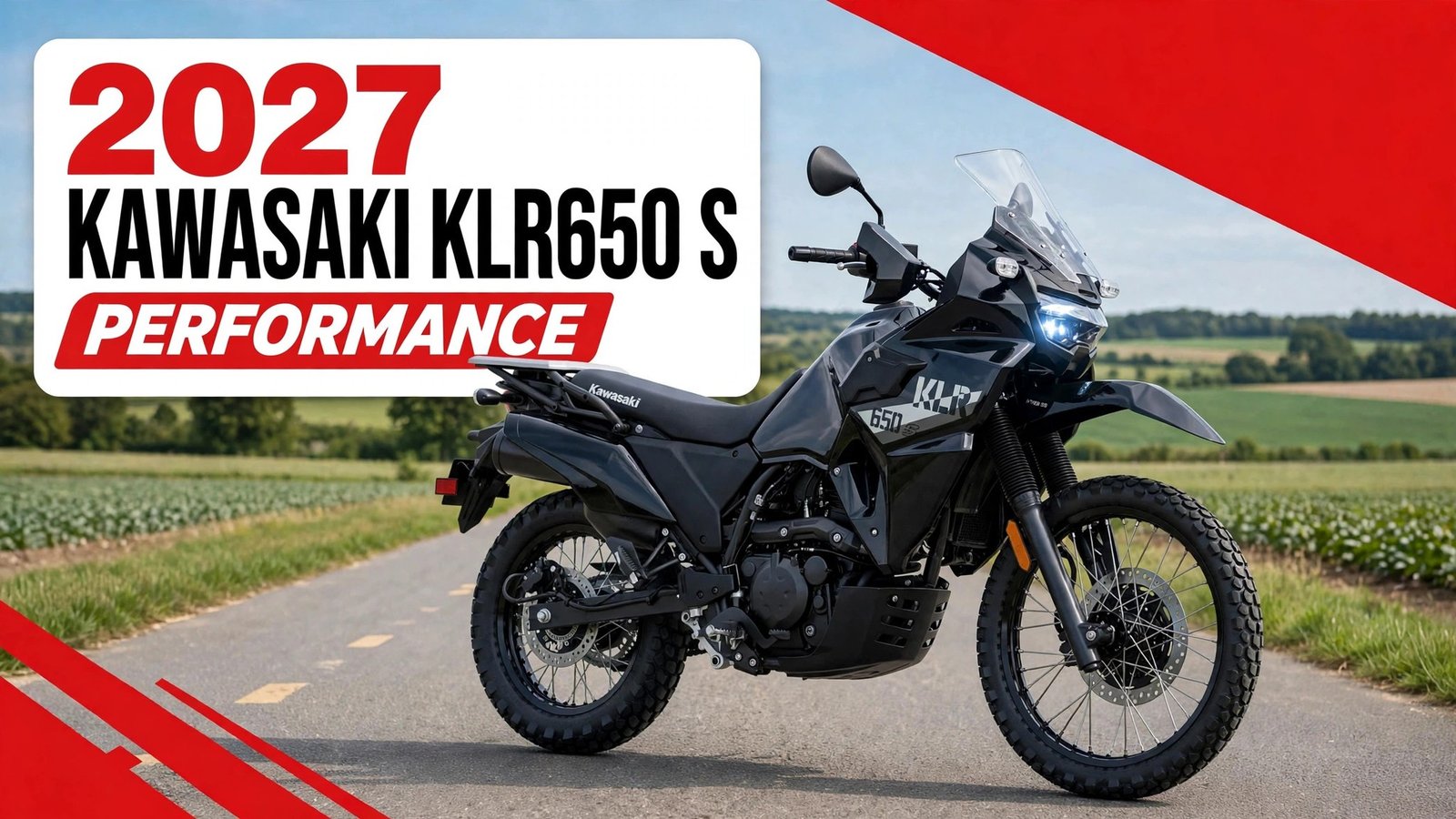
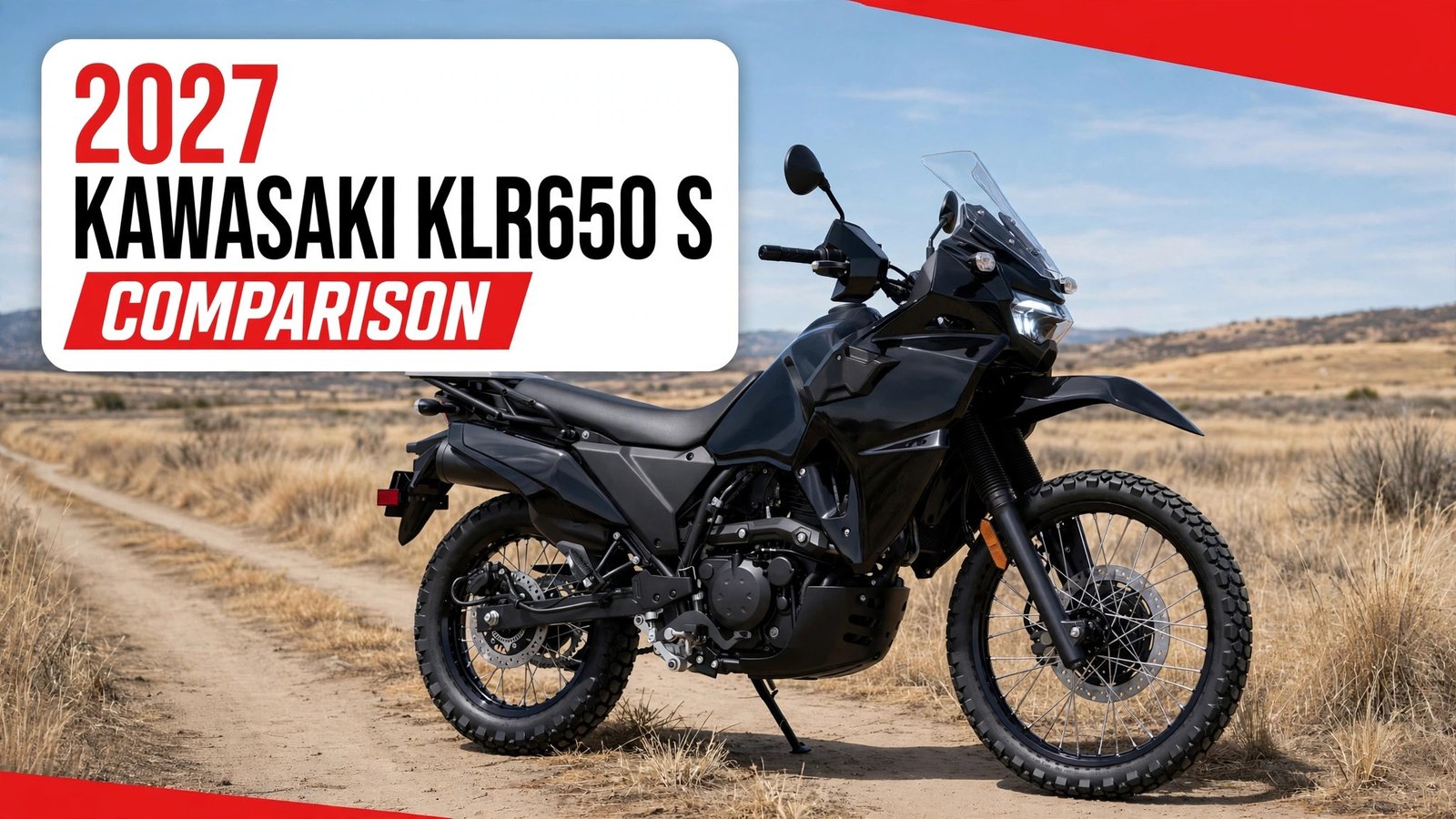
The 2027 Kawasaki KLR650 Adventure costs $8,884 delivered, and that single number is the whole point of this Kawasaki KLR650 Adventure review. For $900 more than the standard KLR650 ABS, Kawasaki bolts on 21-litre side cases, LED auxiliary lights, engine guards, a tank pad and DC and USB outlets, then hands you a bike you can tour on all weekend without buying a single accessory. Nothing else in the showroom does that for under $9,000.
The short answer is that the Adventure is the easiest KLR650 to buy if you plan to travel, and the hardest to justify if you do not. The kit is real factory hardware, the cases stay dry in the rain, and the 6.1-gallon tank still gives the longest legs in its class. The trade is 26.5 pounds of extra weight, a 34.3-inch seat, and no tachometer, no ride modes and no switchable ABS. This Kawasaki KLR650 Adventure review works through the price, the kit and the riding experience so you can decide whether the factory bags are worth the premium.
One thing to settle first: the Adventure is a trim, not a separate model. It shares the same 652cc single, the same five-speed gearbox, the same frame and the same 6.1-gallon tank as every other third-generation KLR650, which returned in 2022 after a three-year gap. Our companion base KLR650 review covers the base bike in full, while this Kawasaki KLR650 Adventure review focuses on what the Adventure adds, what it costs, and whether the added weight and money change the way the bike rides.
Kawasaki KLR650 Adventure Overview and Model-Year Updates
The Adventure has been part of the KLR650 range since the third generation launched in 2022. This Kawasaki KLR650 Adventure review starts with the model-year story.
Factory-Bagged Trim Since the 2022 Rebirth
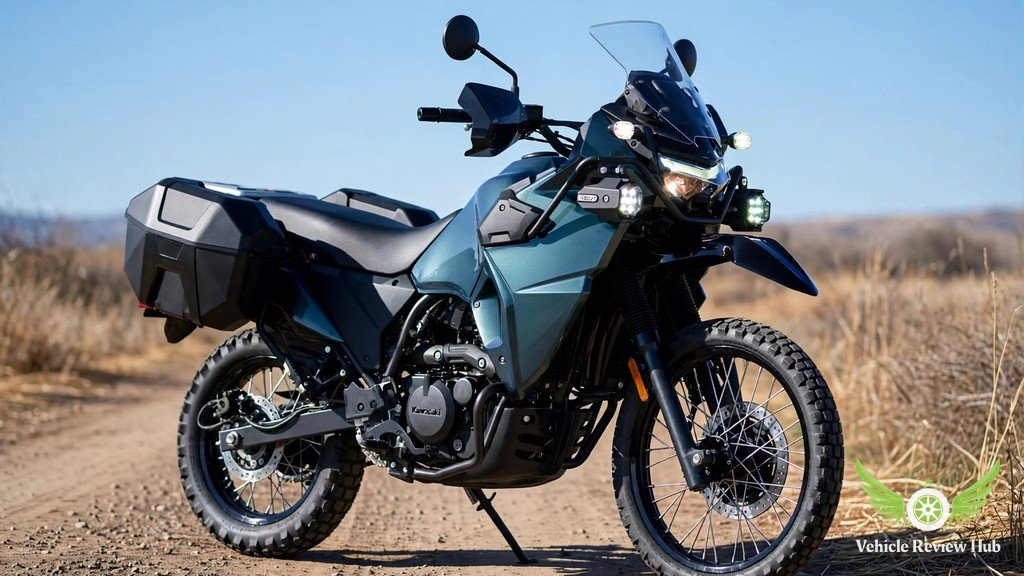
Kawasaki killed the KLR650 after 2018, then brought it back for 2022 with fuel injection, a new frame, LED lighting and an all-digital dash. Three trims arrived at the launch: the base bike, the Traveler and the Adventure. The Traveler, with its top case and tank bag, lasted only two model years and ended after 2023. The Adventure survived, and it is the only KLR650 trim that leaves the factory with hard luggage fitted. That history is why this Kawasaki KLR650 Adventure review treats the 2027 bike as a known quantity rather than a first-year gamble.
The trim also survived the arrival of the DF ABS for 2027, a new trim at $7,699 that adds frame sliders and hand guards but carries no luggage, so the Adventure keeps its own job: it is the KLR650 you buy when you want to ride away with somewhere to put your gear.
Premium Was $1,000, Now $900
In 2022 the Adventure ABS cost $7,999 against $6,999 for the standard KLR650 ABS, a $1,000 premium for the kit. By 2026 the Adventure had risen to $8,199 while the ABS trim had risen to $7,299, so the premium narrowed to $900, and it stays at $900 for 2027. Measured against the non-ABS base bike at $6,999, the premium is $1,200, so the comparison you use changes the answer. Read it against the ABS trim, because the Adventure has always been an ABS bike in practice, and from 2023 it is ABS-only.
The 2022 price needs one more footnote. ABS was a $300 option on the Adventure in its first year, so a non-ABS Adventure existed at $7,699, and Rider Magazine tested one. From 2023 the Adventure is ABS-only, so the $900 premium is now the only premium that matters in this Kawasaki KLR650 Adventure review.
Kawasaki KLR650 Adventure Engine and Specifications
Nothing under the Adventure changes the engine. This Kawasaki KLR650 Adventure review treats the 652cc single as a known quantity, because the Adventure shares it with every other third-generation KLR650.

Same 652cc Single, 26.5 Pounds Heavier
The engine is a 652cc liquid-cooled single with double overhead cams and four valves, a 100.0 by 83.0 mm bore and stroke, a 9.8:1 compression ratio and a 40 mm throttle body feeding it through fuel injection. Kawasaki claims 40 horsepower at 6,000 rpm and 39.1 lb-ft of torque at 4,500 rpm, and the power figure carries an ISO 4106 footnote on the spec sheet. The gearbox is a five-speed with a wet multi-disc clutch and a sealed chain final drive.
What the Adventure adds is weight, not power. The Adventure tips the scales at 487.1 pounds ready to ride, against 460.6 pounds for the standard KLR650 ABS, so the kit costs 26.5 pounds. Motorcycle.com put its Adventure test bike on its own scales and recorded 483 pounds against Kawasaki’s claimed 487, so the factory figure is honest within a few pounds. The extra weight sits high and wide, in the cases and the lights, and it is the first thing you feel when you lift the bike off its stand. Cycle World’s dyno test measured 34.61 horsepower at the rear wheel on a 2022 Adventure, with 33.52 lb-ft of torque.
No Top Case: That Was the Traveler
Buyers sometimes assume the Adventure carries a top case, because the bike looks fully loaded in photos. It does not. The Adventure kit is the 21-litre side cases only, plus the lights, guards, tank pad and outlets. The top case belonged to the Traveler trim, which ended after the 2023 model year. A top case is still available as a Kawasaki accessory, but it is an extra purchase, not part of the trim.
The distinction matters for packing. Two 21-litre side cases give 42 litres of lockable storage, which is a weekend’s worth of gear for one rider, not a two-up tour. The DC outlet, which this Kawasaki KLR650 Adventure review counts as part of the kit, makes charging a phone on the move simple. Our KLR650 performance guide has the full dyno and economy numbers for the platform.
| Specification | Kawasaki KLR650 Adventure (2027) |
|---|---|
| Engine | 652cc liquid-cooled single, DOHC, 4-valve |
| Bore and stroke | 100.0 x 83.0 mm |
| Compression ratio | 9.8:1 |
| Claimed power | 40 hp at 6,000 rpm (ISO 4106) |
| Claimed torque | 39.1 lb-ft at 4,500 rpm |
| Gearbox | 5-speed, wet multi-disc clutch, chain drive |
| Curb weight | 487.1 lb |
| Seat height | 34.3 in |
| Fuel capacity | 6.1 gal |
| Front tyre | 90/90-21 |
| Rear tyre | 130/80-17 |
| Wheelbase | 60.6 in |
| Ground clearance | 8.3 in |
| Warranty | 12 months limited |
Notes for this Kawasaki KLR650 Adventure review spec table: the power figure carries Kawasaki’s ISO 4106 footnote, and the curb weight is the Adventure figure. Rear suspension travel is 8.0 inches on the current Kawasaki sheet, while Kawasaki’s own 2022 launch material printed 7.3 inches.
Kawasaki KLR650 Adventure Price and Market Availability
Price is where the Adventure makes its case, because the whole trim exists to answer one question: is factory luggage worth $900? This Kawasaki KLR650 Adventure review gives the full year-by-year table first.
Kawasaki KLR650 Adventure Price in the USA: $8,199
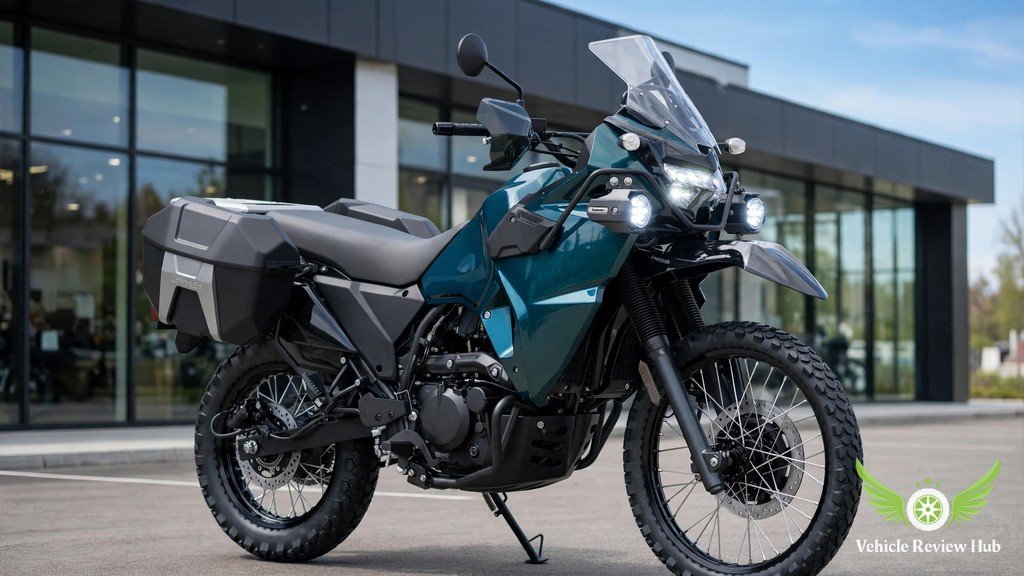
The 2027 Kawasaki KLR650 Adventure ABS lists at $8,199, plus a $685 destination charge, for $8,884 delivered before tax, title and dealer fees. The bike reaches dealers in early December 2026, at the same price as the 2026 model. The 2027 colours are Metallic Bluish Green and Cypher Camo Beige, and the camo bike costs $100 more.
The price has climbed steadily since launch. The 2022 Adventure ABS cost $7,999 plus $435 destination, or $8,434 delivered. The 2023 and 2024 bikes held the $8,199 MSRP while destination rose from $435 to $450. The 2025 bike split by colour, $8,099 in blue and $8,199 in camo, with a $665 destination charge. The 2026 bike returned to a single $8,199 MSRP with a $685 destination charge, for $8,884 delivered, and Kawasaki’s own KLR650 page lists the current model at the same price for 2027.
Camo Costs $100 More for 2027
Cypher Camo Beige costs $8,299 for 2027, $100 more than the $8,199 Metallic Bluish Green bike, and the destination charge is the same $685 either way, so the camo bike delivers at $8,984. The $100 camo premium is not new: the 2025 and 2026 camo bikes carried the same gap. It is a paint charge, nothing more, and it buys the same kit as the green bike.
Camo hides scuffs and trail dust better than a plain colour, and this Kawasaki KLR650 Adventure review assumes no premium at resale, since no resale data for the colour split exists in any published form.
| Model year | Adventure MSRP | Destination | Delivered |
|---|---|---|---|
| 2022 Adventure (non-ABS) | $7,699 | $435 | $8,134 |
| 2022 Adventure ABS | $7,999 | $435 | $8,434 |
| 2023 Adventure ABS | $8,199 | $435 | $8,634 |
| 2024 Adventure ABS | $8,199 | $450 | $8,649 |
| 2025 Adventure ABS, blue | $8,099 | $665 | $8,764 |
| 2025 Adventure ABS, camo | $8,199 | $665 | $8,864 |
| 2026 Adventure ABS | $8,199 | $685 | $8,884 |
| 2027 Adventure ABS | $8,199 | $685 | $8,884 |
| 2027 Adventure ABS, camo | $8,299 | $685 | $8,984 |
Notes for this Kawasaki KLR650 Adventure review price table: delivered means MSRP plus destination charge, before tax, title and dealer fees. The 2025 destination charge is $665, and the 2022 non-ABS Adventure existed only in that first year at $7,699.
Kawasaki KLR650 Adventure Design, Features and Technology
The Adventure kit is six items. This Kawasaki KLR650 Adventure review looks at the kit part by part.
Kit Parts Cost Hundreds More Bought Separately
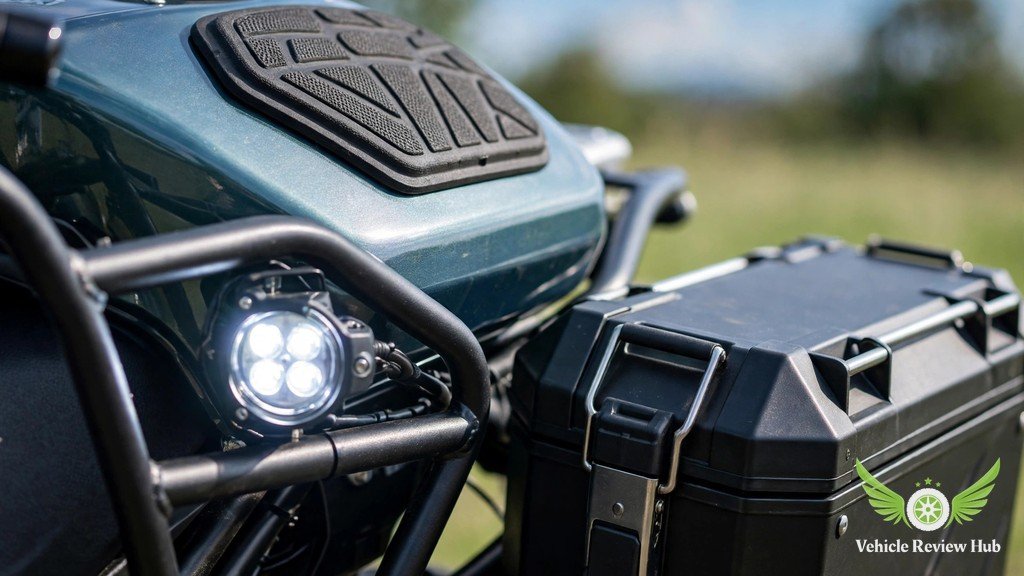
No Kawasaki list price exists for the full Adventure kit bought as separate accessories, so no honest total can be printed. What the aftermarket shows is useful context: a pair of hard side cases for a dual-sport typically costs $600 to $1,000, and a set of LED auxiliary lights typically costs $200 to $400, with the engine guards, tank pad and outlets on top of that. Bought separately, the same hardware would cost hundreds of dollars more than the $900 premium, before fitting, and the factory kit is designed for the bike rather than adapted to it, which is the point this Kawasaki KLR650 Adventure review keeps coming back to.
That maths only works if you want the parts. A rider who already owns soft luggage pays $900 for kit that adds weight without adding use. A rider starting from nothing gets a complete touring setup for less than the sum of its parts, fitted at the factory and covered by the same 12-month warranty as the rest of the bike. Read the premium as a bundle price: good value for a buyer who wants the whole bundle, and poor value for a buyer who wants only part of it.
Frame Sliders or Engine Guards: Same Hardware
Kawasaki calls the Adventure’s protection “engine guards”, dealers and press call them “frame sliders”, and Rider Magazine calls them “crash bars”. All three names describe the same factory hardware, a pair of steel bars that wrap the lower engine and fairing. A buyer searching for replacement parts will meet all three terms, and they all point to the same bars. TotalMotorcycle’s 2027 Adventure page lists the engine guards as part of the standard kit, and this Kawasaki KLR650 Adventure review uses the Kawasaki name from here on.
The guards do real work on a bike this tall and heavy. A KLR650 at 487.1 pounds will go over in a slow-speed drop, and the guards keep the fairing and the engine cases off the ground. They are not crash protection for a highway accident, but for the tip-overs that dual-sport riding guarantees, they are the cheapest insurance on the bike. The 2027 DF ABS adds the same style of protection as part of its own kit.
Kawasaki KLR650 Adventure Riding Experience and Comfort
The Adventure rides like a KLR650 with luggage, because that is what it is. This Kawasaki KLR650 Adventure review covers the cases, the lights and the seat.
Cases Are Slim and Weekend-Sized
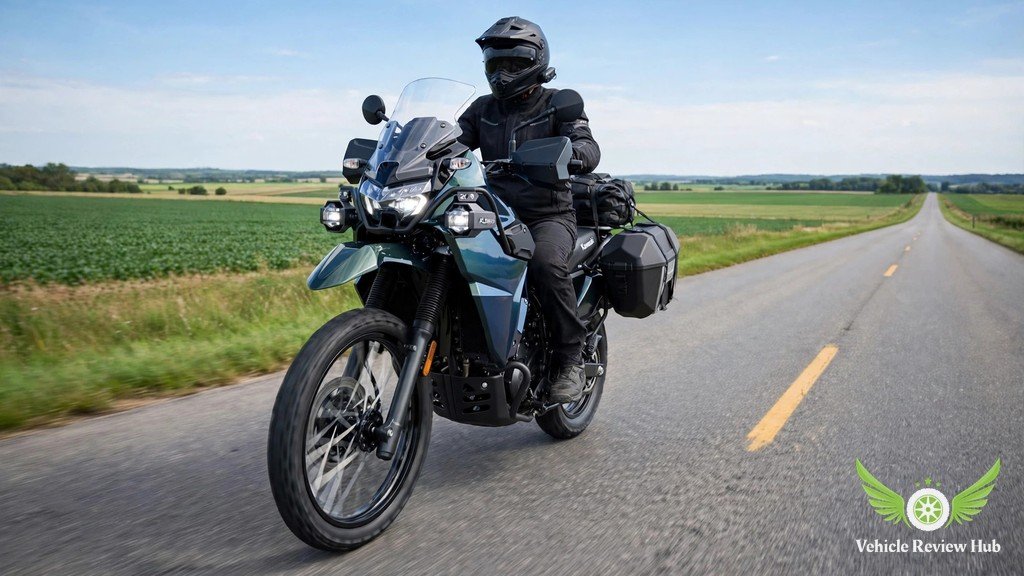
The 21-litre side cases are SHAD-developed, top-opening hard cases, and they are slim enough that the bike still filters through traffic without the cases becoming a second set of handlebars. Each case holds a weekend’s worth of gear for one rider. A full-face helmet does not fit in a 21-litre case, the main practical limit of the system, and the first limit this Kawasaki KLR650 Adventure review found in the kit.
What the cases do well is stay dry. Rider Magazine’s road test rode its Adventure test bike through a thunderstorm on the Arizona border and found the cases bone dry inside, and the top-opening lids mean gear does not spill out when a case is opened on the sidestand. The weight they carry sits high, and a fully loaded bike feels top-heavy at walking pace.
One-Key Operation: Sources Conflict
Here the sources disagree. Kawasaki’s own copy describes the hard saddlebags as having an “optional 1-key System”, and the one-key setup is a rotor kit with its own part number, which suggests the cases do not arrive keyed to the ignition key as standard. Dealer and press listings, by contrast, routinely describe the Adventure as having one-key operation. Both cannot be right in the same sense, and no Kawasaki source found for this review settles it.
Ask the dealer, before you pay, whether the cases open with the ignition key or with a separate key. If they use a separate key, the one-key rotor kit is available as an accessory. Either way, the cases lock, which is what matters on a tour, and that is the conclusion this Kawasaki KLR650 Adventure review reaches on the one-key question.
The video below is an owner’s view rather than a press test. Dork in the Road bought a 2022 KLR650 Adventure, rode it for a few months and a few thousand miles, and filmed five things a buyer should know before buying one. He also says, at 08:34, that he is selling the bike, which is part of the story and not hidden here. Watch it for the owner’s perspective, and read the rest of this Kawasaki KLR650 Adventure review for the press-tested numbers behind his impressions.
Kawasaki KLR650 Adventure Review: Pros, Cons and Verdict
The Adventure’s case is simple: it is the same KLR650, with luggage, for $900. This Kawasaki KLR650 Adventure review ends with the balance sheet.
Main Advantages and Limitations of the Kawasaki KLR650 Adventure
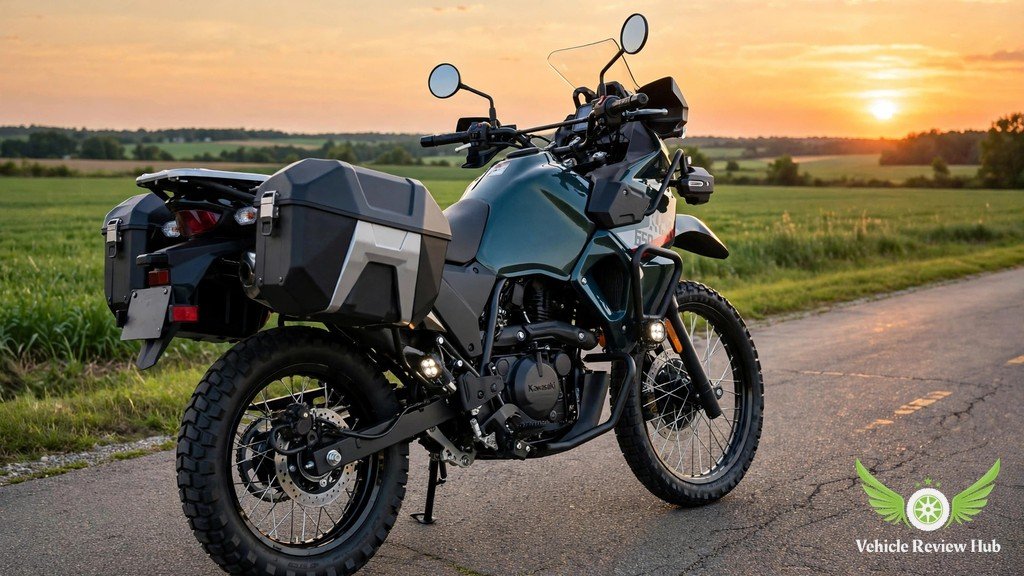
The advantages start with the luggage. Factory-fitted hard cases that stay dry, auxiliary lights that work in the dark, engine guards that save the fairing in a drop, and DC and USB outlets for charging on the move, all for $900 over the ABS trim, which is less than the parts would cost separately. The 6.1-gallon tank still gives the longest range in its class, with Cycle News measuring 49 mpg with the bags packed. The Versys 650 review shows what a smaller Kawasaki twin offers for similar money.
The limitations are the KLR650’s limitations, plus weight. The 34.3-inch seat is tall for shorter riders, and there is no low-seat Adventure variant, while the S trim sits at 32.1 inches. The engine makes 40 horsepower and asks for a downshift on a steep grade. There is no tachometer, no ride modes, no traction control and no switchable ABS, and the rear ABS cannot be deactivated without pulling a fuse, which Cycle News called out in its review. The 487.1-pound curb weight is 26.5 pounds more than the ABS trim. None of this stops the bike working, but a buyer should know it before paying, and this Kawasaki KLR650 Adventure review states it plainly.
| Advantages | Limitations |
|---|---|
| Factory hard cases that stay dry in the rain | 487.1 lb curb weight, 26.5 lb heavier than the ABS trim |
| $900 premium is less than the parts cost separately | 34.3-inch seat with no low-seat Adventure variant |
| 6.1-gallon tank, up to 300 miles of range | 40 hp asks for a downshift on steep highway grades |
| Auxiliary lights, engine guards and DC and USB outlets included | No tachometer, no ride modes, no traction control |
| Largest dealer network of any dual-sport in the US | ABS cannot be switched off without pulling a fuse |
Notes for this Kawasaki KLR650 Adventure review pros and cons table: the advantages are the factory kit and the range, and the limitations are the weight, the seat height and the missing electronics.
12 Month Limited Warranty
The Adventure carries the same 12-month limited warranty as every other KLR650, which is short by modern standards and the weakest part of the ownership story. Kawasaki’s larger adventure tourers carry longer cover, and the Versys 1100 SE LT ABS review shows a 24-month warranty. Buyers who keep the bike for years should budget for servicing after the first year, and should know the valve inspection falls at 15,000 miles on the owner’s-manual chart, covered in detail in our KLR650 reliability guide.
The short warranty does not change the verdict. The Adventure is the KLR650 to buy if you want to tour. If you never carry luggage, buy the ABS trim and save the money. That is the whole of this Kawasaki KLR650 Adventure review in one sentence: the kit is the bike.
Kawasaki KLR650 Adventure Review: Frequently Asked Questions
These are the questions buyers ask most often about the Adventure, and each answer comes from the same sources as the rest of this Kawasaki KLR650 Adventure review.
How Much Does the 2027 Kawasaki KLR650 Adventure Cost?
The 2027 Kawasaki KLR650 Adventure costs $8,199 plus a $685 destination charge, for $8,884 delivered before tax, title and dealer fees, and this Kawasaki KLR650 Adventure review uses the delivered figure throughout. The camo bike delivers at $8,984, and the bike reaches dealers in early December 2026.
What Is Included in the Adventure Kit?
The kit is the 21-litre side cases, the LED auxiliary light set, the engine guards, the tank pad and the DC and USB outlets, all factory fitted. This Kawasaki KLR650 Adventure review counts the rear carrier separately because it is standard on the base bike too. No top case is included.
Is the Adventure a Different Bike From the KLR650?
No. The Adventure is a trim of the third-generation KLR650, not a separate model, and this Kawasaki KLR650 Adventure review treats it that way throughout. It shares the same engine, gearbox, frame and tank as the base bike.
How Heavy Is the Adventure?
The Adventure weighs 487.1 pounds ready to ride, 26.5 pounds more than the standard KLR650 ABS at 460.6 pounds, and this Kawasaki KLR650 Adventure review puts the kit weight first because it is the first thing a rider feels. Motorcycle.com recorded 483 pounds on its own scales, close to Kawasaki’s claimed 487.
How Much Horsepower Does the Adventure Make?
Kawasaki claims 40 horsepower at 6,000 rpm, with an ISO 4106 footnote, and 39.1 lb-ft of torque at 4,500 rpm. At the rear wheel, Cycle World measured 34.61 horsepower on a 2022 Adventure, and this Kawasaki KLR650 Adventure review prints both figures because the crank-to-wheel gap is often misunderstood.
What Is the Fuel Economy and Range?
Cycle News measured 49 mpg with the bags packed on the ride home to California, which gives nearly 300 miles from the 6.1-gallon tank. Motorcycle.com averaged 35.2 mpg on an 800-mile freeway run at nearly full throttle, for just over 200 miles. This Kawasaki KLR650 Adventure review puts the real range at 215 to 300 miles.
Does the Adventure Have a Top Case?
No. The Adventure kit is the side cases only, and this Kawasaki KLR650 Adventure review states that plainly because buyers often assume otherwise. The top case belonged to the Traveler trim, which ended after 2023, and a top case is now an optional Kawasaki accessory rather than part of the trim.
Is One-Key Operation Standard?
The sources conflict, and this Kawasaki KLR650 Adventure review does not pretend otherwise. Kawasaki’s copy calls it an optional 1-key System, while dealer and press listings describe one-key operation as standard. Ask the dealer whether the cases open with the ignition key before you pay.
Can a Shorter Rider Ride the Adventure?
The 34.3-inch seat is tall, and there is no low-seat Adventure variant. Shorter riders should sit on one before buying. The S trim sits at 32.1 inches, although the S carries no luggage, which is the trade this Kawasaki KLR650 Adventure review keeps returning to.
Does the Adventure Have Switchable ABS?
No. ABS is the only rider aid on the KLR650, and it cannot be switched off from the handlebar. The only workaround is pulling a fuse or fitting an aftermarket kill switch, which Cycle News called out as a weakness, and this Kawasaki KLR650 Adventure review notes the same.
What Is the Warranty?
The Adventure carries a 12-month limited warranty, the same as every other KLR650, and this Kawasaki KLR650 Adventure review calls it the weakest part of the ownership story. It is short by modern standards, and buyers should budget for servicing after the first year.
Is the Adventure Worth $900 More Than the KLR650 ABS?
Yes, if you want the kit. The parts would cost hundreds of dollars more bought separately, and this Kawasaki KLR650 Adventure review finds the bundle good value. If you never carry luggage, buy the ABS trim and save the $900.