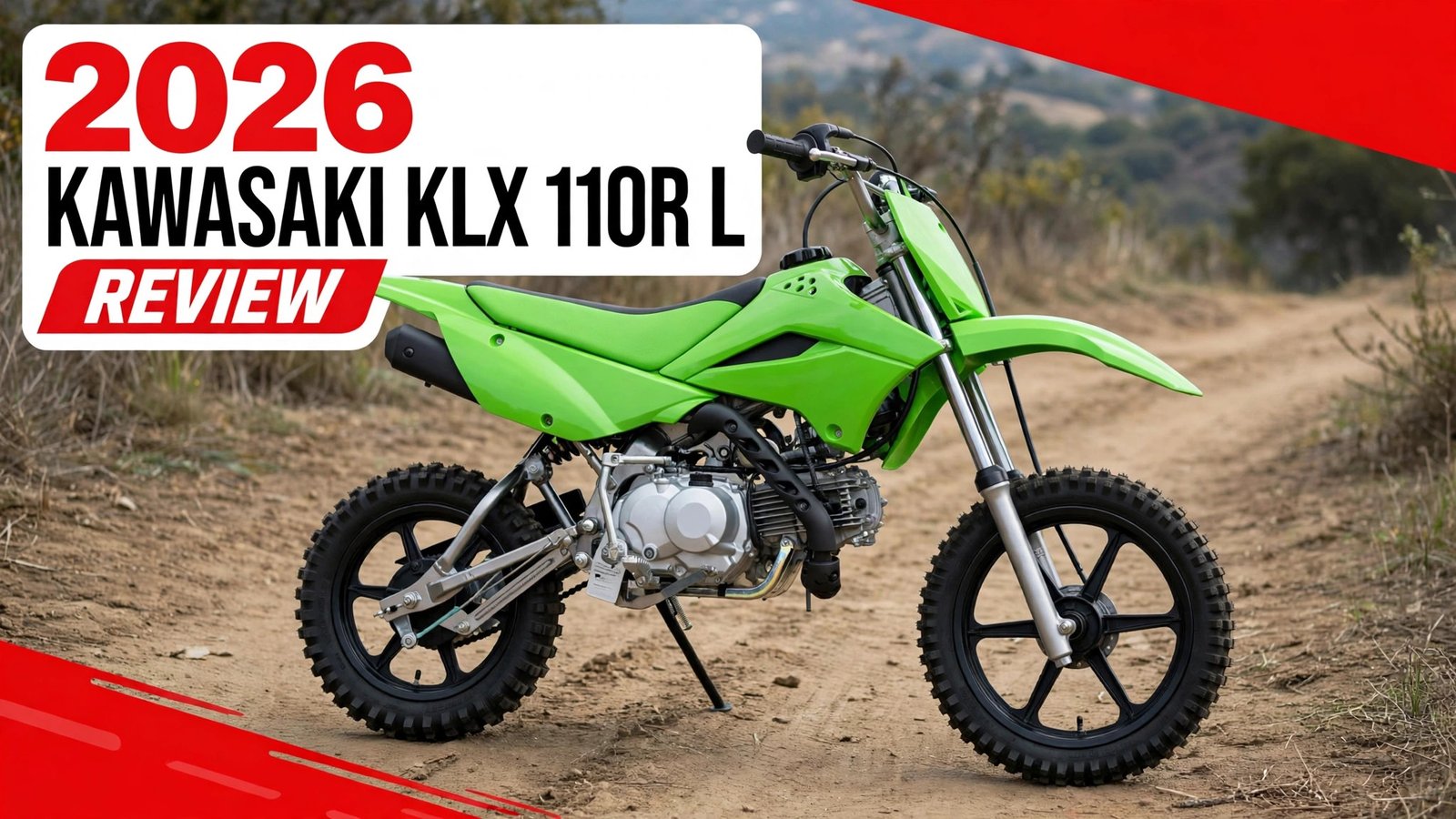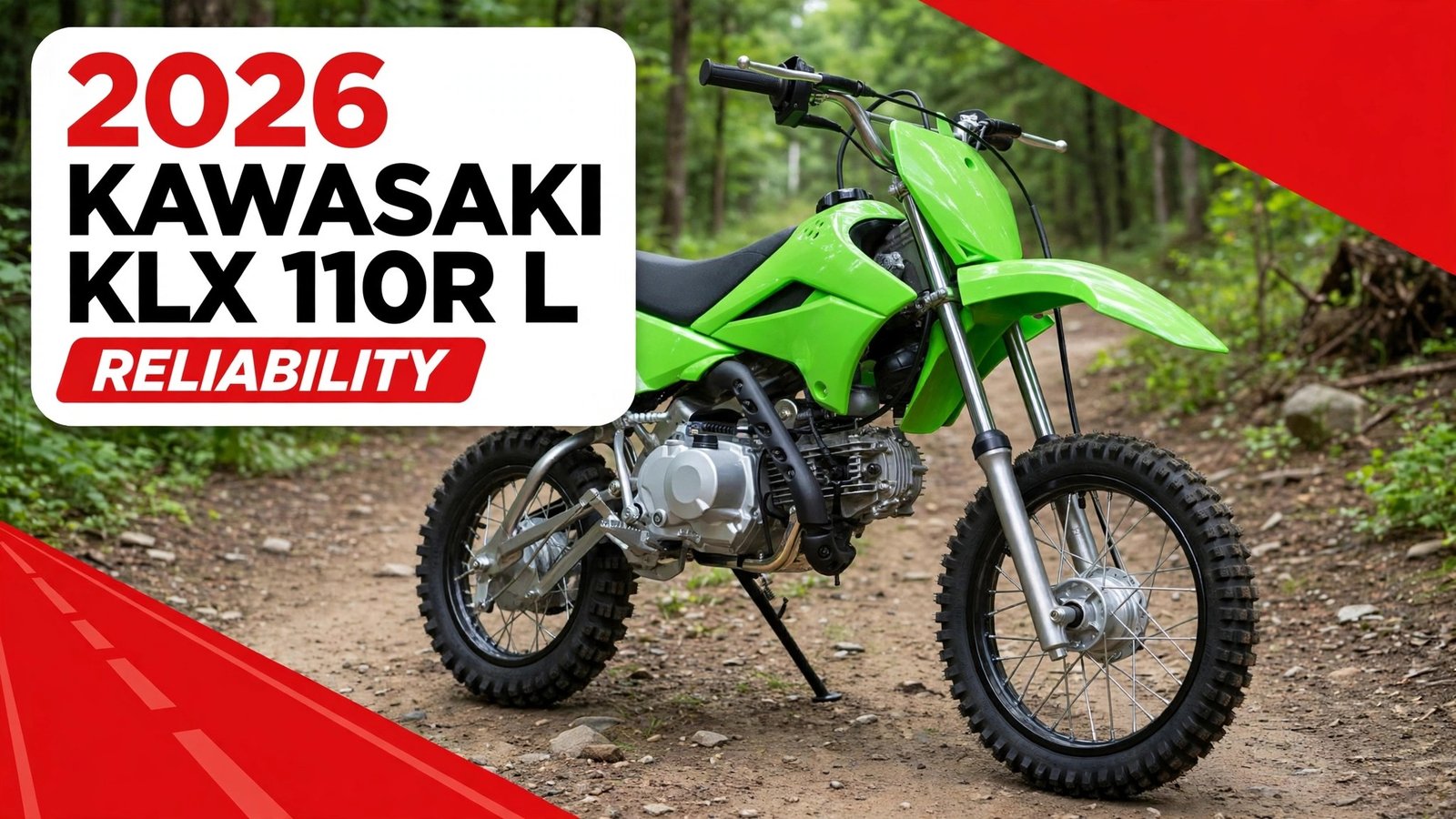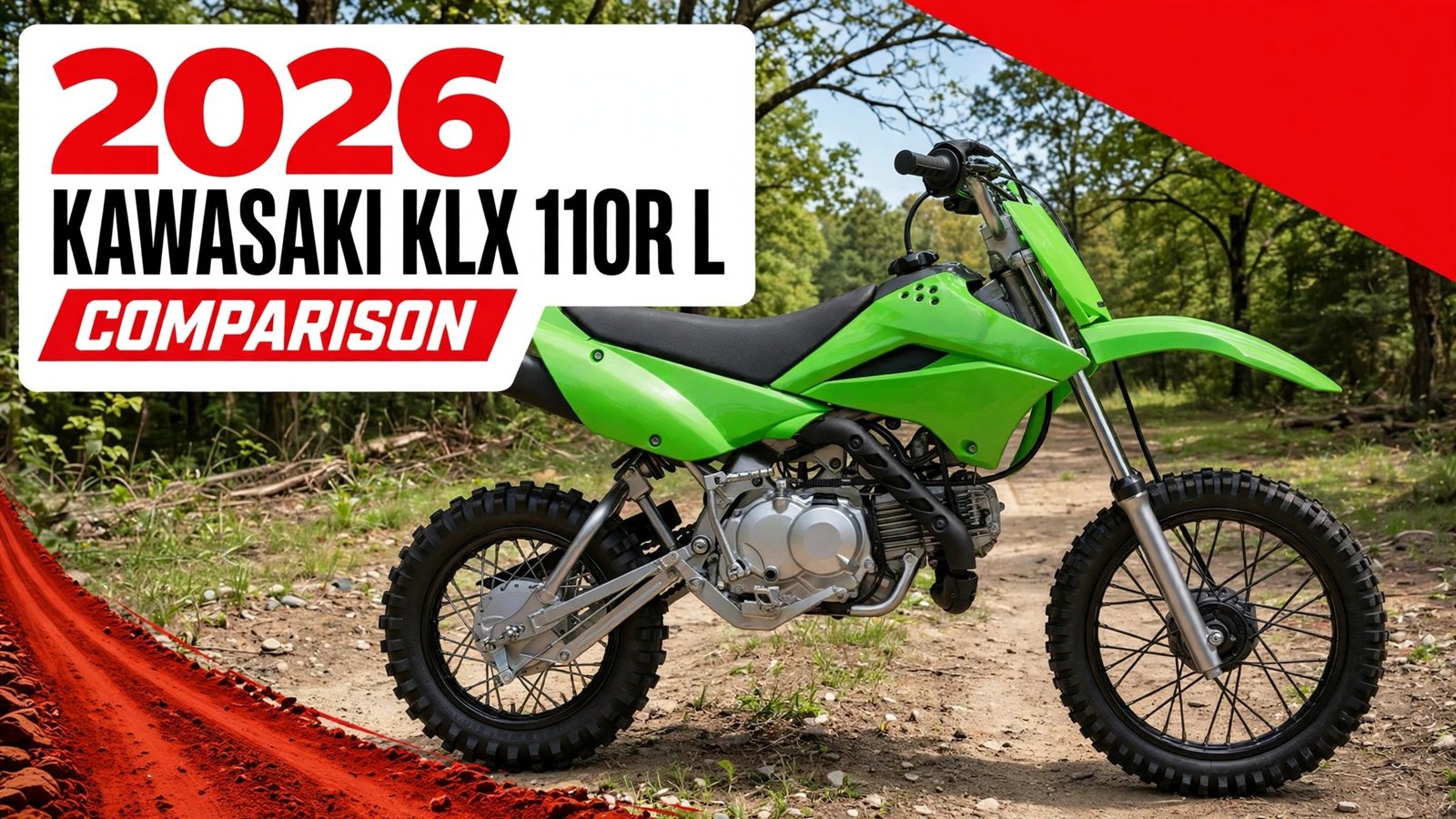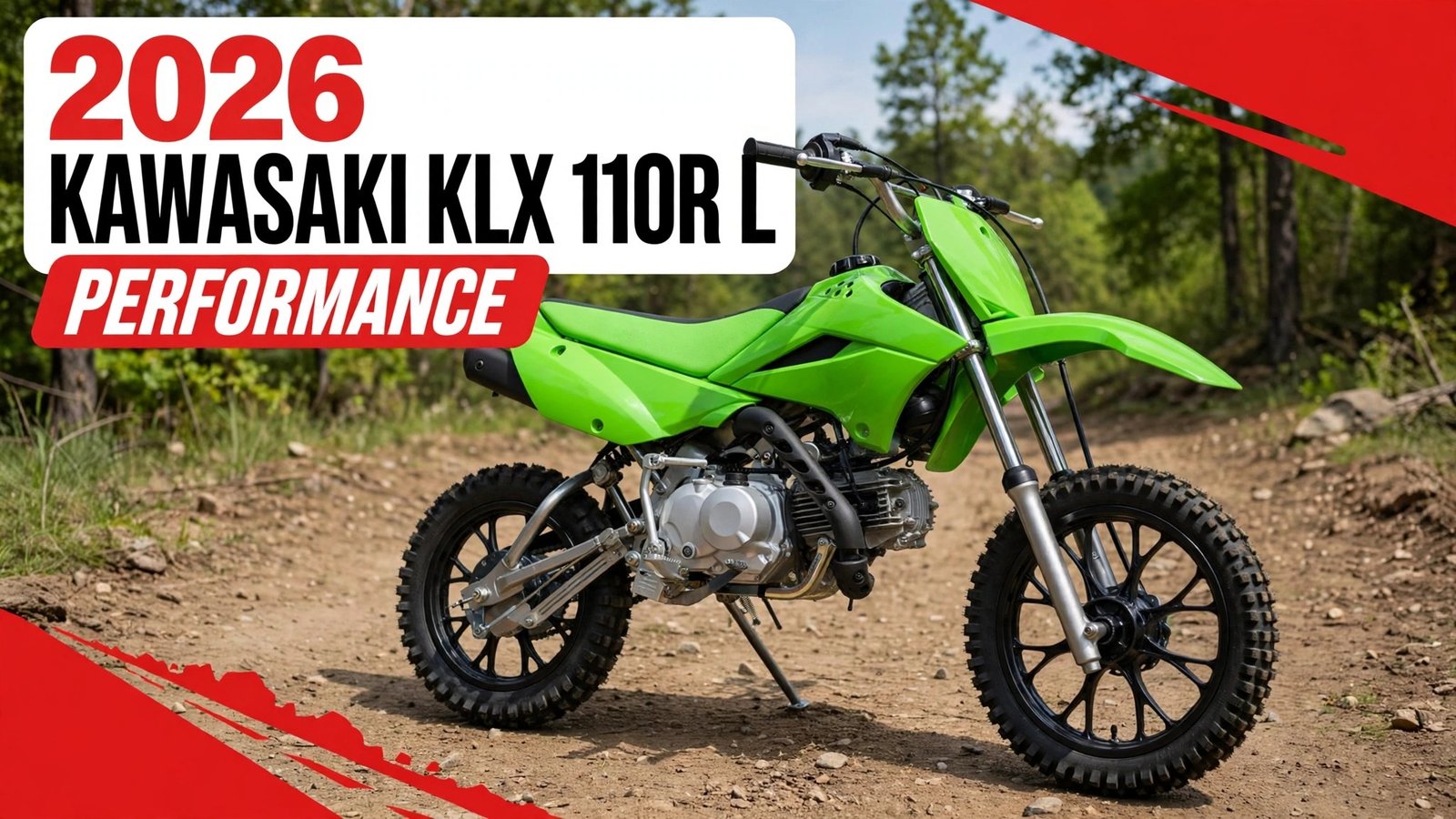
The 2026 Kawasaki KLX 110R L makes the same power as the standard KLX110R, runs the same gearing, and carries the same weight — and this Kawasaki KLX 110R L performance guide starts there, because the honest answer to most performance questions about this bike is that no test exists. There is no dyno chart for any trim, no instrumented top-speed figure for the L, no MPG test, and no 0–60 run.
The value of this Kawasaki KLX 110R L performance guide is in saying plainly what is not tested, and in explaining why: the bike has no odometer and no instrument cluster, and no outlet has put a 110 this way on a dyno or a radar gun. The L is the R with a hand clutch and taller suspension — $3,199 plus a $315 destination charge, $3,514 delivered — and the clutch changes control, not speed.
Kawasaki KLX 110R L Engine Performance and Power Delivery
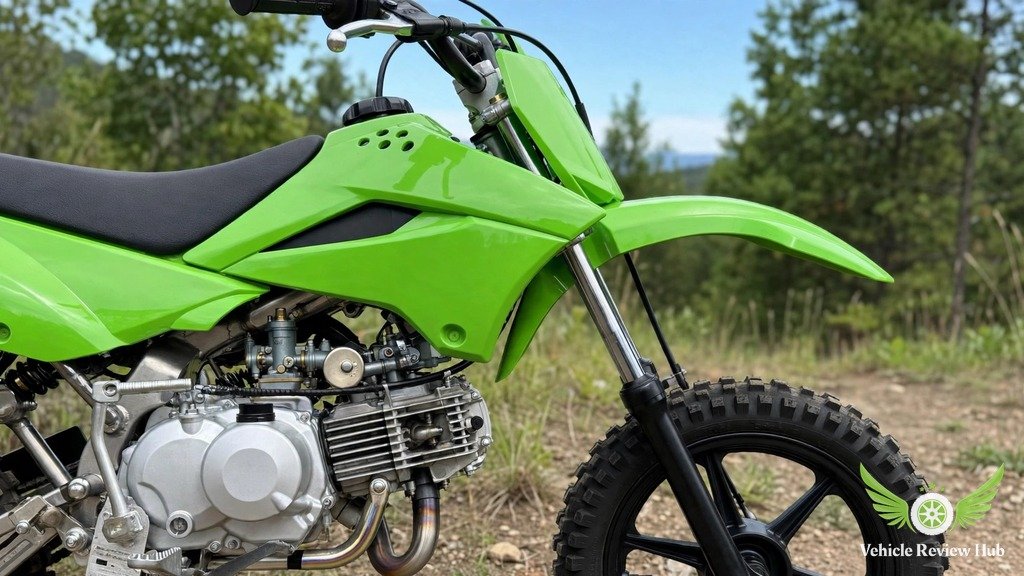
The engine is the same 112cc air-cooled single with the same Keihin PB18 carburettor as the R, and this Kawasaki KLX 110R L performance guide says so first, because every power number below is a number about that shared engine.
No Dyno Exists for Any Trim
No outlet has dyno-tested a KLX110R L or the R. The full Ultimate Motorcycling 2021 review of the R was read end to end and the word “dyno” does not appear in it once — the 6.2 hp figure in its spec box is a plain reported number, not a dyno result. No dyno chart exists for any KLX110, KLX110R or KLX110R L, and this Kawasaki KLX 110R L performance guide prints no dyno figure because none exists to print.
That matters because the only power numbers in circulation come from three different kinds of source, and they do not agree. The table below lays all three out with their sources, and the rest of this Kawasaki KLX 110R L performance guide uses none of them as a settled figure.
Only Test Record: The 2010 Launch
The only instrumented-style test record for the L is the 2010 launch. Motorcycle.com’s 2010 launch review tested both bikes back to back when the L was created, with tester Alfonse Palaima. The 2010 redesign brought a four-speed gearbox, an electric starter and about 15 percent more power than the pre-2010 bike, and Kawasaki’s own claim from that launch — 7.3 PS at 7,500 rpm, or 7.2 horsepower for American readers — is still the highest number in circulation.
Palaima rode the base bike first and then the L, and the L is the bike he came away preferring. No later outlet has tested the L in the same way, and Ultimate Motorcycling’s 2012 KLX110L review is the only other test record — a test of the 2012 L, cited as 2012, not as 2010.
| Source | Power figure | Torque figure | What it is |
|---|---|---|---|
| Kawasaki 2010 claim | 7.2 hp @ 7,500 rpm | Not stated | Manufacturer claim at launch |
| Ultimate Motorcycling 2021 spec box (R) | 6.2 hp @ 7,000 rpm | 4.6 lb-ft @ 4,500 rpm | Reported figure, same engine |
| CycleChaos database | 7.11 hp @ 7,500 rpm | 5.9 lb-ft @ 4,000 rpm | Claimed figures, not a test |
Notes: the power figures in this Kawasaki KLX 110R L performance table are the three numbers in circulation for the shared 112cc engine. The autoevolution database lists 8 Nm (6 lb-ft) at 4,000 rpm — a fourth torque number, also untested.
Kawasaki KLX 110R L Top Speed and Acceleration
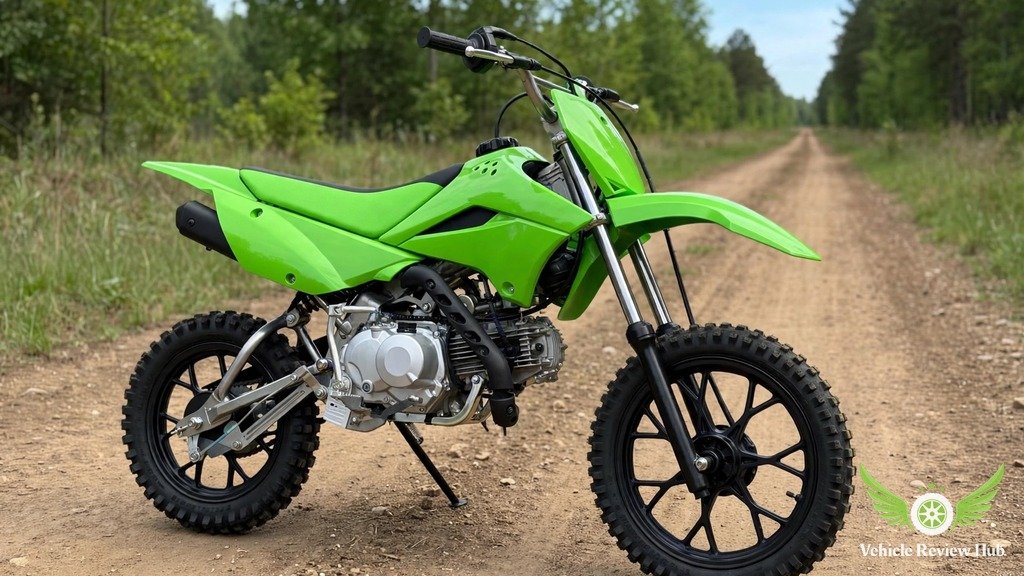
Top speed is where the missing tests hurt most, and this Kawasaki KLX 110R L performance guide does not hide it. There is no instrumented top-speed figure for the L, and the only measurement on the platform is a single YouTube run on the R.
The video below is a radar test of three pre-rename KLX110 pit bikes — the Honda CRF110, the Yamaha TT-R110 and the Kawasaki KLX110 — run by 3SR TV. It is not a KLX110R L top-speed test: the Kawasaki on screen is the pre-rename KLX110, the same engine and the same gearing as the L, but not the L itself. This Kawasaki KLX 110R L performance guide uses it because it is the only measured-speed content on the platform.
No Instrumented Top Speed Anywhere
No magazine, no manufacturer and no test outlet has published an instrumented top speed for the KLX110R L. No GPS or radar run on the L exists in the sources this Kawasaki KLX 110R L performance guide could find. The only measurement on the platform is a single YouTube run: Oneway_Jerry measured 50 mph on a 2022 KLX110R, reported by SlashGear in September 2024. That is a measurement on the R, not the L — one run on the other trim, not a test.
The screw-type throttle limiter matters here too. Kawasaki fits a limiter on the grip housing that restricts the throttle to 3/8 or 1/2 opening for novices, and a limited bike will not reach 50 mph. A buyer who reads “50 mph” as the bike’s top speed is reading a measurement made with the limiter off, on the other trim, and treating it as a factory figure. The “0–60 in 8 seconds” figure that circulates with it is an aggregator claim with no test behind it, and this Kawasaki KLX 110R L performance guide does not print it as a result.
45 to 50 MPH Claims Are Unverified
Aggregator sites quote 45 to 50 mph for both trims — one lists 45 to 48 mph as typical for a stock bike, another lists 45 to 50. Neither cites a test, and this Kawasaki KLX 110R L performance guide treats both as unverified. The physics points one way: the L has the same engine and the same gearing as the R, so the two bikes should reach the same speed in principle. But no L has been measured, so no top-speed figure is printed for the L.
The four ratios, the primary and the final drive are identical for the R and the L, down to the tooth counts, and the overall ratio in top gear is 10.832 for both. The clutch is the only drivetrain difference, and a clutch changes how the power is controlled, not how fast the bike goes.
| Gear | Ratio | Teeth |
|---|---|---|
| 1st | 3.000 | 36/12 |
| 2nd | 1.938 | 31/16 |
| 3rd | 1.350 | 27/20 |
| 4th | 1.087 | 25/23 |
| Primary | 3.409 | 75/22 |
| Final | 2.923 | 38/13 |
| Overall (top gear) | 10.832 | — |
Notes: the gear ratios in this Kawasaki KLX 110R L performance table come from the 2013 owner’s-manual spec table, which lists identical ratios for the R and the L. The clutch is the only drivetrain difference. Kawasaki’s own 2026 spec sheet for the L confirms the shared platform specs.
Kawasaki KLX 110R L Mileage and Fuel Economy
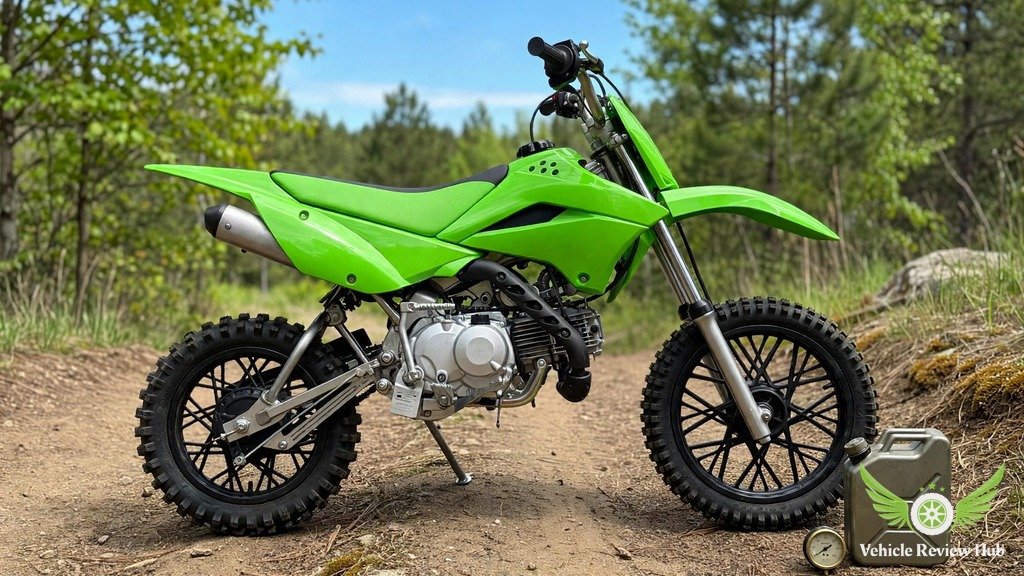
Fuel economy is the thinnest section of this Kawasaki KLX 110R L performance guide: the bike has no odometer and no instrument cluster, so nobody has measured its mileage. The tank holds 1.0 gallon.
No MPG Testing Exists
No outlet has tested the KLX110R L’s MPG, and none has tested the R’s either. With no odometer, a rider cannot measure miles per gallon the way a road-bike rider does, and no test outlet has bothered to work around it. This Kawasaki KLX 110R L performance guide prints no MPG figure, because none exists to print — and a buyer who sees one quoted for this bike is seeing an aggregator’s guess, not a test.
The only honest arithmetic is the tank: at 1.0 gallon, 40 mpg means 40 miles and 60 mpg means 60. That is arithmetic, not a test. The Keihin PB18 needs its float bowl drained before storage, or the jets clog, a chore a fuel-injected bike avoids.
Gearing Identical to the Standard
The gearing is identical to the standard bike, and this Kawasaki KLX 110R L performance guide repeats the point because it settles the speed question: the ratios are the same down to the tooth counts, and the rider changes gear with a hand lever instead of an automatic clutch.
That sameness is the point of the L. The buyer pays $200 over the R — $3,199 against $2,999, $3,514 delivered against $3,314 — for control and fit, not for speed. The R’s performance figures carry straight across to the L, because the two bikes are the same motorcycle underneath.
| What is known | Figure | Status |
|---|---|---|
| Fuel capacity | 1.0 gal | Kawasaki spec sheet |
| Odometer | None fitted | Kawasaki spec sheet |
| Instrument cluster | None fitted | Kawasaki spec sheet |
| Tested MPG | None | No test exists |
| Tested range | None | No test exists |
| Carburettor | Keihin PB18 | Kawasaki spec sheet |
Notes: the figures in this Kawasaki KLX 110R L performance table are from Kawasaki’s own 2026 spec sheet for the L. The “none” rows are the point: no MPG or range figure has been tested for either trim.
Kawasaki KLX 110R L Real-World Riding Experience

The test record for the L is one launch test and one later review, and this Kawasaki KLX 110R L performance guide treats both as what they are: two testers’ accounts, not a consensus.
Testers Preferred the L in 2010
In 2010, Motorcycle.com’s Alfonse Palaima rode the base KLX110 first and then the taller KLX110L, and the L is the bike he came away preferring. His words, from the launch review: the L “seemed more powerful” despite the exact same frame and engine, and it was the roomier rider triangle, the near-two-inch taller saddle and the more-familiar clutched gear control that had him more comfortable in the saddle. That is one tester’s account, and this Kawasaki KLX 110R L performance guide does not present it as a multi-tester consensus.
The second data point is from 2012, not 2010. Ultimate Motorcycling’s 2012 KLX110L review — tester Didrik Thordarson — came back talking enthusiastically about the L’s power and liked the four-speed transmission, especially wide open in top gear on straights, and found even an adult could ride the KLX110L without instant bottoming. The same review carries the counterweight: the clutch engagement is over a fairly narrow range and far out in the lever travel, and getting started from a standing start is the most difficult part of learning to use a manual clutch.
Stock Class Rules May Exclude It
Stock pit-bike classes are written around the automatic clutch, and this Kawasaki KLX 110R L performance guide names the series and the exact rule, because a racing buyer should check the rulebook before buying. The Colorado Pit Bike Series 2025 rulebook says its 12-inch Stock 110 class is “Auto clutch ONLY. No KLX110L or aftermarket/OEM clutch kits” — the L races instead in 12-inch Stock Limited, where auto and manual clutches are both allowed.
Stimilon’s Masters of Mini stock class is “Auto Clutch only (No manual clutches allowed)”, and a 110L must race Kamikaze. The VMD Pitbike National Championship 2026 classes say 110 Stock is for production bikes with an automatic clutch, while 110 Stock Limited expressly permits “L” versions of base models, naming the KLX110L. GoRaceMX’s 110 class is “Semi Auto (no Manual Clutch)”. Rules vary by series, but the stock class itself is closed to the L almost everywhere.
| Series | Stock class rule | Where the L races |
|---|---|---|
| Colorado Pit Bike Series 2025 | Auto clutch ONLY; “No KLX110L or aftermarket/OEM clutch kits” | 12-inch Stock Limited |
| Stimilon Masters of Mini | “Auto Clutch only (No manual clutches allowed)” | Kamikaze class |
| VMD Pitbike Nationals 2026 | 110 Stock: automatic clutch only | 110 Stock Limited (“L” versions permitted) |
| GoRaceMX | 110 class: “Semi Auto (no Manual Clutch)” | Open/limited classes (check the series) |
Notes: the rules in this Kawasaki KLX 110R L performance table are quoted from each series’ own 2025–2026 rulebook or class list. Rules vary by series and change year to year — check the current rulebook before entering.
Kawasaki KLX 110R L Handling, Braking and Stability
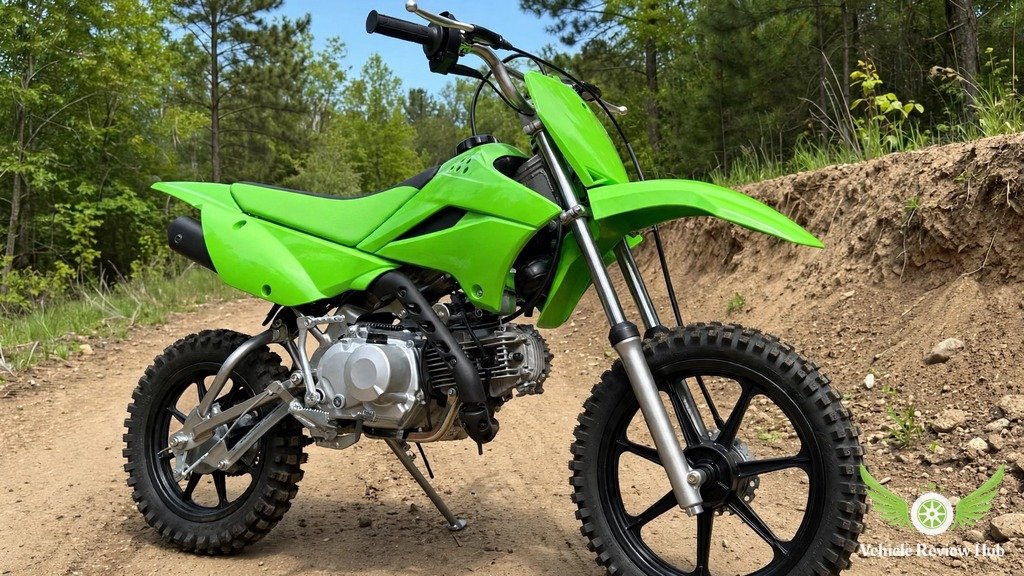
The L handles like the R with a taller seat, and this Kawasaki KLX 110R L performance guide puts the difference in inches: a 28.7-inch seat against 26.8, 5.5 and 5.2 inches of travel against 4.3 and 4.3, and 10.4 inches of clearance against 8.5. The wheelbase is identical at 42.3 inches.
Handling, Braking and Stability on the Trail
The taller suspension is the L’s whole handling story. The 30 mm fork gives 5.5 inches of travel and the rear shock gives 5.2, both longer than the R’s 4.3, and the extra travel is what the taller seat and the extra clearance are built on. Ultimate Motorcycling’s 2012 tester found even an adult could ride the KLX110L without instant bottoming, and the longer travel is the reason. The frame, engine, wheels and brakes are shared with the R.
The aftermarket treats the two trims as one platform. TBparts’ bolt-on fork sets add 10 mm of travel for the L — against 40 mm for the R — at $379.99.
Same Drum Brakes as the Standard
The brakes are the same drums as the standard bike, and this Kawasaki KLX 110R L performance guide does not dress them up. The front is a 90 mm mechanical drum, cable actuated; the rear is a 110 mm mechanical drum, rod actuated. There is no disc, no ABS, and no hydraulic master cylinder anywhere on the bike — both levers are cable levers, which is correct for a drum-brake bike. Ultimate Motorcycling’s 2021 test of the R found the drums “work as expected, even on steep downhills”.
The drums are also the first thing a race-mini build replaces. A KX65 fork swap brings a disc brake to the front, and it is the standard first step for a bike headed for the track rather than the trail. For trail riding, the drums are enough.
| Item | Kawasaki KLX110R L | Kawasaki KLX110R |
|---|---|---|
| Seat height | 28.7 in | 26.8 in |
| Front travel | 5.5 in | 4.3 in |
| Rear travel | 5.2 in | 4.3 in |
| Ground clearance | 10.4 in | 8.5 in |
| Overall height | 39.0 in | 37.6 in |
| Wheelbase | 42.3 in | 42.3 in |
| Front brake | 90 mm drum | 90 mm drum |
| Rear brake | 110 mm drum | 110 mm drum |
| Curb weight | 167.5 lb | 167.5 lb |
Notes: the figures in this Kawasaki KLX 110R L performance table are 2026 Kawasaki spec-sheet figures for both trims. The L is taller in every dimension except the wheelbase and the weight.
Kawasaki KLX 110R L Performance Compared With Other Play Bikes

Against the other play bikes, the L’s performance story is the same story this Kawasaki KLX 110R L performance guide has told throughout: the same engine as the R, the same gearing, the same brakes, and the only manual clutch in the Japanese 110 class.
Kawasaki KLX 110R L vs Kawasaki KLX 110R
Against the R, the L is the same bike with a clutch. The engine, the carburettor, the gearing, the wheels, the brakes, the weight and the wheelbase are identical — the differences are the wet multi-disc manual clutch instead of the automatic one, the 28.7-inch seat instead of 26.8, travel of 5.5 and 5.2 inches instead of 4.3 and 4.3, and 10.4 inches of clearance instead of 8.5. Nothing in the drivetrain changed except the clutch.
The $200 premium is the price of that clutch and that fit: $3,199 against $2,999, $3,514 delivered against $3,314. The R’s review covers the shared platform in full, and the R’s performance figures carry straight across to the L.
Is the Kawasaki KLX 110R L Suitable for Beginner Riders?
Not as a very first bike. A first-time rider should start on the automatic R, because the L asks the rider to manage a hand clutch and a taller seat all at once, and Ultimate Motorcycling’s 2012 tester found the standing start the hardest part of learning the clutch. The L is the right second bike, for the rider who has outgrown the R and wants to learn clutch control — and this Kawasaki KLX 110R L performance guide is blunt about it.
The rider limit is under 154 pounds, from the factory service manual, the same limit as the R. A parent buying for a teenager near the limit should look at the size-up alternatives, and the Suzuki DR-Z125L is the honest next step — a bigger bike a class up, with a 32-inch seat and 19/16 wheels, the wheels some sources wrongly claim for the L. The R’s reliability guide covers the same hour-based servicing.
| Model | Clutch | Delivered price (2026) | Warranty |
|---|---|---|---|
| Kawasaki KLX110R L | Manual | $3,514 | 6 months |
| Kawasaki KLX110R | Automatic | $3,314 | 6 months |
| Honda CRF110F | Automatic | $3,099 | 6 months |
| Yamaha TT-R110E | Automatic | $2,749 | 90 days |
Notes: the prices in this Kawasaki KLX 110R L performance table are 2026 delivered prices. The L is the priciest 110 and the only one with a manual clutch; it is cheaper than both 125s, the Honda CRF125F at $3,899 delivered and the Suzuki DR-Z125L at $3,949.
Kawasaki KLX 110R L Performance FAQ
The questions below answer what buyers ask most, and this Kawasaki KLX 110R L performance guide keeps every answer to what is tested, what is claimed, and what is not tested at all.
How much horsepower does the KLX110R L make?
No settled figure exists, and this Kawasaki KLX 110R L performance guide prints no winner: Kawasaki claimed 7.2 hp at 7,500 rpm in 2010, Ultimate Motorcycling’s 2021 spec box reports 6.2 hp at 7,000 rpm for the same engine, and CycleChaos lists 7.11 hp.
Has anyone dyno-tested the KLX110R L?
No. No dyno chart exists for the L or the R — the full Ultimate Motorcycling 2021 review was read end to end and the word “dyno” does not appear in it. This Kawasaki KLX 110R L performance guide prints no dyno figure because none exists.
What is the top speed of the KLX110R L?
No instrumented figure exists. The only measurement on the platform is a single YouTube run that measured 50 mph on a 2022 KLX110R — the R, not the L. This Kawasaki KLX 110R L performance guide prints no top-speed figure for the L.
Is the KLX110R L faster than the KLX110R?
No. The two bikes share the same engine and gearing, so they should reach the same speed in principle — but neither has been measured. This Kawasaki KLX 110R L performance guide treats them as equally fast, which is to say unmeasured.
What MPG does the KLX110R L get?
No MPG figure has been tested for either trim. The bike has no odometer and no instrument cluster, and its 1.0-gallon tank is the only fuel figure Kawasaki publishes. This Kawasaki KLX 110R L performance guide prints no MPG.
Does the KLX110R L have a manual clutch?
Yes — a wet multi-disc manual clutch with a hand lever, the L’s whole reason to exist. The lever needs 2 to 3 mm of free play, which grows as the cable stretches and the plates wear.
How many gears does the KLX110R L have?
Four, with a return shift — the same four ratios as the R and the same 10.832 overall ratio in top gear. This Kawasaki KLX 110R L performance guide lists the full ratio table in the Top Speed section above.
Can the KLX110R L race in stock pit-bike classes?
Mostly no, and this Kawasaki KLX 110R L performance guide names the rules: Colorado’s 12-inch Stock 110 class is auto clutch only; Stimilon’s stock class is auto clutch only; VMD’s 110 Stock is automatic only; GoRaceMX’s 110 class is semi-auto. The L races in stock-limited classes instead.
Does the KLX110R L have disc brakes?
No. Both ends are drums — a 90 mm front drum and a 110 mm rear drum — with no disc and no ABS. This Kawasaki KLX 110R L performance guide notes a KX65 fork swap is the standard route to a front disc.
Is the KLX110R L good for beginners?
Not as a very first bike. A first-time rider should start on the automatic R. This Kawasaki KLX 110R L performance guide calls the L the right second bike, for the rider who has outgrown the R.
What is the seat height of the KLX110R L?
28.7 inches — 1.9 inches taller than the R’s 26.8-inch seat. This Kawasaki KLX 110R L performance guide notes some sources round the seat to 29 inches; the exact figure from Kawasaki’s own spec sheet is 28.7.
How much does the KLX110R L cost?
The L costs $3,199 plus a $315 destination charge, which lands it at $3,514 delivered for 2026, and this Kawasaki KLX 110R L performance guide uses the manufacturer’s suggested retail price. A $3,099 listing is the stale 2025 MSRP.