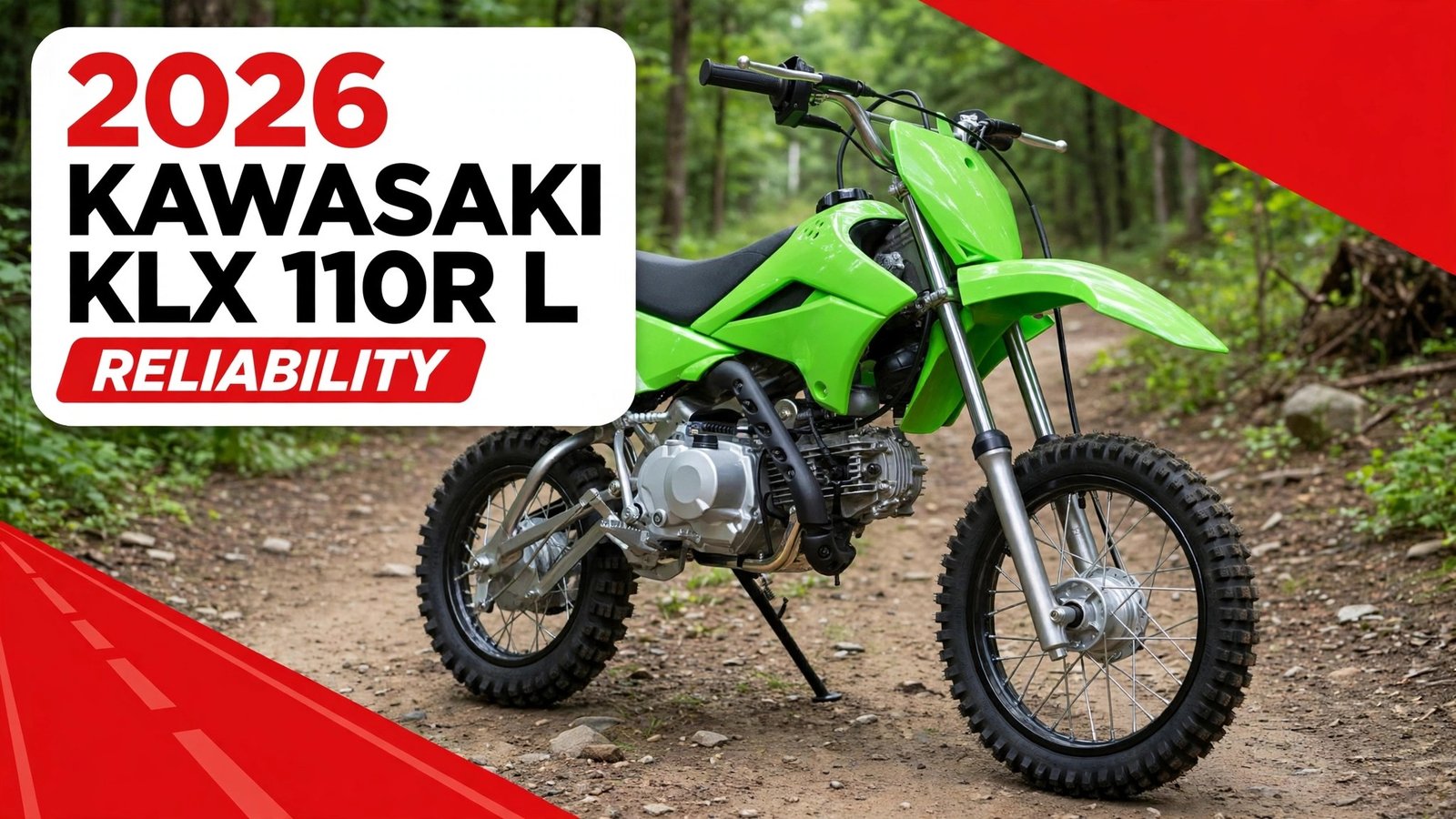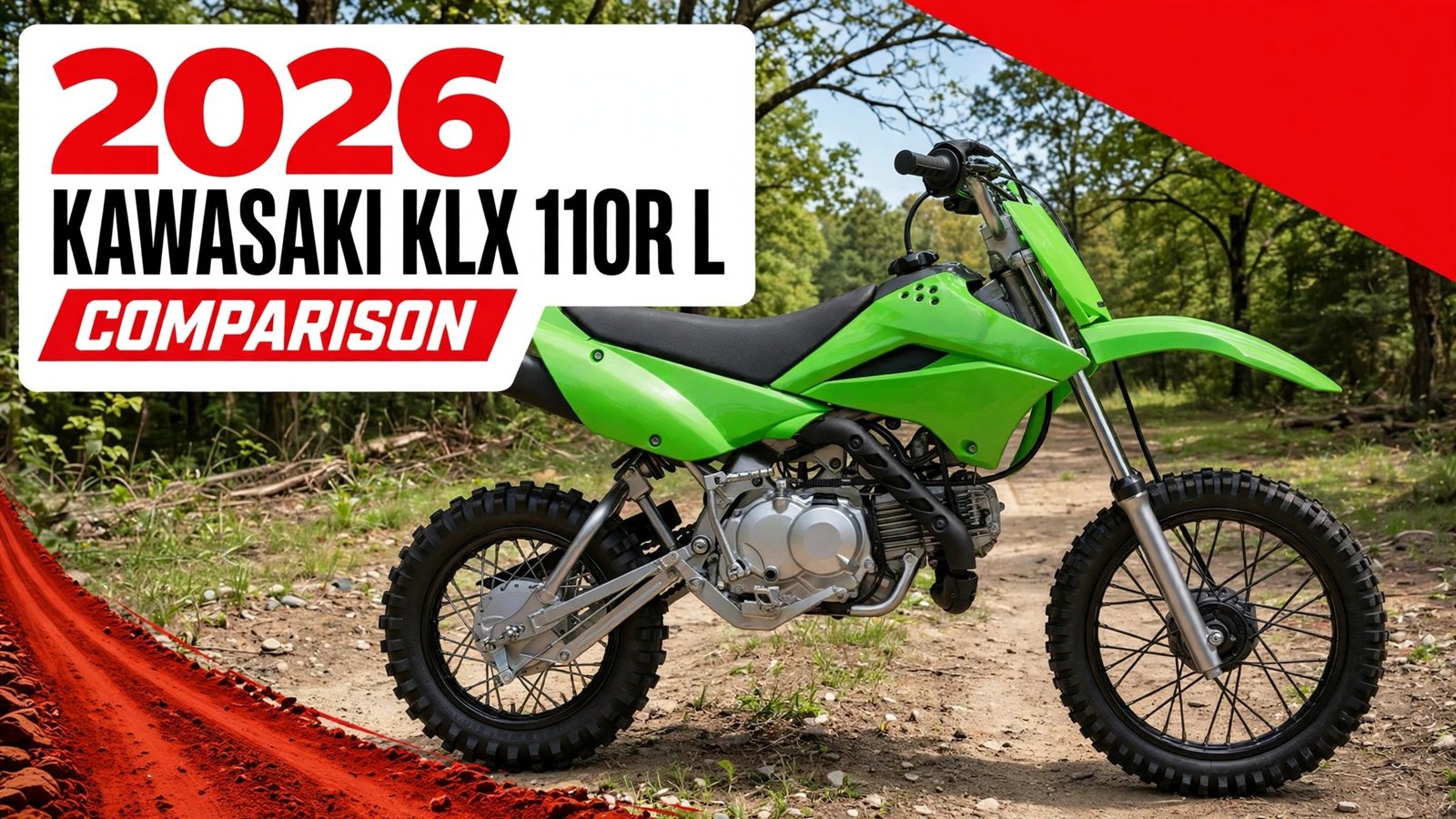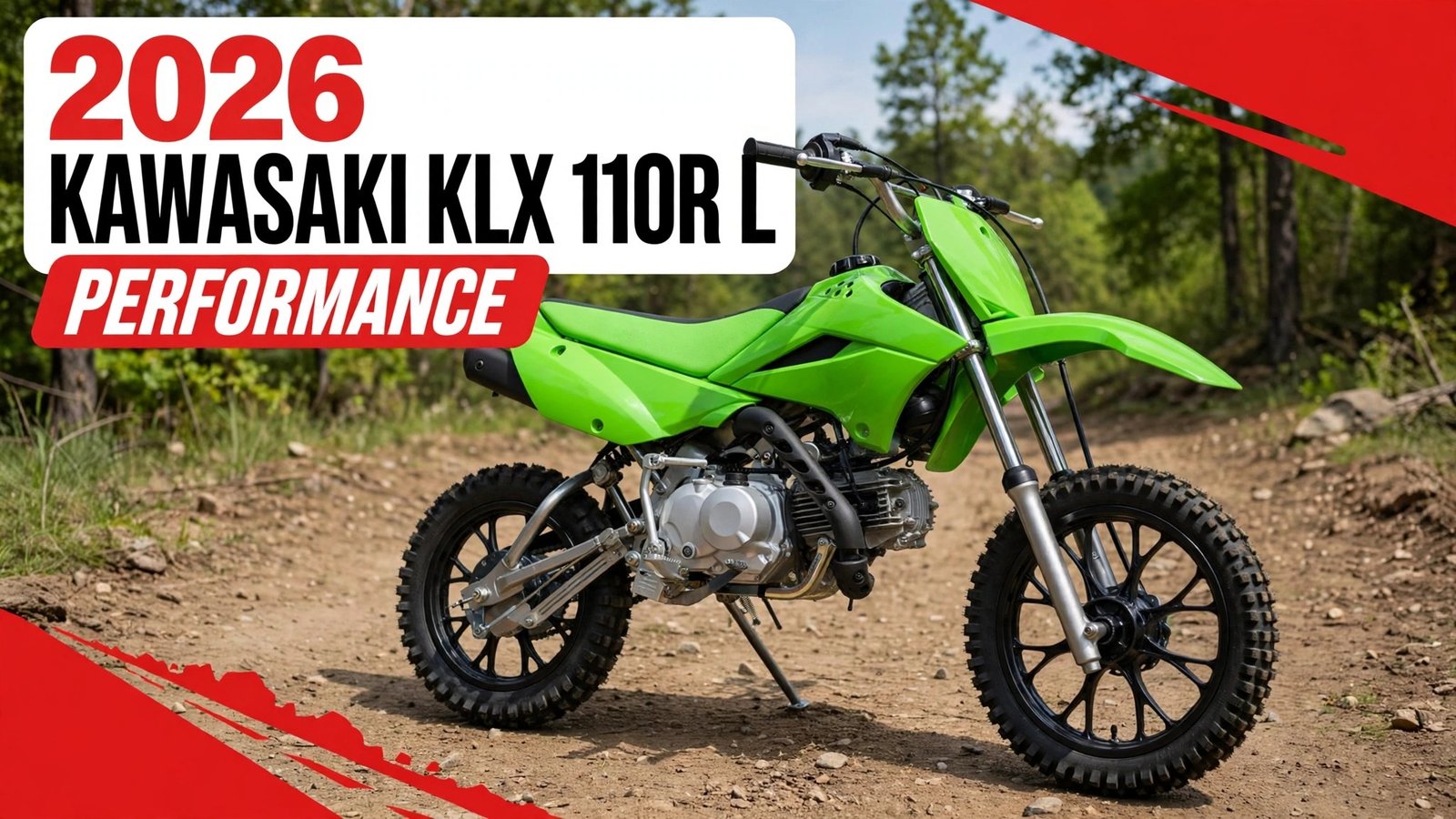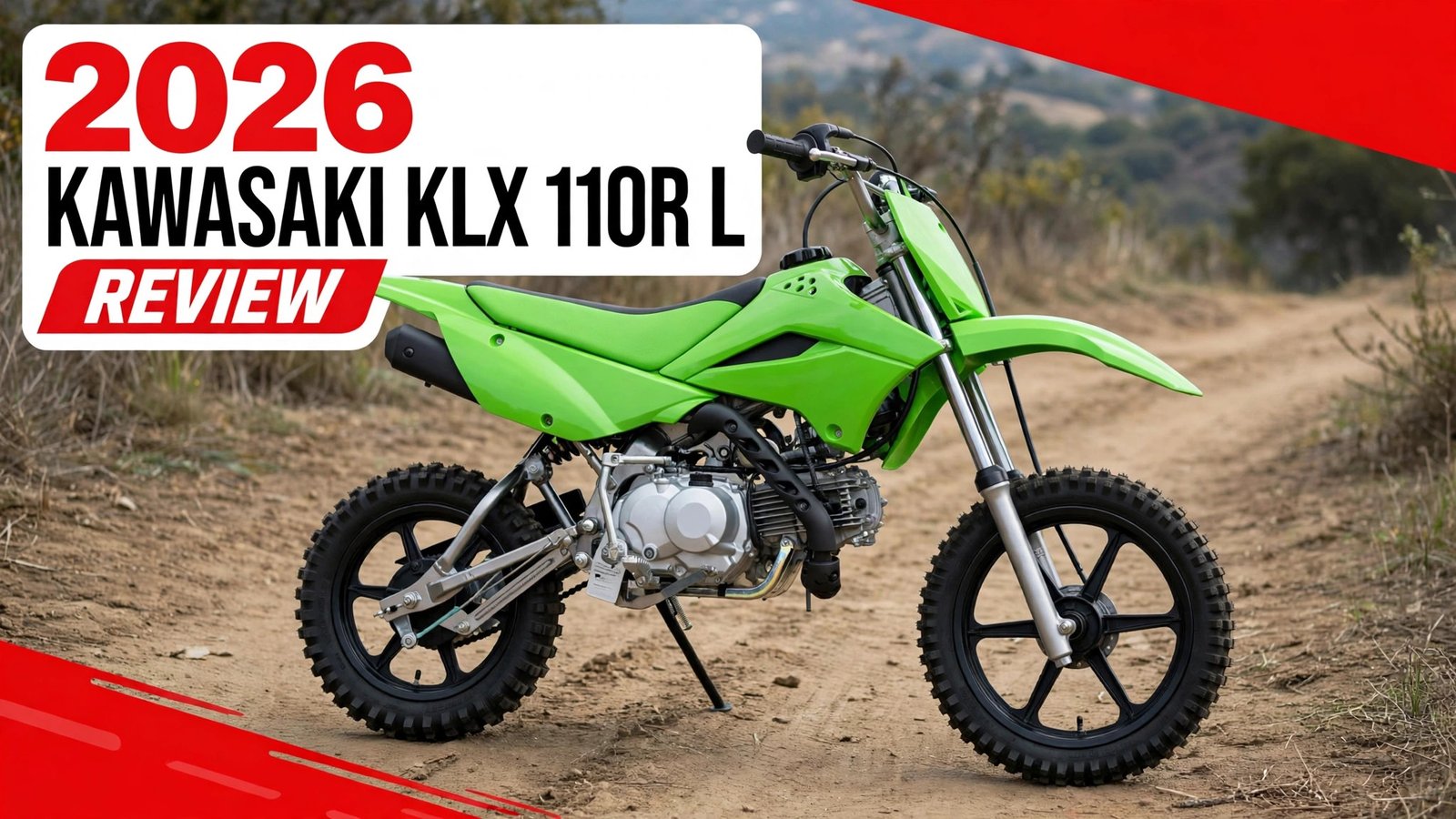
The 2026 Kawasaki KLX 110R L costs $3,199 plus a $315 destination charge, which lands it at $3,514 delivered, and this Kawasaki KLX 110R L review starts with the one fact that matters most: it is the same 112cc trail bike as the standard KLX110R, plus a manual clutch and taller suspension. The L is the only Japanese 110 with a hand clutch, and it is the bike for the rider who has outgrown the automatic clutch but is not ready for a 125. There is no 2027 US model listed, so the 2026 bike is the one to buy.
The engine, carburettor, wheels, drum brakes and weight are identical to the standard bike, and this Kawasaki KLX 110R L review checks each against Kawasaki’s own 2026 spec sheet.
Kawasaki KLX 110R L Overview and Model-Year Updates
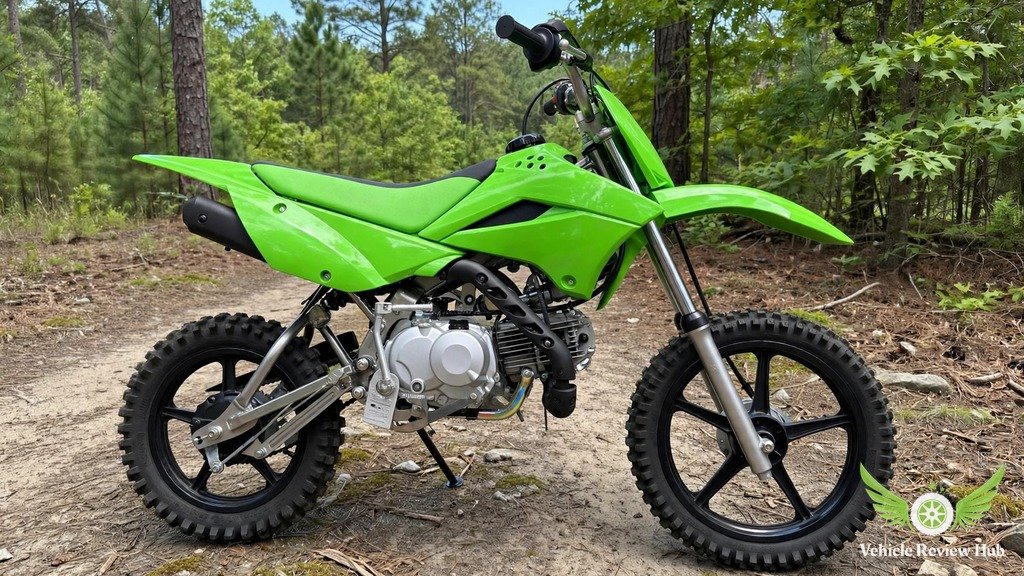
The L has been the same idea since 2010: the smallest Kawasaki trail bike, plus a hand clutch and a taller stance, for the rider ready to learn clutch control. Nothing about that idea has changed for 2026, and this Kawasaki KLX 110R L review finds the 2026 bike carrying the same engine, carburettor and drum brakes as the standard bike. What changed is the name — the KLX110L became the KLX110R L in 2021 — and the price, which has climbed from $2,249 at launch to $3,199 today. The standard KLX110R is the bike to read about first if the automatic version is the one in question, because every fact about the L starts as a fact about the R.
The video below shows the 2026 R, the L’s automatic-clutch twin, in a walkaround of the new-look model. It is not the L itself — no L-only review video exists — but the bike on screen is the same platform, and this Kawasaki KLX 110R L review uses it to show the shared 2026 styling.
Premium Is $200, Was $150 at Launch
At launch in 2010 the gap was $150 — $2,249 against $2,099 — and this Kawasaki KLX 110R L review finds it at $200 for 2026: $3,199 against $2,999. What the buyer gets for that $200 is a manual clutch, a seat 1.9 inches taller, longer suspension travel and 1.9 inches more ground clearance — and nothing else, because the engine, the wheels and the brakes are the same.
| Model year | KLX110R L MSRP | KLX110R MSRP | L premium |
|---|---|---|---|
| 2010 (launch) | $2,249 | $2,099 | $150 |
| 2021 | $2,549 | $2,349 | $200 |
| 2022 | $2,699 | $2,499 | $200 |
| 2023 | $2,849 | $2,649 | $200 |
| 2024 | Not verified | $2,849 | Not verified |
| 2025 | $3,099 | $2,899 | $200 |
| 2026 | $3,199 | $2,999 | $200 |
Notes: the prices in this Kawasaki KLX 110R L review table are manufacturer MSRP per model year. The 2024 L price is not verified and is printed as such. One listing still shows $3,099 as the 2026 L price, but that is the stale 2025 MSRP, and a discounted dealer listing at the same figure is not the MSRP either.
Created in 2010, Renamed in 2021
The L did not exist before 2010, when Kawasaki redesigned the KLX110 with a four-speed gearbox and an electric starter and added the L as the taller, clutched version; Motorcycle.com’s 2010 launch review tested both bikes back to back. The tester rode the base bike first and then the L, and found himself more comfortable on the L — the first written record of the reason the L still exists. The name changed in 2021, when the KLX110 became the KLX110R and the KLX110L became the KLX110R L, and Ultimate Motorcycling’s 2021 review confirms the rename was a name only.
Kawasaki KLX 110R L Engine and Specifications
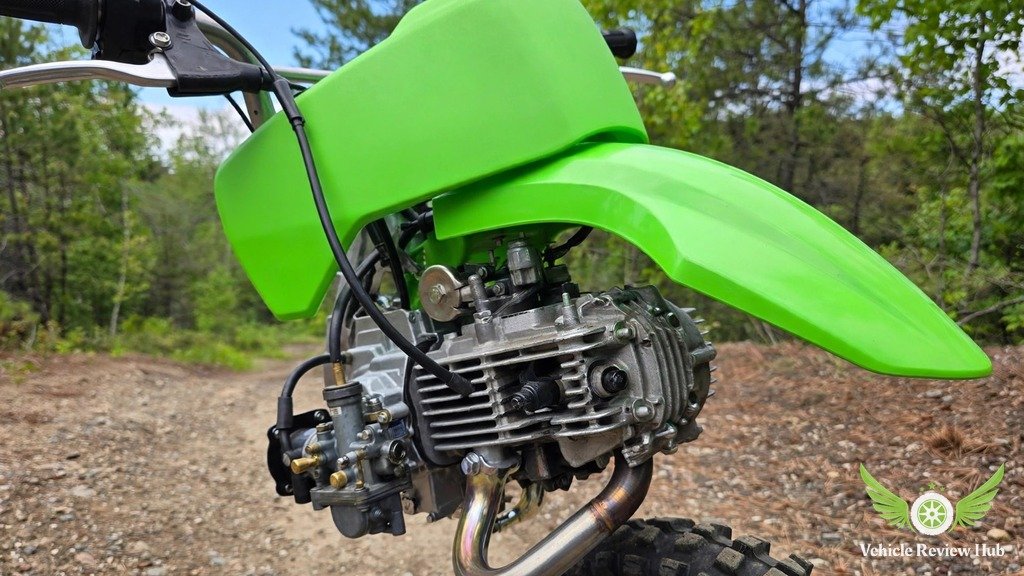
The engine is the same in every number that matters, and this Kawasaki KLX 110R L review says so first. Both bikes run the same 112cc air-cooled single with the same Keihin PB18 carburettor, the same 53.0 by 50.6 mm bore and stroke, and the same 9.5:1 compression — and Kawasaki publishes no power figure at all, so the only numbers in circulation are a 7.2 hp claim from 2010, a reported 6.2 hp in a magazine spec box, and a 7.11 hp database figure. The difference is in how the power reaches the ground: the R’s four-speed works through an automatic centrifugal clutch, while the L’s works through a wet multi-disc manual clutch with a hand lever. The R’s performance figures carry straight across to the L, because the gearing is identical too — the clutch changes control, not speed.
Manual Clutch Is the Whole Point
A manual clutch on a 110 is the L’s entire reason to exist. First, it teaches clutch control: a rider who learns on the L arrives at a 125 already knowing how to feather a lever and slip a clutch, and this Kawasaki KLX 110R L review treats that as the bike’s real value. Second, it gives control the automatic bike cannot: the rider can hold a gear and slip the clutch over an obstacle, which is why the 2010 launch tester felt more comfortable on the L the moment he switched to it. The cost is real too: the lever needs 2 to 3 mm of free play, which grows as the cable stretches and the plates wear, and a learner who rides the clutch will wear the plates faster. The clutch also excludes the L from stock pit-bike classes that require an automatic clutch, so a racing buyer should check the rulebook before buying.
Bigger Wheels Are a Myth
The most repeated wrong fact about the L is that it has bigger wheels, and this Kawasaki KLX 110R L review states the correction plainly: the L has the same 14-inch front and 12-inch rear wheels as the R, with the same 2.50 by 14 and 3.00 by 12 tyres. Kawasaki’s own 2026 spec sheet lists those sizes for the L, and any source claiming 19-inch and 16-inch wheels for the L is wrong — 19/16 belongs to the Suzuki DR-Z125L, a bigger bike a class up. The L is taller in every other way — seat, fork, shock and clearance — which is where the confusion comes from. But the wheels, the wheelbase and the weight did not grow.
| Specification (2026) | Kawasaki KLX110R L | Kawasaki KLX110R |
|---|---|---|
| Engine | 112cc air-cooled single | 112cc air-cooled single |
| Bore x stroke | 53.0 x 50.6 mm | 53.0 x 50.6 mm |
| Compression | 9.5:1 | 9.5:1 |
| Fuelling | PB18 carburettor | PB18 carburettor |
| Clutch and gearbox | 4-speed, manual clutch | 4-speed, auto clutch |
| Starting | Electric + kick | Electric + kick |
| Seat height | 28.7 in | 26.8 in |
| Front suspension travel | 5.5 in | 4.3 in |
| Rear suspension travel | 5.2 in | 4.3 in |
| Ground clearance | 10.4 in | 8.5 in |
| Overall height | 39.0 in | 37.6 in |
| Wheelbase | 42.3 in | 42.3 in |
| Weight | 167.5 lb curb | 167.5 lb curb |
| Fuel capacity | 1.0 gal | 1.0 gal |
| Brakes | Drums, 90/110 mm | Drums, 90/110 mm |
| Wheels and tyres | 14 in / 12 in, 2.50 by 14 / 3.00 by 12 | 14 in / 12 in, 2.50 by 14 / 3.00 by 12 |
| Rake and trail | 24.2 degrees / 1.9 in | 24.8 degrees / 2.0 in |
| MSRP | $3,199 | $2,999 |
| Destination | $315 | $315 |
| Delivered price | $3,514 | $3,314 |
Notes: the figures in this Kawasaki KLX 110R L review table are 2026 Kawasaki figures. The two bikes share the engine, the wheels, the brakes, the weight and the wheelbase — the L differs in the clutch, the seat, the suspension, the clearance and the price. Kawasaki publishes no power figure for either bike, so no power row is printed.
Kawasaki KLX 110R L Price and Market Availability
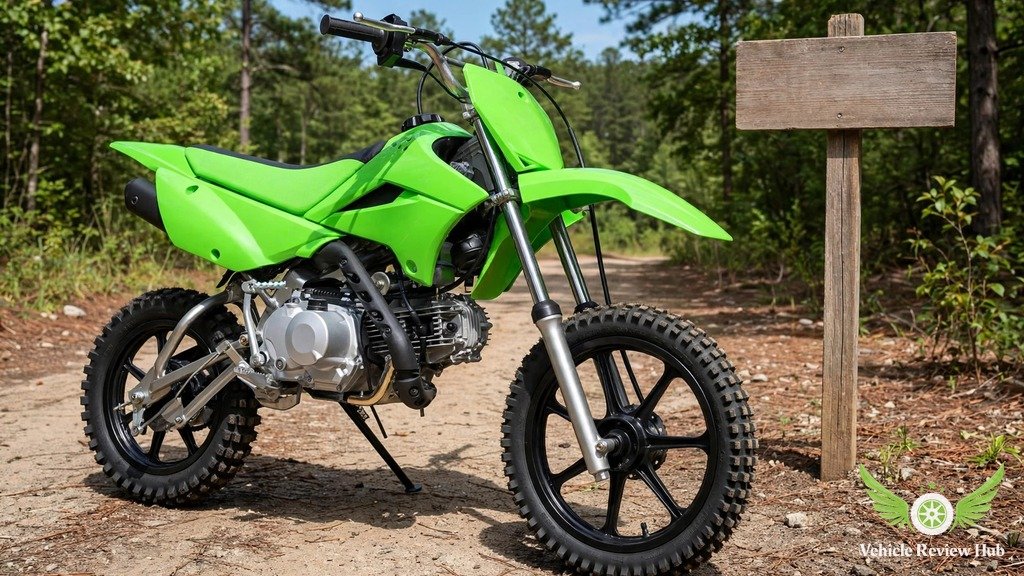
At $3,199 plus a $315 destination charge, the L lands at $3,514 delivered for 2026, and this Kawasaki KLX 110R L review puts that number in context: the priciest Japanese 110 on sale, $200 over the R, $415 over the Honda CRF110F and $765 over the Yamaha TT-R110E — yet still cheaper than both 125s, the Honda CRF125F at $3,899 delivered and the Suzuki DR-Z125L at $3,949.
Kawasaki KLX 110R L Price in the USA: $3,199
Kawasaki’s own 2026 page for the platform lists the R at $2,999, and the L’s $3,199 comes from the same Kawasaki pricing carried in dealer brochures and comparison listings. Two traps wait: a listing at $3,099 is the stale 2025 MSRP, and discounted dealer listings advertise below MSRP — one dealer even lists $2,999 on an L unit, which is the R’s price and a dealer error. The delivered figure is $3,514 before tax, title and any dealer setup fee.
No 2027 US Model Listed
There is no 2027 KLX110R L for sale in the United States, and this Kawasaki KLX 110R L review says so plainly. Kawasaki’s USA site lists no 2027 L, and the 2027 model URL returns a not-found page. That does not mean the L is discontinued — the 2026 bike is still listed and in dealers. A used buyer should note the rename when shopping older bikes: a 2021 or newer bike wears the KLX110R L badge, while a 2010 to 2020 bike wears KLX110L, and they are the same motorcycle underneath.
Kawasaki KLX 110R L Design, Features and Technology
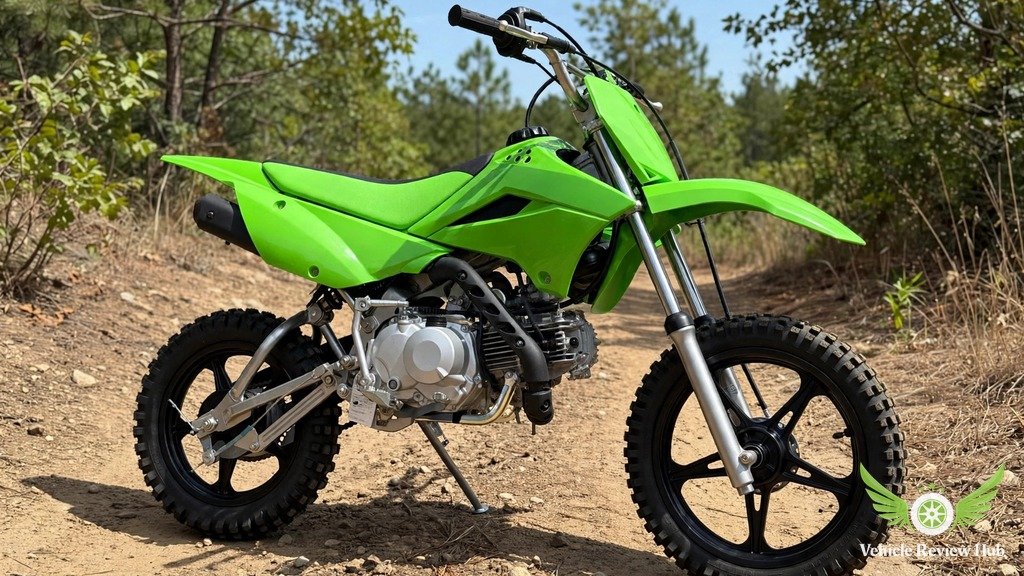
The L is a simple motorcycle by design, and this Kawasaki KLX 110R L review counts that as a feature. There is no fuel injection, no disc brake, no ABS, no instrument cluster and no odometer — the bike is a carburetted air-cooled single with drum brakes and a steel backbone frame. What it does have is what a learner needs: a screw-type throttle limiter, a low 28.7-inch seat, a green front number plate, and controls that are all mechanical. The design has barely changed since 2010, because it does that job with parts proven for sixteen years.
Same Weight as the Standard: 167.5 lb
Both bikes measure 158.7 lb dry and 167.5 lb curb, and this Kawasaki KLX 110R L review double-checked that figure against the official spec sheet, because a taller bike is expected to weigh more. It does not: the extra travel comes from longer fork tubes and a longer shock, not heavier parts, and the frame, the engine, the wheels and the brakes are all shared. The L carries its height without penalty: the same engine pulls the same weight. The extra height shows in the 10.4-inch clearance against the R’s 8.5.
Both Starters Kept: Electric and Kick
The L starts two ways, and both of them work. The electric starter is a keyless push-button system, and the kick starter is the backup for a drained battery, and this Kawasaki KLX 110R L review stresses the point because one magazine once claimed the bike was kick-start only, which is wrong. The 2010 launch review describes the electric starter clearly, and the owner’s manual explains the kick procedure for the L model — including the warning to make sure the transmission is in neutral and not to pull in the clutch lever when kicking.
Kawasaki KLX 110R L Riding Experience and Comfort
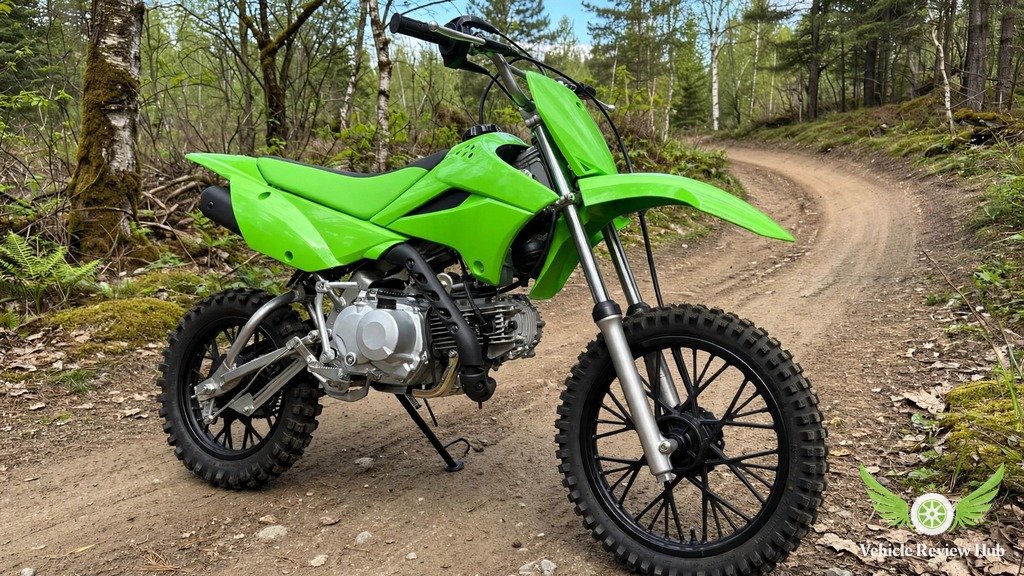
Riding the L is riding the R with one extra control and a taller seat, and this Kawasaki KLX 110R L review finds that the extra control is the whole experience. The engine feels the same, but the rider’s hands and feet do more work: the left hand manages the clutch, the left foot shifts, and the two have to agree. Ultimate Motorcycling’s 2012 KLX110L review is enthusiastic about the L’s power and its four-speed gearbox, and the 2010 launch tester who rode both bikes back to back felt more comfortable on the L, with its more familiar clutched control. That comfort is not about speed — it is about the rider feeling in charge.
Seat 28.7 Inches, Travel 5.5 and 5.2
The L’s seat sits 1.9 inches higher than the R’s, and that number decides who the bike fits. At 28.7 inches, the L suits a taller kid, a teen moving up, or an adult learning clutch control, while the R’s 26.8-inch seat suits the youngest beginners — and this Kawasaki KLX 110R L review recommends sitting on both before choosing, because 1.9 inches is the difference between flat feet and tiptoes. The 30 mm fork gives 5.5 inches of travel against the R’s 4.3, and the rear shock gives 5.2 against 4.3. The wheelbase is identical at 42.3 inches, so the L turns like the R and only feels taller.
Rider Limit Stays 154 Pounds
The figure comes from the factory service manual, and this Kawasaki KLX 110R L review prints it because buyers routinely ignore it. A parent buying for a teenager near the limit should look at the size-up alternatives — the Suzuki DR-Z125L, with its 32-inch seat and 19/16 wheels, is the honest next step. The R’s reliability guide covers the same servicing the L needs, because the two bikes share their hour-based maintenance schedule.
Kawasaki KLX 110R L Review: Pros, Cons and Verdict
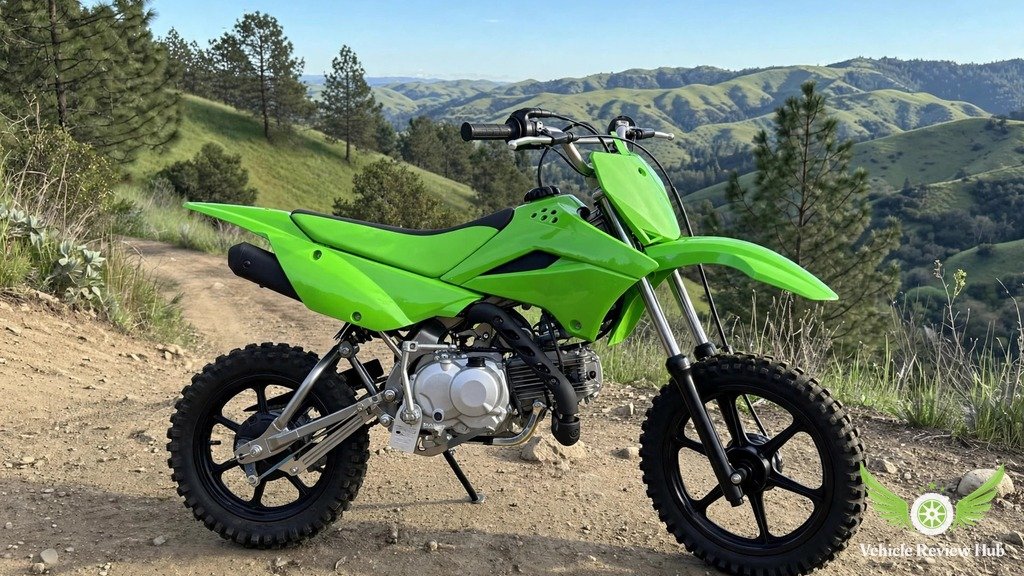
The verdict is that the L is the right bike for exactly one buyer, and this Kawasaki KLX 110R L review ends by naming that buyer plainly: the rider who has outgrown the automatic clutch but is not yet ready for a 125. For that rider, the L is the only Japanese 110 with a manual clutch, and the cheapest way to learn clutch control on a real motorcycle. For everyone else, the R is the better buy — $200 less, the same engine, the same wheels, the same brakes, and no clutch to manage. The R-vs-L comparison lays the two bikes side by side, and it reaches the same conclusion: buy the platform, buy the clutch, or buy the cheaper bike.
Main Advantages and Limitations of the Kawasaki KLX 110R L
The clutch teaches a real skill, the taller seat and suspension fit a taller rider, and the bike weighs the same as the standard one, so nothing is lost in the trade. The limitations are the ones the whole 110 class shares: a carburettor that needs its bowl drained before storage, drum brakes at both ends, no instrument cluster, and a 154-pound rider limit. The L adds two of its own: the clutch free play needs checking as it wears, and the bike is excluded from stock pit-bike classes that require an automatic clutch. Motocross Hideout’s KLX 110 guide covers the platform’s history and the aftermarket the L shares — the same big-bore kits, suspension parts and racing scene.
| Advantages | Limitations |
|---|---|
| Only Japanese 110 with a manual clutch | Carburetted, not fuel injected |
| Taller seat (28.7 in) and longer travel (5.5/5.2 in) | Drum brakes at both ends, no ABS |
| Same weight as the R (167.5 lb curb) | No 2027 US model listed |
| Electric start with kick backup | Rider limit under 154 lb |
| $200 premium, cheapest way to learn a clutch | Excluded from stock classes that require auto clutch |
| Huge aftermarket and race-mini scene | Clutch free play needs checking as it wears |
Notes: the points in this Kawasaki KLX 110R L review table are drawn from the 2026 spec sheet and the launch and 2012 test reports. No resale figure or running-cost dollar figure is printed for the L, because none is verified.
6 Month Limited Warranty
The L carries a 6-month limited factory warranty, the same as the R and the Honda CRF110F, and this Kawasaki KLX 110R L review notes the Yamaha TT-R110E covers only 90 days. What it does cover is a proven platform: sixteen years of the same engine and frame, with three CPSC recalls naming the L itself — all on older bikes. For a bike that will be ridden hard by a learner, six months of cover on a proven platform is a fair deal.
Kawasaki KLX 110R L Review FAQ
The questions below answer what buyers ask most about the KLX110R L, and this Kawasaki KLX 110R L review keeps every answer to the 2026 prices and specs.
How much does the 2026 Kawasaki KLX 110R L cost?
The L costs $3,199 plus a $315 destination charge, which lands it at $3,514 delivered, and this Kawasaki KLX 110R L review uses the manufacturer’s suggested retail price, not a dealer listing. A $3,099 listing is the stale 2025 MSRP.
What is the difference between the KLX110R L and the KLX110R?
The L is the same bike with a manual clutch and a taller stance, and this Kawasaki KLX 110R L review puts the differences in one line: a wet multi-disc manual clutch instead of an automatic one, a 28.7-inch seat instead of 26.8, travel of 5.5 and 5.2 inches instead of 4.3 and 4.3, and 10.4 inches of clearance instead of 8.5. The engine, the wheels, the brakes, the weight and the wheelbase are identical.
Does the KLX110R L really have the same wheels as the R?
Yes, and this Kawasaki KLX 110R L review states it plainly: both bikes run 14-inch front and 12-inch rear wheels, with 2.50 by 14 and 3.00 by 12 tyres. Any source claiming 19-inch and 16-inch wheels for the L is wrong — 19/16 belongs to the Suzuki DR-Z125L.
Is the KLX110R L too tall for a young beginner?
For the youngest beginners, yes, and this Kawasaki KLX 110R L review says so directly: the 28.7-inch seat suits a taller kid or a teen moving up, while the R’s 26.8-inch seat suits the youngest. A first-time rider should start on the R and move to the L when they are ready for a manual clutch.
Does the KLX110R L have electric start?
Yes, and this Kawasaki KLX 110R L review stresses the point because one magazine claimed otherwise: the L has a keyless electric push-button starter with a kick starter as backup. The claim that it is kick-start only is wrong.
How much power does the KLX110R L make?
No settled figure exists, and this Kawasaki KLX 110R L review prints no winner: Kawasaki publishes no power figure, a 2010 claim says 7.2 hp, a magazine spec box reports 6.2 hp, and a database says 7.11 hp. There is no dyno test for any trim, so the honest answer is that the power is unsettled.
Will there be a 2027 KLX110R L?
No 2027 US model is listed, and this Kawasaki KLX 110R L review found no 2027 bike on Kawasaki’s USA site — the 2027 model page returns a not-found error. The 2026 bike is the current one to buy.
What is the seat height of the KLX110R L?
The seat height is 28.7 inches, and this Kawasaki KLX 110R L review notes some sources round it to 29 inches — the exact figure from Kawasaki’s own spec sheet is 28.7. That is 1.9 inches taller than the R’s 26.8-inch seat.
Is the KLX110R L a good first bike?
Not as a very first bike, and this Kawasaki KLX 110R L review is blunt about it: a first-time rider should start on the automatic R, because the L asks the rider to manage a hand clutch and a taller seat all at once. The L is the right second bike, for the rider who has outgrown the R and wants to learn clutch control.
How heavy is the KLX110R L?
The L weighs 167.5 lb at the curb and 158.7 lb dry, and this Kawasaki KLX 110R L review double-checked the figure: it is exactly the same weight as the standard R. The taller suspension adds no weight — the extra travel comes from longer tubes and a longer shock, not heavier parts.
Does the KLX110R L need a clutch to shift?
Yes, and this Kawasaki KLX 110R L review makes the point because it is the whole reason the bike exists: the L has a wet multi-disc manual clutch, so the rider must pull the lever to shift. The R shifts without a clutch lever. That is the only functional difference between the two gearboxes — the gear ratios are identical.
What warranty does the KLX110R L have?
The L carries a 6-month limited factory warranty, and this Kawasaki KLX 110R L review notes it ties the Honda CRF110F at six months and beats the Yamaha TT-R110E at 90 days. The warranty is limited and does not cover wear items, crash damage or racing.