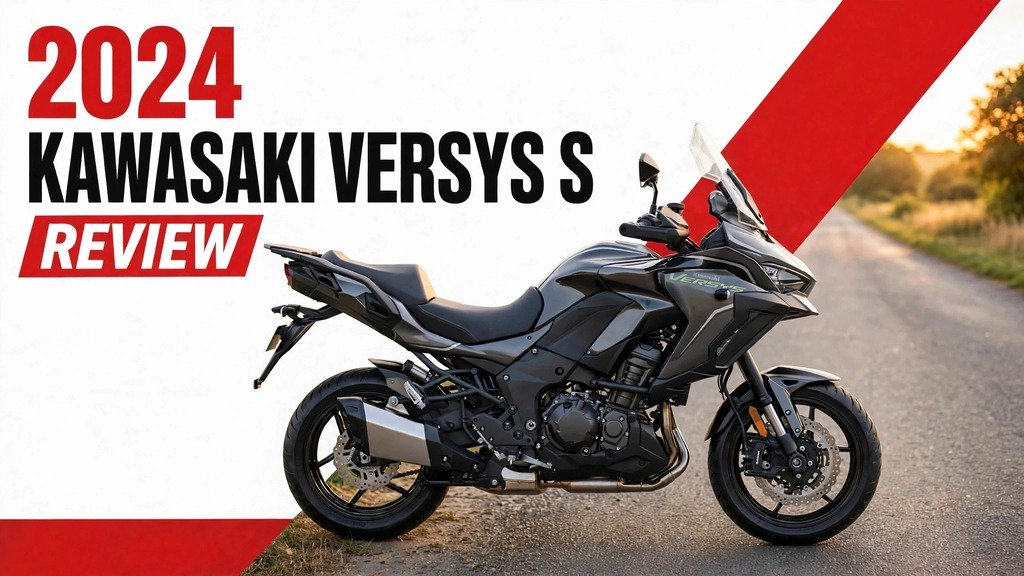
The short answer in this Kawasaki Versys 1000 S review is that the S is a very good touring bike that an American rider cannot buy new at home. Kawasaki never sold the Versys 1000 S in the United States. It was a Europe-only model, launched in the UK for 2021, until the 1,099cc Versys 1100 S replaced it for 2025.
That does not make the S irrelevant to a US reader. It is the manual-suspension version of the American SE LT+, the only trim sold in the US from 2019 to 2024. The numbers in this Kawasaki Versys 1000 S review are UK pounds for the S and US dollars for the SE LT+.
Kawasaki Versys 1000 S Overview and Model-Year Updates
Before 2021, a European buyer who wanted the third-generation Versys 1000 had to pay SE money, and SE money bought semi-active Skyhook suspension. The S kept everything else from the SE and fitted manual Showa suspension instead, per this Kawasaki Versys 1000 S review.
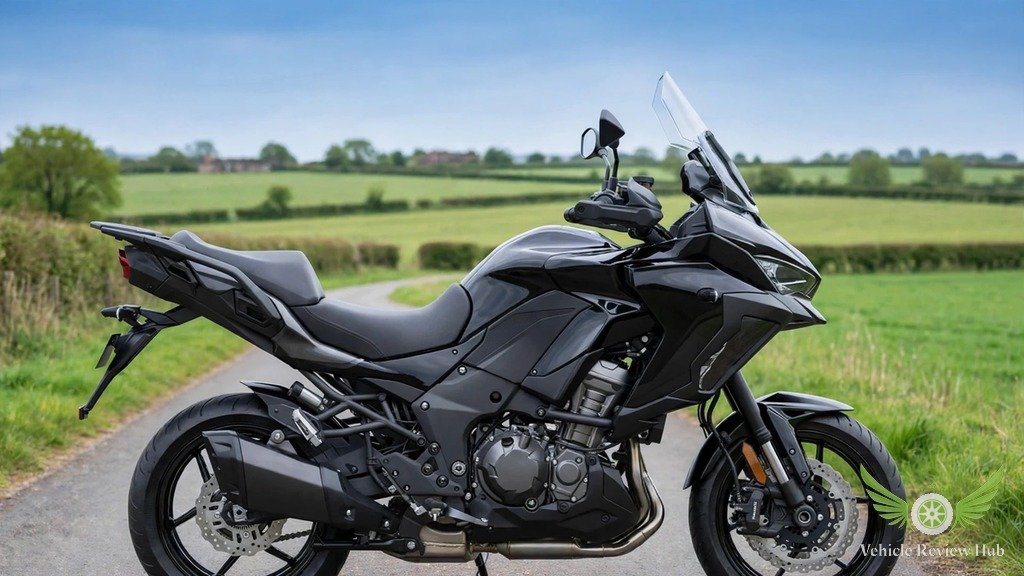
Never Sold in the USA: Europe Only
As this Kawasaki Versys 1000 S review notes, Kawasaki announced the S in October 2020, and UK dealers had it in December 2020 as a 2021 model. It was built for Europe and never crossed the Atlantic as a new bike. The US got the base LT only from 2015 to 2018, and from 2019 the only Versys 1000 on American showroom floors was the top-trim SE LT+.
The 1100 is a 1,099cc bike with a claimed 135 PS, but a magazine dyno found only 1 bhp and 1 lb-ft more than the 1000 it replaced.
US Name Was Versys 1000 SE LT+
From 2019 to 2024, Kawasaki sold one Versys 1000 in the United States: the SE LT+, with Skyhook suspension, 28-litre panniers, and the full electronics suite. The 2023 model cost $19,359 delivered; the 2024 model was listed at $18,899 before destination, whose charge was never verified.
The 2015 to 2018 Versys 1000 LT was the base bike, with 28-litre panniers, hand guards, an adjustable screen, an assist and slipper clutch, and a centre stand, for $12,799 in 2015 and $12,999 in 2016, as the RevZilla first ride shows. It had no IMU, no TFT dash, no cruise, no quickshifter, and no cornering lights.
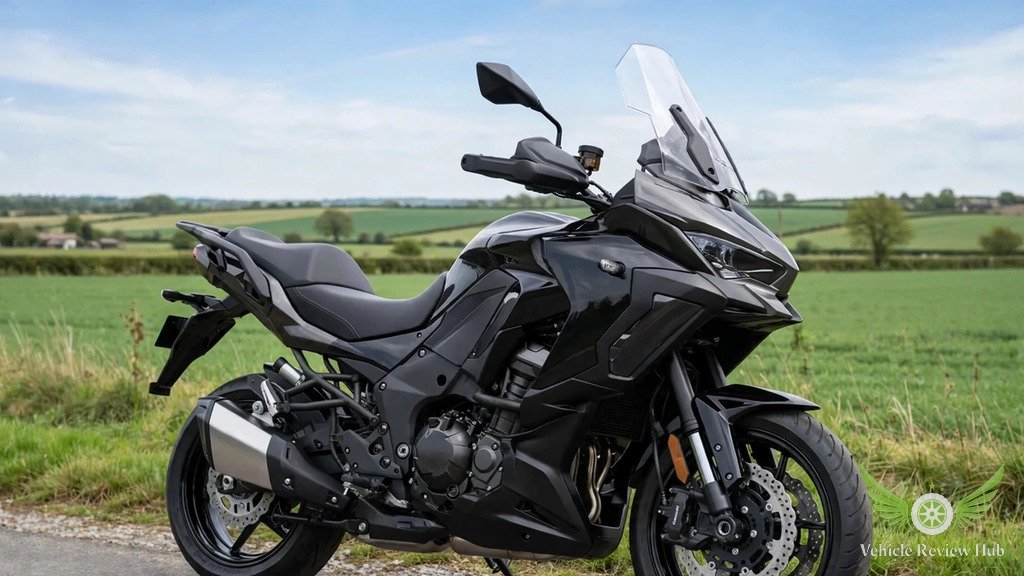
Kawasaki Versys 1000 S Engine and Specifications
The engine is the least controversial part of this Kawasaki Versys 1000 S review. It is a 1,043cc liquid-cooled inline-four, detuned from the Ninja 1000 family for midrange smoothness.
1,043cc Four, Manual Showa Suspension
The four makes 120 PS at 9,000 rpm, which is 88 kW, which is 118 hp — three numbers for the same figure — 120 PS is not 120 hp. Torque is 102 Nm at 7,500 rpm, or 75 lb-ft. Bore is 77.0 mm, stroke is 56.0 mm, compression is 10.3:1. The first-generation Versys 1000, from 2012 to 2014, made 116 bhp.
There is no named US dyno test of the Versys 1000, and this Kawasaki Versys 1000 S review will not invent one. No Cycle World, Motorcycle.com, or RevZilla dyno run was found, so there is no verified rear-wheel horsepower figure to print.
The gearbox is a six-speed with a bi-directional quickshifter, an assist and slipper clutch, and a sealed chain. The tank holds 5.5 US gallons, the seat sits at about 33 inches, the wheelbase is 59.8 inches, and clearance is 5.9 inches.
The suspension is where the S earns its name: a 43 mm inverted Showa fork with manual preload and rebound adjustment, and a horizontal back-link rear shock with a remote preload adjuster. Travel is 150 mm, or 5.9 inches, at both ends.
Skyhook Belongs to the SE Only
The one thing the S does not have is the feature that defines the SE. Skyhook — Kawasaki’s KECS semi-active suspension — samples the suspension response 100 times a second and adjusts compression, rebound, and preload on the move. It works, and it is SE-only. The S buyer gives it up and saves the money.
What the S keeps is everything else from the SE’s electronics suite: a Bosch six-axis IMU, lean-sensitive ABS and traction control with three modes plus off, two power modes, cruise control, a TFT display with RIDEOLOGY connectivity, LED cornering headlights, heated grips, and an adjustable screen.
The brakes are dual 310 mm petal discs at the front with four-piston calipers, and a single 250 mm petal disc at the rear, under cornering ABS. The tyres are 120/70ZR17 front and 180/55ZR17 rear, Bridgestone Battlax rubber, at 36 psi front and 42 psi rear. Bennetts found the brakes lacking, saying they need all four fingers — the most consistent complaint in this Kawasaki Versys 1000 S review.
| Specification | Versys 1000 S (2021, UK) | Versys 1000 SE LT+ (2023, US) | Versys 1000 LT (2015, US) |
|---|---|---|---|
| Engine | 1,043cc inline-four | 1,043cc inline-four | 1,043cc inline-four |
| Claimed power | 120 PS / 118 hp @ 9,000 rpm | 120 PS / 118 hp @ 9,000 rpm | 118 hp @ 9,000 rpm |
| Torque | 102 Nm / 75 lb-ft @ 7,500 rpm | 102 Nm / 75 lb-ft @ 7,500 rpm | 75 lb-ft @ 7,500 rpm |
| Suspension | Manual 43 mm Showa fork | KECS Skyhook semi-active | Manual 43 mm Showa fork |
| Panniers | Not included (paid packs) | 28 L included | 28 L included |
| Electronics | IMU, TFT, cruise, KQS | IMU, TFT, cruise, KQS | KTRC, two power modes |
| Kerb / curb weight | 253 kg (1000PS) / 255 kg (Bennetts) | 566.7 lb with bags | Not verified in this pass |
Notes for this Kawasaki Versys 1000 S review table: the S and the SE LT+ share the same engine and electronics, and differ on suspension and luggage. The S kerb weight is given from two sources, which disagree by 2 kg. The 2015 LT price is the MSRP; its destination charge was not verified.
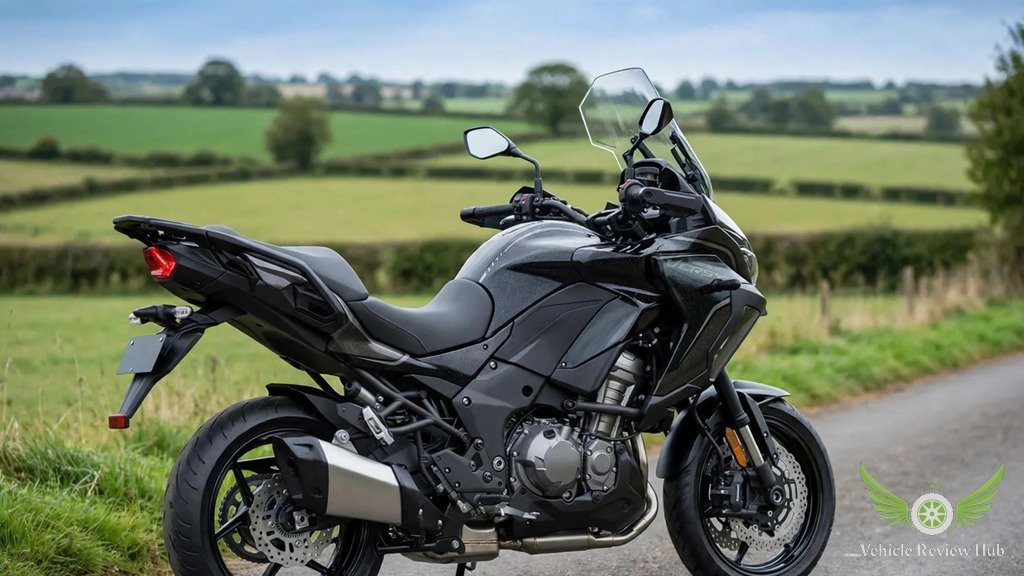
Kawasaki Versys 1000 S Price and Market Availability
Price is where this Kawasaki Versys 1000 S review has to be careful, because the S has a price in pounds and no price in dollars, and the two must never be mixed.
UK Price Was £12,999, No US Price Exists
The base Versys 1000 S launched in the UK at £12,999, up £1,699 from the outgoing 2020 bike at £11,300, as Bennetts noted in its 2021 Grand Tourer review.
The S was the cheapest way into the gen-3 Versys 1000; the SE cost £14,899 at launch, £1,900 more. That £1,900 is the price of Skyhook suspension, and the cleanest value judgement in this Kawasaki Versys 1000 S review — want semi-active suspension, buy the SE; happy to turn a preload adjuster, save £1,900.
On the American side: 2019 $18,379, 2020 $18,409, 2021 $18,649, 2022 $18,849, and 2023 $19,359 delivered. The 2024 model was listed at $18,899 before destination, whose charge was never verified. The jump from the 2015 LT at $12,799 is a trim jump, not inflation.
Base S Came Without Panniers
The base S came without panniers, and that is not a small detail on a touring bike, this Kawasaki Versys 1000 S review stresses. Kawasaki sold the luggage as paid packs. The Tourer pack added 56-litre panniers, inner bags, and a tank pad, at £13,799. The Grand Tourer pack added a 47-litre top case with an inner bag, fog lights, a GPS bracket, and frame sliders, at £14,699.
The fully loaded S Grand Tourer at £14,699 is £200 less than the base SE at £14,899 — full luggage with manual suspension against no luggage with Skyhook.
| Model and year | Market | Price | What is included |
|---|---|---|---|
| Versys 1000 S (2021) | UK | £12,999 | No panniers |
| Versys 1000 S Tourer (2021) | UK | £13,799 | 56 L panniers, inner bags, tank pad |
| Versys 1000 S Grand Tourer (2021) | UK | £14,699 | Tourer kit + 47 L top case, fog lights, GPS bracket, frame sliders |
| Versys 1000 SE (2021) | UK | £14,899 | Skyhook suspension, no luggage |
| Versys 1000 LT (2015) | US | $12,799 MSRP | 28 L panniers, hand guards, centre stand |
| Versys 1000 SE LT+ (2023) | US | $19,359 delivered | Skyhook, 28 L panniers, hand guards |
Notes for this Kawasaki Versys 1000 S review table: UK prices are 2021 launch prices from Kawasaki UK. US delivered prices are MSRP plus destination for the year shown. The 2024 SE LT+ destination charge was not verified, so no 2024 delivered total is printed.
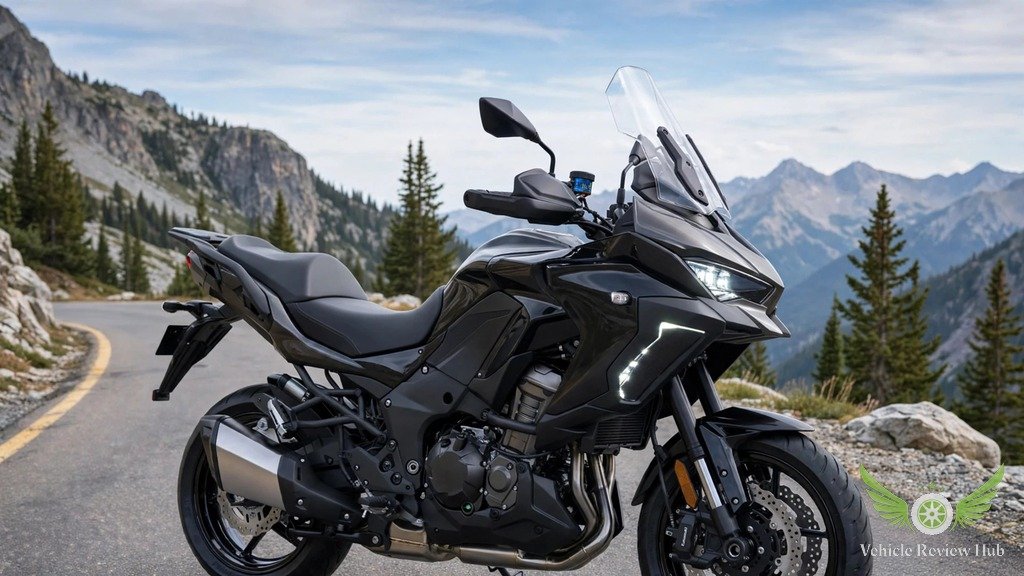
Kawasaki Versys 1000 S Design, Features and Technology
The S looks like a big Versys should: tall fairing, upright bars, a wide seat, and a stance that says road touring rather than adventure. This Kawasaki Versys 1000 S review treats the electronics as the story, because the S is the cheapest way Kawasaki ever sold this electronics suite.
TFT, Cruise, Quickshifter, Cornering Lights
The TFT display is the centrepiece of the cockpit in this Kawasaki Versys 1000 S review, connecting to a phone through Kawasaki’s RIDEOLOGY app, behind an adjustable screen the rider can move without tools. The electronic cruise control is standard — on a bike built for 500-mile days, that matters.
The quickshifter works both ways and is standard on the S — smooth on upshifts, less smooth on backshifts at slow speeds and low revs, a finding Bennetts and 1000PS share. The LED cornering headlights light the inside of a bend as the bike leans, fed by the same Bosch six-axis IMU.
That IMU feeds the Kawasaki Cornering Management Function: lean-sensitive ABS and three-mode traction control, plus off, two power modes, and ABS that cannot be switched off. Self-healing paint and a 12 V socket complete the kit.
Two Steps: Tourer and Grand Tourer Packs
Kawasaki sold the S in three steps, and the steps are luggage, not performance: the base S at £12,999, the Tourer at £13,799 with 56-litre panniers, inner bags, and a tank pad, and the Grand Tourer at £14,699 with a 47-litre top case, fog lights, a GPS bracket, and frame sliders — this Kawasaki Versys 1000 S review’s price ladder.
The SE had its own Tourer and Grand Tourer steps at £15,699 and £16,599. An S Grand Tourer at £14,699 against a base SE at £14,899 is full luggage with manual suspension against no luggage with Skyhook, for £200.
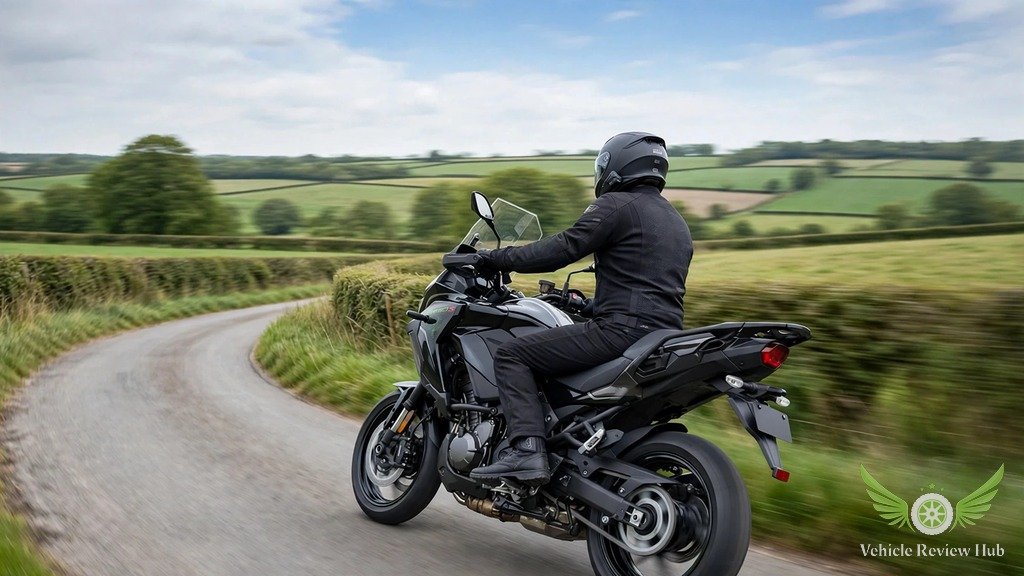
Kawasaki Versys 1000 S Riding Experience and Comfort
Every tester who rode it agrees on two things: it is brilliantly comfortable, and it is heavy with brakes that ask too much of the rider. Those findings come from the same Bennetts test. This Kawasaki Versys 1000 S review takes them together, because the comfort is why a rider buys the bike and the brakes are what he notices every day after.
Brilliantly Comfortable, Said Bennetts
Bennetts rode the S Grand Tourer for 700 miles and called it brilliantly comfortable. The tester completed 170 miles in one stint, stopping only when the fuel light came on, and described a 500-mile-plus day as easy.
The engine helps. The four sits between 4,000 and 5,000 rpm at motorway speeds with little vibration, according to MCN’s long-term test. Bennetts saw just over 50 mpg imperial over 700 miles, and MCN’s long-term SE averaged 51.3 mpg imperial over 16,000 miles, with 200-plus miles between fill-ups. The fuel light comes on at around 160 to 170 miles. Kawasaki publishes no US MPG figure — 50 mpg imperial is about 41.6 mpg US by arithmetic. MCN’s 2021 Versys 1000 review covers the same gen-3 bike in detail.
Heavy and Brakes Lacking, Same Test
The same Bennetts test that praised the comfort also named the two weaknesses. The bike is heavy — 253 kg by one source, 255 kg by another — and the rider feels it at parking speeds and in slow turns. The brakes are lacking compared with the competition, and the tester said they need all four fingers.
The weight is the price of the package: engine, frame, fairing, tank, and touring kit. The SE LT+ with its bags weighs 566.7 lb, and the S is not meaningfully lighter. A rider coming from the Versys 650 review bike, the 649cc twin at 482.9 lb, will notice the difference immediately. The brakes are respectable on paper; the complaint is about feel and power, not failure.
The video below is MCN’s review of the SE — not the S itself, because no dedicated English review video of the S exists. Watch it for the engine and the riding position, which the S shares — the bike on screen has Skyhook suspension and the S does not.
Kawasaki Versys 1000 S Review: Pros, Cons and Verdict
The verdict in this Kawasaki Versys 1000 S review is a split one, and the split is the point. The S is the best-value way into the third-generation Versys 1000 — and a bike an American reader cannot buy.
Main Advantages and Limitations of the Kawasaki Versys 1000 S
The advantages start with the engine and the comfort. The 1,043cc four is smooth and flexible, with 118 hp and 75 lb-ft where a touring rider uses them. The riding position is upright and roomy, and a 500-mile day is easy. The electronics are complete, as this Kawasaki Versys 1000 S review keeps noting: IMU, cornering ABS and traction control, two power modes, cruise, TFT dash, LED cornering lights, heated grips, and quickshifter. The manual suspension is a long-term advantage too — no electronics to fail and no expensive Skyhook parts years down the road.
The limitations are just as clear. The bike is heavy at 253 to 255 kg. The brakes need all four fingers. The quickshifter is not smooth on backshifts at slow speeds and low revs. The base bike comes without panniers, so the headline price is not the touring price: Tourer £800 more, Grand Tourer £1,700 more. And the biggest limitation for an American reader is the one this Kawasaki Versys 1000 S review opened with: the bike was never sold in the United States, so a grey-market S would have no US dealer, no US warranty, and no US parts pipeline.
Now Replaced by the Versys 1100 S in Europe
The S ended after the 2024 model year, and the Versys 1100 S took its place in Europe for 2025, as this Kawasaki Versys 1000 S review records. The 1100 is a 1,099cc bike with a claimed 135 PS, priced in the UK at £13,649 for the S.
In the United States, the replacement is the Versys 1100 SE LT ABS, which arrived for 2025 at $19,499 before destination, with 133 hp, 82.5 lb-ft, and a 24-month warranty. The 2027 model costs $19,799 plus $840 destination, or $20,639 delivered. Its Kawasaki USA spec sheet confirms the figures. The Ninja 1100SX ABS review bike shows the same 1,099cc engine family in sports-touring form.
| Pros | Cons |
|---|---|
| Smooth, flexible 1,043cc four: 118 hp, 75 lb-ft | Heavy: 253–255 kg, felt at slow speeds |
| Brilliantly comfortable; 500-mile days easy | Brakes lacking; need all four fingers |
| Full electronics: IMU, TFT, cruise, quickshifter | Quickshifter rough on low-rev backshifts |
| Manual suspension: nothing electronic to fail | Base S has no panniers; packs cost £800–£1,700 |
| £1,900 cheaper than the SE, same engine | Never sold in the USA; no US dealer or warranty |
| 5.5-gal tank; 200+ miles between fill-ups | Replaced by the Versys 1100 S in Europe for 2025 |
Notes for this Kawasaki Versys 1000 S review table: the comfort and brake findings both come from Bennetts’ 700-mile Grand Tourer test, the same test and the same rider. The weight is a range because 1000PS and Bennetts disagree by 2 kg.
Kawasaki Versys 1000 S Review: Frequently Asked Questions
Direct answers to the Kawasaki Versys 1000 S review questions buyers ask most, including the ones American readers ask first.
Is the Versys 1000 S sold in the USA?
No. The Versys 1000 S was sold in Europe only and never in the United States. It launched in the UK for 2021 and stayed in Europe until the Versys 1100 S replaced it for 2025. A US rider who wants this bike buys the SE LT+ instead, as this Kawasaki Versys 1000 S review advises.
How much does the Versys 1000 S cost?
The base S launched in the UK at £12,999 in 2021, as this Kawasaki Versys 1000 S review records. The Tourer pack cost £13,799 and the Grand Tourer £14,699, while the SE cost £14,899. There is no US price, because there was no US bike. The last US Versys 1000, the 2023 SE LT+, cost $19,359 delivered.
What engine does the Versys 1000 S have?
A 1,043cc liquid-cooled inline-four, making 120 PS at 9,000 rpm, which is 118 hp, with 102 Nm or 75 lb-ft of torque at 7,500 rpm. It is a detuned Ninja 1000 and Z1000 unit, tuned for midrange smoothness. This Kawasaki Versys 1000 S review stresses the point because 120 PS is not 120 hp.
Does the Versys 1000 S have electronic suspension?
No. The S has conventional manually adjustable 43 mm inverted Showa suspension, with preload and rebound adjustment at the front and a remote preload adjuster at the rear. The semi-active Skyhook system belongs to the SE only. The manual suspension is a selling point for long-term owners, and this Kawasaki Versys 1000 S review calls it the S’s honest advantage.
Does the base S come with panniers?
No. The base S came without panniers, and the luggage was sold as paid packs. The Tourer pack added 56-litre panniers, inner bags, and a tank pad for £800 more; the Grand Tourer added a 47-litre top case, fog lights, a GPS bracket, and frame sliders for £1,700 more, as this Kawasaki Versys 1000 S review lists them.
What is the difference between the S and the SE?
Suspension and price. The S has manual Showa suspension and cost £12,999 at launch. The SE has Skyhook semi-active suspension and cost £14,899. Everything else — the 1,043cc engine, the IMU, the TFT dash, the cruise control, the quickshifter, the cornering lights, the heated grips — is the same on both bikes, as this Kawasaki Versys 1000 S review confirms.
Is the Versys 1000 S comfortable for long rides?
Yes. Bennetts called it brilliantly comfortable after a 700-mile test, completing 170 miles in one stint and describing a 500-mile-plus day as easy. The engine sits between 4,000 and 5,000 rpm at motorway speeds with little vibration, and the upright position, wide seat, and adjustable screen help, as this Kawasaki Versys 1000 S review notes.
What is the fuel economy of the Versys 1000 S?
Bennetts saw just over 50 mpg imperial over 700 miles, and MCN’s long-term SE averaged 51.3 mpg imperial over 16,000 miles, as this Kawasaki Versys 1000 S review reports. Those are UK imperial figures, and Kawasaki publishes no US MPG figure. By arithmetic, 50 mpg imperial is about 41.6 mpg US.
Is the Versys 1000 S good for two-up touring?
Yes, with the luggage packs fitted. The upright position, wide seat, 5.5-gallon tank, and smooth midrange make it a natural two-up tourer, and the Grand Tourer top case gives the pillion a backrest. The trade-off is weight: at 253 to 255 kg, the bike is heavy at slow speeds and the brakes ask for all four fingers, as this Kawasaki Versys 1000 S review warns.
What replaced the Versys 1000 S?
The Versys 1100 S replaced it in Europe for 2025, priced in the UK at £13,649, as this Kawasaki Versys 1000 S review notes. The 1100 is a 1,099cc bike with a claimed 135 PS, but a magazine dyno found only 1 bhp and 1 lb-ft more than the old 1000. In the United States, the replacement is the Versys 1100 SE LT ABS, which arrived for 2025 at $19,499 before destination — the US buyer’s answer in this Kawasaki Versys 1000 S review.
Can I import a Versys 1000 S to the USA?
Not as a new bike, and not easily as a used one. The US 25-year rule means a 2021 S becomes importable in 2046, and a 2024 S in 2049. Until then there is no grey-market shortcut worth taking. The honest answer in this Kawasaki Versys 1000 S review is to buy the SE LT+ used or the Versys 1100 SE LT new.
Should a US buyer look at the Versys 1100 SE LT instead?
Yes. The Versys 1100 SE LT ABS is the bike the S points to: the same touring brief, Skyhook suspension, 28-litre panniers included, TFT dash, cruise, and quickshifter, with a 1,099cc engine making 133 hp and a 24-month warranty. The 2025 model costs $19,499 before destination, and the 2027 model costs $20,639 delivered.
The Versys 1000 S is a bike worth knowing about and a bike most American readers should not chase. It was the smart buy in Europe — full electronics, honest manual suspension, and £1,900 saved against the SE. For a US rider, the same brief lives on in the SE LT+ and the Versys 1100 SE LT, and that is where this Kawasaki Versys 1000 S review leaves the decision.