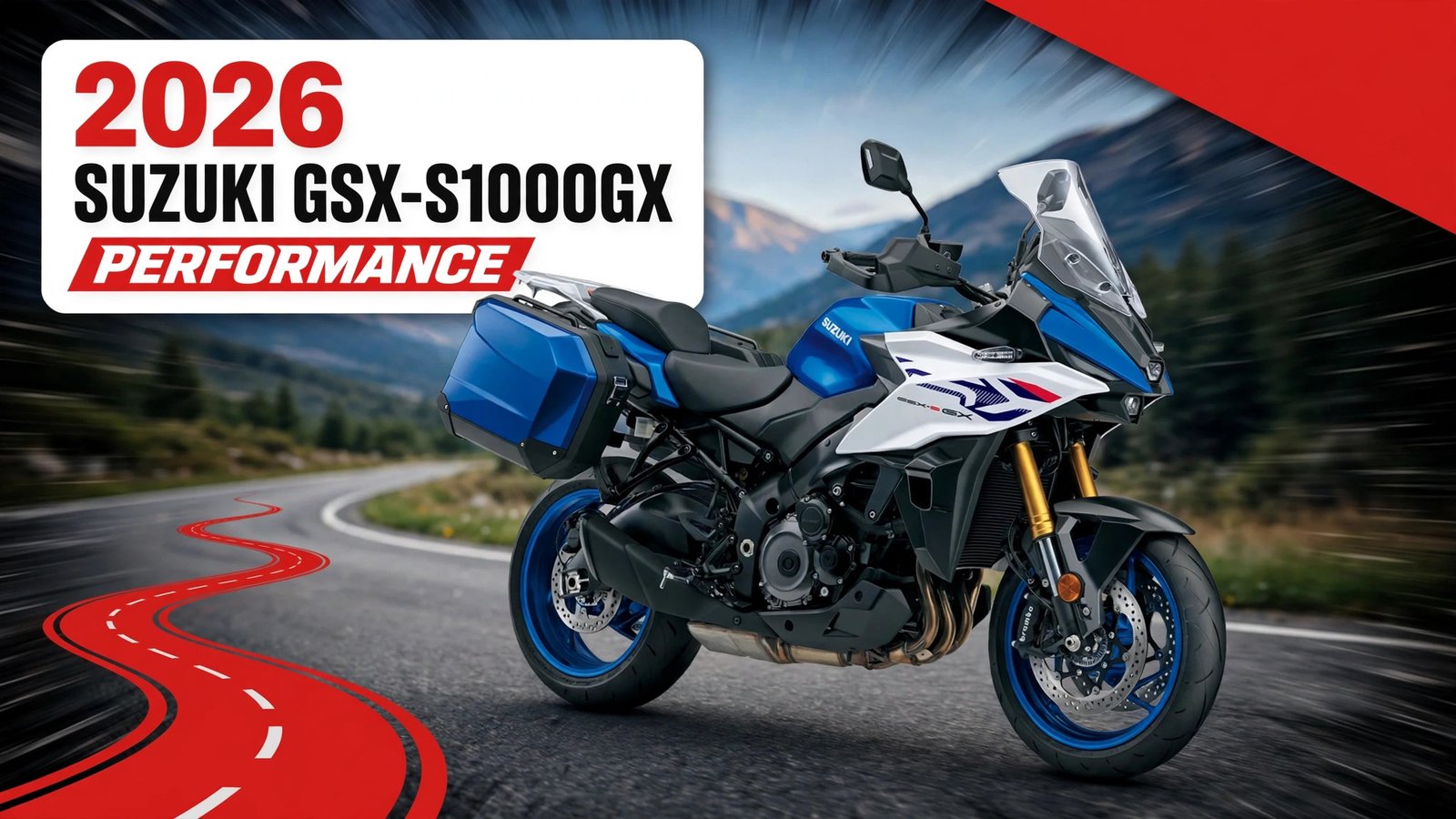
The short answer in this Suzuki GSX-S1000GX performance guide is that the GX is genuinely quick, but its numbers come with footnotes. MCN dynoed the GX itself in the UK at 143.2 bhp, measured a GPS top speed of 132.92 mph with a limiter in the way, and recorded 48 mpg imperial on test. No American outlet has published a GX dyno run or an instrumented acceleration test, so every hard number here comes from MCN’s UK testing.
Suzuki GSX-S1000GX Engine Performance and Power Delivery
The GX runs the same 999cc liquid-cooled inline-four as the GT, a long-stroke K5 GSX-R1000 engine, 73.4 by 59.0mm, 12.2:1 compression. Suzuki claims 150 horsepower at 11,000 rpm and 106 Nm at 9,250 rpm, which is 78 lb-ft. The 152 PS figure in some sources is the same 150 horsepower in metric units, and some American tables print 79.6 lb-ft instead of 78. Suzuki USA publishes no horsepower or torque figure for the GX, so the claimed numbers come from Suzuki’s global specifications.

MCN Dynoed the GX Itself: 143.2 HP in the UK
MCN put the GX+ on its own dyno during its UK deep-dive test and measured 143.2 bhp and 77.3 lb-ft at the rear wheel — the only named GX dyno figure published anywhere, and the figure this Suzuki GSX-S1000GX performance guide carries throughout. The MCN GX deep-dive test notes the power is smooth from below 2,000 rpm, and the quarter-mile time it produced backs that up — the first hard evidence in this Suzuki GSX-S1000GX performance guide.
MCN’s Own Table Mislabels Those Figures as GT+
MCN’s own deep-dive page carries a trap in its “Fast facts” box: it labels the GX’s figures “Suzuki GSX-S1000GT+”, priced at £15,599 against a £14,499 base, with the same 143.2 bhp, 77.3 lb-ft, 132.92 mph and 234.2 kg. Those numbers belong to the GX, not the GT — the label is wrong. The bike MCN dynoed, weighed and speed-tested was the GX+, and this Suzuki GSX-S1000GX performance guide states the mislabel plainly so nobody quotes the GX’s dyno figure as the GT’s. The GT has its own American dyno numbers: the GT on Cycle World’s in-house Dynojet 250i made 135.53 hp at 10,360 rpm and 73.15 lb-ft at 9,190 rpm, while the motorcycle.com Showdown dyno, run on the same dyno on the same day for both bikes, had the GT+ at 125.4 hp at 10,400 rpm and 65.0 lb-ft at 9,700 rpm. Three different dynos, three different days, three different numbers — never rank the GX’s 143.2 bhp against the GT’s 135.53 hp as though they came from one test. Suzuki says the tune is exactly the same as the GT, with only the throttle response changed slightly on the GX, and the Cycle World GT dyno test shows what the shared engine does on a different machine.
| Suzuki GSX-S1000GX performance figure | Result | Source |
|---|---|---|
| Claimed power / torque | 150 hp @ 11,000 rpm / 78 lb-ft @ 9,250 rpm | Suzuki global specs |
| Dyno power / torque | 143.2 bhp / 77.3 lb-ft, rear wheel | MCN, UK |
| GPS top speed | 132.92 mph (indicated 139), restricted | MCN, UK |
| 0–60 mph / 0–100 mph | 3.10 s / 6.98 s | MCN, UK |
| Quarter-mile | 10.88 s @ 129.99 mph | MCN, UK |
| Braking, 70 mph to 0 | 58.67 metres | MCN, UK |
Suzuki GSX-S1000GX Top Speed and Acceleration
The GX is fast where it matters on a real road — hard acceleration, a strong midrange, a quarter-mile time that would embarrass plenty of sports cars — and capped on the spec sheet. MCN’s UK test is the only instrumented GX test published, so every acceleration number in this Suzuki GSX-S1000GX performance guide is an MCN number.

GPS Top Speed 132.92 MPH, Restricted, UK-Tested
MCN measured a GPS top speed of 132.92 mph on its test strip, indicated 139 mph, and the bike is electronically restricted — it simply stops there. The restriction is the headline: the same engine in the GT runs to about 145 mph on MCN’s listing, with a true 146.22 mph in earlier tests, while the GX stops at 133 mph. In practice the cap rarely matters, but it is the one number where the GX is clearly slower than the GT. The acceleration figures tell the other half: 0–60 in 3.10 seconds, 0–100 in 6.98, a quarter-mile of 10.88 seconds at 129.99 mph, and a top-gear roll-on of 40 to 120 mph in 10.81 seconds. That roll-on number matters most in everyday riding, because it is the overtake without a downshift.
No US Dyno or Instrumented Test Exists Yet
No American outlet has published a GX dyno run or an instrumented top-speed or 0–60 test. Every US review — Rider, motorcycle.com, RevZilla, Cycle News and Ultimate Motorcycling — comes from the November 2023 Portugal press launch, and none strapped the bike to a dyno or ran it through timing gear. So this Suzuki GSX-S1000GX performance guide cannot give you an American 0–60 time — one does not exist yet. Any aggregator page that prints a GX top speed or acceleration figure without naming MCN is printing an estimate, and this guide does not repeat estimates as facts. Until then, MCN’s UK figures are the only named instrumented GX test, presented here exactly as MCN published them.
Suzuki GSX-S1000GX Mileage and Fuel Economy
Fuel economy is where the GX’s story gets complicated by gallons: the only measured figure comes from MCN’s UK test, in imperial gallons, bigger than US gallons. This Suzuki GSX-S1000GX performance guide keeps the units labelled, because the difference between 48 and 40 is a British gallon versus an American one.
MCN Measured 48 MPG Imperial on Test
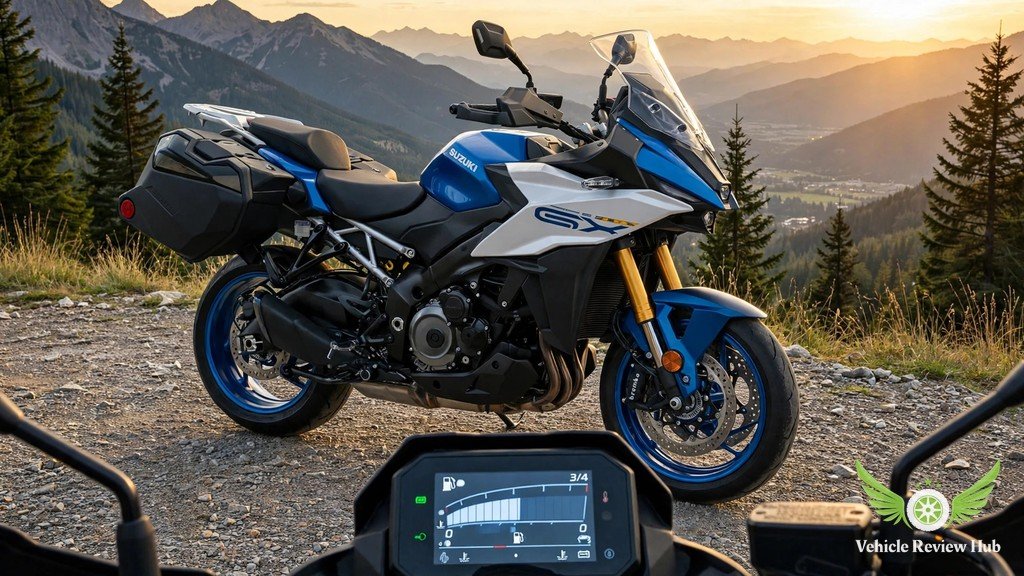
MCN measured 48 mpg imperial on test — about 40 mpg US, always read that way. The fuel light came on at around 150 miles in MCN’s UK test, the more useful number for planning a ride. The GX carries 5.0 US gallons, or 19 litres, the same tank as the GT. Labelled arithmetic: 40 mpg US multiplied by 5.0 gallons gives about 200 miles in theory, but that is theoretical, not measured, and the fuel light at roughly 150 miles suggests the real-world usable range sits well under it. The engine is busy at motorway speed, sitting just short of 5,000 rpm at 70 mph on MCN’s test — short gearing, the same family trait the GT shows, and part of why the mileage figure and the buzz complaints in the next section belong together.
Suzuki USA Publishes No MPG Figure at All
Suzuki USA publishes no MPG figure for the GX — no EPA figure, no Suzuki USA figure — so there is no official American fuel-economy number to quote, and this Suzuki GSX-S1000GX performance guide does not invent one. The 40 mpg US figure above is a conversion of MCN’s measured UK number, not a Suzuki claim or an EPA rating. For contrast, the GT’s Rider-tested figure is 35.5 mpg US, good for about 178 miles, but it comes from a different test, a different bike, different gallons, a different test cycle. Comparing 48 against 35.5 to call the GX more economical than the GT would be wrong: one is imperial, one is US, and the tests are not the same. The honest reading is that the GX’s only measured economy figure is a UK one, the GT’s only measured figure is a US one, and the two cannot be ranked against each other. The GX’s tank matches the GT’s 5.0 gallons and its engine the same tune, so nobody should buy the GX expecting it to sip fuel.
| Suzuki GSX-S1000GX mileage figure | Number | Note |
|---|---|---|
| MCN measured economy | 48 mpg imperial (≈40 mpg US) | UK test; always label the unit |
| Fuel tank | 5.0 US gal (19 L) | Same as the GT |
| Suzuki USA MPG figure | None published | No EPA figure either |
Suzuki GSX-S1000GX Real-World Riding Experience
The GX rides like a GT with the edges taken off: the upright position, the longer travel and the SAES damping make it more comfortable over rough roads. This part of the Suzuki GSX-S1000GX performance guide deals with what the numbers cannot show: where the American testers actually rode it, and the buzz some testers felt and others did not.

US Testers Rode It Only at the Portugal Launch
Every American review of the GX comes from one place: the world launch in Portugal in November 2023, where Rider, motorcycle.com, RevZilla, Cycle News and Ultimate Motorcycling all rode the bike on Suzuki’s chosen roads for a day or two. No US outlet has since done a long-term GX test or a second American test in this guide’s research. That matters, because launch impressions are first impressions: a seat fine for an afternoon can create hotspots after a few hours, and a buzz absent in a day of riding can appear on a long motorway run. The Rider GX first ride from Portugal is the canonical American account of the bike, but it is a launch ride, and this Suzuki GSX-S1000GX performance guide does not present its impressions as long-term findings. The longer-term evidence comes from MCN’s UK deep-dive and from owners who have lived with the bike, and they do not always agree.
Buzz Persists Despite Rubber Mounts: Tester-Dependent
The GX buzzes, or it does not, depending on who you ask. MCN’s UK test found the engine busy at 70 mph with the vibes blurring the mirrors slightly, a 2026 GX+ owner found buzz at 70 mph and above, visible in the mirrors, and another tester found buzzy mirrors at 6,000 rpm. RevZilla and Rider, reporting from the Portugal launch, made no buzz complaint at all. That split is the finding: the buzz is tester-dependent, not a universal defect. Rubber mounts and dampers are fitted, the same family solution as the GT, yet the buzz still gets through the seat, bars and mirrors at motorway rpm, according to the UK sources that report it. A long test ride at motorway speed is what this Suzuki GSX-S1000GX performance guide advises every buyer, because the riders who notice it notice it every time. The engine note is part of the same story: a K5-derived four that sounds like a superbike when wound up, and feels busy at a steady cruise just short of 5,000 rpm in top gear.
Suzuki GSX-S1000GX Handling, Braking and Stability
Handling is where the GX earns its crossover badge: the SAES semi-active suspension is the first on a production Suzuki, and the single biggest difference between the GX and the GT. The brakes are the weakest part of the package, and the testers agree on that more than anything else. This Suzuki GSX-S1000GX performance guide covers the suspension modes, the preload system and the braking test that came out worse than the GT’s.

SAES Damping Modes and Electronic Rear Preload
SAES, Suzuki Advanced Electronic Suspension, adjusts damping automatically up to 1,000 times per second from wheel sensors and IMU input. It offers Soft, Medium and Hard modes plus a User mode, tied to the three ride modes A, B and C but independently adjustable, with the custom mode adjusting each setting by three levels in each direction. Rear preload sets itself automatically with load detection, plus three manual positions. The verdicts in this Suzuki GSX-S1000GX performance guide split. Motorcycle.com found the SAES took time to dial in, but the custom mode and the preload adjustment fixed the feel, and the anti-dive held the front up under braking even if it ramped up quickly. One 2026 GX+ owner found the SAES too firm regardless of the setting; another tester found it too soft in its sportiest setting. The custom mode is the answer for both. A second system, SRAS or Suzuki Road Adaptive Stabilization, adapts the damping to the road surface, and the six-axis IMU behind it also feeds the cornering traction control and cornering ABS. None of that exists on the GT, which runs conventional suspension, standard ABS only and no IMU.
Braking 70 to 0 in 58.67 Metres, Worse Than the GT
MCN measured 70 mph to a stop in 58.67 metres, 2.52 metres worse than the GT at about 56.15 metres. The Brembo front calipers lack power and feel, according to MCN, and motorcycle.com found little initial bite and a vague feel at the lever — the power is there but the feel is not. Both testers blame the rubber brake lines: motorcycle.com calls it inexcusable on a flagship to keep using them, and says steel lines and a pad swap could cure the problem. They should not be needed at this price. The handling around the braking is sound: the GX is stable and comfortable at speed, and motorcycle.com calls it not the fastest to flick back and forth given its long legs and wheelbase, but hardly a slouch. The taller stance and 5.9 inches of travel trade a little of the GT’s flickability for comfort and rough-road composure, and the SAES anti-dive keeps the front up under braking even when the lever feel lets it down. The full ownership side, including the service schedule and the warranty, is covered in the GX reliability guide.
Suzuki GSX-S1000GX Performance Compared With Other Crossover Bikes
Set against the GT, the GX is the same motorcycle in a new chassis kit: same 999cc K5-derived engine, same tune, same main frame and swingarm. What changes is everything around the engine: SAES semi-active suspension with SRAS, a six-axis IMU the GT does not have, cornering ABS where the GT has standard ABS only, a taller upright riding position, 5.9 inches of travel, 17-inch wheels in the same sizes as the GT, a centrestand standard on the GX+ where the GT has no centrestand option, cases standard on the GX+ where only the GT+ gets them, and a windscreen that adjusts where the GT’s is fixed. This Suzuki GSX-S1000GX performance guide puts the two bikes side by side and answers the beginner question.
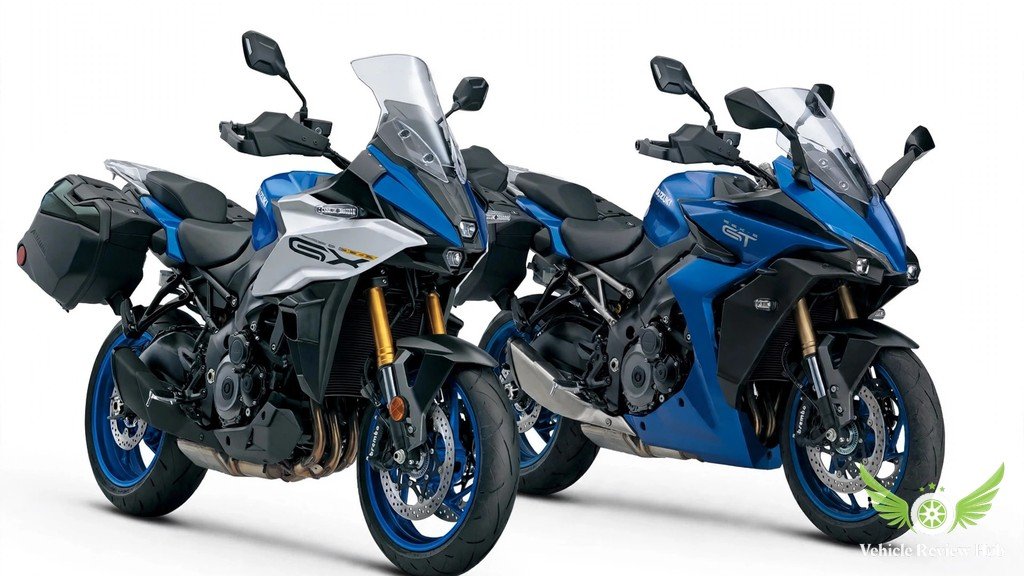
Suzuki GSX-S1000GX vs the GT: Same Tune, New Chassis Kit
The performance differences this Suzuki GSX-S1000GX performance guide found are small on paper and obvious on the road. The GX’s only named dyno figure is MCN’s 143.2 bhp in the UK, against the GT’s 135.53 hp on Cycle World’s Dynojet in the US — different dynos, different days, not ranked here. The GX’s GPS top speed is capped at 132.92 mph, while the GT runs to about 145 mph. The GX is heavier at 511 pounds without its cases against the GT’s 498, and taller with a 33.3-inch seat against the GT’s 31.9 inches. The GX stops worse, 58.67 metres against about 56.15 metres from 70 mph. What the GX gives back is the SAES damping, the IMU and the cornering electronics, the upright position, the longer travel and the standard luggage and centrestand. Riders who want the engine will save thousands on the GT+, and the GT comparison guide shows the price gap. Riders who want the suspension and the stance will pay for the GX. The video below is a same-loop back-to-back of the GX and the GT from Moto Filmer, with UK bikes loaned by Suzuki UK — not a US test, but the closest thing to a direct comparison on the same roads on the same day.
Is the Suzuki GSX-S1000GX Suitable for Beginner Riders? No
No. The GX makes a claimed 150 horsepower, about 143 bhp at the rear wheel on MCN’s dyno, weighs 511 pounds without its cases, and carries a litre-bike throttle with sharp A-mode response. That is an experienced-rider motorcycle, not a first big bike. The taller 33.3-inch seat and the upright position do not make it friendlier — they make it taller and heavier to manage at a stop. New riders drawn to the GX because it looks like an adventure bike should start on smaller, lighter machines and come back once they have the miles behind them — the plain answer of this Suzuki GSX-S1000GX performance guide. The full review, including prices and the verdict, is in the GX review, and the GT’s own performance numbers are in the GT performance guide.
Suzuki GSX-S1000GX Performance: Frequently Asked Questions
Direct answers to the questions riders ask about Suzuki GSX-S1000GX performance.
How much horsepower does the Suzuki GSX-S1000GX make on a dyno?
MCN dynoed the GX itself in the UK and measured 143.2 bhp and 77.3 lb-ft at the rear wheel. Suzuki claims 150 horsepower at 11,000 rpm and 78 lb-ft at 9,250 rpm; this Suzuki GSX-S1000GX performance guide uses MCN’s figure as the only named GX dyno result.
Why does MCN’s table call the GX figures “GT+”?
MCN’s own “Fast facts” box on its GX deep-dive page mislabels the GX’s figures “Suzuki GSX-S1000GT+”. The bike MCN dynoed was the GX+, and the 143.2 bhp, 77.3 lb-ft, 132.92 mph and 234.2 kg figures are the GX’s, as this Suzuki GSX-S1000GX performance guide notes.
What is the top speed of the Suzuki GSX-S1000GX?
MCN measured a GPS top speed of 132.92 mph, indicated 139 mph. The bike is electronically restricted, and this Suzuki GSX-S1000GX performance guide carries the figure labelled as MCN’s UK test.
Is the GSX-S1000GX top speed restricted?
Yes. The GX is electronically capped at a GPS-measured 132.92 mph, while the GT it came from runs to about 145 mph — the GX is the capped one in the family, as this Suzuki GSX-S1000GX performance guide explains.
What is the 0-60 time of the GSX-S1000GX?
MCN measured 0–60 mph in 3.10 seconds in the UK, with 0–100 mph in 6.98 seconds and a quarter-mile of 10.88 seconds at 129.99 mph. No US outlet has published an instrumented 0–60 time for the GX, so this Suzuki GSX-S1000GX performance guide prints only MCN’s figures.
What MPG does the GSX-S1000GX get in real riding?
MCN measured 48 mpg imperial on test, about 40 mpg US, with the fuel light at around 150 miles. Suzuki USA publishes no MPG figure for the GX, so this Suzuki GSX-S1000GX performance guide gives MCN’s UK number with the unit labelled.
Why does Suzuki USA publish no MPG figure for the GX?
Suzuki USA lists no fuel-economy figure for the GX — no EPA rating and no Suzuki USA figure. The only measured economy number is MCN’s UK test, so this Suzuki GSX-S1000GX performance guide converts it to about 40 mpg US instead of quoting a figure Suzuki never published.
How far can the GSX-S1000GX go on a full tank?
The tank holds 5.0 US gallons. At MCN’s measured 48 mpg imperial, about 40 mpg US, the theoretical range is around 200 miles, but the fuel light at roughly 150 miles suggests real-world usable range sits well under that, as this Suzuki GSX-S1000GX performance guide notes.
Does the GSX-S1000GX vibrate at highway speed?
It depends on the tester. MCN found the vibes blur the mirrors slightly at 70 mph, and two owners report buzz at 70 mph and above or at 6,000 rpm, while RevZilla and Rider made no buzz complaint at the Portugal launch. The buzz is tester-dependent, not a universal defect, and this Suzuki GSX-S1000GX performance guide attributes it to the sources that report it.
How does the SAES suspension work on the GX?
SAES is Suzuki Advanced Electronic Suspension, a Showa semi-active system adjusting damping automatically up to 1,000 times per second. It offers Soft, Medium and Hard modes plus a User mode, with automatic rear preload. Testers split on it — some find it too firm, some too soft — and the custom mode is the answer for both, as this Suzuki GSX-S1000GX performance guide explains.
How fast does the GX stop from 70 mph?
MCN measured 70 mph to a stop in 58.67 metres, 2.52 metres worse than the GT at about 56.15 metres. Testers blame the rubber brake lines and the vague lever feel; steel lines and a pad swap are the usual fix, as this Suzuki GSX-S1000GX performance guide notes.
Does the GSX-S1000GX need premium fuel?
Yes. Suzuki’s owner’s manual for the GSX-S1000 family, which shares the GX’s K5-derived engine, specifies premium unleaded with a minimum pump octane rating of 90, or 95 RON by the research method. Use premium under all riding conditions, as this Suzuki GSX-S1000GX performance guide notes.