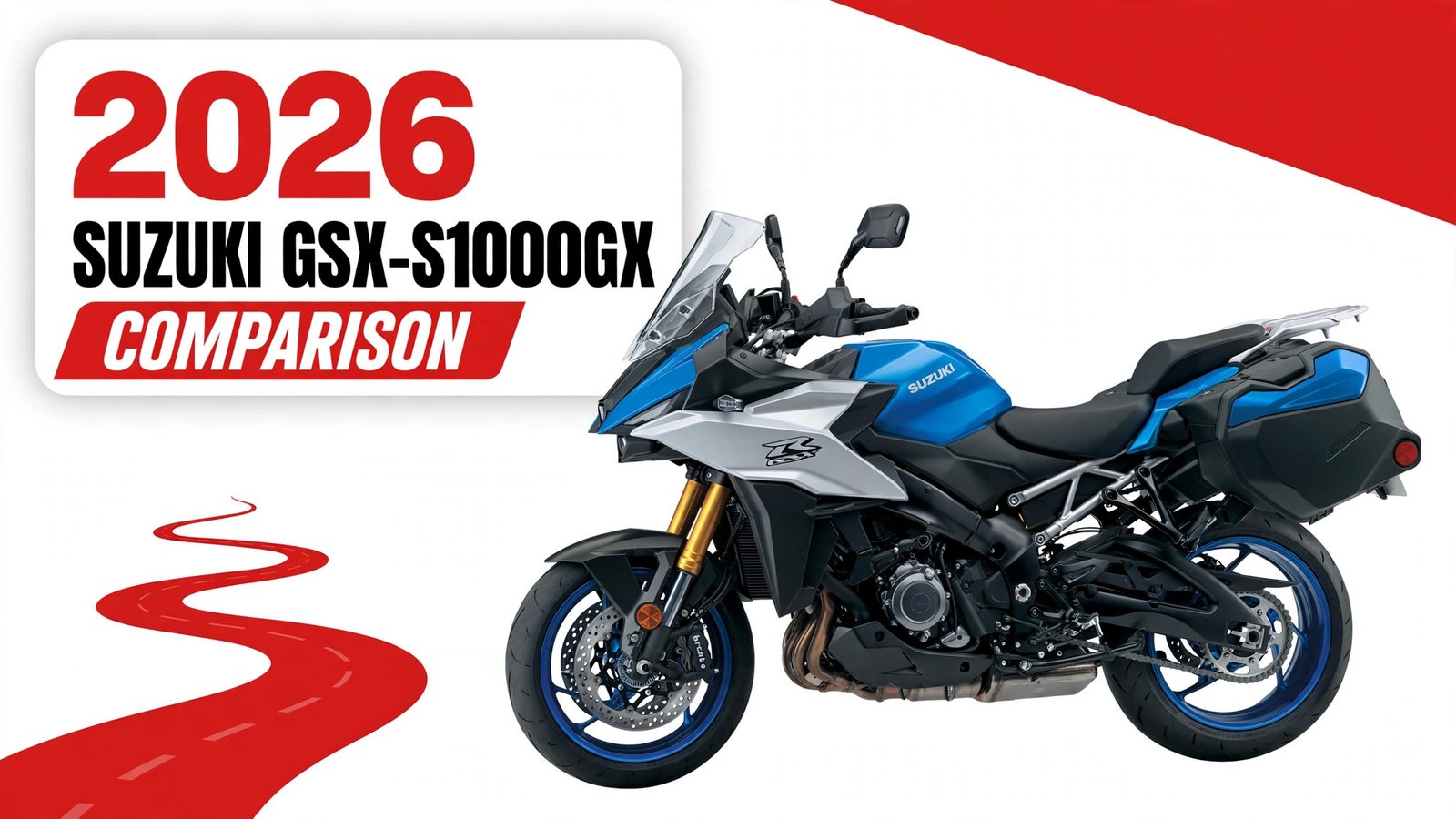
The short answer in this Suzuki GSX-S1000GX comparison is that the GX+ is the value pick in a very expensive class, but only just. At $18,749 for 2026 it sits $4,750 above the Kawasaki Ninja 1100SX, $76 below the BMW S 1000 XR on MSRP, and $11,246 below the Ducati Multistrada V4 S. This Suzuki GSX-S1000GX comparison puts all four side by side on price, specs, electronics and value, so you can see exactly what the extra money buys.
Suzuki GSX-S1000GX Overview and Its Closest Rivals
All four bikes in this Suzuki GSX-S1000GX comparison do the same job: a tall, upright sport-tourer built around a powerful multi-cylinder engine, with full electronics and touring luggage. The BMW S 1000 XR is the identical formula from Munich, the Multistrada V4 S is the premium adventure-touring benchmark, and the Ninja 1100SX is the value pick that proves you do not need $19,000 to tour fast. The GX review covers the bike itself; this Suzuki GSX-S1000GX comparison is about where it stands against the three bikes a buyer actually cross-shops.

Why These Three Rivals: Same Class, Same Job
The S 1000 XR tests the formula itself: same 999cc inline-four capacity, same tall crossover stance, same semi-active suspension idea, and it costs almost exactly the same money. The Multistrada V4 S tests the ceiling: a 1,158cc V4, radar cruise control, Skyhook suspension and a $29,995 price tag. The Ninja 1100SX tests the floor: a 1,099cc four with a six-axis IMU and cornering ABS for $13,999, undercutting the GX+ by $4,750. The Yamaha Tracer 9 GT+ is not in this Suzuki GSX-S1000GX comparison because it is not sold in the United States — the US gets the base Tracer 9 only, which appears later as a budget alternative, never as a GT+.
How the Four Bikes Differ at a Glance
At a glance, the spread is wide: four bikes, four engines, and a price range from $13,999 to $29,995. The GX+ and the XR share the 999cc inline-four layout, while the Ducati brings a V4 and the Kawasaki a bigger 1,099cc four. The GX+’s 2026 destination charge is unpublished, so the table shows its MSRP alone. The MCN GX deep-dive test is the source for the GX+’s tested figures: 143.2 bhp on MCN’s own dyno and a GPS top speed of 132.92 mph, restricted.
| Bike (2026 US) | Engine | Claimed power | MSRP | Standout electronics |
|---|---|---|---|---|
| Suzuki GSX-S1000GX+ | 999cc inline-four | 150 hp | $18,749 | SAES semi-active suspension, 6-axis IMU, cornering ABS |
| BMW S 1000 XR | 999cc inline-four | 170 hp | $18,825 | Dynamic ESA, 6-axis IMU, lean-sensitive TC |
| Ducati Multistrada V4 S | 1,158cc V4 | 170 hp | $29,995 | Radar cruise, Skyhook suspension, auto-lowering device |
| Kawasaki Ninja 1100SX ABS | 1,099cc inline-four | 134 hp | $13,999 | 6-axis IMU, cornering ABS, remote rear preload |
The video below is MCN’s four-bike group test — the GX+ is in it, alongside the BMW S 1000 XR and the Kawasaki Ninja 1100SX, two of this blog’s three rivals. The fourth bike in the video, the Honda CB1000GT, is not sold in the United States, so it is not one of this Suzuki GSX-S1000GX comparison’s rivals.
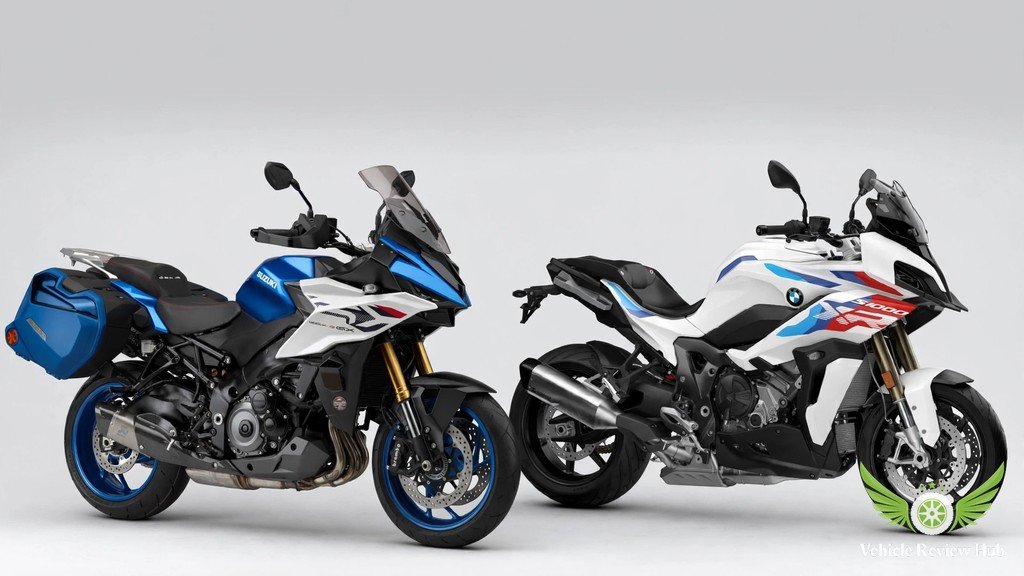
Suzuki GSX-S1000GX vs BMW S 1000 XR
The S 1000 XR is the GX+’s mirror image, and the hardest rival in this Suzuki GSX-S1000GX comparison. Both are tall, upright crossovers built around a 999cc inline-four, both have a six-axis IMU and cornering ABS, and both wear semi-active suspension. The GX+ answers with standard luggage and a centrestand, and with a price that — on 2027 totals — undercuts the XR by only $121. It is the same formula at essentially the same money.
Engine, Specs and Performance Side by Side
Same capacity, different output. The XR’s 999cc inline-four makes a claimed 170 horsepower at 11,000 rpm and 84 lb-ft at 9,250 rpm — 20 horsepower and 6 lb-ft more than the GX+’s claimed 150 horsepower and 78 lb-ft. The XR’s top speed is 155 mph, while the GX+ is electronically capped at a GPS-measured 132.92 mph on MCN’s UK test. That cap is the one place the GX+ is clearly slower, and this Suzuki GSX-S1000GX comparison does not hide it. The GX+’s only named dyno figure is MCN’s 143.2 bhp at the rear wheel; no US outlet has dynoed the GX. The XR’s claimed weight was not verified from a primary source, so this Suzuki GSX-S1000GX comparison prints no XR weight figure.
Price, Equipment and Which Suits Which Rider
On price the two are almost tied, which is exactly what makes the choice hard. The 2026 XR costs $18,825 plus a $995 destination charge, for a total of $19,820. The 2026 GX+ costs $18,749 before destination, and its 2026 destination charge has not been verified in the sources used, so no 2026 GX+ total is printed here. On 2027 totals the picture is complete: the GX+ is $18,949 plus $750 destination, $19,699 in total, against the XR’s $19,820 — the GX+ undercuts the XR by $121. The value case for the GX+ against the XR is not price. It is what comes in the box: the GX+ ships with colour-matched locking side cases and a centrestand as standard, while the XR buyer pays extra for luggage, and the GX+’s running costs are lower — oil every 3,750 miles on a simple schedule, and no premium-brand service pricing. The XR buyer pays for 20 extra horsepower, the BMW badge, a broader electronics suite led by Dynamic ESA, and a three-year, 36,000-mile warranty against the GX+’s 12-month unlimited-mileage warranty. The rider who wants the most complete electronics package and the longest warranty takes the XR; the rider who wants the same formula with luggage included and cheaper running costs takes the GX+, and the GX performance guide shows what the shared engine family does on the road.
Suzuki GSX-S1000GX vs Ducati Multistrada V4 S
The Multistrada V4 S is the ceiling of this Suzuki GSX-S1000GX comparison — the premium adventure-touring benchmark, and the most expensive bike here by a wide margin. The question is whether the $11,246 gap between the two MSRPs buys anything a road rider would actually miss on the GX+.

Engine, Specs and Performance Side by Side
The V4 S engine is the headline: a 1,158cc V4 Granturismo making a claimed 170 horsepower at 10,750 rpm and 91 lb-ft at 9,000 rpm — 20 horsepower and 13 lb-ft more than the GX+’s claimed 150 horsepower and 78 lb-ft. Ducati’s own torque figure is 91 lb-ft, not the 92 some sources round it to. The V4 S also carries the longest valve interval in this class at 37,000 miles, against the GX+’s 15,000 — a real long-term servicing advantage. Both list 511 lb, but on different bases — the V4 S wet with no fuel, the GX+ without its cases — so the numbers must not be compared directly. The V4 S is a true adventure-tourer underneath — 19-inch front wheel, 220 mm ground clearance, 840–860 mm adjustable seat, 22-litre tank — against the GX+’s road-crossover stance with 17-inch wheels and a 33.3-inch seat. The Multistrada V4 S specifications confirm the 170-horsepower claim and the $29,995 price used here.
Price, Equipment and Which Suits Which Rider
The price gap is the story: the V4 S costs $29,995 plus a $1,295 destination charge, $31,290 in total, against the GX+’s $18,749 MSRP for 2026 — an $11,246 gap on MSRP alone. What the extra money buys is the most advanced electronics package in this Suzuki GSX-S1000GX comparison: radar with adaptive cruise control, forward collision warning and blind spot detection as standard, Skyhook semi-active suspension with bump detection, an automatic lowering device, five riding modes and four power modes, and a 6.5-inch TFT with integrated map navigation. The GX+ has no radar and no auto-lowering, and this Suzuki GSX-S1000GX comparison says so plainly. The rider who wants genuine adventure capability and radar should buy the Ducati, and should also look at the 2027 V4 S Grand Tour at $30,995 MSRP in Cycle News’ 2027 Grand Tour report. The rider who rides roads, not trails, gets roughly 90 percent of the road performance for roughly 60 percent of the money in the GX+.
Suzuki GSX-S1000GX vs Kawasaki Ninja 1100SX
The Ninja 1100SX is the value test in this Suzuki GSX-S1000GX comparison, and the bike most likely to steal a GX+ sale. It costs $13,999 before destination — $4,750 less than the GX+ on MSRP — and it is not a stripped-down bike: it has a six-axis IMU, cornering traction control and cornering ABS, a remote rear preload adjuster and a height-adjustable screen. The Ninja asks the sharpest question in this Suzuki GSX-S1000GX comparison: is the GX+’s suspension and included luggage worth $4,750?

Engine, Specs and Performance Side by Side
The Ninja’s 1,099cc inline-four makes a claimed 134 horsepower at 9,000 rpm and 83.2 lb-ft at 7,600 rpm — 16 horsepower down on the GX+’s claimed 150, but with 5.2 lb-ft more torque. MCN’s 2025 group test found the Suzuki engine family rough and ready next to the ultra-smooth Ninja, with the GT decidedly more vibey and raw than the Ninja SE. The same applies to the GX+, which shares that engine and tune. The Ninja weighs 518 lb wet (TopSpeed), and the SE ABS version is $16,639 in total — still $2,110 less than the GX+’s 2026 MSRP alone. The motorcycle.com Showdown between the Ninja 1000SX and the GT is the source for the refinement gap described here.
Price, Equipment and Which Suits Which Rider
The Ninja undercuts the GX+ by $4,750 on MSRP, and by $3,910 against the GX+’s MSRP when the Ninja’s destination is included in its $14,839 total — either way, the gap is large. The GX+ buyer pays that premium for the SAES suspension, the cornering ABS and the IMU, and luggage that comes in the box. The Ninja’s cases are an add-on, and the 2023 pricing shows the scale: the bike was $13,199 with the bags at $922.95 (components only — the source’s printed total does not match its own parts). The Ninja is the value pick and the refinement pick; the GX+ is the electronics and luggage pick. A rider who tours smooth roads and values a smooth engine will be happier on the Ninja and $4,750 richer; a rider who rides rough roads where the SAES earns its keep will find the GX+ worth the premium. The GX reliability guide covers the ownership side both buyers should read before deciding.
Suzuki GSX-S1000GX Price and Value Compared
Prices decide this Suzuki GSX-S1000GX comparison more than any spec sheet does. The ladder is simple on MSRP and honest about what is missing: the GX+’s 2026 destination charge has not been verified in the sources used, so no 2026 GX+ total is printed — only the 2027 total, where the destination is confirmed at $750.

New Prices Across the Four Bikes in the USA
The 2026 MSRP ladder runs Ninja $13,999, GX+ $18,749, XR $18,825, V4 S $29,995. With destination where it is verified, the totals are Ninja $14,839, XR $19,820 and V4 S $31,290. The 2027 GX+ total is $19,699 ($18,949 plus $750 destination), which undercuts the XR’s $19,820 by only $121. The motorcycle.com 2027 GX+ comparison page confirms the $18,949 MSRP and $750 destination used for the 2027 total.
| Bike (2026 US) | MSRP | Destination | Total |
|---|---|---|---|
| Kawasaki Ninja 1100SX ABS | $13,999 | $840 | $14,839 |
| Suzuki GSX-S1000GX+ | $18,749 | Not verified | — |
| BMW S 1000 XR | $18,825 | $995 | $19,820 |
| Ducati Multistrada V4 S | $29,995 | $1,295 | $31,290 |
Running Costs and Resale Value Compared
Running costs are where this Suzuki GSX-S1000GX comparison has to be honest about what is not known. The GX+’s fuel figure is the only measured one here: MCN recorded 48 mpg imperial on test, about 40 mpg US, with the fuel light at around 150 miles. No named-test US MPG figure was verified for the Ninja, the XR or the V4 S, so none is printed — and this Suzuki GSX-S1000GX comparison does not present a lab figure as a road test. On servicing, the GX+ follows a simple schedule: oil every 3,750 miles, a valve inspection at 15,000 miles, and no SAES service interval — inspection only. The one rival interval verified is the V4 S valve check at 37,000 miles, the longest in this class; no rival oil interval was verified, so none is printed. No single-dataset US insurance figure was verified for the GX+ or any rival, so buyers should compare like-for-like quotes. The Ninja is cheapest to buy, the GX+ carries standard luggage the others charge extra for, and the V4 S is the most expensive to buy and to own over time.
Suzuki GSX-S1000GX Comparison Verdict and US Alternatives
The verdict in this Suzuki GSX-S1000GX comparison is that the GX+ wins on value, but by equipment rather than by price. Against the XR it is essentially the same money for the same formula. Against the Multistrada it gives up radar and the V4 for $11,246 less. Against the Ninja it costs $4,750 more and earns it with semi-active suspension and standard cases. That is why the GX+ is the pick of this Suzuki GSX-S1000GX comparison for most US riders.
The S 1000 XR Is the Identical Formula, Pricier Equipped
The XR is the same idea done by BMW: a 999cc inline-four, a tall crossover stance, semi-active suspension and a full IMU-based electronics suite. The XR’s advantages are real: 20 more horsepower, a broader electronics package, and a three-year, 36,000-mile warranty. But on 2027 totals the GX+ is $121 cheaper than the XR with cases and a centrestand already fitted. The rider who values the BMW badge, the extra power and the warranty should buy the XR; the rider who values the same riding experience with luggage included should buy the GX+. The GT comparison guide makes the same point from the other side of the family, with the GT+ against the same three rivals.
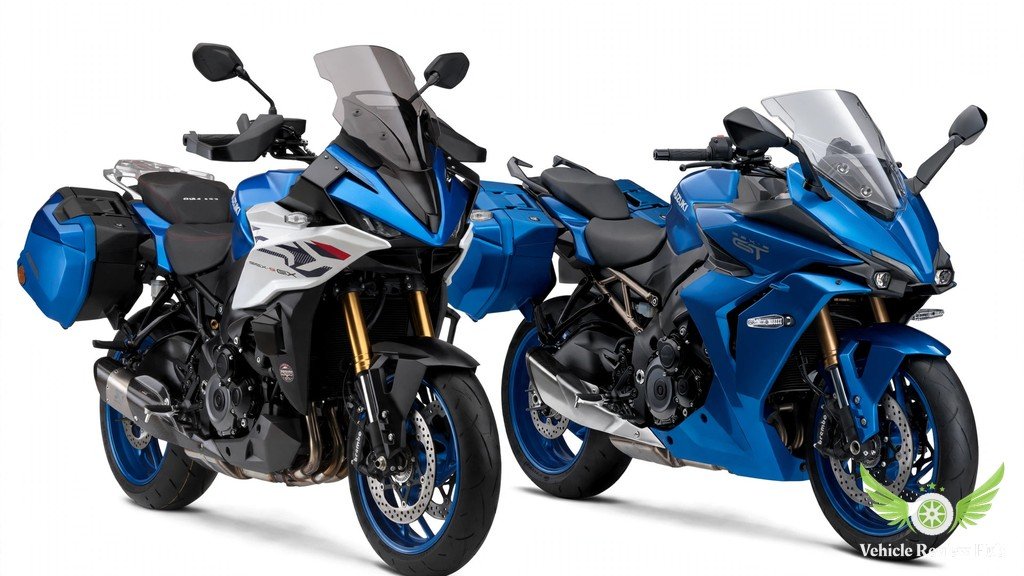
Also Consider: the GT+ Saves Thousands, Same Engine
The strongest alternative to the GX+ is not a rival at all — it is Suzuki’s own GSX-S1000GT+. The GT+ runs the same 999cc K5-derived engine with the same tune, and it costs $15,099 in total for 2026 ($14,399 plus $700) or $15,349 for 2027 ($14,599 plus $750). Against the GX+ that is a saving of $4,350 on 2026 MSRP and $4,350 on 2027 totals — the same $4,350 twice. What the GT+ buyer gives up is the SAES suspension, the six-axis IMU, the cornering ABS, the taller stance, the adjustable windscreen and the centrestand. The GT+ is lower at 31.9 inches and heavier at 518 lb against the GX+’s 511 lb without cases. A rider who wants the engine and rides mostly smooth roads should save the $4,350 on the GT+; a rider who wants the suspension, the electronics and the upright stance should pay it on the GX+. The Yamaha Tracer 9, the US base bike only at $13,299 in total ($12,599 plus $700), is the budget alternative with an 890cc triple making 117 horsepower and hard cases standard — but the Tracer 9 GT+ is Euro-only and is not sold in the United States. The KTM 1290 Super Duke GT is the used alternative: its last US model year was 2024, and the 1390 Super Duke GT was not brought to North America for 2025. The Honda NT1100 and the Honda CB1000GT are not sold in the US and are not alternatives here.
Suzuki GSX-S1000GX Comparison: Frequently Asked Questions
Direct answers to the questions riders ask about the Suzuki GSX-S1000GX comparison.
Which is better, the Suzuki GSX-S1000GX or the BMW S 1000 XR?
Neither wins outright — the same formula at essentially the same money. The XR has 20 more horsepower, a broader electronics package and a three-year, 36,000-mile warranty; the GX+ has standard cases and a centrestand, lower running costs, and undercuts the XR by $121 on 2027 totals. This Suzuki GSX-S1000GX comparison calls the GX+ the value pick and the XR the equipment pick.
Is the S 1000 XR worth more than the GSX-S1000GX+?
On 2027 totals it costs $121 more than the GX+ before luggage, and more again once cases are added. The XR is worth it for a rider who values the 20 extra horsepower, the wider electronics suite and the three-year warranty; for a rider who wants the same riding experience with luggage included, the GX+ is the better buy in this Suzuki GSX-S1000GX comparison.
Which is faster, the GSX-S1000GX or the S 1000 XR?
The XR is faster on paper: a 155 mph top speed against the GX+’s GPS-measured 132.92 mph, which is electronically capped, and 20 more horsepower. In everyday riding the gap is smaller than the numbers suggest, since the cap rarely matters on a real road, but the XR is the faster bike in this Suzuki GSX-S1000GX comparison.
Is the Ducati Multistrada V4 S worth $11,000 more than the GSX-S1000GX+?
The gap is $11,246 on MSRP, and it buys a V4 engine, radar cruise control, Skyhook suspension, an automatic lowering device and a 37,000-mile valve interval. It is worth it for a rider who wants genuine adventure capability and the most advanced electronics in the class. For a rider who rides roads rather than trails, this Suzuki GSX-S1000GX comparison finds the GX+ gives roughly 90 percent of the road performance for roughly 60 percent of the money.
Does the Multistrada V4 S have radar and the GX does not?
Yes. The V4 S has radar as standard, with adaptive cruise control, forward collision warning and blind spot detection. The GX+ has smart cruise control but no radar, and no automatic lowering device either. That is the single biggest equipment gap in this Suzuki GSX-S1000GX comparison.
Which is better for touring, the GSX-S1000GX or the Ninja 1100SX?
It depends on the roads. The GX+ is better on rough roads, with SAES suspension, a taller upright stance and standard cases and a centrestand; the Ninja is better on smooth roads, with a smoother engine, a lower price and a more refined ride. This Suzuki GSX-S1000GX comparison gives the touring win to the GX+ for rough-road comfort and to the Ninja for value and refinement.
Is the Ninja 1100SX cheaper than the GSX-S1000GX+?
Yes, by $4,750 on MSRP — $13,999 against the GX+’s $18,749 — and by $3,910 against the GX+’s MSRP once the Ninja’s $840 destination is included in its $14,839 total. The SE ABS version is $16,639 in total, still $2,110 less than the GX+’s 2026 MSRP alone.
Does the Ninja 1100SX have cornering ABS like the GX?
Yes. The Ninja 1100SX has a six-axis IMU with cornering traction control and cornering ABS, plus a remote rear preload adjuster and a height-adjustable screen. Where the GX+ pulls ahead is suspension: SAES semi-active damping, which the Ninja does not have, and this Suzuki GSX-S1000GX comparison calls that the GX+’s main equipment advantage over the Kawasaki.
Which of the four bikes is cheapest to buy in the USA?
The Kawasaki Ninja 1100SX ABS, at $13,999 MSRP and $14,839 in total with destination. The GX+ is next at $18,749 MSRP, then the S 1000 XR at $18,825, then the Multistrada V4 S at $29,995. The in-family GT+ is cheaper still at $15,099 in total for 2026, but it is not one of the four bikes in this Suzuki GSX-S1000GX comparison.
Which of the four bikes is cheapest to run?
No firm ranking is possible from verified figures. The GX+ is the only one with a measured fuel figure — MCN’s 48 mpg imperial, about 40 mpg US — and it has a simple service schedule with oil every 3,750 miles and no SAES service interval. The V4 S has the longest valve interval at 37,000 miles. No named-test MPG, no rival oil interval and no single-dataset insurance figure was verified for the other three, so this Suzuki GSX-S1000GX comparison does not invent a running-cost winner.
Does the GSX-S1000GX+ come with luggage while the Ninja does not?
Yes. The GX+ ships with colour-matched locking side cases and a centrestand as standard in the US. The Ninja 1100SX’s cases are an add-on, priced separately — the 2023 pricing had the bike at $13,199 with the bags at $922.95. That included luggage is a large part of the GX+’s value case in this Suzuki GSX-S1000GX comparison.
Should I buy a GSX-S1000GX or save thousands on the GT+?
Buy the GT+ if you want the engine and ride mostly smooth roads: it saves $4,350 on 2026 MSRP and $4,350 on 2027 totals, with the same 999cc engine and the same tune. Buy the GX+ if you want the SAES suspension, the six-axis IMU, the cornering ABS, the taller upright stance, the adjustable windscreen and the centrestand. That is the whole decision in this Suzuki GSX-S1000GX comparison, and it is worth a test ride on both before choosing.