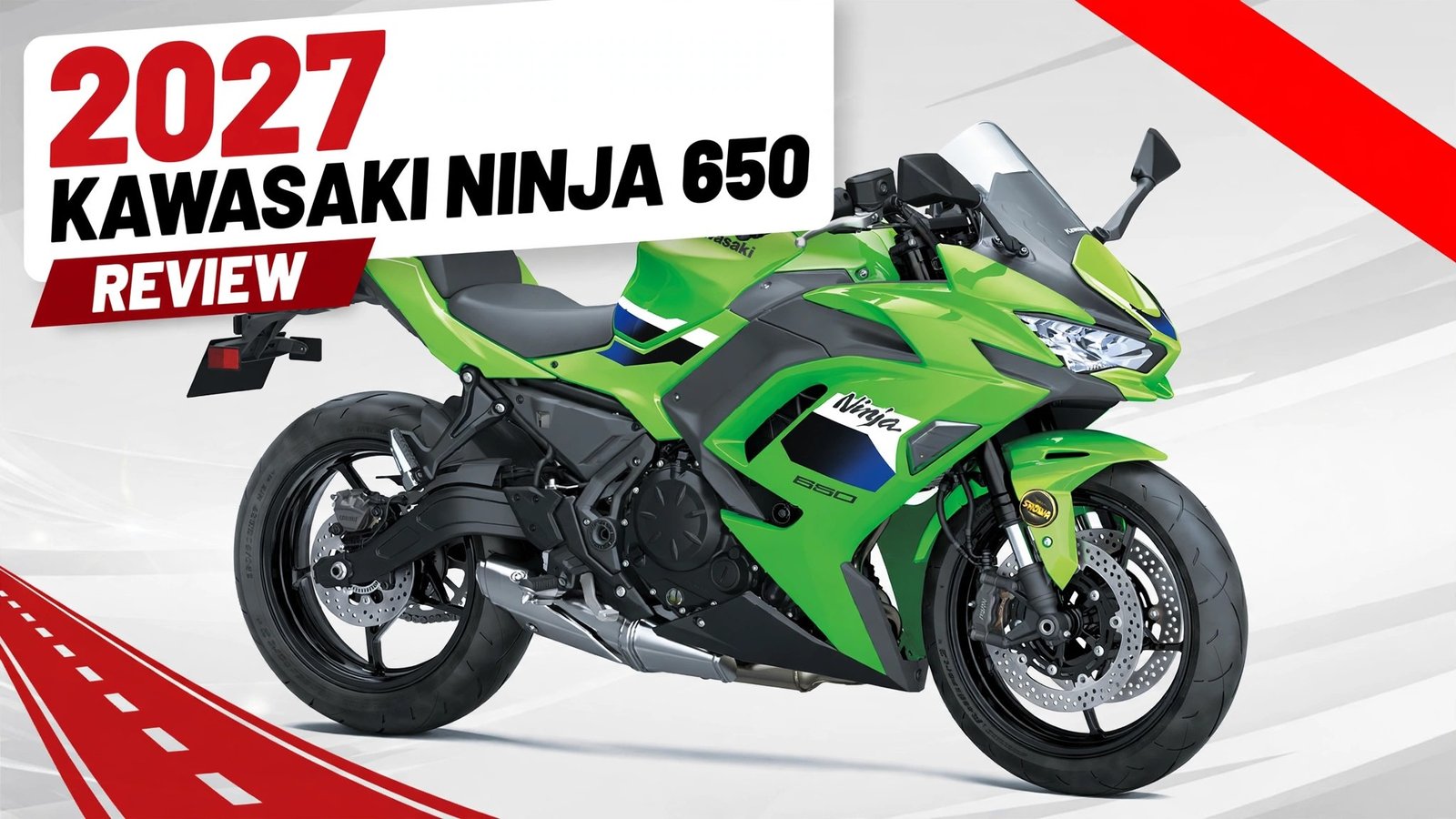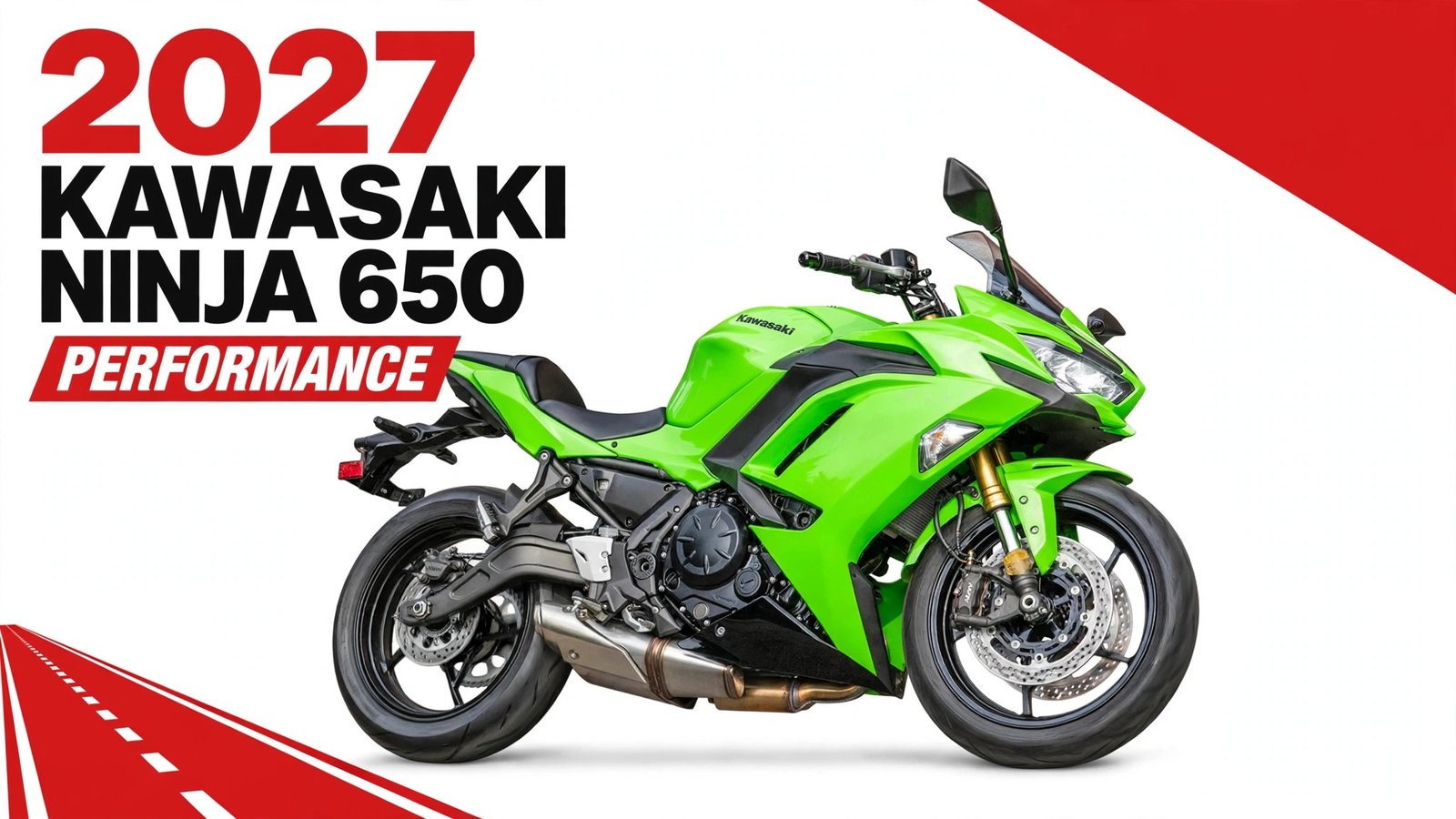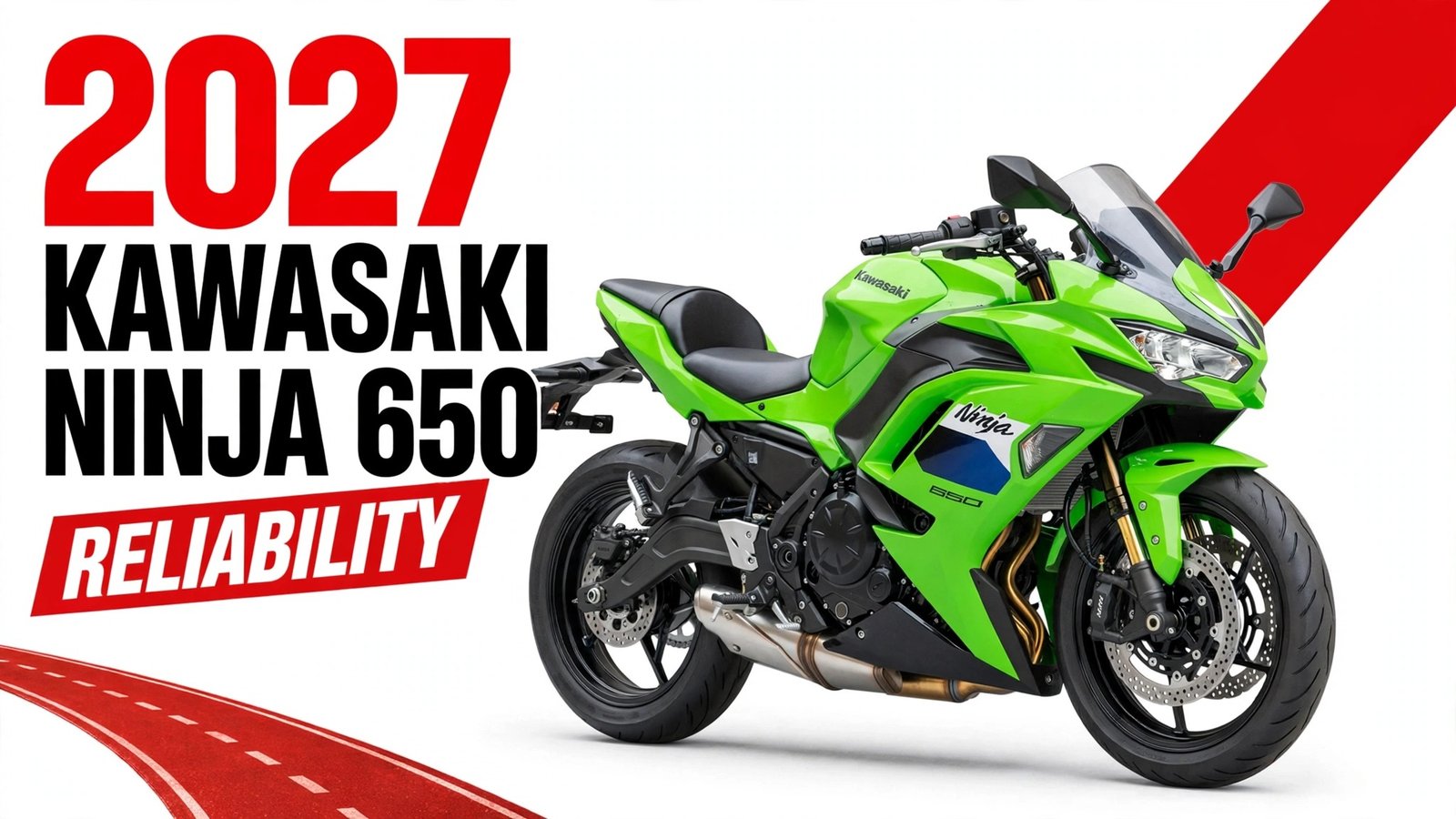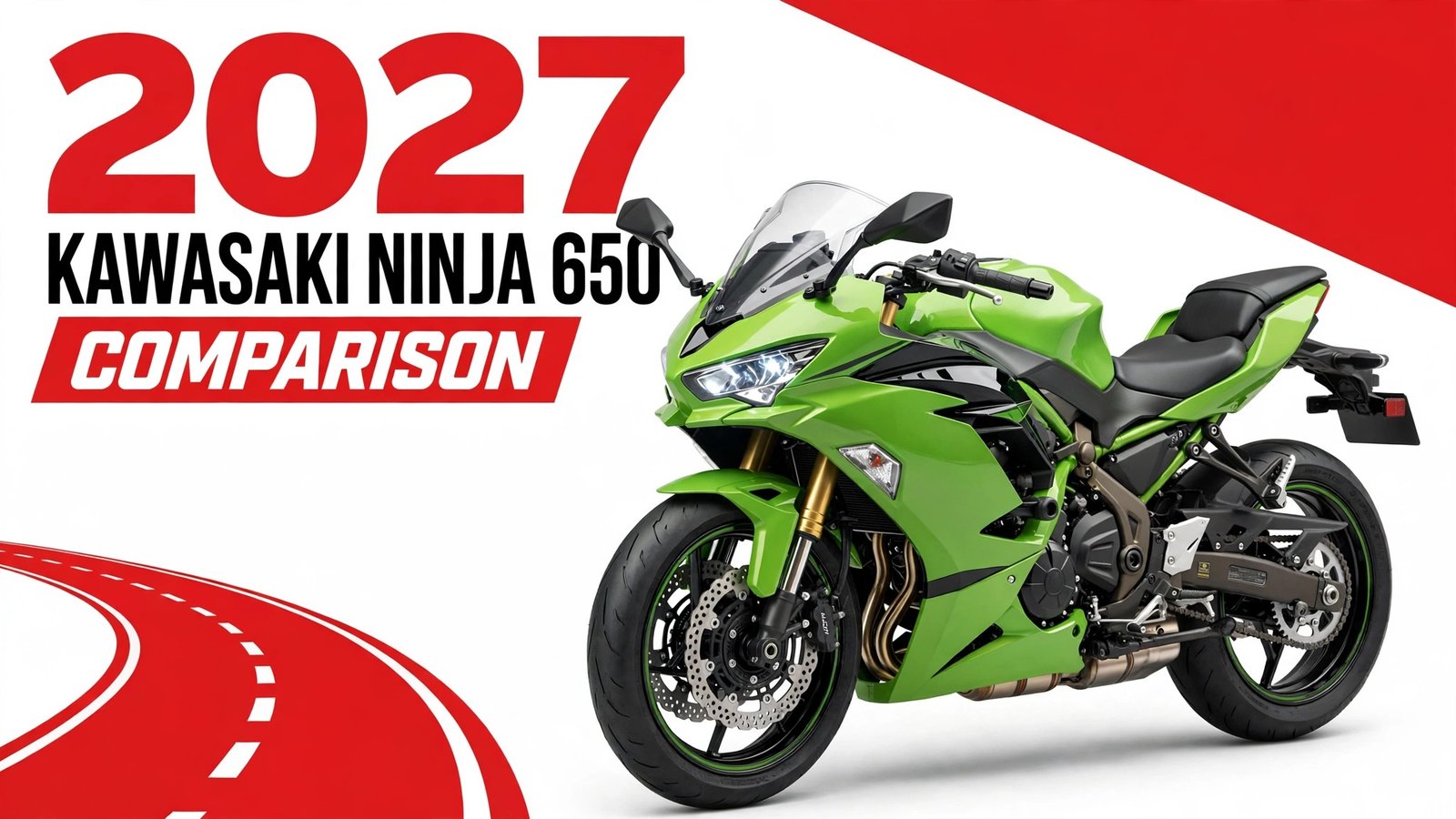
The 2027 Kawasaki Ninja 650 gets its biggest chassis change in years — a 37 mm inverted Showa SFF-BP fork with radial calipers — while the price barely moves: $8,099 for the base colours and $8,299 for the KRT Edition, plus a $685 destination charge. This Kawasaki Ninja 650 comparison sets that bike against the three middleweight rivals buyers actually cross-shop — the Suzuki SV650, the Yamaha R7 and the Suzuki GSX-8R — and then checks the leftover 2025 KRT Edition and the Aprilia RS 660 for buyers willing to pay more.
The tension at the heart of this Kawasaki Ninja 650 comparison is simple. The 650’s 649cc parallel twin claims 67.0 hp at 8,000 rpm with 48.5 lb-ft at 6,700 rpm — the lowest output of the four — yet on MSRP it is the cheapest of the set, and its case rests on comfort and everyday usability rather than peak numbers: upright bars, a 30.9-inch seat and torque that arrives low down. The price ladder, the spec tables and the verdict below are all built from the verified figures.
Kawasaki Ninja 650 Overview and Its Closest Rivals
The direct answer in this Kawasaki Ninja 650 comparison is that the 2027 Ninja 650 is the cheapest bike of its four-bike set on MSRP and the least powerful of the four, and that split is the whole story. At $8,099 for the base colours, the 650 undercuts the SV650 by $50, the GSX-8R by $1,100 and the R7 by $1,300 — but its 67.0 hp claim is the lowest of the group, and once the destination charge is added the SV650 is actually $35 cheaper delivered. What it wins on is comfort: upright bars, a 30.9-inch seat and a twin that makes its torque low down. This Kawasaki Ninja 650 comparison puts the 2027 bike against the SV650, the R7 and the GSX-8R on price, power, equipment and weight, then checks the leftover 2025 KRT Edition and the Aprilia RS 660.
Least Power, Lowest Price Near Top
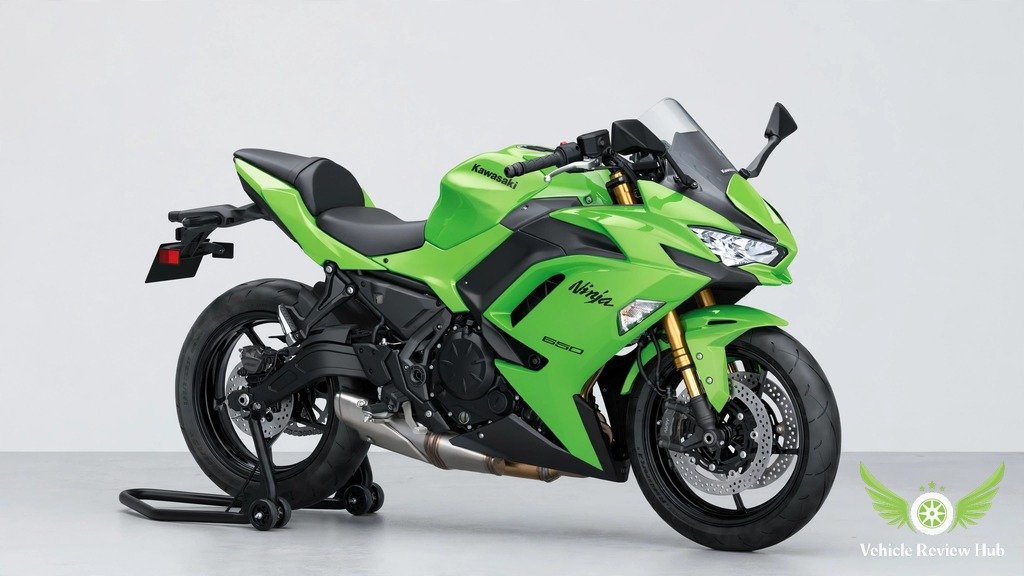
The 650 has the least power of the four bikes in this Kawasaki Ninja 650 comparison. Its 649cc parallel twin claims 67.0 hp at 8,000 rpm and 48.5 lb-ft at 6,700 rpm, and that claim is a crank figure under ISO 4106, not a rear-wheel number. The SV650 claims 75.1 hp from its 645cc V-twin, the R7 claims 72.4 hp from its 689cc CP2 twin, and the GSX-8R claims 81.8 hp from its 776cc twin. The measured figures agree: the 650 puts about 60 to 61 hp to the rear wheel — MCN measured 60.38 bhp on its long-term bike and Rider Magazine measured 60.6 hp on the same engine in the Z650 — while Cycle World measured 72.75 hp at the rear wheel on the GSX-8R. A buyer who cares most about power should know that before anything else. Our Kawasaki Ninja 650 performance guide covers the measured figures in full.
The price half needs the same care: “lowest price” depends on which price you mean. On MSRP the 650 is the cheapest of the four at $8,099 — $50 less than the SV650 at $8,149, $1,100 less than the 2027 GSX-8R at $9,199 and $1,300 less than the R7 at $9,399. On delivered price the order flips at the top: the SV650 lands at $8,749 with its $600 destination charge, while the 650 lands at $8,784 with its $685 — the SV650 is $35 cheaper out the door. The 650 is therefore the lowest-priced bike on the sticker and the second-lowest once freight is added, and this Kawasaki Ninja 650 comparison shows both columns in every table. The full specification is in our Kawasaki Ninja 650 review, and the service record is in our Kawasaki Ninja 650 reliability guide.
How the Four Bikes Differ at a Glance
Four bikes, four different answers: the 650 is the comfort twin, the SV650 is the simple V-twin, the R7 is the supersport, and the GSX-8R is the most powerful. The table below is the whole Kawasaki Ninja 650 comparison in one place.
| Figure | Ninja 650 ABS (2027) | Suzuki SV650 ABS (2026) | Yamaha YZF-R7 (2026) | Suzuki GSX-8R (2027) |
|---|---|---|---|---|
| MSRP | $8,099 base / $8,299 premium | $8,149 | $9,399 | $9,199 |
| Destination | $685 | $600 | $675 | $750 (dealer-sourced) |
| Delivered | $8,784 / $8,984 | $8,749 | $10,074 | $9,949 |
| Engine | 649cc parallel twin | 645cc 90° V-twin | 689cc CP2 parallel twin | 776cc parallel twin |
| Claimed power | 67.0 hp @ 8,000 / 48.5 lb-ft @ 6,700 | 75.1 hp @ 8,500 / 47.2 lb-ft | 72.4 hp @ 8,750 / 50.2 lb-ft @ 6,500 | 81.8 hp @ 8,500 / 57.5 lb-ft @ 6,800 |
| Front fork | 37 mm inverted Showa SFF-BP | 41 mm telescopic | 41 mm inverted KYB, fully adjustable | 41 mm inverted Showa SFF-BP |
Note: every figure in this Kawasaki Ninja 650 comparison table is labelled by model year, and the delivered prices are MSRP plus the destination charge shown. The GSX-8R destination of $750 is dealer-sourced, and the SV650 delivered figure of $8,749 does not include the $250 Suzuki freight surcharge in dealer pricing — that caveat is carried in the SV650 section below.
Kawasaki Ninja 650 vs Suzuki SV650
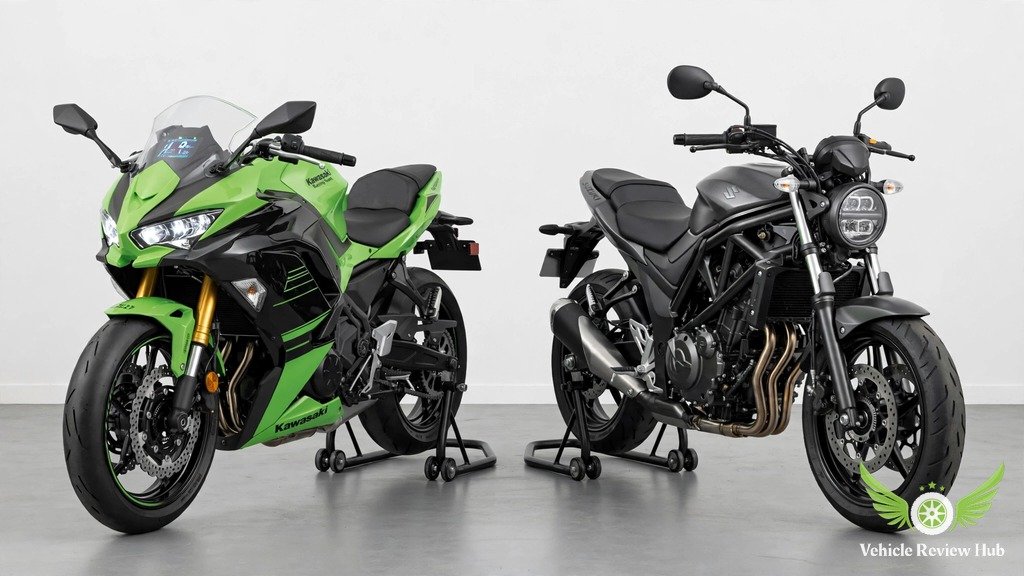
The SV650 is the oldest rival in this Kawasaki Ninja 650 comparison, and the two bikes have fought the same fight since 2006. That year Motorcycle.com put the new Ninja 650R against the SV650S: the Suzuki won on handling, power, brakes and suspension, while the Kawasaki won on comfort and ease — and twenty years later the same split still holds. The SV650 is the sportier twin and the 650 is the more comfortable one, and the prices are so close the choice comes down to what the rider values. Our Suzuki SV650 comparison covers the Suzuki side of the same fight from the other direction.
Engine, Specs and Performance Side by Side
On paper the SV650 has the stronger engine in this Kawasaki Ninja 650 comparison. Its 645cc 90-degree V-twin claims 75.1 hp at 8,500 rpm at launch, against the 650’s 67.0 hp at 8,000 rpm, and its torque is 47.2 lb-ft, or 64 Nm, against the 650’s 48.5 lb-ft. Two caveats: First, the SV650’s claim changed with the 2021 Euro 5 revision, which cut it to 73 hp, so the 75.1 hp figure is the launch claim and the 73 hp figure is the post-2021 figure. Second, the SV650’s torque peak rpm is disputed — launch sources say 47.2 lb-ft at 8,100 rpm and post-2021 sources variously quote 64 Nm at 6,800 rpm — so no peak rpm is printed here. The 650’s torque is a single clean figure, 48.5 lb-ft at 6,700 rpm, arriving 1,400 rpm lower than the SV650’s launch peak, which is why the Kawasaki feels stronger at town speeds. The 2006 shootout is the evidence: the SV650S won on power and handling, and the Ninja 650R won on comfort, as Motorcycle.com’s 2006 shootout records.
The chassis figures in this Kawasaki Ninja 650 comparison are closer: both bikes seat the rider at 30.9 inches, both wear a 160/60-17 rear tyre, and the weights are within 10 pounds — the 650 at 427.8 lb in 50-state trim and the SV650 at 437 lb. Where they differ is the front end: for 2027 the 650 gains a 37 mm inverted Showa SFF-BP fork with radial-mount 4-piston calipers on dual 300 mm discs, while the SV650 keeps a 41 mm conventional fork and dual 290 mm discs — the first time in a decade the 650 has had the better front end. The SV650 answers with simplicity: an LCD dash, no traction control, no quickshifter and no ride modes.
| Figure | Ninja 650 ABS (2027) | Suzuki SV650 ABS (2026) |
|---|---|---|
| MSRP | $8,099 base / $8,299 premium | $8,149 |
| Destination | $685 | $600 |
| Delivered | $8,784 / $8,984 | $8,749 |
| Engine | 649cc parallel twin | 645cc 90° V-twin |
| Claimed power | 67.0 hp @ 8,000 / 48.5 lb-ft @ 6,700 | 75.1 hp @ 8,500 (launch) / 73 hp (Euro 5); 47.2 lb-ft, no peak rpm stated |
| Curb weight | 427.8 lb (50-state) | 437 lb |
| Front fork / brakes | 37 mm inverted SFF-BP / dual 300 mm, radial 4-piston | 41 mm telescopic / dual 290 mm discs |
Note: the SV650 figures in this Kawasaki Ninja 650 comparison table come from the parent-verified Cluster 33 brief. The torque is printed with no peak rpm because the launch and post-2021 sources disagree on it, and Suzuki USA publishes no torque figure.
Price, Equipment and Which Suits Which Rider
The price gap is $50 on the sticker and $35 the other way once freight is added — no gap at all, so this Kawasaki Ninja 650 comparison spends its time on equipment instead of money. The 650 costs $8,099 against the SV650’s $8,149, and the 650’s $685 destination charge against the SV650’s $600 leaves the Suzuki $35 cheaper delivered, at $8,749 against $8,784. One caveat: a $250 Suzuki freight surcharge exists in dealer pricing and is not part of the $600 destination charge. It is not added to the $8,749 above — but a buyer should ask the Suzuki dealer whether it applies, since it can erase the SV650’s $35 edge on its own.
On equipment the 650 is the better buy in this Kawasaki Ninja 650 comparison: a 4.3-inch TFT dash with Rideology against the SV650’s LCD, two-mode KTRC against none, a 2027 inverted fork and radial calipers against a conventional fork, and a 4.0-gallon tank against 3.8 gallons. The SV650’s case is character, not equipment: a 90-degree V-twin with a narrower feel and a sportier chassis, the bike that won the 2006 shootout on handling, and the simplest machine of the four. The rider who wants the most bike for the money and the most comfort should take the 650; the rider who wants the sportier twin should take the SV650. One more fact matters: the SV650 name is ending. Suzuki dropped it from Europe for 2026 and its successor, the 2027 SV-7S, has been announced — but this Kawasaki Ninja 650 comparison judges the 650 against the SV650 that is actually on sale, not its successor. A rider stepping up from a smaller Ninja should also read our Ninja 500 comparison and our Ninja 400 comparison.
Kawasaki Ninja 650 vs Yamaha YZF-R7
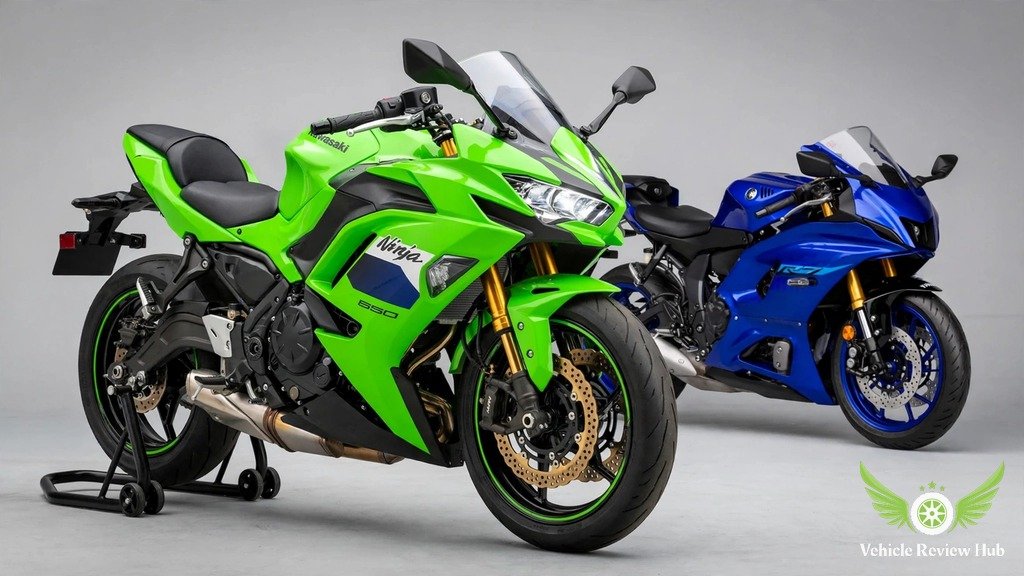
The R7 is the supersport of this Kawasaki Ninja 650 comparison, and the gap between the two bikes is a gap in philosophy as much as in price. The R7 costs $9,399 against the 650’s $8,099 — $1,300 more on MSRP and $1,290 more delivered — and for that money it brings clip-ons, a 32.7-inch seat, a six-axis IMU, ride-by-wire, a gen-3 quickshifter, cruise control and a 5-inch TFT. The 650 answers with upright bars, a 30.9-inch seat and a riding position a rider can hold all day. Our YZF-R7 review covers the Yamaha side in full.
Engine, Specs and Performance Side by Side
The R7’s 689cc CP2 twin claims 72.4 hp at 8,750 rpm and 50.2 lb-ft at 6,500 rpm, against the 650’s 67.0 hp at 8,000 rpm and 48.5 lb-ft at 6,700 rpm — a gap of 5.4 hp and 1.7 lb-ft in the Yamaha’s favour. That is the figure this Kawasaki Ninja 650 comparison uses, verified through the parent-verified Cluster 28 brief. The R7 is also the lightest bike of the four at 417 lb, 10.8 lb lighter than the 650, and its 180/55-17 rear tyre and fully adjustable inverted KYB 41 mm fork mark it out as the track-biased machine. The 650’s counter is its 2027 front end: the inverted Showa SFF-BP fork and radial calipers close much of the hardware gap the old bike had, even though the R7’s IMU-based traction control and ride modes are still a generation ahead of the 650’s wheel-speed KTRC. As SlashGear’s R7-versus-650 comparison puts it, the two bikes are aimed at different riders.
| Figure | Ninja 650 ABS (2027) | YZF-R7 (2026) |
|---|---|---|
| MSRP / delivered | $8,099 / $8,784 | $9,399 / $10,074 |
| Engine | 649cc parallel twin | 689cc CP2 parallel twin |
| Claimed power | 67.0 hp @ 8,000 / 48.5 lb-ft @ 6,700 | 72.4 hp @ 8,750 / 50.2 lb-ft @ 6,500 |
| Electronics | KTRC 2 modes + OFF, no IMU; no QS, no cruise | Six-axis IMU, ride modes, gen-3 QS, cruise, 5-in TFT |
Note: the R7 figures in this Kawasaki Ninja 650 comparison table are the Cluster 28-verified figures (72.4 hp at 8,750 rpm, 50.2 lb-ft at 6,500 rpm) with the 2026 refresh — six-axis IMU, ride-by-wire, gen-3 quickshifter, cruise, ride modes and 5-inch TFT. The old R7’s specification is not printed here as the 2026 bike.
Price, Equipment and Which Suits Which Rider
The R7 costs $1,300 more than the 650 on MSRP and $1,290 more delivered in this Kawasaki Ninja 650 comparison, at $10,074 against $8,784, and the equipment list explains where the money goes: an IMU suite, ride-by-wire, a quickshifter, cruise control, ride modes and a bigger TFT. What the money does not buy is comfort: the R7’s clip-ons and 32.7-inch seat — 1.8 inches taller than the 650’s — make it the least comfortable bike in this Kawasaki Ninja 650 comparison. The rider who wants the most capable machine should take the R7; the rider who wants a middleweight twin to ride every day in comfort, for $1,290 less, should take the 650. A rider coming from Yamaha’s smaller twin should also read our YZF-R3 review.
Kawasaki Ninja 650 vs Suzuki GSX-8R
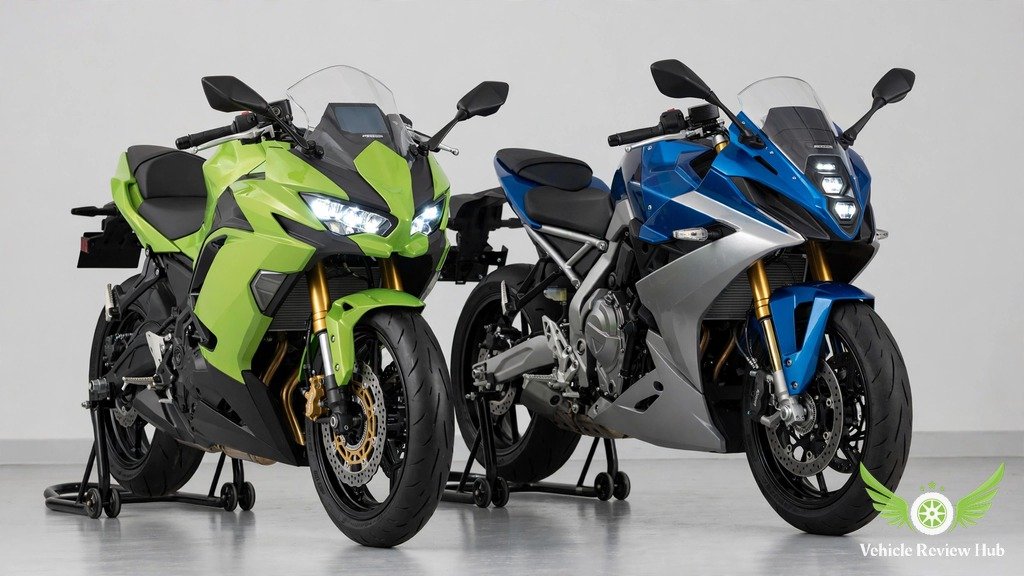
The GSX-8R is the most powerful bike in this Kawasaki Ninja 650 comparison, because Suzuki cut its price for 2027: the 2027 8R costs $9,199 against the 650’s $8,099 — a $1,100 gap on MSRP and $1,165 delivered — $500 less than the 2026 8R, with no mechanical changes since launch. Our Suzuki GSX-8R comparison covers the Suzuki side of the same pairing.
Engine, Specs and Performance Side by Side
The 8R’s 776cc twin claims 81.8 hp at 8,500 rpm and 57.5 lb-ft at 6,800 rpm, 14.8 hp and 9 lb-ft more than the 650 claims, and the measured figures keep the same order: Cycle World measured 72.75 hp at 8,120 rpm at the 8R’s rear wheel, against the 650’s 60.38 bhp from MCN and 60.6 hp from Rider. The 83 figure is PS, the same output as 81.8 hp. The 8R is also the heaviest bike in this Kawasaki Ninja 650 comparison at 453 lb wet, 25.2 lb more than the 650, and its 31.9-inch seat sits an inch higher than the 650’s. Its hardware is the strongest of the set: a 41 mm inverted Showa SFF-BP fork, Nissin radial 4-piston calipers on dual 310 mm discs, a 5-inch TFT, three power modes, multi-level traction control and a bi-directional quickshifter. What it does not have is an IMU, cornering ABS or cruise control — the 2026 R7 has moved past it on electronics.
| Figure | Ninja 650 ABS (2027) | GSX-8R (2027) |
|---|---|---|
| MSRP / delivered | $8,099 / $8,784 | $9,199 / $9,949 |
| Engine | 649cc parallel twin | 776cc parallel twin |
| Claimed power | 67.0 hp @ 8,000 / 48.5 lb-ft @ 6,700 | 81.8 hp @ 8,500 / 57.5 lb-ft @ 6,800 (83 PS) |
| Measured rear-wheel hp | MCN 60.38 bhp / Rider 60.6 hp | Cycle World 72.75 hp @ 8,120 |
Note: the 8R figures in this Kawasaki Ninja 650 comparison table are the 2027 figures — $9,199 MSRP plus a dealer-sourced $750 destination charge, $9,949 delivered. The 2026 8R cost $9,699 plus $700, or $10,399 delivered; the years must not be mixed.
Price, Equipment and Which Suits Which Rider
The 8R costs $1,100 more than the 650 on MSRP and $1,165 more delivered in this Kawasaki Ninja 650 comparison, and the buyer gets 14.8 hp, a quickshifter, three power modes and a bigger TFT — but also 25.2 lb more weight and a taller seat. The 650’s case is comfort and money: upright bars, a 30.9-inch seat, and $1,165 left in the pocket. The rider who wants the strongest middleweight twin should take the 8R, especially now that the 2027 price cut has narrowed the gap; the rider who wants the comfortable everyday twin should take the 650. Either way, this Kawasaki Ninja 650 comparison is clear that the 8R is the performance pick and the 650 is the comfort pick.
Kawasaki Ninja 650 Price and Value Compared
The price story in this Kawasaki Ninja 650 comparison is not the 2027 sticker — it is the leftover 2025 KRT Edition on dealer floors at $7,999, and the running costs that follow the purchase. This Kawasaki Ninja 650 comparison puts both on the table before the verdict.
Leftover KRT Beats Them All on Price
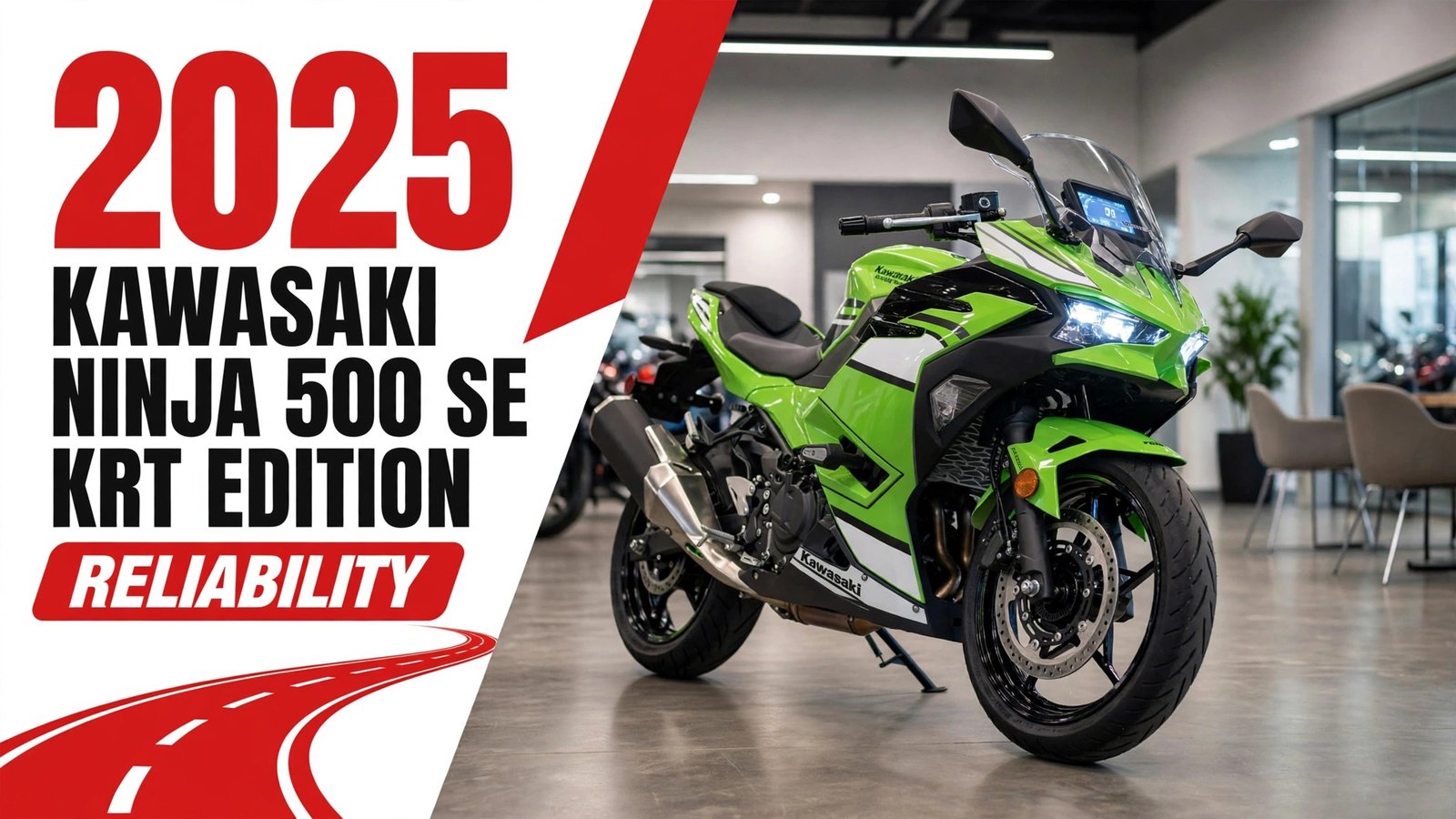
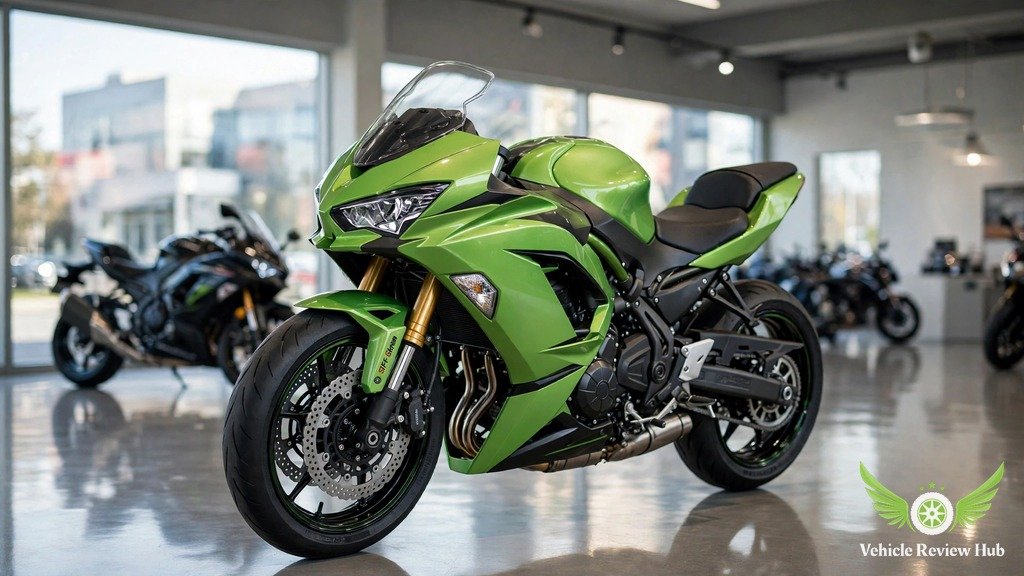
A new 2025 Ninja 650 KRT Edition ABS at $7,999 total — Columbia Powersports, stock E8495K, confirmed in November 2026 — undercuts the 2027 bike’s $8,784 delivered price by $785, the 2026 ABS’s $8,884 by $885, and every rival’s MSRP in this Kawasaki Ninja 650 comparison: the SV650 at $8,149, the GSX-8R at $9,199 and the R7 at $9,399. The framing matters: the KRT is not discounted below its own MSRP — it costs exactly its $7,999 MSRP, because the KRT paint was free in 2025, the same as the plain ABS. The $785 is the gap to the new bike’s delivered price, not a discount on the KRT, and this Kawasaki Ninja 650 comparison does not write “discounted $785” anywhere. The trade in this Kawasaki Ninja 650 comparison is the old bike: a 41 mm conventional fork, 2-piston calipers on petal discs and a 31.1-inch seat instead of the 2027 inverted fork and radial calipers. A buyer who does not need the 2027 front end should take the leftover and keep $785. The same free-paint pattern runs down the family — our Ninja 500 SE KRT Edition comparison shows the KRT paint cost nothing over the SE ABS.
| Bike | Price | Gap to the 2027 Ninja 650 delivered ($8,784) |
|---|---|---|
| 2025 Ninja 650 KRT ABS (new leftover) | $7,999 total | $785 cheaper — a gap, not a discount |
| 2023 Ninja 650 (new leftover) | $7,499 (Howell Cycle, stock 23M6619) | $1,285 cheaper — a three-year-old leftover, not used |
| 2026 Ninja 650 ABS (new) | $8,000 total (Shawnee Cycle Plaza, stock KAJ8858) | $784 cheaper |
| 2025 Ninja 650 ABS (used, 7,124 mi) | $7,999 after offers (Columbia, TN) | $785 cheaper — used money for new-leftover money is not a deal |
Note: every price in this Kawasaki Ninja 650 comparison table is a dated dealer figure from November 2026, labelled as the dealer’s own total, not as Kawasaki’s MSRP. The $7,499 2023 bike is a new leftover, never a used bike, and no used price band or resale percentage was verified.
Running Costs and Resale Value Compared
Running costs in this Kawasaki Ninja 650 comparison start with the service chart: oil and filter every 7,500 miles, plugs and air filter at the same interval, the valve check at 24,000 km, brake fluid every two years and coolant every three. The 650 takes 1.8 litres of oil and NGK CR9EIA-9 plugs — not the 500’s 2.3 litres or LMAR9G plugs — and the filter is Kawasaki 16097-0008, the same part the 500 uses. Fuel is MCN’s measured 49.44 mpg average over 9,500 miles, about 198 miles from the 4.0-gallon tank as a labelled calculation, not a tested range. No verified dealer cost figures exist, so no cost-per-year figure is printed here. The one verified used data point is the 2025 ABS at $7,999 after offers with 7,124 miles — the same money as a new leftover 2025 KRT ABS. For context, the SV650’s valve checks fall near 15,000 miles and the GSX-8R’s valve inspection is every 15,000 miles. Riders weighing the step up from a smaller bike should also read our Ninja 300 comparison and our Ninja 125 comparison.
Kawasaki Ninja 650 Comparison Verdict and US Alternatives
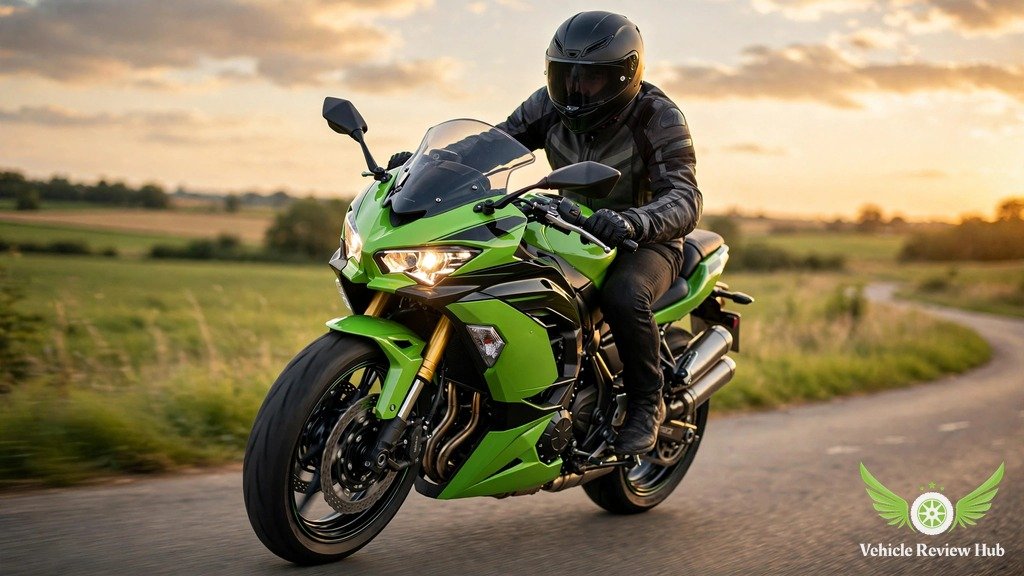
The verdict in this Kawasaki Ninja 650 comparison is simple: the 2027 bike keeps the 650’s comfort and adds a genuinely sharper front end — the first time in a decade the chassis has moved.
Verdict: Comfort With a Sharper Front
The 650’s case in this Kawasaki Ninja 650 comparison is comfort, price and history: the cheapest MSRP of the four at $8,099, the most comfortable riding position, the only 2027 front-end upgrade in this price band, and a twenty-year US sales record with just two recalls. Its weakness in this Kawasaki Ninja 650 comparison is power — 67 hp, the least of the four — and electronics: KTRC only, no IMU, no quickshifter, no cruise, no ride modes. The SV650 is the value rival at $8,749 delivered, the R7 is the supersport at $10,074 and the 8R is the performance pick at $9,949, and this Kawasaki Ninja 650 comparison puts the 650 between them. The buyer who wants the most comfort for the least money should take the 650; the buyer who does not need the 2027 front end should take the leftover 2025 KRT at $7,999 instead. The engine, the dash, the electronics and the weight are unchanged, and the bike is still the least powerful of the four — but the inverted fork and radial calipers are real, and they are what make the 2027 bike the best Ninja 650 yet.
RS 660 Is the Premium Pole
The Aprilia RS 660 sits above this Kawasaki Ninja 650 comparison as the premium pole: $11,849 for the base bike and $14,149 for the Factory on Aprilia’s own US store, which governs over the $11,749 and $13,999 figures in early-2026 sources. That is $3,750 more than the 2027 Ninja 650 on MSRP, and it buys 105 hp at 10,400 rpm and 52 lb-ft, a full IMU electronics suite and cruise control as standard. Aprilia gives a dry weight of 183 kg only, and no wet weight was verified. The RS 660 is for the rider who wants a genuine supersport with modern electronics; the 650 is for the rider who wants the comfortable everyday twin for $3,750 less. This Kawasaki Ninja 650 comparison ends where it began: the 650 is the cheapest, the most comfortable and the least powerful bike of its set, and the 2027 front end is the reason to buy the new bike rather than the leftover.
Kawasaki Ninja 650 Comparison Frequently Asked Questions
These are the questions buyers ask most when they cross-shop the Ninja 650 against its rivals, answered from the tests and the live listings in this Kawasaki Ninja 650 comparison. The short version is that the 650 is the cheapest bike of its four-bike set on MSRP and the least powerful of the four, and that split is the whole story.
Ninja 650 or Suzuki SV650 — which is cheaper?
It depends on which price you mean. On MSRP the Ninja 650 is cheaper at $8,099 against the SV650’s $8,149, a $50 gap. On delivered price the order flips: the SV650 lands at $8,749 with its $600 destination charge, while the 650 lands at $8,784 with its $685, so the SV650 is $35 cheaper out the door. One caveat: a $250 Suzuki freight surcharge exists in dealer pricing and is not part of the $600 destination charge, so a buyer should ask the Suzuki dealer whether it applies, since it can erase the SV650’s $35 edge on its own. This Kawasaki Ninja 650 comparison shows both columns in every table, because the sticker and the delivered price tell different stories.
Ninja 650 or Yamaha YZF-R7 — which should I buy?
The R7 is the supersport and the 650 is the comfort twin, and the gap is $1,300 on MSRP and $1,290 delivered: $9,399 plus $675 destination, or $10,074 delivered, against the 650’s $8,099 plus $685, or $8,784. The R7’s 689cc CP2 twin claims 72.4 hp at 8,750 rpm and 50.2 lb-ft at 6,500 rpm, against the 650’s 67.0 hp and 48.5 lb-ft, and its 2026 refresh brought a six-axis IMU, ride-by-wire, a gen-3 quickshifter, cruise control, ride modes and a 5-inch TFT. What the money does not buy is comfort: the R7’s clip-ons and 32.7-inch seat, 1.8 inches taller than the 650’s, make it the least comfortable bike in this Kawasaki Ninja 650 comparison. Buy the R7 for the most capable machine, and the 650 for the everyday twin.
Ninja 650 or Suzuki GSX-8R — which is better?
The 8R is the most powerful bike of the four and the 650 is the most comfortable, and the gap is $1,100 on MSRP and $1,165 delivered. The 2027 8R costs $9,199 plus a dealer-sourced $750 destination charge, or $9,949 delivered — $500 less than the 2026 8R at $9,699, with no mechanical changes since launch. Its 776cc twin claims 81.8 hp at 8,500 rpm and 57.5 lb-ft at 6,800 rpm, and Cycle World measured 72.75 hp at the rear wheel, against the 650’s 60.38 bhp from MCN. The 8R is also the heaviest bike of the four at 453 lb wet, and it has no IMU, no cornering ABS and no cruise control. This Kawasaki Ninja 650 comparison calls the 8R the performance pick and the 650 the comfort pick.
Is a leftover 2025 KRT Edition the best value?
Yes, while verified leftovers last, with one honest trade. A new 2025 Ninja 650 KRT Edition ABS at $7,999 total, at Columbia Powersports, stock E8495K, undercuts the 2027 bike’s $8,784 delivered price by $785 and undercuts every rival’s MSRP. The framing matters: the KRT is not discounted below its own MSRP, because the KRT paint was free in 2025 and the bike costs exactly its $7,999 MSRP. The $785 is the gap to the new bike’s delivered price, not a discount on the KRT. The trade is the old bike: a 41 mm conventional fork, two-piston calipers on petal discs and a 31.1-inch seat instead of the 2027 inverted fork and radial calipers. This Kawasaki Ninja 650 comparison also notes the cheapest new 650 found, a new 2023 leftover at $7,499 at Howell Cycle, stock 23M6619 — a three-year-old leftover, never a used bike.
What about the Aprilia RS 660?
The RS 660 sits above this Kawasaki Ninja 650 comparison as the premium pole: $11,849 for the base bike and $14,149 for the Factory on Aprilia’s own US store, which governs over the $11,749 and $13,999 figures in early-2026 sources. That is $3,750 more than the 2027 Ninja 650 on MSRP, and it buys 105 hp at 10,400 rpm and 52 lb-ft, a full IMU electronics suite and cruise control as standard. Aprilia gives a dry weight of 183 kg only, and no wet weight was verified. The RS 660 is for the rider who wants a genuine supersport with modern electronics; the 650 is for the rider who wants the comfortable everyday twin for $3,750 less. This Kawasaki Ninja 650 comparison ends where it began: the 650 is the cheapest, the most comfortable and the least powerful bike of its set, and the 2027 front end is the reason to buy the new bike rather than the leftover.
What does the Ninja 650 cost to run, and does it hold its value?
The service chart in this Kawasaki Ninja 650 comparison is short: oil and filter every 7,500 miles, plugs and air filter at the same interval, the valve check at 24,000 km, brake fluid every two years and coolant every three. The 650 takes 1.8 litres of oil and NGK CR9EIA-9 plugs, and the filter is Kawasaki 16097-0008. Fuel is MCN’s measured 49.44 mpg average over 9,500 miles, about 198 miles from the 4.0-gallon tank as a labelled calculation. No verified dealer cost figures exist, so no cost-per-year figure is printed in this Kawasaki Ninja 650 comparison. On resale, no used price band and no resale percentage were verified. The one verified used data point is a 2025 ABS at $7,999 after offers with 7,124 miles in Columbia, Tennessee — the same money as a new leftover 2025 KRT ABS, which is not a deal.