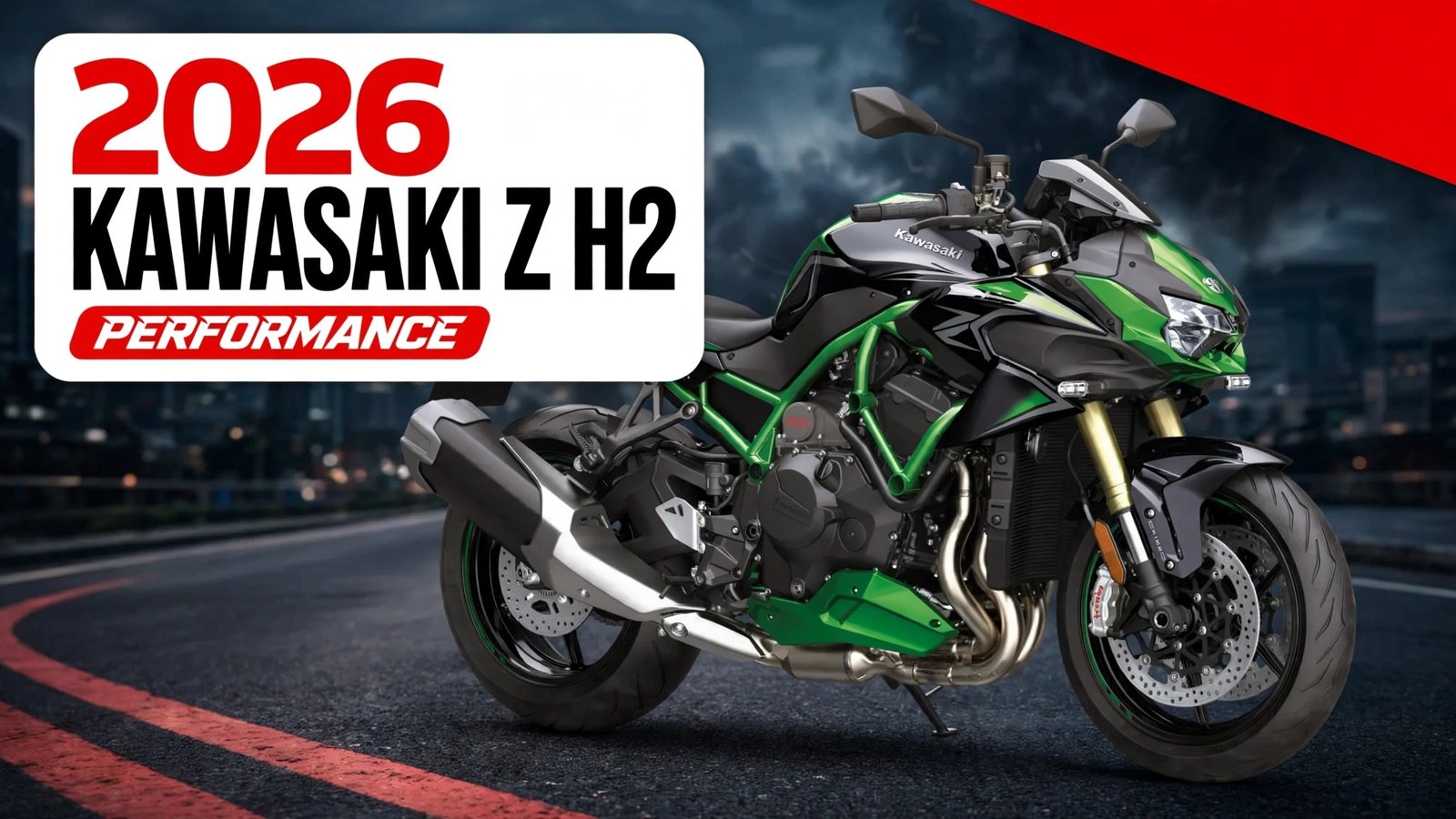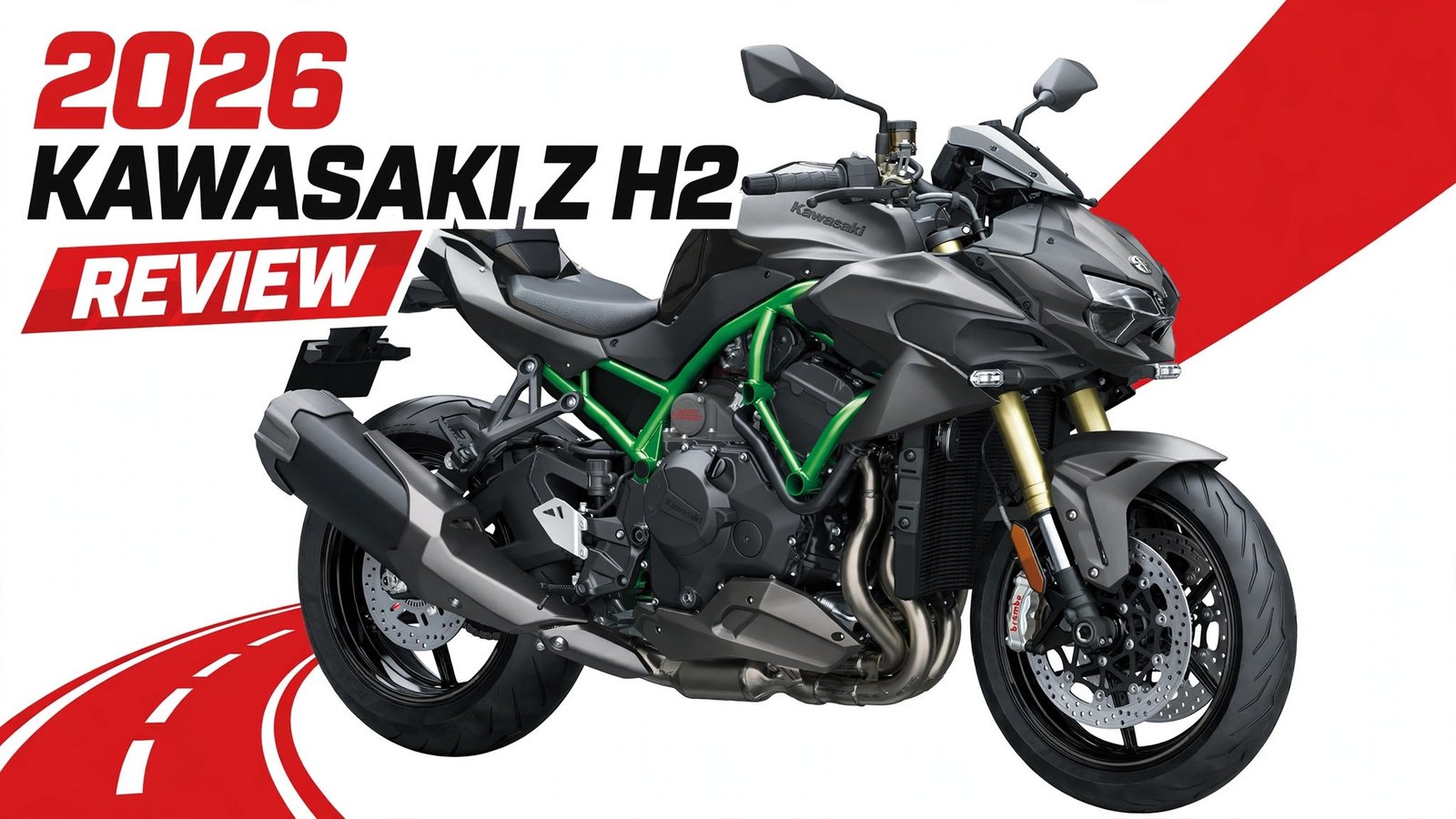
Kawasaki did something no other Japanese maker dared to do in the naked class: it took the supercharged 998cc four from the Ninja H2, stripped the fairing off, fitted a wide flat handlebar, and sold the result as the Z H2. Claimed output is 197.1 hp, the launch price was $17,000, and nothing else in the class arrives with a blower. This Kawasaki Z H2 review covers what changed across the model years, what the base bike and the SE really cost in the USA, how the supercharged engine behaves on the road, and where the bike falls short.
The short version is that the Z H2 is a bargain hyper-naked with a catch. The base bike ended after 2023, so only the SE is sold new now, at $21,999 for 2026. In this Kawasaki Z H2 review you will find the verified price ladder, the full specification sheet, the brake-calibre correction most listings get wrong, and an honest verdict on whether a 197.1 hp supercharged naked makes sense as a road bike.
Kawasaki Z H2 Overview and Model-Year Updates
This Kawasaki Z H2 review starts with the model run, because the used market and the new market are now two different bikes. The bike at the centre of this Kawasaki Z H2 review was revealed at the Tokyo Motor Show in October 2019 and launched to the international press in February 2020 at Las Vegas Motor Speedway. It is the naked sibling of the Ninja H2, sharing the supercharged 998cc inline-four in an exposed trellis frame, but with upright Z ergonomics, a wide flat bar, and a riding position built for the road rather than the track.
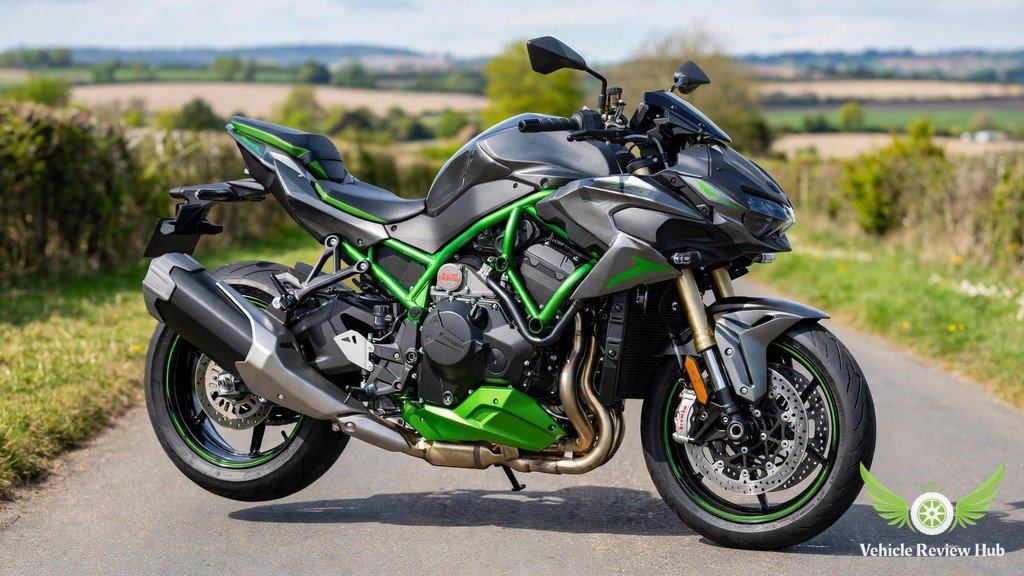
Cycle News rode the 2020 base bike at its February 2020 press launch, first on the bankings of Las Vegas Motor Speedway and then on the desert roads of the Valley of Fire, and the four-minute review below is the best short introduction to this Kawasaki Z H2 review: in the presenter’s words, a bike this fast should not be this easy to ride.
Base Bike Ended in 2023
The base Z H2 was sold in the USA for four model years, 2020 through 2023, and then it stopped. Kawasaki’s own spec sheets exist for the base for those four years only. That matters for buyers: no new base-model Z H2 exists at any price. As this Kawasaki Z H2 review explains in the price section, the last base bike listed at $18,500 for 2023, or $18,960 with its $460 destination charge. Anyone shopping for a base bike today is shopping used, and this Kawasaki Z H2 review treats the 2020 to 2023 bikes as the whole pool. No 2024, 2025 or 2026 base model exists in any US source, and no 2027 Z H2 of any trim exists either, so a listing that claims one should be treated with suspicion.
Only SE Is Sold New Now
Since 2024 the SE has been the only Z H2 sold new in the USA. For buyers using this Kawasaki Z H2 review as a shopping guide, that is the single most important fact: the new-bike choice is the SE or nothing. The SE carries the same 197.1 hp engine as the base, and adds KECS semi-active suspension with Skyhook damping, a standard up and down quickshifter, and SE livery. The 2024 SE listed at $21,300, the 2025 SE at $21,700 at launch and later $21,999, and the 2026 SE at $21,999, all per the Motorcycle.com database. The SE premium over the base was $2,700 in 2021 and $2,200 in 2022 and 2023.
Kawasaki Z H2 Engine and Specifications
The engine is where any Kawasaki Z H2 review has to start, because it is the whole point of the bike. A 998cc liquid-cooled inline-four with a centrifugal supercharger sits in a trellis frame, the only forced-induction engine in the hyper-naked class. The claimed figures are 197.1 hp at 11,000 rpm and 101.1 lb-ft at 8,500 rpm, and the bike underneath them is a conventional naked: six-speed dog-ring gearbox, assist and slipper clutch, sealed 525 chain, ride-by-wire throttle, full electronics suite.

197 hp, Gear-Driven Blower
The supercharger is a centrifugal unit driven by a planetary gear train off the crankshaft, with the impeller spinning up to 9.2 times crank speed. There is no belt in the drive, and the boost arrives with the low-down and midrange punch testers keep coming back to. A Kawasaki Z H2 review that calls it a 197 hp bike should say where the number comes from: 197.1 hp at 11,000 rpm is the Motorcycle.com database figure for every trim and year from 2020 to 2023, while Kawasaki’s own sheets print “Maximum Torque 101.0 lb-ft” and no power line. The database torque figure is 101.1 lb-ft at 8,500 rpm, and the 0.1 lb-ft gap is a rounding artefact. One figure to avoid is the launch-press line that put the power peak at 10,500 rpm and the torque peak at 9,500 rpm, printed by Cycle News and Ultimate Motorcycling in their 2020 first rides: those rpm figures contradict the database and the sheets, and Cycle World’s own 2020 buyers-guide page repeats the same error. The track-only Ninja H2R uses the same supercharged family in a far more extreme state.
No Belt, No Intercooler
Two things the Z H2 does not have are a blower belt and an intercooler, and both absences are deliberate. The gear drive means there is no belt to service or replace, and Kawasaki says the supercharger’s high efficiency and minimal heat gain made an intercooler unnecessary. The engine is a 998cc unit with a 76.0 by 55.0 mm bore and stroke and an 11.2:1 compression ratio, breathing through 36 mm Keihin throttle bodies on the 2020 bike and 40 mm bodies from 2021 onward — the only meaningful engine revision this Kawasaki Z H2 review found across the run, and it arrived with the SE. Our Kawasaki Z H2 performance guide covers the verified dyno spread, top speed and mileage.
| Specification | Kawasaki Z H2 (all years) |
|---|---|
| Engine | 998cc liquid-cooled DOHC supercharged inline-four, 4 valves per cylinder |
| Claimed power | 197.1 hp at 11,000 rpm (Motorcycle.com database; Kawasaki sheets print no power line) |
| Claimed torque | 101.1 lb-ft at 8,500 rpm (sheets print 101.0 lb-ft, no rpm) |
| Bore x stroke / compression | 76.0 x 55.0 mm / 11.2:1 |
| Transmission / final drive | 6-speed dog-ring, assist and slipper clutch / sealed 525 chain, slack 20-30 mm |
| Throttle bodies | 36 mm Keihin (2020), 40 mm (2021 onward) |
| Seat height / wheelbase | 32.7 in / 57.3 in |
| Ground clearance / fuel capacity | 5.5 in / 5.0 gal |
| Tyres | 120/70-17 front, 190/55-17 rear (Pirelli Diablo Rosso III) |
| Curb weight | Base 527.0 lb (2020/2021), 529.2 lb (2022/2023); SE 531.4 lb all years |
| Warranty | 12 months Limited |
Note: This Kawasaki Z H2 review uses the Motorcycle.com database for the 197.1 hp claim because Kawasaki’s own spec sheets print no maximum-power line; the 101.0 lb-ft sheet figure and the 101.1 lb-ft database figure differ only by rounding.
Kawasaki Z H2 Price and Market Availability
Price is where this Kawasaki Z H2 review gets practical, because the numbers in circulation are often wrong in the same two ways: the launch price gets quoted as $17,500, and the destination charge gets carried from one year to another. The launch price was $17,000 for the 2020 base bike, and the destination charge was $410 in 2020 and 2021, $430 in 2022 and $460 in 2023; every delivered price below adds the charge for its own year.

Kawasaki Z H2 Price in the USA: $18,500 (2023)
The 2023 base bike listed at $18,500, an MSRP, not a delivered price: with its $460 destination charge it cost $18,960 before tax and fees. This Kawasaki Z H2 review prices every year the same way, MSRP plus that year’s own destination charge, because the charge moved every year. The 2023 SE listed at $20,700, or $21,160 delivered. The cheapest way into a Z H2 today is a used 2020 to 2023 base bike, since no new base bike exists, while the only new Z H2 in this Kawasaki Z H2 review is the 2026 SE at $21,999, or $22,839 delivered.
Launch Was $17,000, Not $17,500
The launch-price correction is one of the most useful facts in this Kawasaki Z H2 review, because $17,500 appears in listing after listing as the launch price, and it is not. Kawasaki’s own 2021 lineup press release prints $17,500 as the 2021 base price, and Cycle World’s 2020 buyers-guide page, quoted in this Kawasaki Z H2 review, prints “Price: $17,000” for the launch bike. The $17,000 launch price plus the $410 destination charge made a 2020 Z H2 $17,410 before tax, a remarkable figure for a 197.1 hp supercharged naked. The Cycle World 2020 buyers-guide page confirms the $17,000 launch price.
| Year | Trim | MSRP | Destination | Delivered |
|---|---|---|---|---|
| 2020 | Base | $17,000 | $410 | $17,410 |
| 2021 | Base | $17,500 | $410 | $17,910 |
| 2021 | SE | $19,700 | $410 | $20,110 |
| 2022 | Base | $18,000 | $430 | $18,430 |
| 2022 | SE | $20,200 | $430 | $20,630 |
| 2023 | Base | $18,500 | $460 | $18,960 |
| 2023 | SE | $20,700 | $460 | $21,160 |
| 2024 | SE | $21,300 | Not verified | Not printed |
| 2025 | SE | $21,700 at launch, later $21,999 | $815 vs $840 (conflict) | Not settled |
| 2026 | SE | $21,999 | $840 | $22,839 |
Note: This Kawasaki Z H2 review labels the 2024 to 2026 SE prices as Motorcycle.com database figures, since no Kawasaki USA spec-sheet PDF was obtained for those years. The 2024 SE destination charge was not found anywhere, so no 2024 SE delivered price is printed, and the 2025 destination charge is in conflict ($815 per the Motorcycle.com compare page versus $840 printed alongside the later $21,999 price), so no 2025 SE delivered price is printed as settled.
Kawasaki Z H2 Design, Features and Technology
This Kawasaki Z H2 review now turns to the hardware around the engine, starting with what the bike does not have: no single-sided swingarm, no analogue dials, no belt-driven blower. The Z H2 carries a TFT colour dash from launch, a conventional double-sided swingarm, and a gear-driven supercharger, and any description that borrows single-sided or analogue details from another bike is describing a different machine.

Brakes Are M4.32, Not Stylema
The brakes are the one place where most listings get the Z H2 wrong, and this Kawasaki Z H2 review carries the correction in full. The front brakes are dual 320 mm discs on every year and both trims, with Brembo M4.32 calipers on the base bike every year and on the SE from 2022. The single exception is the 2021 SE, which wore Brembo Stylema calipers: the 2021 SE sheet says so, and the 2022 and 2023 SE sheets both say M4.32, corroborated by the MotorcycleDB year-to-year difference. The rear brake is a single disc with a Nissin caliper, 260 mm on the 2020 base, all SEs and the 2023 base, and 250 mm on the 2021 and 2022 base bikes. The front master cylinder is a Brembo radial unit. A buyer using this Kawasaki Z H2 review to check a used 2021 SE should therefore expect Stylema calipers, any other year should show M4.32 calipers, and a seller who claims Stylema on a 2022 or 2023 SE has the listing wrong.
Tank Is 5.0 Gallons
The fuel tank holds 5.0 gallons on every year and both trims, per Kawasaki’s own spec sheets, and it is shaped for the rider as much as for capacity: narrowed below and behind so the knees tuck in, as Cycle World noted at launch. The tank sits between a wide flat handlebar and a 32.7-inch seat, over a 57.3-inch wheelbase with 5.5 inches of ground clearance. The electronics fill out the rest of the package in this Kawasaki Z H2 review: Integrated Riding Modes (Sport, Road, Rain, Rider), KCMF cornering management, KTRC traction control, KLCM launch control, KEBC engine-brake control, KIBS cornering ABS on a Bosch IMU, an up and down quickshifter, cruise control, and the TFT colour dash with RIDEOLOGY connectivity. Colours ran from the 2020 base in Metallic Spark Black and Metallic Graphite Gray, through the 2021 and 2022 SE in Golden Blazed Green and Metallic Diablo Black, to the 2023 SE in Metallic Matte Graphenesteel Gray and Ebony; the base was never sold in green.
| Equipment | Z H2 Base (2020-2023) | Z H2 SE (2021-2026) |
|---|---|---|
| Suspension | Conventional fully adjustable fork and shock | KECS semi-active suspension with Skyhook damping |
| Front calipers | Brembo M4.32, dual 320 mm discs | Brembo Stylema (2021 only), M4.32 (2022 onward) |
| Quickshifter | KQS up and down quickshifter | KQS up and down quickshifter, standard |
| Curb weight | 527.0 lb (2020/2021), 529.2 lb (2022/2023) | 531.4 lb all years |
| Signature colour | Metallic Spark Black / Metallic Graphite Gray (2020) | Golden Blazed Green (2021/2022), Graphenesteel Gray (2023) |
Note: The SE’s equipment differences in this Kawasaki Z H2 review are suspension, quickshifter fitment and livery, plus the 2021-only Stylema calipers. Both trims share the same 197.1 hp supercharged engine, the same electronics suite, the same 32.7-inch seat and the same 5.0-gallon tank.
Kawasaki Z H2 Riding Experience and Comfort
The riding experience is where the Z H2 earns its reputation, and this Kawasaki Z H2 review leans on the testers who rode it rather than on any invented ride. Their consensus: a naked litre bike with genial open seating, a wide low-rise handlebar, a fat tank narrowed for the knees, a modestly padded seat, and then a very large amount of power. Cycle World put it plainly at the launch: “The Z H2 presents as expected: a naked literbike with genial open seating and cockpit dimensions; a wide, low-rise handlebar; a fat fuel tank (narrowed below and behind for the knees, thanks much); and a modestly padded seat. And. Huge. Freaking. Power!”

Best Naked Bike of 2020
The award behind this heading in this Kawasaki Z H2 review belongs to Motorcycle.com, which named the 2020 Z H2 its Best Naked Motorcycle of 2020, with the Ducati Streetfighter V4 as runner-up. It is Motorcycle.com’s MOBO award, and it should always be named as such, never as a generic honour. Motorcycle.com’s own first-ride score was 90.25 out of 100. MCN rates the base bike 4 out of 5 and the SE 5 out of 5, calling the Z H2 “the most powerful naked we’ve ever swung a leg over… for now” in its 2020 review, and MCN also ran a long-term test. The Motorcycle.com Best Naked Motorcycle of 2020 page and the MCN Z H2 review both stand as the primary sources for those verdicts.
Riding Position and Comfort Over Longer Distances
The riding position in this Kawasaki Z H2 review is upright and open, with a wide flat bar, a 32.7-inch seat and a 5.0-gallon tank, and the long-distance assets are the upright position itself and the cruise control, which the 2020 Ducati Streetfighter V4 lacked. The limits are the ones every tester names: a firm seat and wind exposure at speed. No publication has published a measured highway tank range for the Z H2, so this Kawasaki Z H2 review prints no range figure: the only observed economy figures are Motorcyclist’s 40 to 45 mpg on the freeway and 28 to 30 mpg on back roads. Our Kawasaki Z H2 comparison puts the bike against the Streetfighter V4, the Aprilia Tuono V4 Factory and the Yamaha MT-10 SP on price and power for US buyers.
Kawasaki Z H2 Review: Pros, Cons and Verdict
The verdict in this Kawasaki Z H2 review is straightforward: the bike is the cheapest way into supercharged performance on two wheels, and its weaknesses are weight, thirst and a firm seat rather than anything wrong with the engine. A used 2020 to 2023 base bike is the value buy, and a new 2026 SE at $21,999 is the only new option. Buyers should check both recall campaigns by VIN before purchase, as our Kawasaki Z H2 reliability guide explains, and budget for the supercharger oil-screen replacement at 24,000 km. Underneath those caveats is a 197.1 hp naked with a full electronics suite, cruise control and a 5.0-gallon tank — nothing else in the class offers forced induction at anything like the price.

Main Advantages and Limitations of the Kawasaki Z H2
The advantages in this Kawasaki Z H2 review start with the engine: a supercharged 998cc four with 197.1 hp and 101.1 lb-ft, low-down torque that testers describe as dramatically faster than the Ducati Streetfighter V4 in a straight line, and a gear-driven blower with no belt to service and no intercooler. The base bike’s electronics are complete — cornering ABS, traction control, launch control, engine-brake control, quickshifter and cruise control — and the SE adds semi-active suspension. The 5.0-gallon tank is the largest in its rival set, the upright position suits real roads, and the $17,000 launch price made it a bargain that still shapes used values. The limitations are equally clear: the SE weighs 531.4 lb, the heaviest of its rivals, and the base is 527.0 to 529.2 lb depending on year. Fuel economy is 40 to 45 mpg on the freeway and 28 to 30 mpg on back roads by Motorcyclist’s test, and Cycle News recorded 22 mpg on an SE under hard riding. The seat is firm, wind protection is nil, and two recalls name the bike: NHTSA campaign 21V-593 for an oil-pressure relief valve fault, covering 324 Z H2 bikes, and campaign 22V-912 for a camshaft-chain tensioner fault, covering 1,176 Z H2 and SE bikes combined, both repaired free at the dealer. The supercharged sport-tourer sibling in our Ninja H2 SX review offers the same blower with a fairing and luggage.
Destinations Missing, 2020 to 2022
The heading above is out of date, and this Kawasaki Z H2 review corrects it in the first sentence: the destinations are not missing at all. They were found for every year in the Motorcycle.com spec database, one page per year and trim: $410 for 2020 and 2021, $430 for 2022 and $460 for 2023. Delivered prices in this Kawasaki Z H2 review therefore run from $17,410 for the 2020 base bike to $21,160 for the 2023 SE, and the 2026 SE costs $22,839 delivered with its $840 destination charge. Two gaps remain and are printed honestly: the 2024 SE destination charge was not found anywhere, so no 2024 SE delivered price is printed, and the 2025 charge is in conflict at $815 per the Motorcycle.com compare page versus $840 alongside the later $21,999 price, so no 2025 SE delivered price is printed as settled. A buyer who sees a delivered price for a 2024 or 2025 SE should ask which destination charge it uses.
Kawasaki Z H2 Review FAQs
The questions below cover the facts buyers ask about most in this Kawasaki Z H2 review: prices, the launch-price correction, the base and SE differences, the supercharger, the seat height, and the 2020 award.
How much does the Kawasaki Z H2 cost in the USA?
The base bike launched at $17,000 in 2020 ($17,410 delivered) and ended after 2023 at $18,500 ($18,960 delivered), as this Kawasaki Z H2 review records. Only the SE is sold new now: $21,999 MSRP for 2026, $22,839 delivered.
Was the Kawasaki Z H2 really launched at $17,000?
Yes. Kawasaki’s own 2021 lineup press release and Cycle World’s 2020 buyers-guide page both print $17,000 for the 2020 bike. The $17,500 figure is the 2021 base price, not the launch price, and this Kawasaki Z H2 review prints the correction because listings so often get it backwards.
What is the difference between the Z H2 and the Z H2 SE?
The SE adds KECS semi-active suspension with Skyhook damping, a standard up and down quickshifter, and SE livery. The 2021 SE alone also wore Brembo Stylema front calipers; the 2022 and 2023 SE reverted to the base bike’s M4.32 calipers. Both bikes share the same 197.1 hp supercharged engine.
Does the Z H2 have a supercharger?
Yes. This Kawasaki Z H2 review confirms the detail: a centrifugal supercharger is driven by a planetary gear train off the crankshaft, with the impeller spinning up to 9.2 times crank speed. There is no belt and no intercooler: Kawasaki says the blower’s high efficiency and minimal heat gain made an intercooler unnecessary.
What is the seat height of the Kawasaki Z H2?
The seat height is 32.7 inches on every year and both trims, per Kawasaki’s own spec sheets. The wheelbase is 57.3 inches, ground clearance is 5.5 inches, and the fuel tank holds 5.0 gallons. A Kawasaki Z H2 review that quotes any other seat height is quoting a different bike.
Was the Z H2 named Best Naked Bike of 2020?
Yes, by Motorcycle.com, which named the 2020 Z H2 its Best Naked Motorcycle of 2020, ahead of the Ducati Streetfighter V4 as runner-up. MCN rates the base bike 4 out of 5 and the SE 5 out of 5.