Yamaha WR450F reliability is why this big-bore enduro keeps its value on the used market. It is an off-road-only bike with a high-compression 449cc four-stroke, yet owner reports and long-term tests describe an engine that holds valve clearances, survives triple-digit hours, and rarely produces a surprise bill. It is not maintenance-free; Yamaha WR450F reliability comes from a demanding rhythm: small oil capacity changed often, valve checks done cold, and wear items replaced before they fail.
The WR450F is not a street bike or a dual-sport, so none of the advice here uses road mileage as the service clock. Service is counted in races, kilometres, and riding hours, off-highway rules vary by state, and California rules have changed, so run a VIN check before buying. For a full model overview, read the WR450F review alongside this guide to Yamaha WR450F reliability.
Yamaha WR450F Reliability Overview
Yamaha WR450F reliability rests on a proven 449cc reverse-cylinder engine, a five-speed wide-ratio trail gearbox, and a chassis shared with Yamaha’s motocross programme, tuned softer for enduro. The evidence is a pattern, not a single test: magazine bikes, used-buyer guides, and owner reports all point the same way, and Yamaha WR450F reliability shows up in all of them as clean oil, clean filters, and honest hour counts.
Bulletproof Reputation, Owner Reports and a 30-Day Factory Warranty
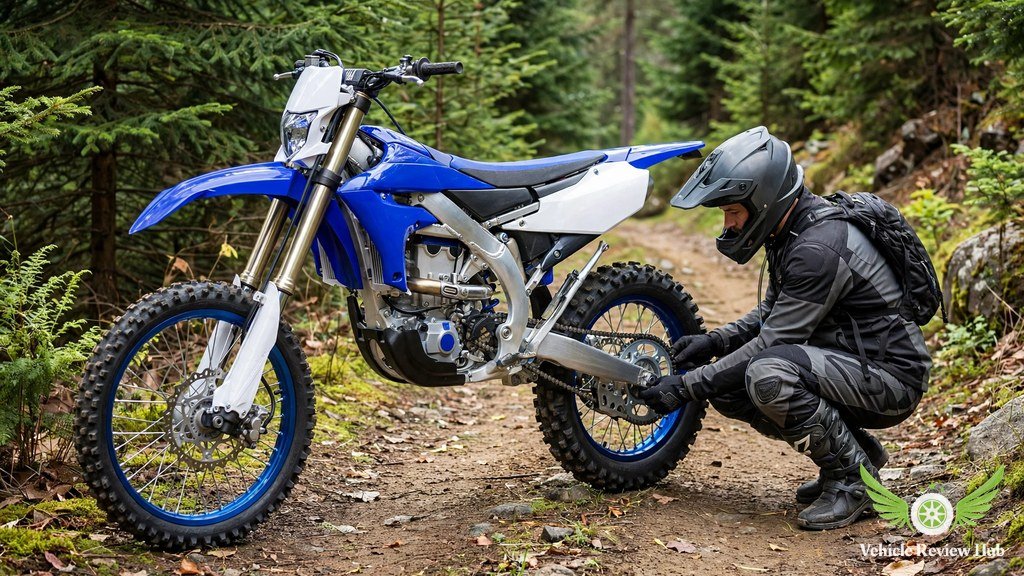
The “bulletproof” label follows the WR450F around for a reason: owners routinely report years of hard trail use with little more than consumables, and Yamaha WR450F reliability is one of the first things sellers mention in used listings. Australasian Dirt Bike Magazine’s used-bike guide to the 2021–2024 bike calls it a reliable do-it-all machine, popular from weekend riders to farm work horses, as described in their 2021–2024 WR450F used-bike guide. That reputation needs one honest qualifier, and Yamaha WR450F reliability buyers should know it: the factory warranty is only 30 days limited. A current 2027 dealer listing states “Warranty: 30 Day (Limited Factory Warranty)” plainly, so a used WR450F is effectively bought as-is and the service file matters more than any warranty promise. Yamaha WR450F reliability is therefore a maintenance story, not a warranty story: the bike rewards owners who service it on schedule and punishes owners who stretch intervals.
Long-term magazine use backs the reputation: Yamaha WR450F reliability shows up as setup notes about suspension and mapping, not mechanical failure.
How Riding Hours, Maintenance History and Previous Use Affect Reliability
Hours tell the truth that road mileage cannot on a dirt bike. A 100-hour bike with oil changes every 10–15 hours and a valve check on record beats a 40-hour bike with a clogged filter and seasonal oil changes. Dust is the enemy of Yamaha WR450F reliability: a poorly sealed or neglected air filter lets grit into the engine, showing up as valve-seat wear, cylinder scoring, and fast-blackening oil. Previous use shapes what to inspect: a former race bike may have perfect maintenance and a tired clutch, while a casual trail bike may have low hours and long service gaps. None of this makes Yamaha WR450F reliability a gamble; it makes the pre-purchase inspection your most valuable hour, and the buying guide covers that inspection in full.
Yamaha WR450F Common Problems and Wear Items
For Yamaha WR450F reliability, the wear list is short, familiar, and cheap to catch early: the small oil supply, the chain and sprockets, wheel and linkage bearings, radiators, and small electrical parts. None is a defect pattern; all are the normal cost of riding a 450 hard off-road.
Small Oil Capacity and Frequent Oil Changes Explained
The single most important number for Yamaha WR450F reliability is the oil capacity: roughly 0.8 litres on the 2024 bike, with older bikes listed at 0.9 litres. That small supply for a 450cc engine is exactly why the interval is so short: contamination builds fast and there is little reserve when oil degrades, so Yamaha WR450F reliability depends on changing oil before it wears out rather than on a calendar date. The widely used guideline, repeated in manual FAQ material and oil-change guides for 2012-on bikes, is an oil change every 10–15 hours or every 1,000 kilometres, filter included. Treat that as the owner and shop translation of the manual’s race-based chart, not a direct quotation, and shorten it further in sand, mud, or racing use. For Yamaha WR450F reliability, fresh oil is the cheapest insurance on a high-compression 450, and black, thin oil at inspection has already told you how the bike was treated.
Chain, Sprockets, Wheel Bearings, Radiators and Electrical Checks
The chain and sprockets wear fastest on a 450: torque stretches chains and hooks sprocket teeth, and a neglected chain then eats the countershaft sprocket and guide. Check chain slack against the manual’s 48–58 mm range, look for hooked sprocket teeth, and replace chain and sprockets as a set. A sealed O-ring chain is standard, but it still needs cleaning and lubrication for Yamaha WR450F reliability. Wheel, linkage, and steering-head bearings are the quiet wear items, and the WR450F has a known weak spot here: Australasian Dirt Bike’s used-bike guide warns that linkage and swingarm bearings do not come heavily greased from the factory, so they commonly seize after a few years without proper maintenance. Lift each wheel, feel for play, and grease the linkage on schedule.
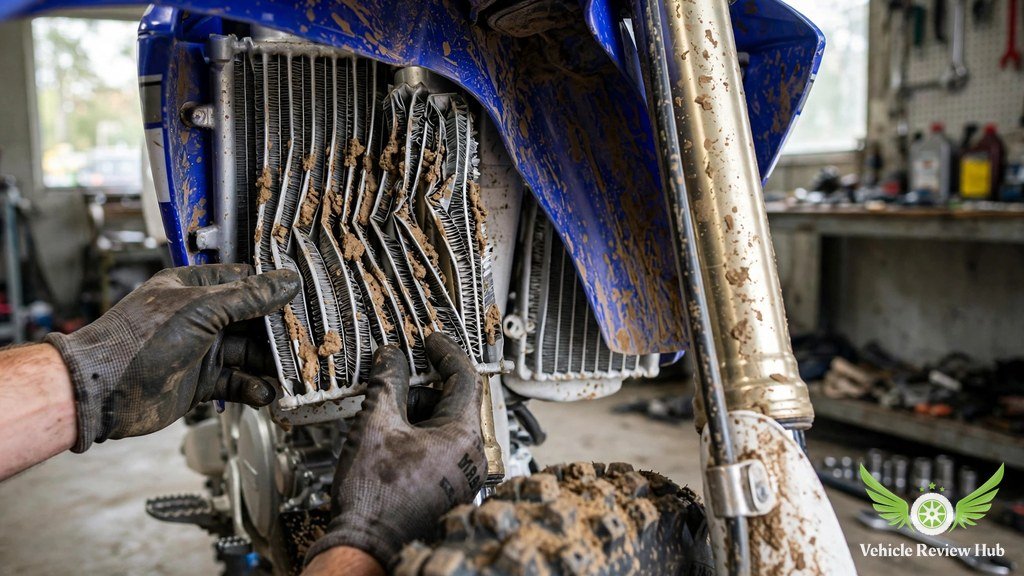
Radiators sit out front and take hits: a bent radiator or flattened fins restrict airflow, and on slow trails normal warmth becomes overheating. Check both radiators for bent fins, seam leaks, cracked louvers, and coolant stains pointing to a slow leak. Test the battery under load, check terminals for corrosion, confirm brisk starter spin, and check lights, meter, and fan. The same used-bike guide notes the WR has a reputation for going through starter motors, so a slow or reluctant starter on a used bike is a bargaining point, not a reason to panic — but it is a reason to budget for Yamaha WR450F reliability work before the first trail day.
Yamaha WR450F Maintenance Schedule and Servicing
Yamaha WR450F reliability is built on a race-based schedule. For Yamaha WR450F reliability, it prevents two common mistakes: servicing by road miles, which do not apply to a competition enduro, and quoting the manual as if it listed riding hours. The chart is race-based; the hour figures owners use are a translation.
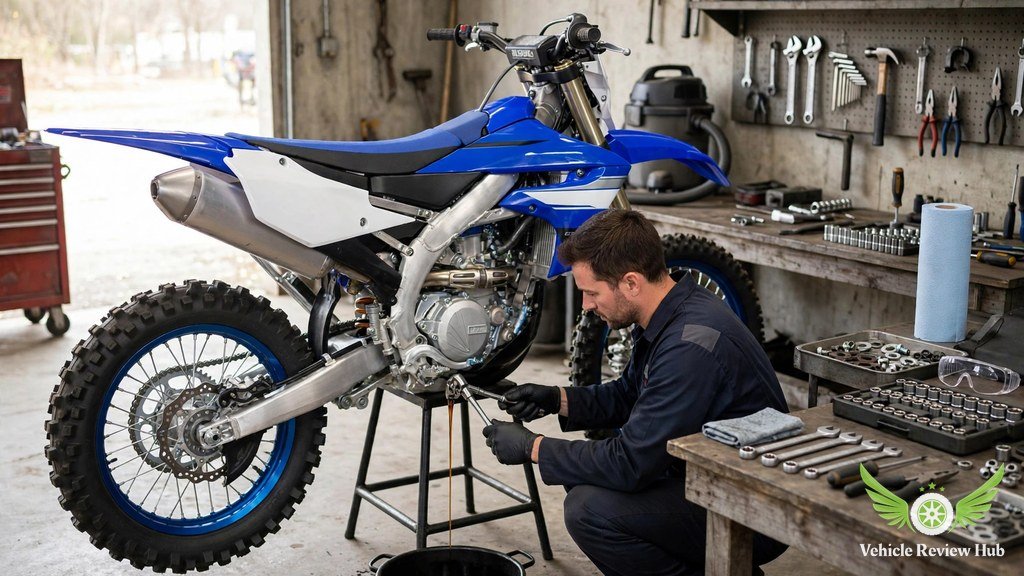
Race-Based Manual Schedule: Oil After Break-In and Every Race
The service manual maintenance chart uses columns headed after break-in, every race, every third race (or 500 km), every fifth race (or 1,000 km), and as required. Engine oil and the oil filter sit at the frequent end of that chart: oil after break-in and every race, with the filter replaced alongside it. The manual notes the schedule is a general guide, with weather, terrain, and usage altering intervals. The owner and shop translation is an oil and filter change roughly every 10–15 hours or every 1,000 kilometres for a trail bike, and every race for a competition bike. Those hour figures are the widely used conversion of the manual’s race-based pattern, not a direct quotation. For Yamaha WR450F reliability, the practical rule is simple: counting races, follow the chart; counting trail hours, follow the 10–15 hour translation and never let a busy season push oil to 30 hours.
The rest of the chart fills in around the oil changes: the air filter is cleaned and lubricated on the frequent cycle and replaced as required, the spark arrester is cleaned every six months, coolant is replaced every two years, brake fluid every year, and the drive chain is lubricated with slack checked constantly at 48–58 mm. None of this is complicated, which is the point for Yamaha WR450F reliability: the schedule is short, frequent, and cheap, and the bikes that last are the ones whose owners follow it.
Valve Checks Every Third Race or 500 km and Piston Inspection
The widely used schedule for valves is a check every third race or 500 km, as the manual chart’s third-race column sets out. The service manual gives cold clearances of 0.10–0.15 mm intake and 0.20–0.25 mm exhaust, engine cool and piston at top dead centre on compression, as listed in the valve clearance specifications. Reassuringly, those checks rarely find anything wrong, which is why Yamaha WR450F reliability surprises new owners: titanium valves in a well-filtered engine hold clearances for a long time. Workshops commonly pair piston and ring inspection with the major-service visit at the same rhythm, measuring anything tired rather than rebuilding on a fixed schedule. For Yamaha WR450F reliability, measure at the check, replace what measures out, and do not rebuild an engine that is still in spec.
The video below walks through a quick oil change on a 2012-on WR450F, including the 1,000 km or 10–15 hour rhythm the job follows.
Yamaha WR450F Tires, Brakes and Suspension Maintenance
Yamaha WR450F reliability extends beyond the engine to the parts that touch the ground and stop the bike. These parts wear visibly, and a used-bike inspection pays off fastest here for Yamaha WR450F reliability, because worn parts cost less than engine work.
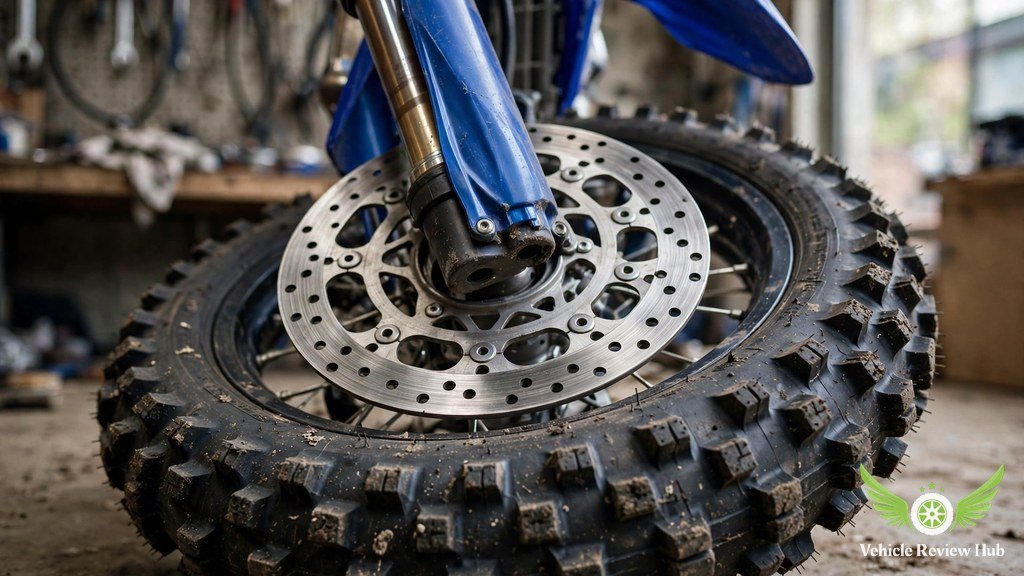
Tire Condition, Pressure, Tread Wear and Replacement
Knobby tires wear fast under a 450, and the wear pattern tells you how the bike was ridden — useful evidence for Yamaha WR450F reliability. Check tread depth, torn knobs, sidewall cuts, and age cracking, and replace tires worn to the indicators. Pressure matters as much as tread: too high and the bike skitters, too low and you risk pinch flats and rim damage. A widely quoted off-road guideline is roughly 12–15 psi front and 10–12 psi rear, adjusted for terrain rather than treated as a factory figure. Current US bikes wear Dunlop Geomax AT82 tires in 80/100-21 front and 120/90-18 rear on the 2027 listing, while the 2024 US spec sheet lists Geomax MX33F and MX33 — check your year’s fitment before ordering, because Yamaha WR450F reliability includes ordering the right rubber first time.
Brake Pads, Brake Discs, Fork Seals and Rear Suspension Checks
Brake pads are a consumable on a 258 lb bike ridden hard: check pad thickness, look for scored discs, and feel for a spongy lever pointing to air or a tired cylinder. Brake size varies by year, so quote your year when ordering: the 2024 US spec sheet lists 270 mm front with a 240 mm rear, while the 2027 dealer listing lists 270 mm front with a 220 mm rear. Fork seals are the other regular job: oil mist or drips should be handled promptly before dirt scores the tubes. Check the rear shock for leaks, test linkage for play, and service suspension on hours. The performance figures cover how the KYB suspension behaves on the trail, but the maintenance point is simpler: clean tubes, fresh oil, honest intervals, and greased linkage bearings keep Yamaha WR450F reliability intact at the chassis end.
Yamaha WR450F Maintenance and Ownership Costs
Yamaha WR450F reliability keeps ownership costs predictable because expensive failures are rare and routine costs are small and regular. Budget by separating seasonal consumables from larger jobs; every price below is a planning estimate, not a quote.
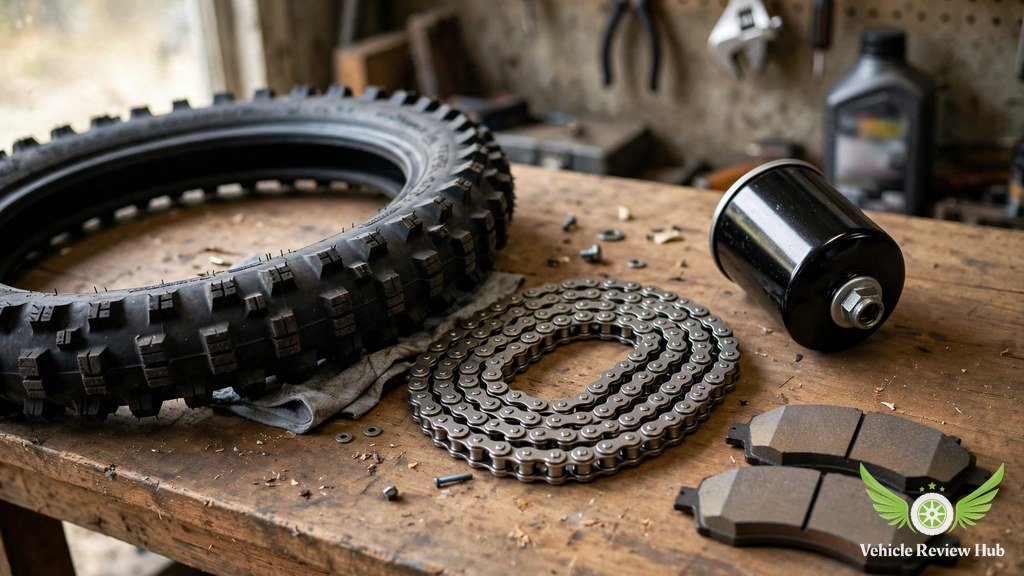
Fuel, Oil, Air Filters, Tires and Replacement Parts
Fuel is the smallest line in the budget. Yamaha publishes no miles-per-gallon figure, and the tank holds 2.0 gallons on current US bikes, so trail range is a planning exercise — and for Yamaha WR450F reliability, a 450 ridden hard drinks fuel and oil together, so both need watching.
| Wear item | Typical interval | Planning estimate, parts only |
|---|---|---|
| Engine oil + filter | Every race / 10–15 hours trail | $25–$50 |
| Chain + both sprockets | As wear dictates, often 40–80 hours | $150–$250 |
| Tires (each) | As tread dictates | $100–$180 |
| Brake pads (per end) | As thickness dictates | $30–$60 |
| Fork seal kit + fork oil | At suspension service | $40–$90 |
| Piston kit | When inspection says so | $200–$350 |
| Season total, typical trail rider | Per riding season | A few hundred dollars in parts |
Parts availability is a strength for Yamaha WR450F reliability: the WR450F shares much engine architecture with the YZ450F family, and dealer and aftermarket support is deep. One caution: do not order YZ450F parts blindly — the WR’s wide-ratio gearbox, lights, meter, fan, and suspension settings differ, so confirm part numbers. The buying guide covers used prices and inspection.
Repair Expenses, Parts Availability and Long-Term Ownership Costs
Repair expenses stay low when the schedule above is followed, because the jobs that cost real money — valve work, top-end rebuilds, and bottom-end work — are rarely needed early — the financial side of Yamaha WR450F reliability. A professional valve-clearance check typically costs a few hundred dollars in shop labor, worth paying for Yamaha WR450F reliability if you are uncomfortable opening the engine, and it buys the measurement record that protects resale value. A piston replacement is parts-plus-labor in the mid hundreds; a full rebuild runs into four figures. Riders wanting a smaller alternative sometimes look at the smaller WR250F, but the 450’s costs stay in the same shape: regular small spending beats rare big bills. Long-term ownership also includes coolant, brake fluid, fork oil, and grease. Yamaha WR450F reliability rewards owners who spend a little regularly, and shows up at resale as documented service history worth real money.
How to Keep a Yamaha WR450F Reliable
Yamaha WR450F reliability is mostly a habit, not a purchase. The best owners kept the same short checklist every ride, logged hours honestly, and fixed small things before they became big ones — the habit behind Yamaha WR450F reliability. This section turns everything above into that checklist for Yamaha WR450F reliability, plus the recall check every buyer should run.
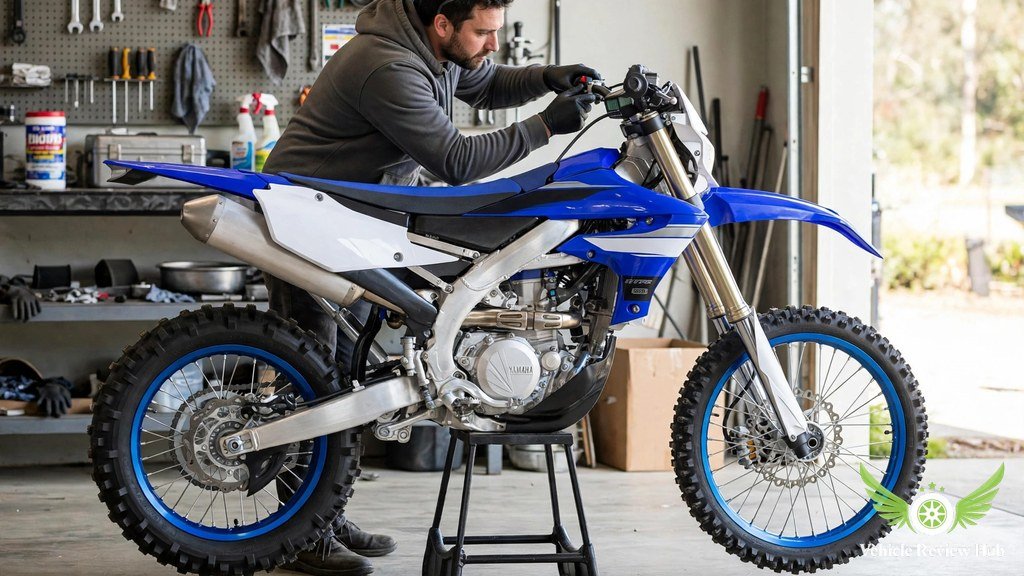
Preventive Maintenance, Hour Meter Use and Regular Inspections
Fit an hour meter if the bike does not already have one, and log every service against it — the simplest tool for Yamaha WR450F reliability. The WR450F’s enduro meter covers trail functions, but a dedicated hour meter makes the 10–15 hour oil rhythm and third-race valve rhythm easy to follow. Before every ride, check oil, coolant, chain slack, tire pressures, brake feel, and fresh leaks. After every ride, clean the bike and check radiators for mud. Every few rides, inspect chain and sprockets, wheel and linkage bearings, fork seals, brake pads, and the battery for Yamaha WR450F reliability, and keep a logbook of dates, hours, and parts. Grease the linkage and swingarm bearings on schedule — the factory grease is thin, and seized bearings are the most avoidable Yamaha WR450F reliability failure there is. This routine is exactly what the long-term test bikes received, and Yamaha WR450F reliability is what happens when maintenance is done on time, every time.
Recall Reality Check: No WR450F-Specific US Recall Found, VIN Check Anyway
Here is the plain answer for Yamaha WR450F reliability: no US safety recall naming the Yamaha WR450F surfaced in recall searches for this guide. Two cautions keep that answer honest. First, off-road competition bikes sit awkwardly in road-vehicle recall databases: the NHTSA vehicle-recall API returns no record for the WR450F at all, which reflects the bike’s off-road status rather than proof about every unit built. Second, beware wrong-bike lists: a 2014 Consumer Product Safety Commission recall for detaching drive chains named YZ250F and YZ450F motocross bikes, not the WR450F, and old Yamaha transmission and brake recalls name other models entirely. For Yamaha WR450F reliability, check the NHTSA recalls lookup by your exact model and year, ask a dealer to run the VIN, and ignore any list that says YZ or WR250 when you ride a WR450F.
Yamaha WR450F Reliability FAQs
These are the questions owners and buyers ask most about Yamaha WR450F reliability, answered from the manual, long-term tests, and recall records above.
Is the Yamaha WR450F reliable?
Yes, by the best available evidence. Owner reports, magazine long-term tests, and used-bike guides all describe a strong, durable engine with few mechanical complaints. Yamaha WR450F reliability is strong with frequent oil changes, clean air filters, and regular valve checks.
How often should I change the oil on a WR450F?
For Yamaha WR450F reliability, use the widely adopted translation of the manual’s race-based chart: oil and filter after break-in and every race for competition, or roughly every 10–15 hours or 1,000 kilometres for trail riding.
Do WR450F valves go out of spec often?
Rarely — and that is Yamaha WR450F reliability in practice. Titanium valves in a well-filtered engine hold cold clearances (0.10–0.15 mm intake, 0.20–0.25 mm exhaust) for a long time, so the third-race check usually finds nothing to adjust.
How many hours will a WR450F engine last before a rebuild?
There is no fixed hour limit, because maintenance and riding style decide Yamaha WR450F reliability. The manual’s chart works in races and kilometres rather than hours, and engines with clean oil, clean filters, and measured valve checks stay healthy far longer than neglected ones.
What are the most common WR450F problems?
For Yamaha WR450F reliability, the common items are wear and trail damage, not defects: short oil-change intervals from the small 0.8-litre supply, worn chains and sprockets, seized linkage bearings from thin factory grease, tired brake pads, weeping fork seals, and worn starter motors.
Are there any recalls on the Yamaha WR450F?
No WR450F-specific US safety recall surfaced in recall searches for this guide — good news for Yamaha WR450F reliability. Still check by VIN, and beware lists citing YZ450F or WR250 recalls.
What should I check when buying a used WR450F?
Start with the hour meter and service records — the two best guides to Yamaha WR450F reliability — then check cold starting, valve history, radiators, chain and sprocket wear, linkage and wheel bearings, fork seals, brake pads, and the battery.
Is the WR450F street legal?
No. The WR450F is an off-road-only enduro with no street-legal equipment or plate, and it should never be presented as a road bike — Yamaha WR450F reliability is an off-road story. Off-highway rules vary by state, and California classification rules have changed over the years, so run a VIN check for the exact year before buying.