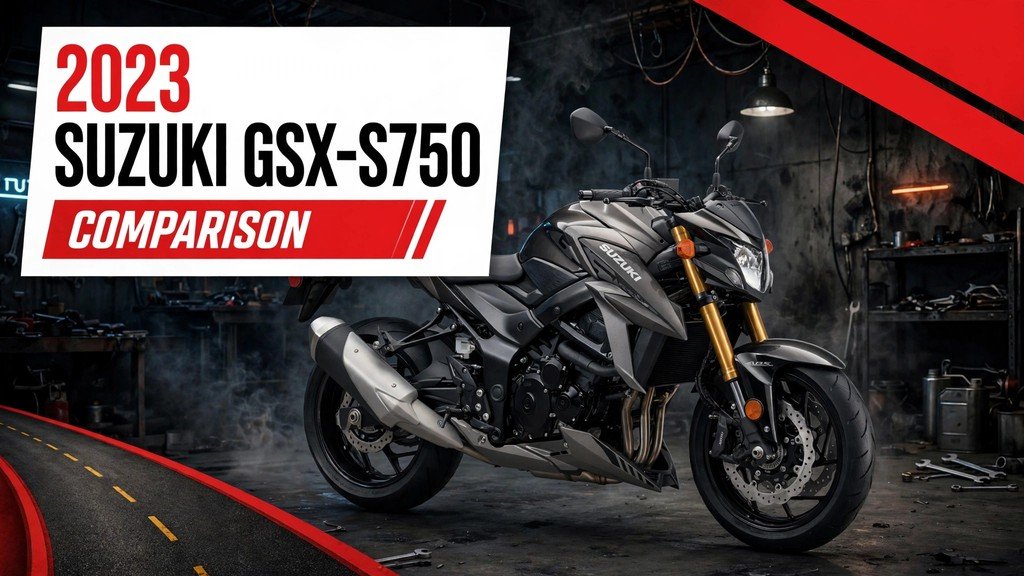
The Suzuki GSX-S750 is gone from Suzuki’s showrooms, but it has not gone from the used market — and that is exactly what makes this Suzuki GSX-S750 comparison worth reading. The last new bike sold in the USA was a 2023 model at $9,589 delivered, and clean used examples now ask $6,000 to $8,000 — for a 113-horsepower inline-four naked with a decade of proven mechanicals. This Suzuki GSX-S750 comparison answers it with the tested figures, the delivered prices, and the shootout verdicts.
Suzuki GSX-S750 Overview and Its Closest Rivals
The GSX-S750 was sold in the USA from 2015 to 2023, skipping 2017, and it was discontinued after 2023. That long run makes it a known quantity in this Suzuki GSX-S750 comparison. Its rivals fall into two eras: then and today.
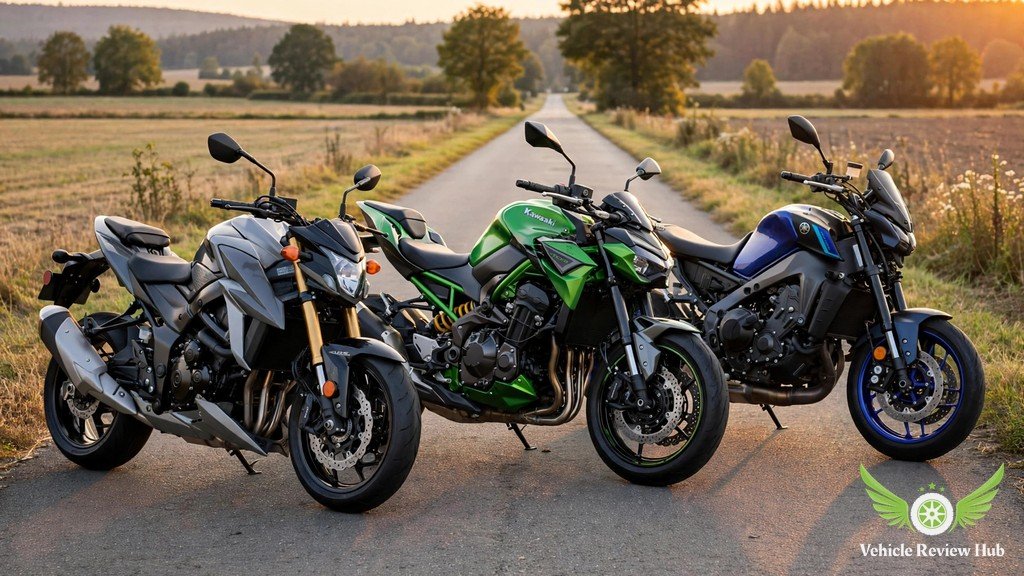
Why These Three Rivals: Twin Eras Compared
The three rivals were chosen for different reasons. The Suzuki GSX-8S is the in-house rival: the de facto successor, a 776cc twin. The Honda CB750 Hornet and Triumph Trident 660 appear in the verdict section of this Suzuki GSX-S750 comparison.
How the Four Bikes Differ at a Glance
Price, power, weight, and electronics decide this Suzuki GSX-S750 comparison. The S750 is the only bike here with a cable throttle and an LCD dash. Every rival has a 5-inch TFT, ride-by-wire, and a quickshifter.
| Bike | Delivered price | Engine / claimed power | Weight | Dash / electronics |
|---|---|---|---|---|
| Suzuki GSX-S750Z ABS (2023) | $9,589 new; $6,000–$8,000 used | 749cc inline-4, 112.4–112.6 bhp (114 PS) @ 10,500 rpm | 469–470 lb | LCD dash, 3-mode TC, no modes, no quickshifter |
| Kawasaki Z900 ABS (2026) | $10,839 delivered | 948cc inline-4, 123 hp @ 9,500 rpm | 467.5 lb | 5-in TFT, 4 modes, IMU, cornering ABS, quickshifter |
| Yamaha MT-09 (2026 / 2027) | $11,599 delivered | 890cc inline-3, 117 hp @ 10,000 rpm (EU/global rating) | 425 lb | 5-in TFT, IMU, slide/lift control, cruise, quickshifter |
| Suzuki GSX-8S (2027) | $9,499 delivered | 776cc parallel twin, 83 hp @ 8,500 rpm | 445 lb | 5-in TFT, 3 ride modes, quickshifter, no cruise |
The table in this Suzuki GSX-S750 comparison shows the trade at once: the S750 gives up 30 horsepower to the GSX-8S and 44 pounds to the MT-09, but no new bike here matches a used S750’s price for its power. Power figures for the MT-09 are EU/global factory ratings — Yamaha USA publishes no horsepower figure — and the S750’s own claim is a global figure too.
The video below is ZigWheels’ solo review of the 2018 GSX-S750 — not a head-to-head test, but a useful buyer view of the bike.
Suzuki GSX-S750 vs Kawasaki Z900
The Z900 is the closest rival in this Suzuki GSX-S750 comparison, in both eras. It beat the S750 in 2017, and it is the only other inline-four naked in the group. The two bikes were nearly the same price when new — $8,299 against $8,399 — and they are separated by $1,250 today. The performance guide covers the S750’s own dyno runs; this Suzuki GSX-S750 comparison puts those numbers next to the Z900’s.

Engine, Specs and Performance Side by Side
On paper the Z900 wins the engine argument. The 2017 Z900 claimed 125 horsepower at 9,500 rpm and measured 115.6 at 9,800 rpm on Motorcycle.com’s dyno, where the S750 measured around 100 at the rear wheel. Its best quarter-mile was 10.89 seconds at 129 mph against the Suzuki’s 11.24 seconds (MotoStatz, single-source, labelled), and its 0–60 mph time of 3.10 seconds matched the Suzuki’s 3.1 seconds. Weights are a dead heat — 469 pounds for the Z900 against 467 for the S750 — so the gap is power, not mass. The current 2026 Z900 claims 123 horsepower at 9,500 rpm, and it weighs 467.5 pounds with a 17-litre tank against the S750’s 16. The S750’s one performance win is its brakes: in the 2017 test its Nissin four-piston radial calipers scored 90.8 percent against the Z900’s 85.0 — the best brakes of the three — though that verdict belongs to the 2018 bike only, since the 2015–2016 bike’s two-piston sliding calipers were criticised for weak initial bite. The S750’s calipers are Nissin, not Brembo — unlike the bigger GSX-S1000’s.
| Shootout | Winner | GSX-S750 result | Notes |
|---|---|---|---|
| “More for Less” (2015): S750 vs FZ-09 vs Shiver 750 | Yamaha FZ-09, 86.6% | 2nd, 83.9% | Shiver 750 3rd, 82.5%; S750 won the price category |
| “Naked Sports Threeway” (2017): S750 vs Z900 vs Shiver 900 | Kawasaki Z900, 89.4% | 2nd, 86.5% | Shiver 900 3rd, 86.3%; S750 won the brakes category at 90.8% |
| “Gentleman’s Hooligan” (2016): S750 vs Z800 | Kawasaki Z800, 85.2% | 2nd, 84.8% | Decided on details: S750 won price and seat comfort |
The shootout table tells one story three times: the S750 finished second in every big test it entered, beaten on power and on nothing else. Bennetts’ UK head-to-head reached a split decision instead, so this Suzuki GSX-S750 comparison presents it as a split, not a Z900 win. Cycle World’s Budget Blasters test also put the FZ-09 first overall, and the S750’s only category win there was top speed — 140 mph against the Yamaha’s 130 mph.
Price, Equipment and Which Suits Which Rider
In 2017 the Z900 had no traction control or ride modes, while the S750 already had traction control and radial calipers. The 2025 redesign flipped that: the current Z900 has a 5-inch TFT, a 6-axis IMU, cornering ABS, and a quickshifter, while the S750 still has its LCD dash, cable throttle, and three-mode traction control with no IMU. New against new, the Z900 costs $10,839 delivered — $1,250 more than the last S750 ABS — and it is the better bike for a rider who wants modern electronics. Against a used S750 at $6,000 to $8,000, the Z900 costs $2,800 to $4,800 more, and the S750 is the better buy for a rider who wants an inline-four. The Motorcycle.com three-way test is the source for the 2017 verdict, and the 2026 Z900 spec page confirms the current price.
Suzuki GSX-S750 vs Yamaha MT-09
The MT-09 is the benchmark in this Suzuki GSX-S750 comparison — the lightest bike here at 425 pounds and the most expensive at $11,599 delivered. It is also the rival the S750 has the longest history with. The current MT-09 costs $10,899 for both 2026 and 2027 — Yamaha kept the price flat — which makes it $2,010 more than the last S750 ABS was. The review covers the S750’s own prices and specs.

Engine, Specs and Performance Side by Side
The MT-09’s 890cc triple makes a different kind of power, and in this Suzuki GSX-S750 comparison the triple wins on paper and on the scales. The current bike is rated 117 horsepower at 10,000 rpm with 93 Nm at 7,000 rpm — an EU/global factory rating, since Yamaha USA publishes no horsepower figure — against the S750’s 112.4–112.6 bhp at 10,500 rpm. The triple’s torque peaks 2,000 rpm lower, so it pulls harder from low revs. The weight gap is the bigger story: 425 pounds against 469–470. In the 2015 shootout the FZ-09 measured 104.6 horsepower at 9,800 rpm against the S750’s 96.1, ran the quarter-mile in 10.66 seconds against the Suzuki’s 11.24, and was electronically limited to 130 mph against the Suzuki’s 140 mph. The MT-09’s tank is smaller at 14 litres against the S750’s 16, so the Suzuki still goes further between fill-ups.
Price, Equipment and Which Suits Which Rider
The MT-09 has a 6-axis IMU, four-mode traction control with slide and lift control, two-mode brake control, a 5-inch TFT, a third-generation quickshifter, and cruise control as standard. The S750 has three-mode traction control with no IMU, an LCD dash, no ride modes, no quickshifter, and no cruise control. That is the honest price of the benchmark: $11,599 delivered for the standard MT-09, flat for 2027, confirmed by Cycle News’ 2027 Yamaha pricing report and the 2027 MT-09 spec page.
Suzuki GSX-S750 vs Suzuki GSX-8S
The GSX-8S is the in-house rival in this Suzuki GSX-S750 comparison, and the strangest one: it now occupies the S750’s slot, costs less new than the last S750 ABS did, and is worse on power by 30 horsepower. The two overlapped for one model year, 2023. The 2027 GSX-8S costs $9,499 delivered — $90 cheaper than the last new S750 ABS was, after a $500 cut. The GSX-8S review covers the newer bike in full.

Engine, Specs and Performance Side by Side
The engine swap is the whole story of this Suzuki GSX-S750 comparison. The S750’s 749cc inline-four claims 112.4–112.6 bhp at 10,500 rpm and measures around 100 at the rear wheel. The 8S’s 776cc twin claims 83 horsepower at 8,500 rpm with 78 Nm at 6,800 rpm — about 30 less, but its torque peaks 2,200 rpm lower than the S750’s 81 Nm at 9,000 rpm, so the twin feels stronger in everyday riding. The 8S is lighter at 445 pounds against 469–470, with a smaller 14-litre tank against the S750’s 16. The electronics run the other way: the 8S has ride-by-wire, three rider modes, a quickshifter, and a 5-inch TFT, while the S750 has a cable throttle, an LCD dash, no modes, and no quickshifter. The 2027 GSX-8S spec page confirms the current price and figures, and the GSX-8S performance guide covers the twin’s own test numbers.
Price, Equipment and Which Suits Which Rider
Call the 8S the S750’s de facto successor, not its official replacement — no Suzuki USA press release calls it the S750’s replacement, and this Suzuki GSX-S750 comparison will not pretend otherwise. Reviewers have said it plainly: BigWheels wrote that “the GSX-8S is here to succeed the GSX-S750 which has been around since 2015”. But it is not a like-for-like replacement: different engine, 30 fewer horsepower. A new 2027 8S is only $1,500 to $3,500 more than a clean used S750. For that premium the buyer gets a warranty, modern electronics, and a lighter bike. For the saving, the S750 buyer gets an inline-four, 30 more horsepower, a bigger tank, and simpler mechanicals. The 8S suits the rider who wants a new bike with a warranty and modern kit; the S750 suits the rider who wants the four-cylinder engine and the lower price.
Suzuki GSX-S750 Price and Value Compared
Price is where this Suzuki GSX-S750 comparison is decided, because the S750 is the only bike here bought used.

Closest Rival in Both Eras: the Z900
The Z900 is the closest rival in this Suzuki GSX-S750 comparison because it wins the value argument in both eras. In 2017 the two bikes were $100 apart when new — $8,299 against $8,399 — and the Z900 won the three-way test while the S750 won only the brakes category. Today the new Z900 costs $10,839 delivered, $1,250 more than the last S750 ABS, and it brings a TFT, an IMU, cornering ABS, and a quickshifter.
| Bike | MSRP | Destination | Delivered | vs 2023 S750Z ABS |
|---|---|---|---|---|
| Suzuki GSX-S750Z (2023) | $8,649 | $440 | $9,089 | −$500 |
| Suzuki GSX-S750Z ABS (2023) | $9,149 | $440 | $9,589 | — |
| Kawasaki Z900 ABS (2026) | $9,999 | $840 | $10,839 | +$1,250 |
| Yamaha MT-09 (2026 / 2027) | $10,899 | $700 | $11,599 | +$2,010 |
| Suzuki GSX-8S (2027) | $8,749 | $750 | $9,499 | −$90 |
| Honda CB750 Hornet (2025) | $7,999 | $600 | $8,599 | −$990 |
| Triumph Trident 660 (2026) | $8,745 | $725 | $9,470 | −$119 |
The price table in this Suzuki GSX-S750 comparison carries two surprises. The first is that a new 2027 GSX-8S is $90 cheaper delivered than the last new S750 ABS was. The Trident 660 sits at $9,470 delivered after Triumph cut its price $400 in June 2026 to $8,745; one dealer lists a $950 destination charge instead of $725, which would make it $9,695, so buyers should check the destination line.
Running Costs and Resale Value Compared
Running costs favour the S750 in this Suzuki GSX-S750 comparison, and resale favours it too. Tested US fuel economy runs 36.9 to 41.7 mpg on the 2015–2016 bike and 46–48 mpg on the 2018 bike. Servicing is simple: oil at every service, the filter only at 600 and 11,000 miles, plugs at 7,500 miles, and a valve inspection at 14,500 miles — see the reliability guide. No dealer fixed-price servicing figure was found, and no KBB or NADA book value could be retrieved, so this Suzuki GSX-S750 comparison cites dealer asking prices only. The November 2026 snapshot shows a clean 2023 Z ABS at $7,999 — 87 percent of its original MSRP — while a 2023 Z without ABS asks $8,999, or 104 percent, after sitting listed for 89 days. Typical 2018–2021 bikes ask $5,600 to $7,700.
| Used GSX-S750 (asking price, Nov 2026) | Asking | Original MSRP | % of MSRP |
|---|---|---|---|
| 2023 GSX-S750Z ABS | $7,999 | $9,149 | 87% |
| 2023 GSX-S750Z (non-ABS), 9,547 miles | $8,999 | $8,649 | 104% — above original MSRP |
| 2018 GSX-S750 | $6,597 | $8,299 | 79% |
| 2018 GSX-S750Z | $5,630 | $8,899 | 63% |
The used-price table in this Suzuki GSX-S750 comparison is the strongest argument for the bike: late examples hold 87 percent of their original price. The warning is the 2023 Z at $8,999 — asking above its original MSRP after 89 days is scarcity pricing. The 2023 GSX-S750Z ABS spec page confirms the original $9,149 price and $440 destination behind these percentages.
Suzuki GSX-S750 Comparison Verdict and US Alternatives
The verdict of this Suzuki GSX-S750 comparison depends on what the buyer values most — no single bike wins every category. The S750 wins on price-per-horsepower and inline-four character; the Z900 on performance and equipment; the MT-09 on lightness and electronics; the GSX-8S on warranty and convenience.

Today’s MT-09 Costs $10,899
The MT-09’s price is the ceiling of this Suzuki GSX-S750 comparison: $10,899 for 2026 and 2027 alike, or $11,599 delivered — $2,010 more than the last S750 ABS and $3,600 to $5,600 more than a clean used S750. For that money the buyer gets the lightest bike, the most electronics, and a triple that makes its torque 2,000 rpm lower. The SP at $13,399 delivered adds upgraded suspension for riders who will use it. But the MT-09’s price also frames the S750’s value: a used S750 gives up 44 pounds and a generation of electronics, and keeps roughly $4,000. The GSX-S1000 review covers the bigger Suzuki alternative, and the SV650 review covers the V-twin middleweight for riders who want a lighter, cheaper twin. This Suzuki GSX-S750 comparison calls the MT-09 the benchmark and the S750 the bargain.
Hornet and Trident 660 Alternatives
Two cheaper new bikes sit below the S750’s final price in this Suzuki GSX-S750 comparison, and both are worth a look. The Honda CB750 Hornet is the cheapest new bike in the group at $8,599 delivered — $990 less than the last S750 ABS and barely more than a clean used 2023 example. It is also the least powerful at 91 horsepower from its 755cc parallel twin — an EU/global factory rating — and it is a twin, not a four. The Triumph Trident 660 costs $9,470 delivered, after Triumph cut its price $400 in June 2026 to $8,745. Its 2026 engine makes 95 horsepower at 11,250 rpm with 50 lb-ft at 8,250 rpm — 15 more than the previous Trident — and it comes with cruise control and Triumph Shift Assist as standard. The Trident is the character pick, and at $29 less delivered than a new GSX-8S it competes with the 8S, not with a used S750. The RevZilla Hornet report confirms the Honda’s US price, and the Gear Patrol price-drop report confirms the Trident’s cut.
Suzuki GSX-S750 Comparison: Frequently Asked Questions
Direct answers to the questions riders ask about this Suzuki GSX-S750 comparison.
Is the Suzuki GSX-S750 better than the Kawasaki Z900?
Not on performance — the Z900 is faster, better equipped, and won the 2017 three-way test. But the S750 is better value: a clean used example at $6,000 to $8,000 costs $2,800 to $4,800 less than a new Z900, with the same inline-four layout. This Suzuki GSX-S750 comparison calls the Z900 the better bike and the S750 the better buy.
Is the GSX-S750 faster than the MT-09?
No. The MT-09’s triple makes 117 horsepower against the S750’s 112.4–112.6 bhp and weighs 44 pounds less. In 2015 the FZ-09 ran the quarter-mile in 10.66 seconds against the S750’s 11.24. This Suzuki GSX-S750 comparison gives the speed crown to the MT-09.
Should I buy a used GSX-S750 or a new GSX-8S?
Buy the 8S if you want a warranty, modern electronics, and a lighter bike. Buy the used S750 if you want an inline-four with 30 more horsepower and a $1,500 to $3,500 saving. This Suzuki GSX-S750 comparison treats the 8S as the de facto successor, not an official replacement, since no Suzuki statement calls it one.
How much does a used GSX-S750 cost?
A realistic budget is $6,000 to $8,000 for a clean bike. November 2026 asking prices show a 2023 Z ABS at $7,999, a 2018 bike at $6,597, and a 2018 Z at $5,630. One 2023 Z asks $8,999 — above its original $8,649 MSRP after 89 days listed — which is scarcity pricing, not the market. This Suzuki GSX-S750 comparison cites asking prices only, since no KBB or NADA book value could be retrieved.
What is the cheapest new alternative to the GSX-S750?
The Honda CB750 Hornet at $8,599 delivered — $990 less than the last S750 ABS. It makes 91 horsepower from a 755cc parallel twin, an EU/global factory rating, and it is the least powerful bike in this Suzuki GSX-S750 comparison.
Does the GSX-S750 have more power than the GSX-8S?
Yes — about 30 horsepower more. The S750 claims 112.4–112.6 bhp at 10,500 rpm and measures around 100 horsepower at the rear wheel, while the 8S claims 83 horsepower at 8,500 rpm. The 8S’s twin makes its torque at 6,800 rpm, 2,200 rpm lower than the S750’s peak, so it feels stronger at low revs. This Suzuki GSX-S750 comparison gives the power win to the older bike.
Which bike is best for a beginner: GSX-S750 or Z900?
The S750, with caveats — and the 2018-or-later Z ABS is the sensible pick. Its upright position, linear power, and traction control help a newer rider. Against that, the bike weighs 465–470 pounds and the early bike has no ABS at all. This Suzuki GSX-S750 comparison steers beginners to the 2018-or-later Z ABS rather than the cheapest 2015 bike.
Is the GSX-S750 cheaper to run than the MT-09?
Yes, slightly. Tested US fuel economy runs 36.9 to 41.7 mpg on the early S750 and 46–48 mpg on the 2018 bike, against 35.9 mpg for the FZ-09 in 2015. Servicing is simple: oil at every service, the filter only at 600 and 11,000 miles, and plugs at 7,500 miles. This Suzuki GSX-S750 comparison found no dealer fixed-price servicing figure, so it prints none.
What replaced the GSX-S750?
Nothing officially — Suzuki never announced a replacement. The GSX-8S is the de facto successor: it arrived for 2023, the S750’s last year, and occupies the same price slot. But it is not a like-for-like replacement, since it is a 776cc twin with 30 fewer horsepower. This Suzuki GSX-S750 comparison uses “de facto successor” wording only.
Is the GSX-S750 good value in 2026?
Yes — it is the cheapest route to a 100-horsepower inline-four naked. A clean used bike at $6,000 to $8,000 undercuts every new rival by at least $600, with one recall in nine model years and a simple service schedule. This Suzuki GSX-S750 comparison calls it the value pick of the middleweight naked class for buyers who will buy used.
Which rival has the best electronics?
The Yamaha MT-09: a 6-axis IMU, four-mode traction control with slide and lift control, two-mode brake control, a 5-inch TFT, ride modes, a quickshifter, and cruise control. The Z900 is next with its IMU, cornering ABS, and quickshifter. The GSX-8S has ride-by-wire, three modes, and a quickshifter. The S750 has the oldest kit: three-mode traction control with no IMU, an LCD dash, and no quickshifter. This Suzuki GSX-S750 comparison ranks them MT-09 first, Z900 second, 8S third, S750 last.
Where can I read the full GSX-S750 review?
The review covers the final 2023 prices, the full specs and the ownership picture, the performance guide covers the dyno runs, the top speed, the quarter-mile and the tested fuel economy, and the reliability guide covers servicing, the common problems and the single recall. This Suzuki GSX-S750 comparison puts the bike against the Z900, the MT-09 and the GSX-8S on price, power and equipment.