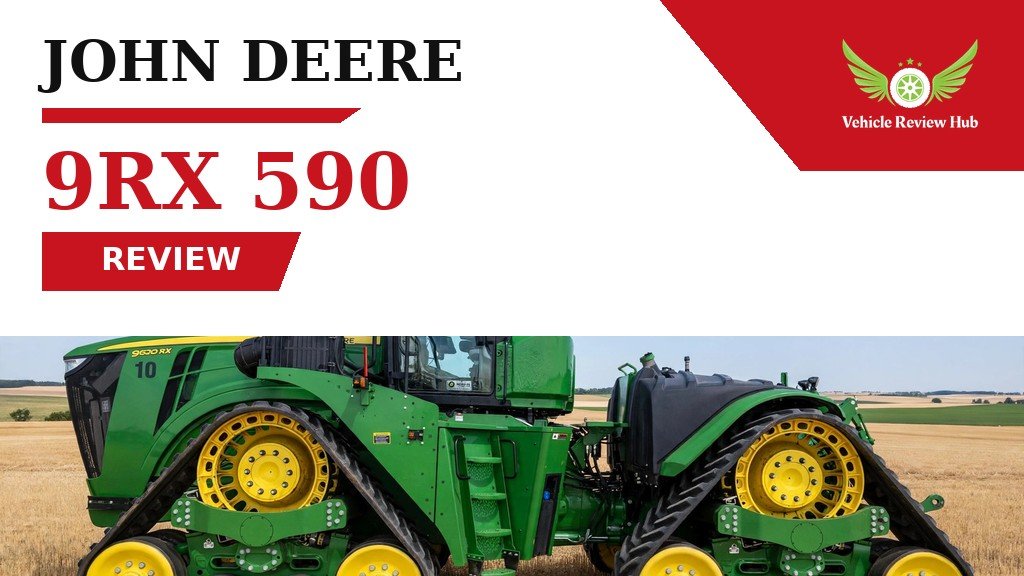
The John Deere 9RX 590 review starts with a straight answer: this is the sweet spot of Deere’s current four-track lineup, a 590-horsepower machine bringing the newer JD14 engine, a suspended cab, and full precision-ag readiness to farms needing big-track traction without stepping up to the 700-plus-horsepower JD18 flagships. Built in Waterloo, Iowa, it pairs a 13.6-liter John Deere engine with an 18-speed PowerShift and four Camso rubber tracks for the biggest tillage, seeding, and scraper work. This John Deere 9RX 590 review covers the verified specs, transmission, track system, current used prices, and how it stacks up against the 9RX 540 and the bigger 9RX 710.
Unlike the older 9620RX, which is now used-only, the 9RX 590 is still a current model — so buyers can choose between a new machine with a full warranty and a used one at a steep discount. That changes what matters: new-versus-used value, hours, track condition, and whether it left the factory with a PTO and hitch or drawbar-only. This John Deere 9RX 590 review answers those questions from dealer spec sheets and current October 2026 listings.
John Deere 9RX 590 Review, Features and Used Price
The 9RX 590 sits in the middle of the JD14-powered 9RX family, alongside the 9RX 490, 540, and 640. All four share the same 13.6-liter engine block, e18 transmission, and four-track undercarriage, differing mainly in engine tune. That shared platform is good news: parts, service knowledge, and track hardware are common across the range, and this John Deere 9RX 590 review treats the 590 as the balance point — enough power for 50- to 60-foot tools without the JD18 price jump.
Key Features, Configurations and Intended Uses
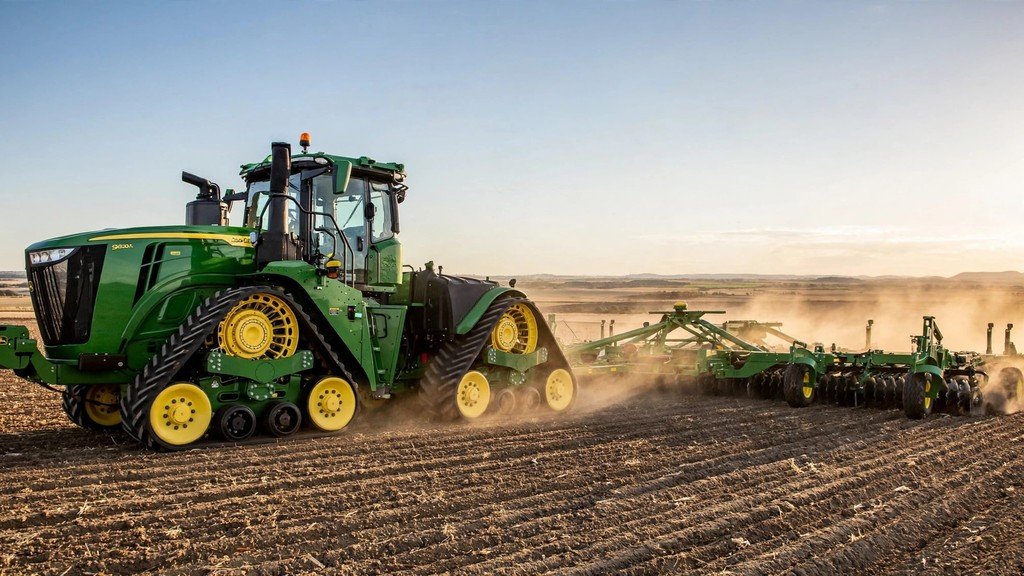
Standard equipment includes the e18 18-speed PowerShift with Efficiency Manager, full-locking differential locks, the Generation 4 4600 CommandCenter with integrated AutoTrac, JDLink telematics, and a cab-suspension CommandView cab with standard 10-inch display. Intended work covers primary tillage, large air seeders and carts, nutrient application, scraper work, and high-horsepower drawbar jobs. Deere also sells the 590 in a Scraper Special configuration with a short scraper drawbar and the 110-gallon-per-minute hydraulic setup as standard, aimed at earthmoving contractors — the variant this John Deere 9RX 590 review flags for dirt work. The video below gives a complete 9RX series overview — specs, features, and pros and cons — and this John Deere 9RX 590 review includes it because it puts the 590’s place in the family in context:
Two newer features cut running costs rather than adding gadgetry: a maintenance-free hydraulic fan drive instead of a belt-driven setup, and a single-canister inline aftertreatment system with fewer parts than the older split arrangement. For buyers comparing the 590 with its smaller sibling, our 9570RX review covers the older Cummins-powered generation, and the full 9RX 590 performance and fuel usage guide breaks down what the JD14 drinks per hour.
Used Prices by Model Year, Hours and Equipment
Because the 9RX 590 is still in production, the used market is young — mostly 2022 to 2024 machines — and prices track hours. Current October 2026 dealer listings put clean 2022–2024 machines with under 1,500 hours at roughly $500,000 to $700,000: a 2022 example with 1,473 hours at Van Wall in Nevada, Iowa, at $499,900 with 36-inch tracks; a 2023 with 944 hours at Van Wall in Perry, Iowa, at $559,900; and a 2024 with 397 hours at Papé Machinery in Four Lakes, Washington, at $662,999 with 36-inch tracks, PTO, and hitch. Hours move the price more than model year, and track condition is the second price lever.
| Example (verified Oct 2026) | Hours | Asking price | Notable equipment |
|---|---|---|---|
| 2022, Van Wall, Nevada, IA | 1,473 | $499,900 | 36-in tracks, PTO, guidance-ready |
| 2023, Van Wall, Perry, IA | 944 | $559,900 | 36-in tracks, PTO, guidance-ready |
| 2024, Papé, Four Lakes, WA | 397 | $662,999 | 36-in tracks, PTO and 3-pt hitch |
John Deere 9RX 590 Engine, Horsepower and Specifications
The engine is the heart of this John Deere 9RX 590 review, and it is where the 590 differs most from the older four-track generation. The 9620RX and 9570RX used a Cummins block; the 590 uses Deere’s own JD14, bringing a different torque curve, a different aftertreatment layout, and a 500-hour oil-change interval on approved oil. Everything below comes from dealer spec sheets mirroring Deere’s figures.
13.6L JD14 Engine, Rated HP, Maximum HP and PTO Power
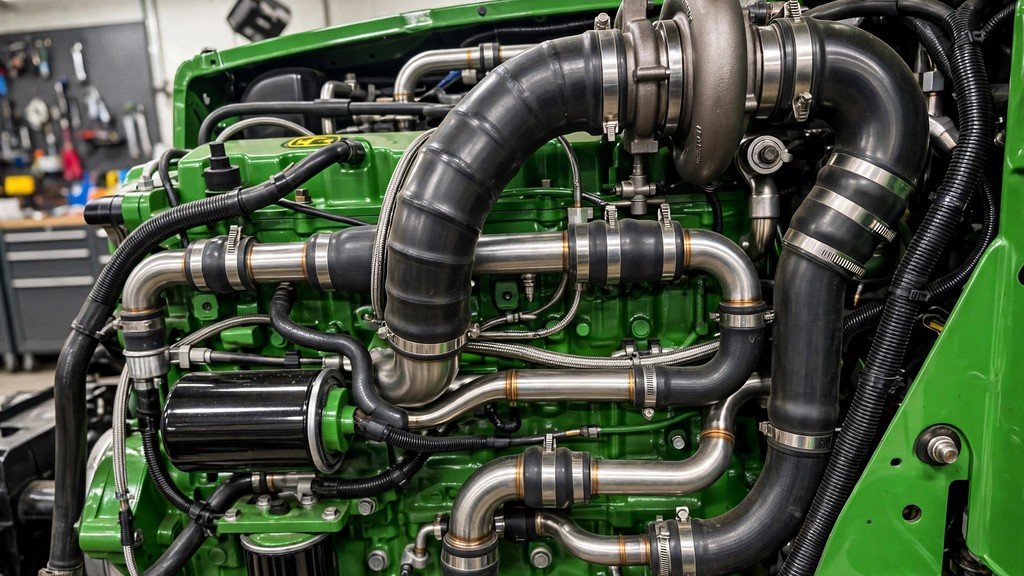
Rated power is 590 horsepower at 2,100 rpm, with a 10 percent boost to a maximum of 649 horsepower. Rated PTO power is 335 horsepower SAE on the independent 1,000-rpm shaft — the same driveline-limited figure shared across the whole JD14 9RX family. Peak torque is 2,723 Nm at 1,550 rpm — about 2,008 lb-ft — with 38 percent PTO torque rise. The engine itself is a 13.6-liter (827 cu in) inline six with wet-sleeve liners, four valves per cylinder, a dual series turbocharger, air-to-air aftercooling, and cooled EGR. It meets US Final Tier 4 with DOC and SCR aftertreatment, so unlike the newer JD18 models it does use diesel exhaust fluid. For the full consumption picture, this John Deere 9RX 590 review points to our 9RX 590 performance and fuel usage guide, which covers gallons per hour by application.
Dimensions, Fuel Capacity, Hydraulic Flow and Track Options
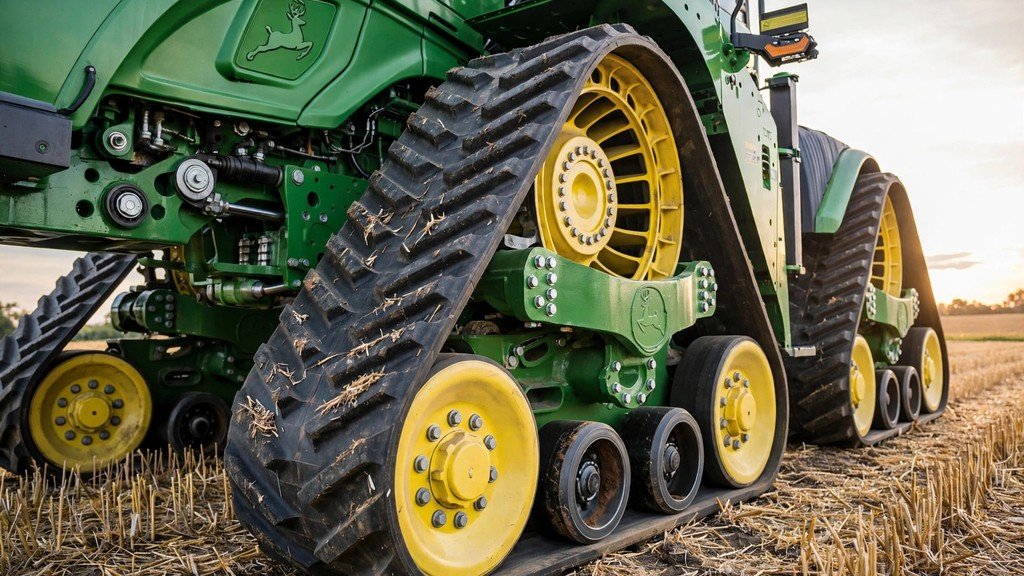
Base weight is 56,320 pounds, ballasted toward 67,000 pounds. Wheelbase is 162.4 inches, overall length is 327.1 inches without the hitch, 336.4 inches with hitch and coupler, drawbar clearance is 12.2 inches, and the turning radius with brakes is 30 feet. The fuel tank holds 400 US gallons, with a 31.7-gallon DEF tank — worth stating plainly, because the 590’s aftertreatment needs DEF, unlike the DEF-free JD18 flagships. Hydraulics are a closed-center, pressure-and-flow-compensated system: 55 gallons per minute standard, or 110 with the optional dual-pump setup (the Scraper Special gets 110 as standard). Rear SCVs run four 3/4-inch deluxe couplers as standard, six optional, and a single SCV delivers 42 gallons per minute. The track system is the Camso positive-drive setup in AG 3500 or AG 6500 belts, in 30- or 36-inch widths on narrow or wide tread spacing. A Category 5 drawbar is standard with a 12,000-pound maximum vertical load; a Category 4N hitch was optional, and many used units are drawbar-only, so verify the hitch before buying. The dealer spec sheet for the 9RX 590 confirms the JD14 engine, the 590-horsepower rating, and the figures used here.
John Deere 9RX 590 Transmission and Implement Compatibility
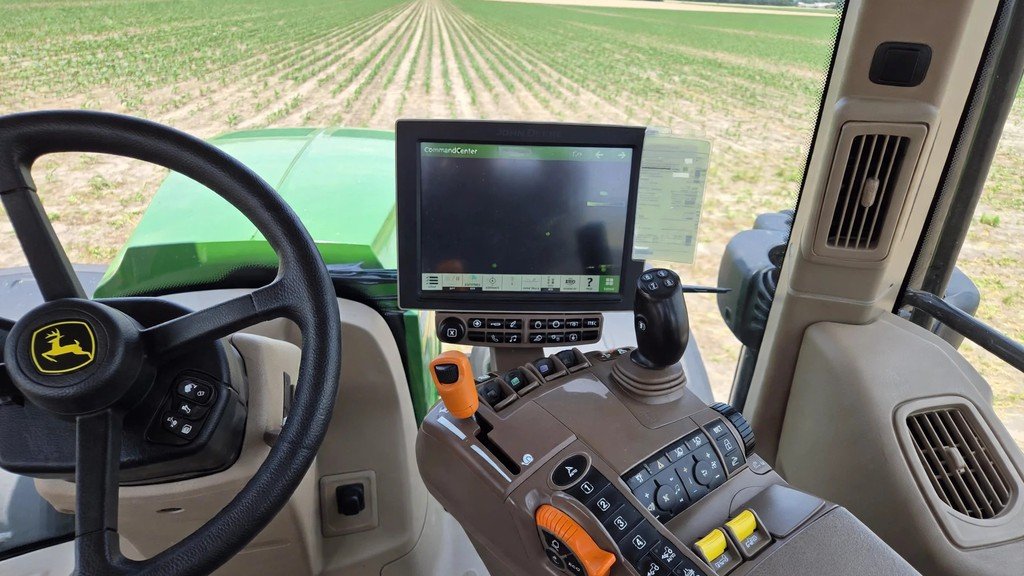
The e18 PowerShift is the only transmission offered on the 9RX 590, and it is a conventional full powershift, not a continuously variable box: 18 forward speeds and 6 reverse, with Efficiency Manager software that shifts based on load and target speed. It pairs with electrohydraulic differential locks and the articulated chassis, which bends at the center pivot for steering. The cab is a step up from the older generation: a suspended CommandView cab with a standard 10-inch Generation 4 4600 display, 71.47 square feet of cab glass, and integrated AutoTrac guidance.
e18 PowerShift Transmission and Efficiency Manager
Efficiency Manager defines daily use of the e18: set a target speed and the software picks the gear and throttles back when the load allows, which saves fuel on long passes. Top road speed is about 25 mph, and roading wears belts faster than field work, so transport distance matters. Our 9RX 590 maintenance and common problems guide covers the e18’s service intervals and the issues owners report most; this John Deere 9RX 590 review recommends reading it before inspecting any high-hour machine.
PTO, Rear Hitch, Hydraulic Flow and Heavy Implement Compatibility
Implement compatibility is where the 590 earns its price, and this John Deere 9RX 590 review ranks it as the strongest reason to choose tracks over wheels for heavy draft work. The independent rear PTO is 1,000 rpm on a 1.75-inch 20-spline shaft, with electrohydraulic engagement. The main connection on most 590 machines is the Category 5 drawbar pulling towed implements: disc rippers, vertical tillage, field cultivators, chisel plows, and air-seeder carts. With up to 110 gallons per minute and up to six rear SCVs, it runs the largest air seeders and planters, including central-fill planters with hydraulic downforce, managed through the Generation 4 CommandCenter. Many 590 machines were ordered drawbar-only, and adding a hitch later is expensive — several used listings, including the 397-hour Papé machine, carry PTO but no three-point hitch, so check the build sheet.
John Deere 9RX 590 vs. 9RX 540 and 9RX 710
The 590 sits between two very different buying decisions. Against the 540, it brings 50 more rated horsepower from the same JD14 block, with the same PTO, fuel capacity, cab, and transmission. Against the 710, it trades the newer JD18 engine, the 21-speed transmission, and DEF-free operation for a price hundreds of thousands of dollars lower. This John Deere 9RX 590 review treats that trade as the core of the value case.
Differences in Horsepower, Specifications and Operating Scale
| Attribute | 9RX 540 | 9RX 590 | 9RX 710 (newer JD18) |
|---|---|---|---|
| Rated hp | 540 | 590 | 710 PS (700 SAE) |
| Engine | JD14 13.6L | JD14 13.6L | JD18 18.0L |
| Rated PTO hp | 335 | 335 | 335 |
| Peak torque | 1,838 lb-ft | 2,008 lb-ft | 2,671 lb-ft |
| Transmission | e18 18F/6R PowerShift | e18 18F/6R PowerShift | e21 21F/11R PowerShift |
| Fuel capacity | 400 gal | 400 gal | 515 gal |
| Hydraulics | 55 / 110 gpm | 55 / 110 gpm | 56 / 112 / 168 gpm |
| DEF system | DOC + SCR (uses DEF) | DOC + SCR (uses DEF) | EGR only (no DEF) |
| Base weight | 54,320 / 56,320 lb | 56,320 lb | 74,000 lb |
The differences that matter in daily use are the engine’s torque, the transmission’s gear count, and the purchase price. The 540 and 590 are the same tractor with different tunes — same block, same gearbox, same hydraulics — while the 710 is a genuinely bigger machine: a larger engine, a newer transmission, and roughly 18,000 pounds more weight. The dealer spec sheet for the 9RX 710 confirms the JD18 figures used above. For the older flagship, see our 9620RX review.
Which High-Horsepower Tractor Offers Better Value?
Start with the work, not the badge. If your biggest tools are 50- to 60-foot tillage implements, large air seeders, or scrapers, the 590 covers them well below JD18 flagship pricing — and, bought used with under 1,000 hours, at roughly half the price of a new 710. If you want the newest engine technology, a new-machine warranty, and DEF-free operation, the 710 is the answer, but at a large premium. Against the 540, the 590’s extra 50 horsepower and 170 lb-ft cost relatively little used, which makes the 590 the better buy unless your implements never exceed what the 540 pulls. This John Deere 9RX 590 review treats the 590 as the value pick of the JD14 range: the most usable power per dollar in the current four-track lineup, provided you buy on track condition and service history, not hours alone. Our 9RX 590 ownership cost guide runs the five-year math behind that judgment.
Frequently Asked Questions About the John Deere 9RX 590
Buyers researching a 9RX 590 ask the same core questions: what engine it has, how much power it makes, what it costs today, how it compares with the 540 and 710, and what to check before buying. This John Deere 9RX 590 review answers them below from dealer spec sheets and current listings.
What engine does the John Deere 9RX 590 have?
The 9RX 590 uses a John Deere JD14: a 13.6-liter (827 cu in) inline six with a dual series turbocharger, air-to-air aftercooling, and cooled EGR. It meets US Final Tier 4 with DOC and SCR aftertreatment, so it uses diesel exhaust fluid from a 31.7-gallon DEF tank. Do not confuse it with the older 9570RX and 9620RX, which used a Cummins engine, or with the newer 710, 770, and 830, which use the JD18 — a distinction this John Deere 9RX 590 review repeats because listings get it wrong.
How much horsepower does the John Deere 9RX 590 have?
This John Deere 9RX 590 review confirms the 590 is rated at 590 horsepower at 2,100 rpm, with a 10 percent power boost giving a maximum of 649 horsepower. Rated PTO power is 335 horsepower SAE, which is a driveline limit shared across the JD14 9RX family.
What is the peak torque of the 9RX 590?
Peak torque is 2,723 Nm at 1,550 rpm, about 2,008 lb-ft, with 38 percent PTO torque rise. That peak arrives lower in the rev range than the older Cummins-powered models, which helps the 590 hold implements at depth without frequent downshifts — a point this John Deere 9RX 590 review stresses for tillage buyers.
What years was the John Deere 9RX 590 made?
The 9RX 590 belongs to the JD14-powered 9RX family, with used examples from 2022 to 2024 in current listings, and it remains a current model in dealer lineups. It is not used-only: new machines are still available, which this John Deere 9RX 590 review notes because it changes the new-versus-used calculation.
How much does a used John Deere 9RX 590 cost?
Current October 2026 dealer listings put clean mid-hour machines at roughly $500,000 to $700,000: a 2022 with 1,473 hours at $499,900, a 2023 with 944 hours at $559,900, and a 2024 with 397 hours at $662,999. Hours and track condition move the price more than model year, which is why this John Deere 9RX 590 review ranks inspection above model year.
What transmission does the 9RX 590 use?
The e18 PowerShift: 18 forward speeds and 6 reverse, full powershift with Efficiency Manager software that shifts based on load and target speed. Top road speed is about 25 mph, as covered in the transmission section of this John Deere 9RX 590 review.
Does the 9RX 590 use DEF?
Yes. Unlike the newer JD18-powered 9RX models, which meet Final Tier 4 with cooled EGR only, the 590’s JD14 engine uses a DOC and SCR system with diesel exhaust fluid from a 31.7-gallon tank — a difference this John Deere 9RX 590 review flags because it affects running costs. Do not confuse it with the DEF-free 710, 770, and 830.
What is the fuel capacity of the 9RX 590?
The fuel tank holds 400 US gallons, the same as the older 9RX generation, well short of the 515-gallon tank on the newer JD18 flagships, as this John Deere 9RX 590 review notes in the specs table.
What hydraulic flow does the 9RX 590 have?
This John Deere 9RX 590 review lists 55 gallons per minute from the standard pump, or 110 with the optional dual-pump setup. Four 3/4-inch deluxe rear SCVs are standard, six optional, and a single SCV delivers 42 gallons per minute.
Does the 9RX 590 have a three-point hitch?
Not always, as this John Deere 9RX 590 review explains. A Category 5 drawbar is standard and a Category 4N three-point hitch was optional, but many used 590s were ordered drawbar-only. Verify the hitch before you buy; adding it later is expensive.
What tracks does the 9RX 590 run?
For this John Deere 9RX 590 review, the track answer is straightforward: Camso positive-drive belts in the AG 3500 or AG 6500 series, in 30- or 36-inch widths on narrow or wide tread spacing. Track condition is the biggest inspection item on a used machine, since a full belt set is a five-figure job and belt life depends on roading, tension, and alignment.
How much does the 9RX 590 weigh?
This John Deere 9RX 590 review lists base weight at 56,320 pounds, rising toward 67,000 pounds with full ballast. Wheelbase is 162.4 inches, and overall length is 336.4 inches with hitch and coupler.
Is the 9RX 590 good for heavy tillage?
Yes, that is its core job, and this John Deere 9RX 590 review rates tillage as the 590’s strongest suit. Four tracks, 590 horsepower, and a heavy articulated chassis give it the traction and flotation for 50- to 60-foot tillage tools, large air seeders, and scraper work, especially on soft or wet soils where wheeled tractors slip.
What is the difference between the 9RX 590 and the 9RX 540?
Mainly tune: the 540 makes 540 horsepower and 1,838 lb-ft, while the 590 makes 590 horsepower and 2,008 lb-ft from the same JD14 block. Both share the e18 transmission, 400-gallon fuel tank, and four-track layout, so the choice, in this John Deere 9RX 590 review’s view, comes down to how much power your implements need.
What is the difference between the 9RX 590 and the 9RX 710?
The 710 is a newer generation: an 18-liter JD18 engine making 710 PS rated and 781 PS maximum, a 21-speed e21 transmission, a 515-gallon tank, and DEF-free operation, at a much higher price. The 590 counters with a far lower purchase price and a simpler DEF-based aftertreatment system that dealers know well, which is why this John Deere 9RX 590 review favors it for buyers not needing 700-plus horsepower.
What warranty comes with a 9RX 590?
New machines carry Deere’s standard agricultural base warranty of 24 months or 2,000 hours, as this John Deere 9RX 590 review notes. On a used machine, check whether any factory coverage remains and ask about paid PowerGard extended protection; service history matters more than any remaining claim.
Are there any recalls on the John Deere 9RX 590?
This John Deere 9RX 590 review could not verify any 9RX 590-specific CPSC safety recall. Treat any recall claim as reported, not confirmed, and check a used machine’s serial number through your Deere dealer or by calling Deere at 800-537-8233 before buying.
Is a used 9RX 590 a good buy?
Often yes, for the right farm. A clean mid-hour machine with good tracks, verified hours, current software, and a full service history delivers four-track 590-horsepower capability well below new pricing. The deal-breakers are worn tracks, unverified hours, and missing PTO or hitch equipment, as this John Deere 9RX 590 review recommends throughout.