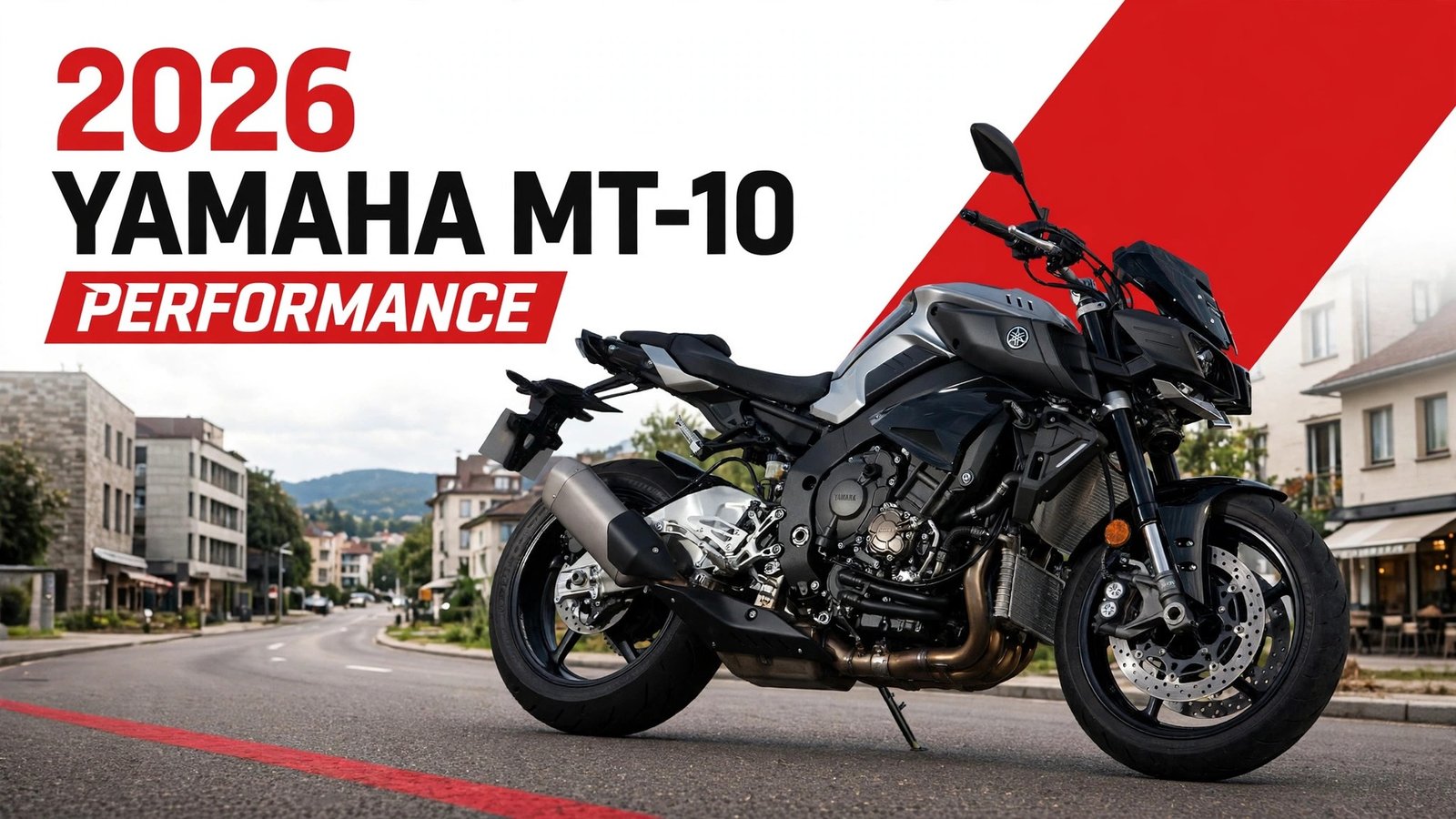
The short version of Yamaha MT-10 performance is this: a 998cc crossplane-crank inline-four, a Rider dyno reading of 138.5 rear-wheel horsepower, an official 36 mpg estimate, and a 4.5-gallon tank that makes range the real-world limit. What Yamaha MT-10 performance lacks, in any published American test found here, is a verified stock top speed or instrumented acceleration test of the current bike. Gen-1 FZ-10 numbers appear with their generation attached. The broader standard MT-10 review covers the whole motorcycle; this one focuses on Yamaha MT-10 performance.
Yamaha MT-10 performance starts with the CP4 engine, an R1-derived 998cc inline-four whose uneven firing order sounds closer to a V4 than a conventional four-cylinder. Yamaha claims 163.6 hp at 11,500 rpm and 82.6 lb-ft at 9,000 rpm, but those are European figures, since Yamaha publishes no US horsepower numbers.
| Yamaha MT-10 performance figure | Value | Source and status |
|---|---|---|
| Rear-wheel horsepower (standard) | 138.5 hp at 10,200 rpm | Rider 2023 tour test dyno |
| Rear-wheel torque (standard) | 76.5 lb-ft at 9,000 rpm | Rider 2023 tour test dyno |
| 0-60 mph (gen-1 FZ-10) | 2.9 seconds | Cycle World gen-1 test |
| Quarter mile (gen-1 FZ-10) | 10.77 seconds at 130.30 mph | Cycle World gen-1 test |
| Top speed, gen-2 standard | No verified US test found | MCN spec listing only |
| Fuel range | About 162 miles at 36 mpg | 4.5-gallon tank calculation |
Yamaha MT-10 Engine Performance and Power Delivery
Yamaha MT-10 performance is built around the CP4 engine, whose character matters as much as its peak numbers. The 2022 redesign retuned it for stronger midrange torque, with revised injection, a redesigned intake and exhaust, and 40-percent more crank inertia.
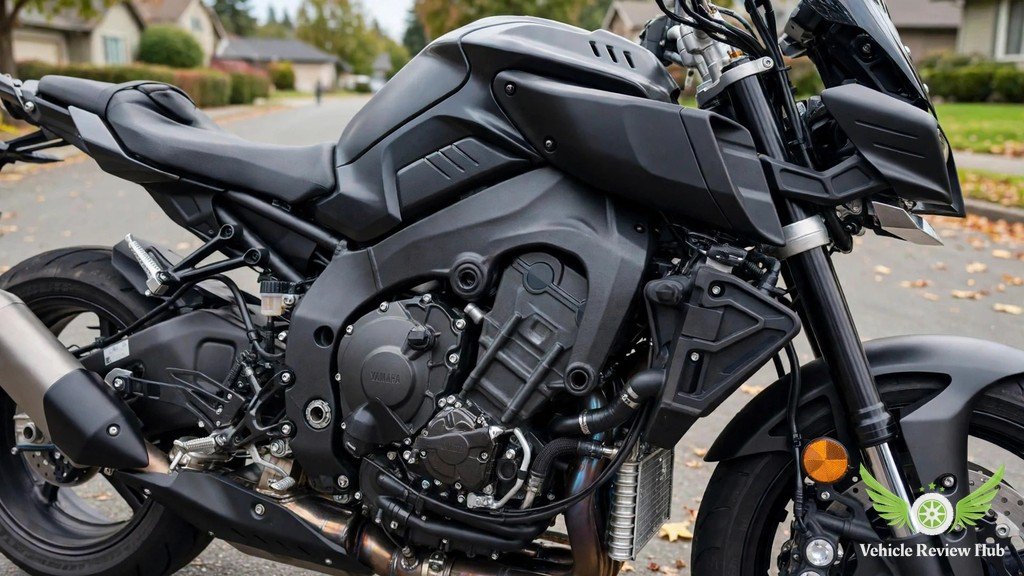
Rider Dyno 138.5 RWHP for the Standard Bike, Not the SP Dyno
The headline dyno figure for Yamaha MT-10 performance comes from the Rider tour test of a 2023 standard MT-10: 138.5 rear-wheel horsepower at 10,200 rpm and 76.5 lb-ft at 9,000 rpm. That is the standard bike’s number, and it must never be swapped with the SP’s. Cycle World’s SP measured 134.4 on its own dyno in a standalone test and 134.5 in a comparison test; the gap to Rider’s 138.5 proves nothing, since the bikes, dynos, and days differ. For Yamaha MT-10 performance, the two share essentially the same engine tune; the MT-10 SP performance budget goes into suspension, brakes, and styling, not extra power. Rider’s 2022 coverage quoted 138 hp at 9,400 rpm for the previous model.
Six-Speed Transmission, Gear Shifting and CP4 Power Delivery
Yamaha MT-10 performance depends on a six-speed gearbox with an up-and-down quickshifter standard from 2022, plus an assist-and-slipper clutch. The quickshifter allows clutchless shifts in both directions, keeping the chassis settled and smoothing downshifts. The assist function lightens lever effort, while the slipper function prevents rear-wheel hop on downshifts. First gear is tall, good for roughly 75 mph, and second and third gear cover most back-road riding. Ride-by-wire throttle and four power modes let the rider soften or sharpen response for Yamaha MT-10 performance.
Yamaha MT-10 Top Speed and Acceleration
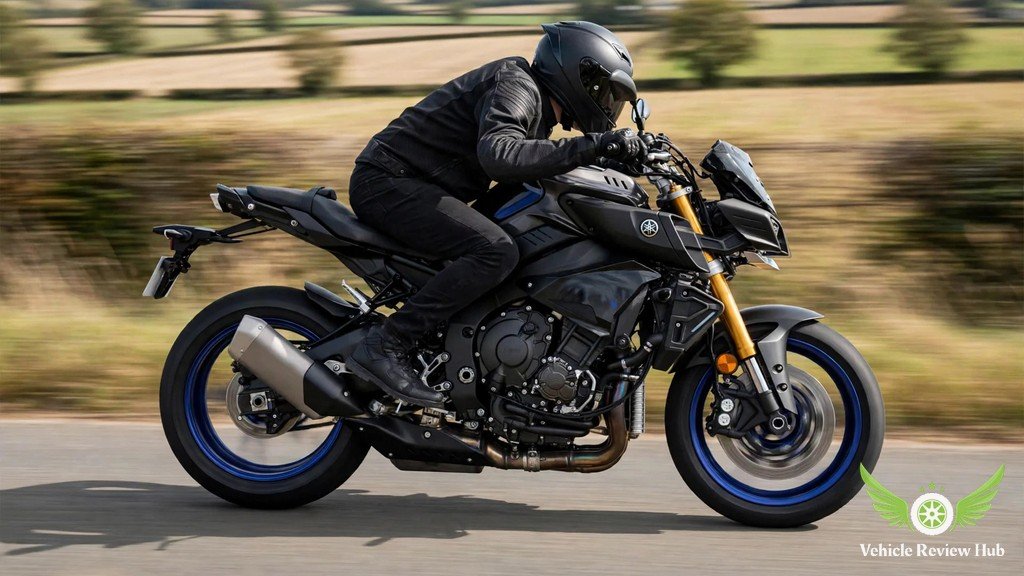
Yamaha MT-10 performance at full throttle feels superbike-fast, but the current standard bike has no instrumented American acceleration or top-speed test in published testing.
Why No Verified Stock Top Speed or Gen-2 US Test Was Found
No verified stock top speed or gen-2 US acceleration test for the standard MT-10 surfaced in published American testing for Yamaha MT-10 performance. First-ride reviews describe the experience, but neither produced an instrumented run. Two figures circulate that look like answers and are not. MCN’s UK spec page lists 160 mph for the 2022-on standard bike, but it is a listing, not a GPS-verified test. The other figure, 155 mph, is Bennetts’ European estimate for the SP, a different motorcycle, covered in MT-10 SP performance coverage. For Yamaha MT-10 performance, the honest summary: a stock gen-2 bike will run well past any legal US speed, capped somewhere in the 150-160 mph region, with no instrumented US figure published.
MCN’s launch video below is a first-ride impression, not an instrumented test.
Gen-1 FZ-10 Tested 0-60 in 2.9 Seconds and Quarter Mile in 10.77 Seconds
The only instrumented acceleration figures with a tester’s name attached to this family come from the first generation. Cycle World’s test of the 2017 FZ-10, the North American name for the original MT-10, recorded 0-60 mph in 2.9 seconds, 0-100 mph in 6.2 seconds, and a quarter mile of 10.77 seconds at 130.30 mph. The same Cycle World FZ-10 test logged 40-60 mph in 2.6 seconds and 60-80 mph in 2.8 seconds in top gear, the more useful measure of Yamaha MT-10 performance: roll-on punch. Those figures describe a 468 lb tank-full motorcycle with a 55.1-inch wheelbase, a 32.5-inch seat, and S20 tires. They do not describe the current bike, 467 lb wet with a 55.3-inch wheelbase, a 32.9-inch seat, and S22 tires. Used as what they are, they set a sensible expectation: the gen-1 bike was already sub-three-second, and gen-2 should be in the same territory.
Yamaha MT-10 Mileage and Fuel Economy
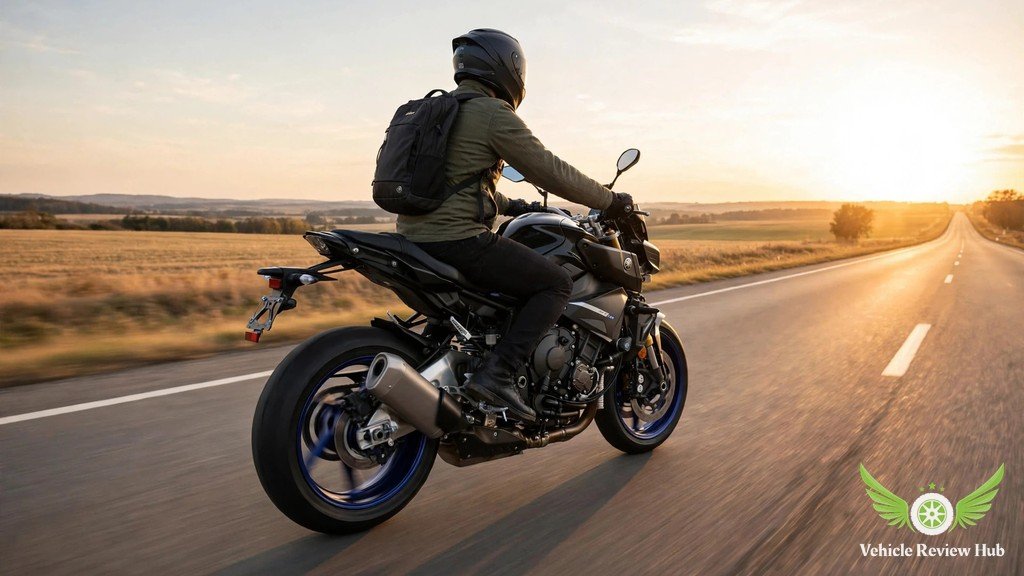
Yamaha MT-10 performance comes with a fuel bill. Yamaha’s official estimate is 36 mpg, the 4.5-gallon tank gives roughly 162 miles at that figure, and real-world riding lands below it.
Official Yamaha 36 MPG Estimate and Estimated US Fuel Range
Yamaha lists 36 mpg for the MT-10, the right starting point for Yamaha MT-10 performance discussions, and the official Yamaha MT-10 page carries the same tank. The range math: 36 mpg times 4.5 gallons equals 162 miles to empty. Nobody rides to empty, so plan fuel stops every 130-150 miles. Cycle World’s gen-1 test averaged 32 mpg, with a 144-mile range including reserve. At 32 mpg range is 144 miles; at 30 mpg, 135 miles; at 27 mpg, 120 miles.
| Riding scenario | Fuel economy (US mpg) | Estimated range on 4.5 gallons |
|---|---|---|
| Yamaha official estimate | 36 mpg | 162 miles |
| Cycle World gen-1 test average | 32 mpg | 144 miles |
| Fuelly owner logs, gen-2 bikes | About 30-39 mpg per tank | 135-175 miles |
| Planning figure for most riders | 32-34 mpg | About 145-150 miles |
Real-World MPG, UK Imperial Conversion and Fuelly Owner Data Limits
UK reviews of Yamaha MT-10 performance often quote figures that look better than American ones, and the reason is the gallon, not the motorcycle. A UK imperial gallon is about 1.2 US gallons, so divide imperial mpg by 1.2 for the US equivalent. MCN’s UK page lists 41 mpg for the 2022-on standard bike, but that is imperial, equal to about 34.2 mpg US, close to 36 mpg. Bennetts’ guide for the earlier bike reports Yamaha claiming 35 mpg with owners reckoning closer to 30 mpg gently, again imperial, equal to about 29.2 and 25 mpg US, plus a fuel warning light near 90 miles on gen-1. Always check which gallon a source uses before comparing with Yamaha MT-10 performance figures.
Fuelly owner data tells a similar story with important limits. The Fuelly MT-10 page aggregates a small sample: its 2016 entries show 28.8 average mpg across 401 fuel-ups and nearly 37,000 tracked miles, while gen-2 logs show tanks roughly between 30 and 39 mpg, including a 2023 bike between about 33 and 39 mpg. The limits matter: the sample is tiny and self-selected, it mixes gen-1 and gen-2 bikes on one page, it publishes no SP-versus-standard split, partial fill-ups distort individual tanks, and one owner’s style can dominate an average. Used honestly, Fuelly supports a planning figure in the low-to-mid 30s for Yamaha MT-10 performance.
Yamaha MT-10 Real-World Riding Performance
Yamaha MT-10 performance in daily use is more than dyno numbers.
City Riding, Traffic Performance and Everyday Acceleration
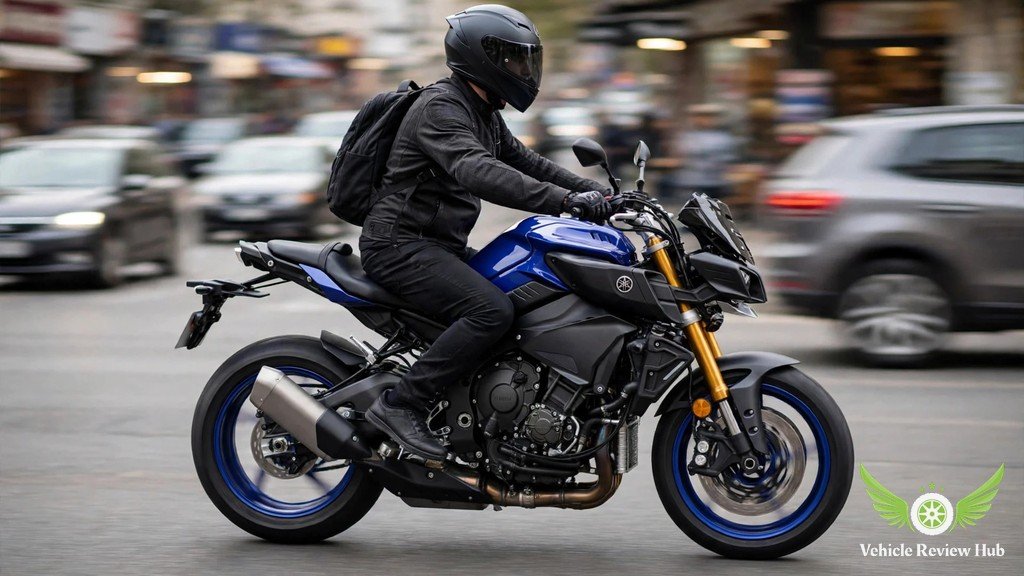
In city traffic, Yamaha MT-10 performance is surprisingly manageable for a 467 lb liter bike. First, the CP4 feels slightly dull below 4,000 rpm, so keep revs midrange. Second, the 32.9-inch seat, 10mm higher than gen-1, and the 467 lb weight demand attention at stops. The ride-by-wire throttle is smooth in gentler power modes, the assist clutch keeps effort light, and the quickshifter eases low-speed changes. Everyday acceleration is instant, with partial throttle in second or third gear clearing gaps. That dual personality defines Yamaha MT-10 performance.
Highway Riding, Overtaking Ability and Long-Distance Limitations
On the highway, Yamaha MT-10 performance shines in one area and struggles in two. Overtaking is effortless: midrange torque means a top-gear roll-on is usually enough. Standard cruise control eases long stretches, and the small flyscreen cowl removes neck strain at motorway speeds for average-height riders, though very tall riders report a wind vortex at the helmet. The limitations are wind and range: the flyscreen offers little protection, so sustained high-speed riding means full wind blast, and the tank caps highway range at roughly 150 miles. Yamaha MT-10 performance is therefore a brilliant overtaking tool but a mediocre tourer, and the MT-10 reliability picture covers consumables.
Yamaha MT-10 Handling, Braking and Stability
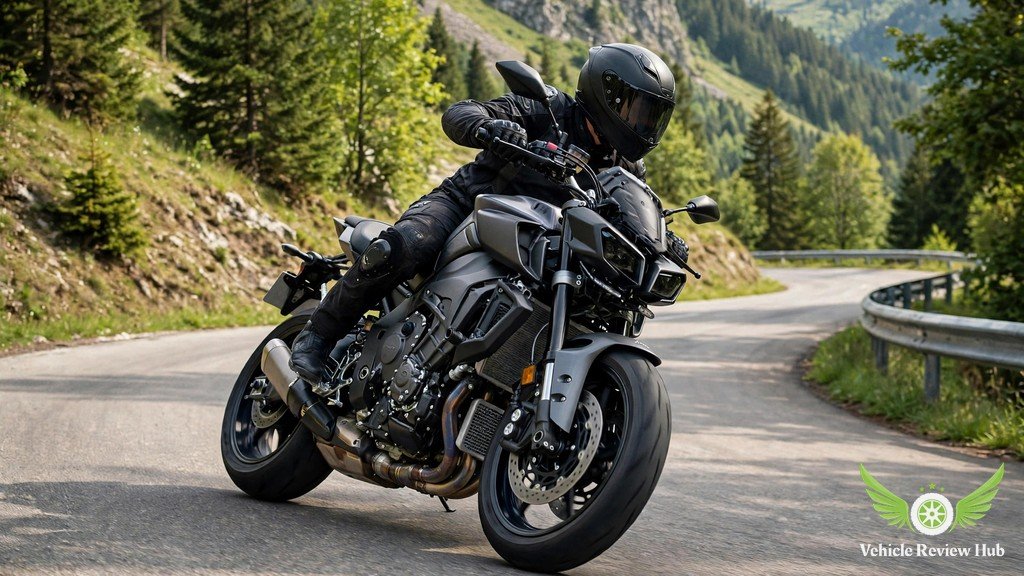
Yamaha MT-10 performance is not only straight-line speed; the chassis lets ordinary riders use its power. With an R1-derived Deltabox frame, a 55.3-inch wheelbase, and a six-axis IMU suite from 2022 on, the standard bike handles like the SP on the road for most riders.
KYB Suspension, Deltabox Chassis, Tires and Cornering Performance
The standard bike’s headline chassis difference from the SP is its suspension: a fully adjustable 43mm KYB inverted fork and a fully adjustable KYB piggyback shock, each with 4.7 inches of travel, replacing the SP’s Öhlins hardware. For Yamaha MT-10 performance on the road, that is a trade, not a downgrade. The KYB units adjust manually with tools rather than through the TFT, cost less to service at any shop, and testers rate them highly, one calling the setup better than nearly every other KYB-suspended bike it could remember. The Deltabox frame uses the engine as a stressed member, with 24.0 degrees of rake and 4.0 inches of trail, and the 55.3-inch wheelbase is shorter than most rivals. Tires are Bridgestone Battlax Hypersport S22 in 120/70ZR17 front and 190/55ZR17 rear, the same sizes as the SP, and Yamaha MT-10 performance in corners comes from the whole chassis, not horsepower alone. Gen-1 bikes also used KYB suspension, but with a 55.1-inch wheelbase, a 32.5-inch seat, and S20 tires, and no IMU.
Brembo Master Cylinder, Advics Calipers and ABS Features
Yamaha MT-10 performance under braking comes from dual 320mm front discs with radial four-piston calipers, a Brembo radial master cylinder added for 2022, and a 220mm rear disc. Two details separate the standard bike from the SP. First, the calipers are Advics four-piston radial units, not Brembo; the Brembo part is the master cylinder only. Second, braided steel brake lines are SP-exclusive and do not come standard on the base bike, which uses conventional lines. Yamaha’s Brake Control works with lean-sensitive ABS, driven by the six-axis IMU, to reduce slip at lean; testers found the 2022 brakes sharper than gen-1’s, if slightly wooden near the limit versus the latest Brembo stoppers. Cycle World’s gen-1 test measured 127 feet from 60-0 mph and 34 feet from 30-0 mph; no gen-2 equivalent surfaced, so those figures carry their generation attached.
Yamaha MT-10 Performance Compared With Other Liter Naked Bikes
Yamaha MT-10 performance only makes full sense in context. The standard bike sits mid-pack on price, below the European flagships on power, and ahead of most on value. The comparison below uses manufacturer-rated figures, because mixing claimed and dyno figures misleads.
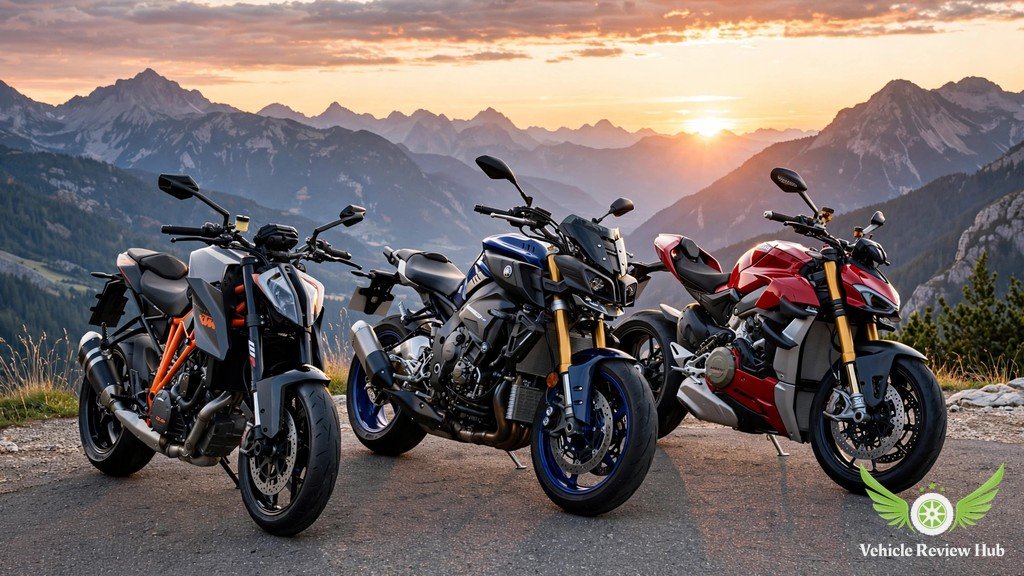
Yamaha MT-10 vs MT-10 SP, BMW S 1000 R and Aprilia Tuono V4
Against its SP sibling, Yamaha MT-10 performance is effectively identical in a straight line. The two share the same engine tune, and the SP’s premium of $2,500 to $3,000 in most years, narrowing to $2,300 in 2025, buys Öhlins suspension, braided lines, a polished swingarm, a color-matched fairing, and exclusive paint, plus 5 lb. The MT-10 SP review covers that hardware. Against the Europeans, the standard bike gives away displacement and power but wins on price. The BMW and Aprilia comparison rates the BMW S 1000 R at 170 hp from 999cc and 199 kg, and the Aprilia Tuono V4 1100 Factory at 180 hp from 1,099cc and 211 kg. The Yamaha’s claimed 163.6 hp and 212 kg put it behind both on paper, yet its shorter wheelbase and lower price keep it competitive on real roads, where midrange torque matters more. Riders stepping up from YZF-R3 performance levels or YZF-R7 performance territory should treat the standard MT-10 as a multi-step jump.
| Motorcycle | Displacement | Claimed power | Weight | Fuel capacity |
|---|---|---|---|---|
| Yamaha MT-10 (standard) | 998cc | 163.6 hp (EU claimed) | 467 lb / 212 kg | 4.5 gal / 17 L |
| Yamaha MT-10 SP | 998cc | 163.6 hp (EU claimed) | 472 lb / 214 kg | 4.5 gal / 17 L |
| BMW S 1000 R | 999cc | 170 hp (rated) | 199 kg | 16.5 L |
| Aprilia Tuono V4 1100 Factory | 1,099cc | 180 hp (rated) | 211 kg | 211 kg |