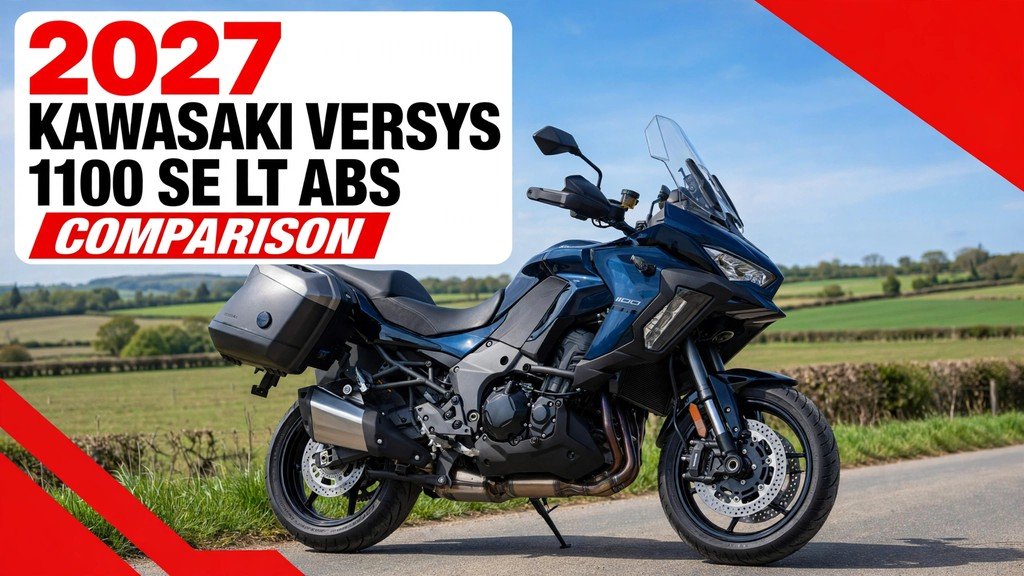
The short answer in this Kawasaki Versys 1100 SE LT ABS comparison is that the Versys is the most expensive bike in its own group. The 2027 SE LT ABS costs $20,639 delivered — $819 more than the 170 hp BMW S 1000 XR, $4,440 more than the Suzuki V-Strom 1050 and $7,340 more than the Yamaha Tracer 9. The comparison turns on what that money buys: the Versys is the only one of the four that arrives with everything fitted at a single price.
None of the three rivals is a bad bike. The V-Strom is the twin, the Tracer is the triple, and the XR is the sport four, and each one beats the Versys somewhere that matters.
Kawasaki Versys 1100 SE LT ABS Overview and Its Closest Rivals
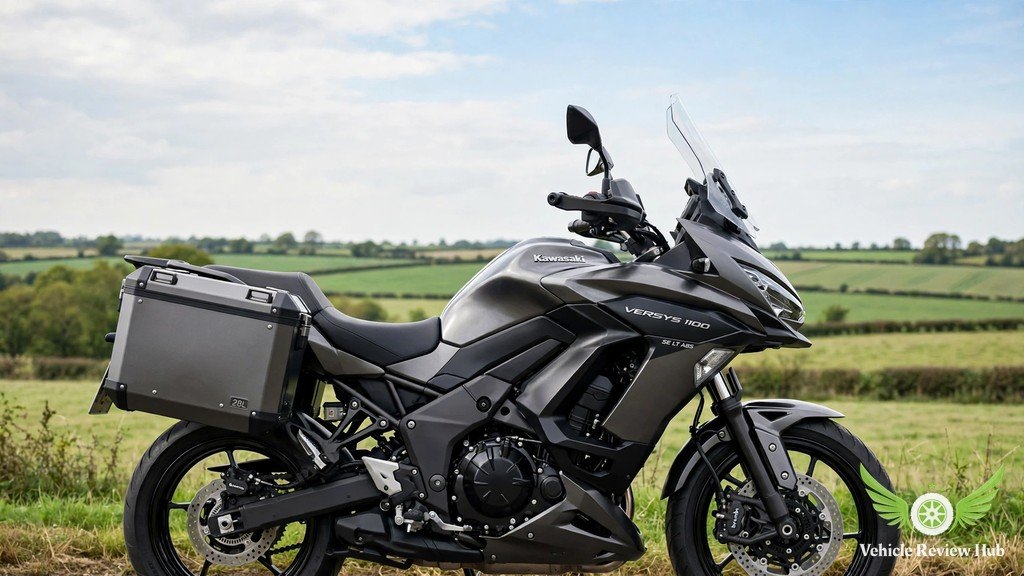
The three rivals in this Kawasaki Versys 1100 SE LT ABS comparison answer the Versys from a different direction. The V-Strom 1050 is the twin: Suzuki’s 1,037cc V-twin. The Tracer 9 is the triple: Yamaha’s 890cc CP3, the lightest and cheapest bike here. The S 1000 XR is the sport four: BMW’s 999cc four with 170 hp, and still cheaper delivered than the Versys.
Why These Three Rivals: Twin, Triple, Sport Four
The engine layout is the honest way to tell these four apart, and this Kawasaki Versys 1100 SE LT ABS comparison starts there. The Versys runs a 1,099cc inline-four with 133 hp at 9,000 rpm and 82.5 lb-ft at 7,600 rpm, measured to ISO 4106. The V-Strom runs a 1,037cc V-twin with 106 hp at 8,500 rpm and 74 lb-ft at 6,000 rpm. The Tracer runs an 890cc inline-triple with 119 hp and 68 lb-ft. The XR runs a 999cc inline-four with 170 hp at 11,000 rpm and 84 lb-ft at 9,250 rpm.
How the Four Bikes Differ at a Glance
The table below is the whole comparison on one page, and this Kawasaki Versys 1100 SE LT ABS comparison uses 2026 figures for the rivals and the 2027 figure for the Versys.
| Bike | Engine | Power | Torque | Weight | Seat | Tank | Delivered |
|---|---|---|---|---|---|---|---|
| Versys 1100 SE LT ABS (2027) | 1,099cc inline-four | 133 hp @ 9,000 rpm | 82.5 lb-ft @ 7,600 rpm | 571.1 lb curb | 33.1 in | 5.5 gal | $20,639 |
| Suzuki V-Strom 1050 (2026) | 1,037cc V-twin | 106 hp @ 8,500 rpm | 74 lb-ft @ 6,000 rpm | 534 lb curb | 33.7 in | 5.3 gal | $16,199 |
| Yamaha Tracer 9 (2026) | 890cc inline-triple | 119 hp | 68 lb-ft | 485 lb wet | 31.9 in | 5.0 gal | $13,299 |
| BMW S 1000 XR (2026) | 999cc inline-four | 170 hp @ 11,000 rpm | 84 lb-ft @ 9,250 rpm | 500 lb wet | 33.5 in | 5.2 gal | $19,820 |
Notes for this Kawasaki Versys 1100 SE LT ABS comparison table: delivered prices are MSRP plus destination for the year shown. The Versys weight excludes its panniers; the Tracer and XR weights are wet figures. The Versys power figure carries Kawasaki’s ISO 4106 footnote, and the only dyno figure for the 1100 is a UK wheel figure of 119 bhp from Bike magazine, reported secondhand.
Kawasaki Versys 1100 SE LT ABS vs Suzuki V-Strom 1050
The V-Strom 1050 is the oldest rivalry in this Kawasaki Versys 1100 SE LT ABS comparison: two big Japanese adventure tourers, one with a V-twin and one with an inline-four. Our V-Strom 1050 review covers the Suzuki in full.
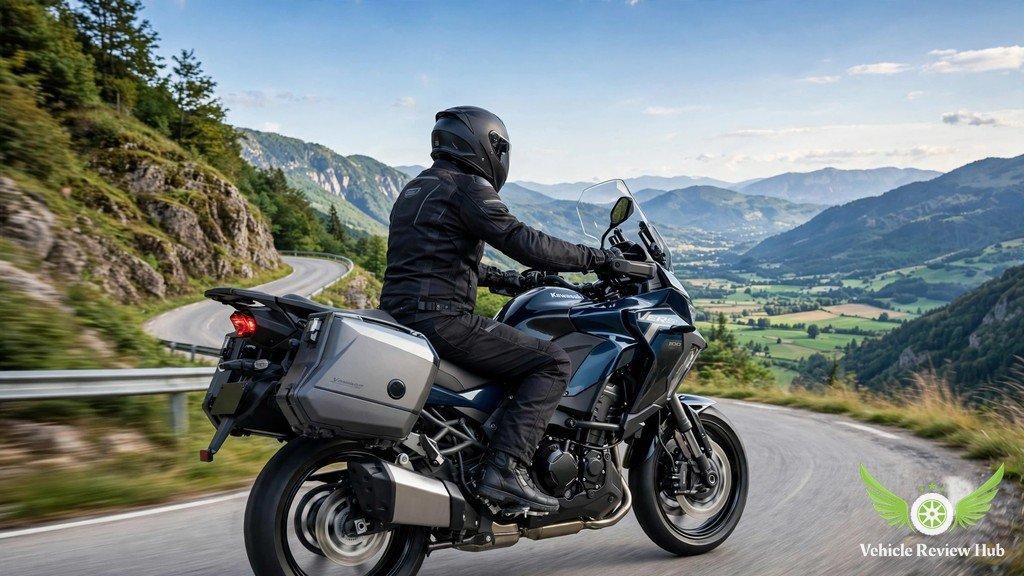
Engine, Specs and Performance Side by Side
On paper the Versys wins the engine argument, and this Kawasaki Versys 1100 SE LT ABS comparison does not hide that: 133 hp against 106 hp is a 27 hp gap, and 82.5 lb-ft against 74 lb-ft is the torque gap that shows up every time the road rises. The V-twin answers with character: the Suzuki pulls cleanly from 1,800 rpm in top gear, it is easier to ride slowly than the Versys, and its 33.7-inch seat is the tallest of the four.
The weight gap is smaller than the power gap in this Kawasaki Versys 1100 SE LT ABS comparison: the V-Strom is 534 lb at the curb, 37 lb under the Versys before panniers, and its 5.3-gallon tank gives it a 217 to 248 mile range.
| Figure | Versys 1100 SE LT ABS | V-Strom 1050 |
|---|---|---|
| Engine | 1,099cc inline-four | 1,037cc V-twin |
| Power | 133 hp @ 9,000 rpm | 106 hp @ 8,500 rpm |
| Torque | 82.5 lb-ft @ 7,600 rpm | 74 lb-ft @ 6,000 rpm |
| Curb weight | 571.1 lb (bags excluded) | 534 lb |
| Seat height | 33.1 in | 33.7 in |
| Tank | 5.5 gal | 5.3 gal |
| Warranty | 24 months limited | 12 months |
| Delivered price | $20,639 (2027) | $16,199 (2026) |
Notes for this Kawasaki Versys 1100 SE LT ABS comparison table: the Versys price is the 2027 delivered figure and the V-Strom price is the 2026 delivered figure. The V-Strom seat is dual-height at 33.7 or 34.5 inches.
Price, Equipment and Which Suits Which Rider
The $4,440 price gap is the V-Strom’s whole case, and this Kawasaki Versys 1100 SE LT ABS comparison states it plainly: the 2026 V-Strom 1050 costs $16,199 delivered against the 2027 Versys at $20,639. What the gap buys on the Versys side is equipment the Suzuki does not include at all: no TFT display, no included luggage, a halogen headlight, no semi-active suspension and a 12-month warranty on the base 1050, against the full Skyhook, panniers, grips, guards, centre stand, cruise control, quickshifter and cornering lights kit, all standard on the Versys.
The Versys suits the rider who wants the full touring kit without shopping for accessories. The V-Strom suits the rider who prefers the V-twin character, wants the simpler bike, and would rather spend the $4,440 on luggage and trips than on electronics. The smaller sibling in our Versys 650 comparison shows the same pattern at a lower price.
Kawasaki Versys 1100 SE LT ABS vs Yamaha Tracer 9
The Tracer 9 is the value pick in this Kawasaki Versys 1100 SE LT ABS comparison: the 2026 Tracer 9 costs $13,299 delivered.
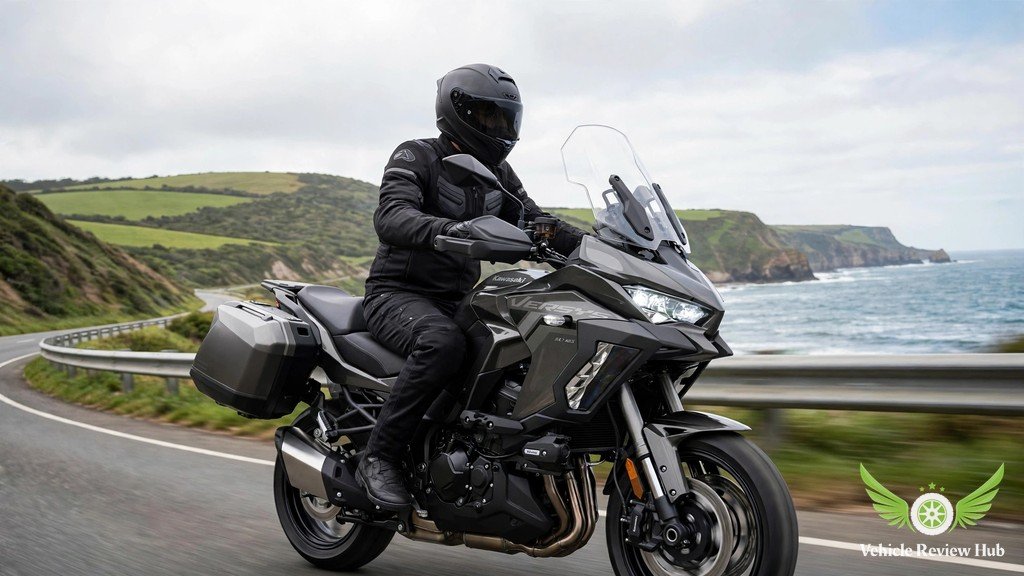
Engine, Specs and Performance Side by Side
The triple is the keener engine and the weaker one at the same time, and this Kawasaki Versys 1100 SE LT ABS comparison says both halves. The Tracer 9’s 890cc CP3 makes 119 hp and 68 lb-ft, 14 hp and 14.5 lb-ft down on the Versys, so the Versys pulls harder from 2,000 to 7,000 rpm and carries a passenger and luggage with less effort. The Tracer answers with weight: at 485 lb wet it is 86 lb under the Versys.
Fuel economy is the Tracer’s other win. In the 1000PS comparison test the Tracer 9GT+ returned 4.4 litres per 100 km, or 53.5 mpg US, against the Versys 1100’s 5.5 litres per 100 km, or 42.8 mpg US. That test used the higher-spec GT+ trim, so this Kawasaki Versys 1100 SE LT ABS comparison labels the trim: the base Tracer 9 is the doc rival, and the GT+ figures belong to the GT+.
Price, Equipment and Which Suits Which Rider
The $7,340 gap buys a different kind of bike, not a worse one. The base Tracer 9 carries less standard touring kit than the Versys SE LT: no semi-active suspension on the base bike, no heated grips and hand guards as standard. The GT+ trim adds the semi-active suspension at a higher price. The Versys answers with the full kit at one price and a 24-month warranty.
The Tracer suits the rider who values lightness, agility and price above all. The Versys suits the rider who wants the touring kit fitted at the dealer, the bigger engine for two-up work, and the Skyhook suspension for loaded highway days. A rider cross-shopping the two should also look at our Ninja 1100SX ABS comparison and our Versys 1000 S comparison.
Kawasaki Versys 1100 SE LT ABS vs BMW S 1000 XR
The XR section is where this Kawasaki Versys 1100 SE LT ABS comparison gets uncomfortable for the Kawasaki: the BMW is faster, lighter and cheaper at $19,820 delivered, $819 under the 2027 Versys.
The video below is InMoto’s Italian-language comparison of four four-cylinder crossovers: the BMW S 1000 XR, the Honda CB1000GT, the Kawasaki Versys 1100 SE and the Suzuki GSX-S1000GX. Only the XR is one of this comparison’s three rivals, and the audio is Italian throughout. The timestamps are the way in: Versys features and price at 03:58, road test at 36:04, report card at 53:57, winner at 55:04.
Engine, Specs and Performance Side by Side
The engine gap is the biggest one in this Kawasaki Versys 1100 SE LT ABS comparison: 170 hp at 11,000 rpm against 133 hp at 9,000 rpm, and 84 lb-ft at 9,250 rpm against 82.5 lb-ft at 7,600 rpm. The XR is also 71 lb lighter at 500 lb wet, and BMW claims a top speed over 155 mph, while the Versys has no official or measured top speed. The Motorcycle.com first ride scored the Versys 84.0% overall and praised the torque above all else.
The Versys’ midrange is its real defence: the Cycle News first ride says the engine has acres of beefy torque from 2,000 to 7,000 rpm and pulls like a tractor, and the RevZilla first ride reaches the same verdict. The XR’s power lives higher up the rev range, and its position is more aggressive. The Versys seat is 33.1 inches against the XR’s 33.5 inches standard, with a 31.1-inch low option.
| Figure | Versys 1100 SE LT ABS | S 1000 XR |
|---|---|---|
| Engine | 1,099cc inline-four | 999cc inline-four |
| Power | 133 hp @ 9,000 rpm | 170 hp @ 11,000 rpm |
| Torque | 82.5 lb-ft @ 7,600 rpm | 84 lb-ft @ 9,250 rpm |
| Weight | 571.1 lb curb (bags excluded) | 500 lb wet |
| Seat height | 33.1 in | 33.5 in (31.1 in low) |
| Tank | 5.5 gal | 5.2 gal |
| Top speed | No figure published | Over 155 mph (maker claim) |
| Warranty | 24 months limited | 36 months / 36,000 mi |
| Delivered price | $20,639 (2027) | $19,820 (2026) |
Notes for this Kawasaki Versys 1100 SE LT ABS comparison table: the Versys price is the 2027 delivered figure and the XR price is the 2026 delivered figure. The XR top speed is BMW’s claim, not a test result, and the Versys has no published top speed figure.
Price, Equipment and Which Suits Which Rider
The price gap runs the wrong way for the Versys, and this Kawasaki Versys 1100 SE LT ABS comparison does not soften it: the 2027 Versys at $20,639 delivered costs $819 more than the 2026 XR at $19,820 delivered. The Versys’ defence is the equipment list, all standard: Skyhook suspension, 28-litre panniers, heated grips, hand guards, centre stand, cruise control, quickshifter and cornering lights. The XR’s base price excludes the equipment the Versys includes, and optioning the XR up to the same spec costs around $21,000, according to Cycle News on 2025 prices. The XR also carries the longer warranty at 36 months and 36,000 miles against the Versys’ 24 months.
The XR suits the rider who wants the power and the sharper, sportier position and will add luggage and grips as options. The Versys suits the rider who wants the full touring kit at one price, the softer midrange pull for two-up work, and the more relaxed position for long days. The Ultimate Motorcycling review lists the same standard kit and the same $19,499 launch price for the 2025 Versys.
Kawasaki Versys 1100 SE LT ABS Price and Value Compared
Price is where this Kawasaki Versys 1100 SE LT ABS comparison stops being a spec sheet. The 2027 SE LT ABS costs $20,639 delivered.
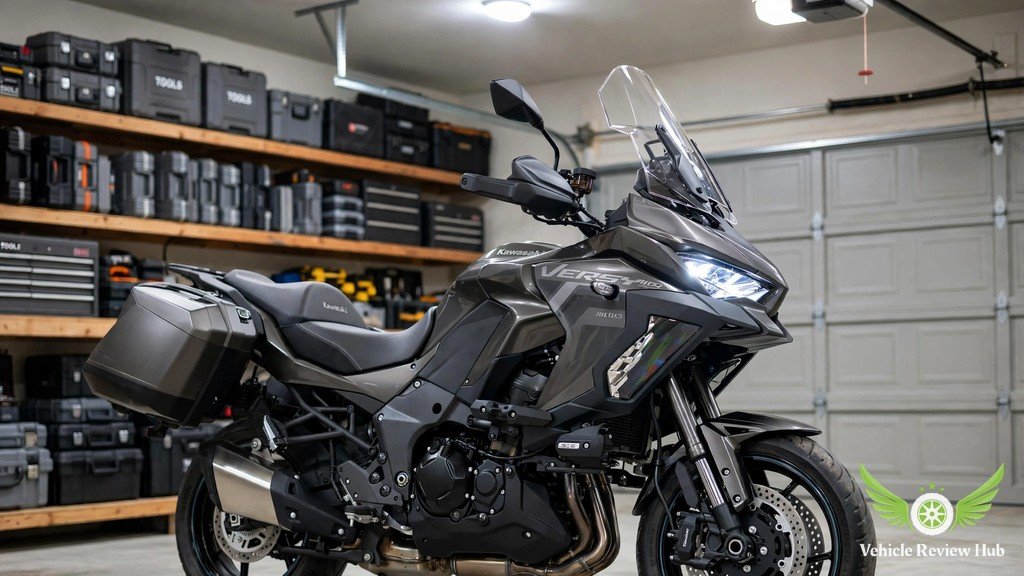
Price Now Overlaps the 170 HP BMW
The Versys’ defence is the one-price argument, and this Kawasaki Versys 1100 SE LT ABS comparison gives it fairly. The XR’s $19,820 buys the faster bike but not the touring kit, and Cycle News put the cost of optioning the XR up to the same spec at around $21,000 on 2025 prices. The Versys includes all of it at $20,639.
| Bike | MSRP | Destination | Delivered | Year |
|---|---|---|---|---|
| Yamaha Tracer 9 | $12,599 | $700 | $13,299 | 2026 |
| Suzuki V-Strom 1050 | $15,499 | $700 | $16,199 | 2026 |
| BMW S 1000 XR | $18,825 | $995 | $19,820 | 2026 |
| Versys 1100 SE LT ABS | $19,499 | $815 | $20,314 | 2025 |
| Versys 1100 SE LT ABS | $19,799 | $840 | $20,639 | 2027 |
| BMW R 1300 GS | $20,395 | $1,095 | $21,490 | 2026 |
| Honda NT1100 DCT | $11,999 | $775 | $12,774 | 2026 |
| Suzuki GSX-S1000GX+ | $18,499 | $460 | $18,959 | 2026 |
Notes for this Kawasaki Versys 1100 SE LT ABS comparison table: delivered prices are MSRP plus destination for the year shown. There is no 2026 US Versys 1100 model year, so no 2026 Versys price is printed. The NT1100 panniers are a $1,196 accessory, not standard.
Running Costs and Resale Value Compared
Running costs favour the lighter bikes, and this Kawasaki Versys 1100 SE LT ABS comparison keeps the figures labelled. The Versys has no tested US fuel figure: its 42 mpg US is Kawasaki’s claim converted from 50.4 mpg imperial, not a test, while the Tracer 9GT+ returned 53.5 mpg US and the Versys 1100 returned 42.8 mpg US in the 1000PS test. Services fall every 7,600 miles or 12 months on the Versys, with oil, filter and spark plugs at every service, and the valve check at 15,000 miles in the US. No US dealer service price was found; the only servicing figure on record is the single UK owner’s £300 a year, labelled as UK.
Resale is the honest blank in this Kawasaki Versys 1100 SE LT ABS comparison: no US resale data exists for a one-year-old model, so no resale figure or depreciation percentage is printed here. The only evidence is the platform’s longevity — older Versys 1000s with six-digit mileage exist — and UK used prices of £10,000 to £15,700. The Skyhook service cost is also unpublished anywhere, so no figure is printed for it either.
Kawasaki Versys 1100 SE LT ABS Comparison Verdict and US Alternatives
The verdict in this Kawasaki Versys 1100 SE LT ABS comparison is that the Versys is the best-equipped bike in the group and the worst value on the sticker. The 1000PS comparison test rated the Versys 1100 SE 4.5 out of 5, calling its electronic suspension in a class of its own and its passenger seat like a second living room.
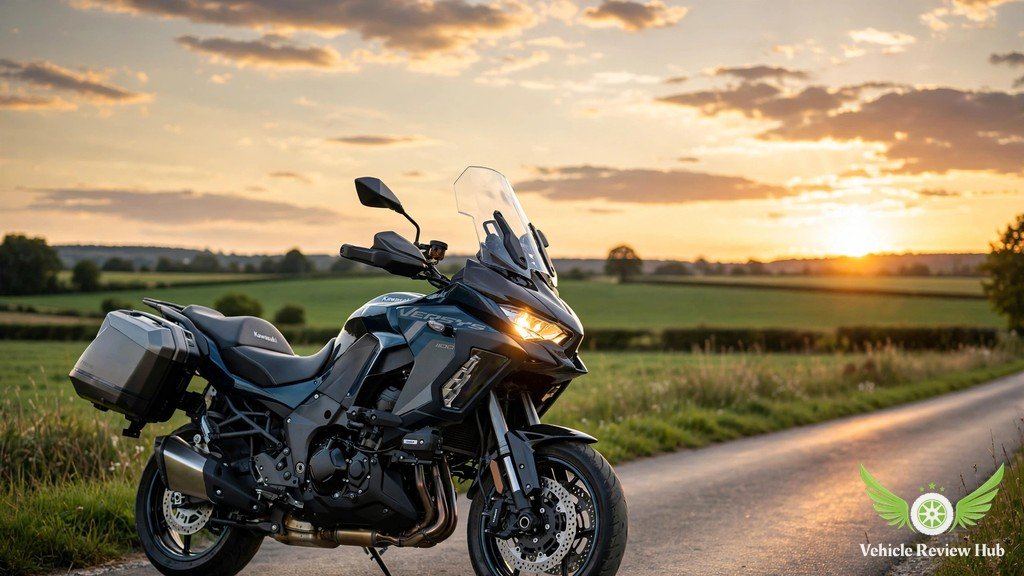
Verdict: Everything Standard, One Price
Buy the Versys if you want the full touring kit without shopping for options, and this Kawasaki Versys 1100 SE LT ABS comparison is blunt about who that is: the rider who tours two-up, loads the panniers, rides in all weather and wants the dealer to hand over a finished bike. The torque from 2,000 to 7,000 rpm is the engine the kit deserves. The press verdicts agree on the rest too: the seat is far too stiff, the vibration splits the testers at 6,000 or 8,000 rpm, and the windscreen needs two hands.
Buy a rival if the kit is not the priority: the XR for 170 hp, the Tracer for the lightest and cheapest bike, the V-Strom for the V-twin and the $4,440 saving. The Versys 1000 SE LT+, the predecessor, is the used-bike version of the same argument: the 2023 bike cost $19,359 delivered, and our Versys 1000 S comparison covers what the old bike gives up. The MCN Versys 1100 page rates the 1100 4 out of 5 overall and 5 out of 5 for reliability.
R 1300 GS Alternative
The R 1300 GS is the alternative for the rider who wants something the Versys cannot offer, and this Kawasaki Versys 1100 SE LT ABS comparison prices it honestly: the 2026 base GS costs $21,490 delivered, only $851 over the 2027 Versys, with a 1,300cc boxer twin, 143 hp at 7,750 rpm, 110 lb-ft, shaft final drive, real off-road ability, a 522 lb wet weight, and the same 36-month and 36,000-mile warranty as the XR. It is not a cheaper Versys: it carries less standard touring kit at base price, and dealer listings show optioned GS bikes at $28,000 and more. The budget alternative is the Honda NT1100 DCT at $12,774 delivered, which undercuts the Versys by $7,865 with a 1,084cc twin, 101 hp and 86.2 lb-ft — but its panniers are a $1,196 accessory, not standard, and it is DCT-only in the US. Our NT1100 DCT review covers that bike in full. The sport-touring alternative is the Suzuki GSX-S1000GX+ at $18,959 delivered.
Kawasaki Versys 1100 SE LT ABS Comparison: Frequently Asked Questions
Direct answers to the Kawasaki Versys 1100 SE LT ABS comparison questions buyers ask.
Which bike wins this comparison?
It depends on the rider. This Kawasaki Versys 1100 SE LT ABS comparison finds the Versys wins on standard equipment, the XR on power, the Tracer on lightness and price, and the V-Strom on twin character and value. No single bike wins all four.
Is the Versys 1100 SE LT ABS worth $20,639?
Yes, if you want the kit. This Kawasaki Versys 1100 SE LT ABS comparison notes the $20,639 delivered price includes Skyhook suspension, 28-litre panniers, heated grips, hand guards, a centre stand, cruise control, a quickshifter and cornering lights — optioning the XR to the same spec costs around $21,000.
Why does the Versys cost more than the BMW S 1000 XR?
Because the Versys includes the touring kit and the XR does not. This Kawasaki Versys 1100 SE LT ABS comparison shows the 2027 Versys at $20,639 delivered against the 2026 XR at $19,820 delivered, a gap of $819, while the XR’s base price excludes the kit the Versys includes.
Is the V-Strom 1050 a good cheaper alternative?
Yes. This Kawasaki Versys 1100 SE LT ABS comparison puts the 2026 V-Strom 1050 at $16,199 delivered, $4,440 under the 2027 Versys, with a 1,037cc V-twin, 106 hp and a 33.7-inch seat — no TFT display, no included luggage and a 12-month warranty, but the simpler and cheaper bike.
Is the Tracer 9 too small next to the Versys?
Not for most riders. This Kawasaki Versys 1100 SE LT ABS comparison notes the Tracer 9 is 86 lb lighter at 485 lb wet, has the lowest seat at 31.9 inches, and costs $13,299 delivered, making 119 hp and 68 lb-ft against the Versys’ 133 hp and 82.5 lb-ft — it gives up torque, not size.
What does the XR give up for its lower price?
Standard touring equipment. This Kawasaki Versys 1100 SE LT ABS comparison notes the XR’s $19,820 base price excludes the panniers, heated grips, hand guards and centre stand that come standard on the Versys, and its position is more aggressive and sporty.
Which bike is best for two-up touring?
The Versys. This Kawasaki Versys 1100 SE LT ABS comparison points to the 82.5 lb-ft of torque from 2,000 to 7,000 rpm, the 28-litre panniers, the Skyhook suspension and the passenger seat the 1000PS test called like a second living room — the XR is faster, but the Versys is the easier two-up bike.
Which rival is lightest?
The Tracer 9. This Kawasaki Versys 1100 SE LT ABS comparison lists the Tracer at 485 lb wet, the XR at 500 lb wet, the V-Strom at 534 lb curb and the Versys at 571.1 lb curb before panniers — the Tracer is 86 lb under the Versys.
Does the Versys hold its value?
There is no US data yet. This Kawasaki Versys 1100 SE LT ABS comparison prints no resale figure or depreciation percentage, because no US resale data exists for a one-year-old model. UK used prices of £10,000 to £15,700 are UK-only.
Should I buy the 2025 Versys instead of the 2027?
Yes, if you can find one. This Kawasaki Versys 1100 SE LT ABS comparison prices the 2025 bike at $20,314 delivered against $20,639 for the 2027, a saving of $325 for the same specification. There is no 2026 US model year.
What about the NT1100 DCT or the GSX-S1000GX+?
Both are real alternatives. This Kawasaki Versys 1100 SE LT ABS comparison prices the NT1100 DCT at $12,774 delivered, $7,865 under the Versys, with panniers as a $1,196 accessory and DCT-only in the US. The GSX-S1000GX+ costs $18,959 delivered with 150 hp and 511 lb.
Is the R 1300 GS worth the extra $851 over the Versys?
Yes, if you want a boxer and shaft drive. This Kawasaki Versys 1100 SE LT ABS comparison prices the 2026 base GS at $21,490 delivered, $851 over the 2027 Versys, with a 1,300cc boxer, 143 hp, shaft final drive and real off-road ability. — though it carries less standard touring kit at base price.