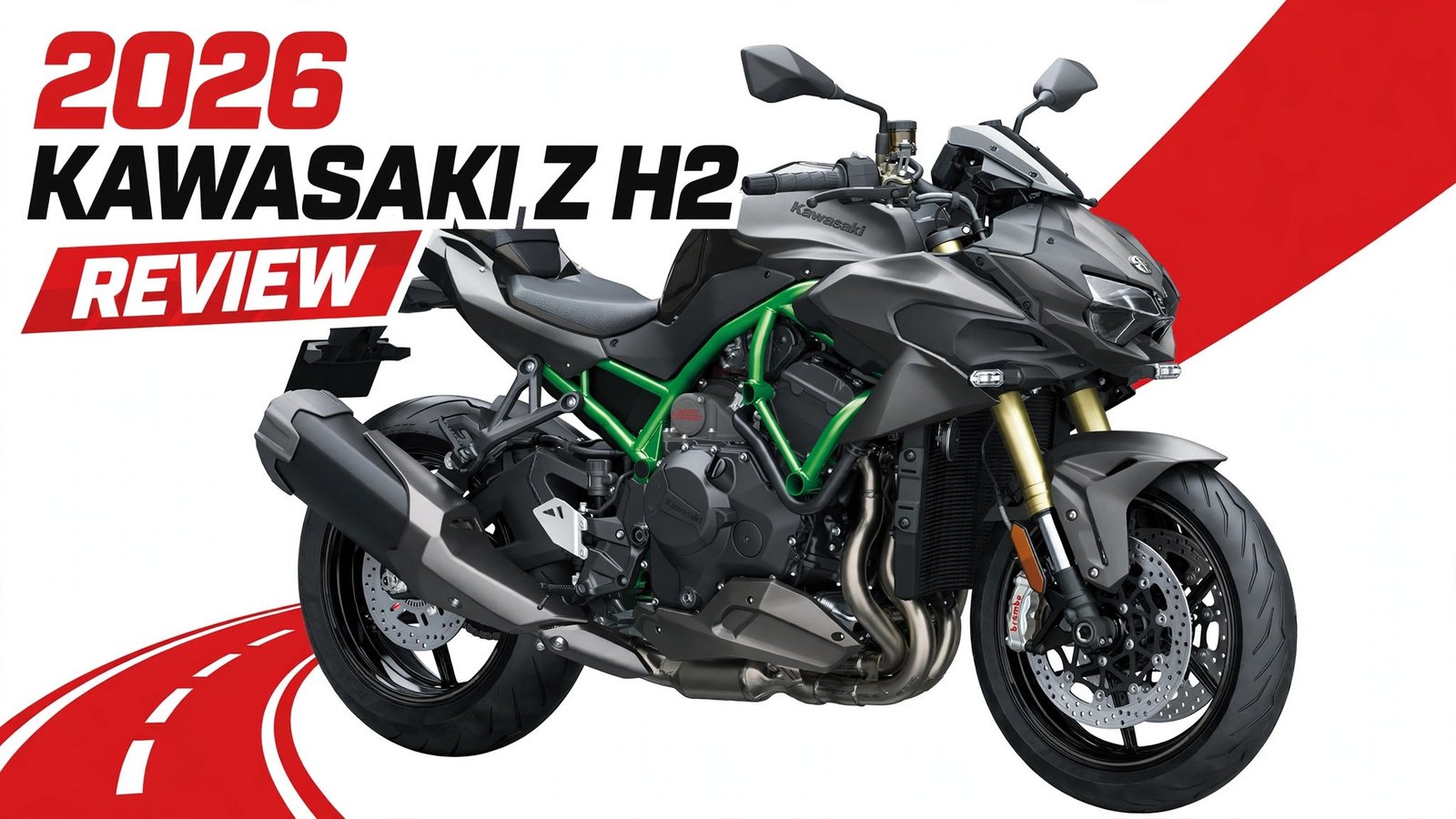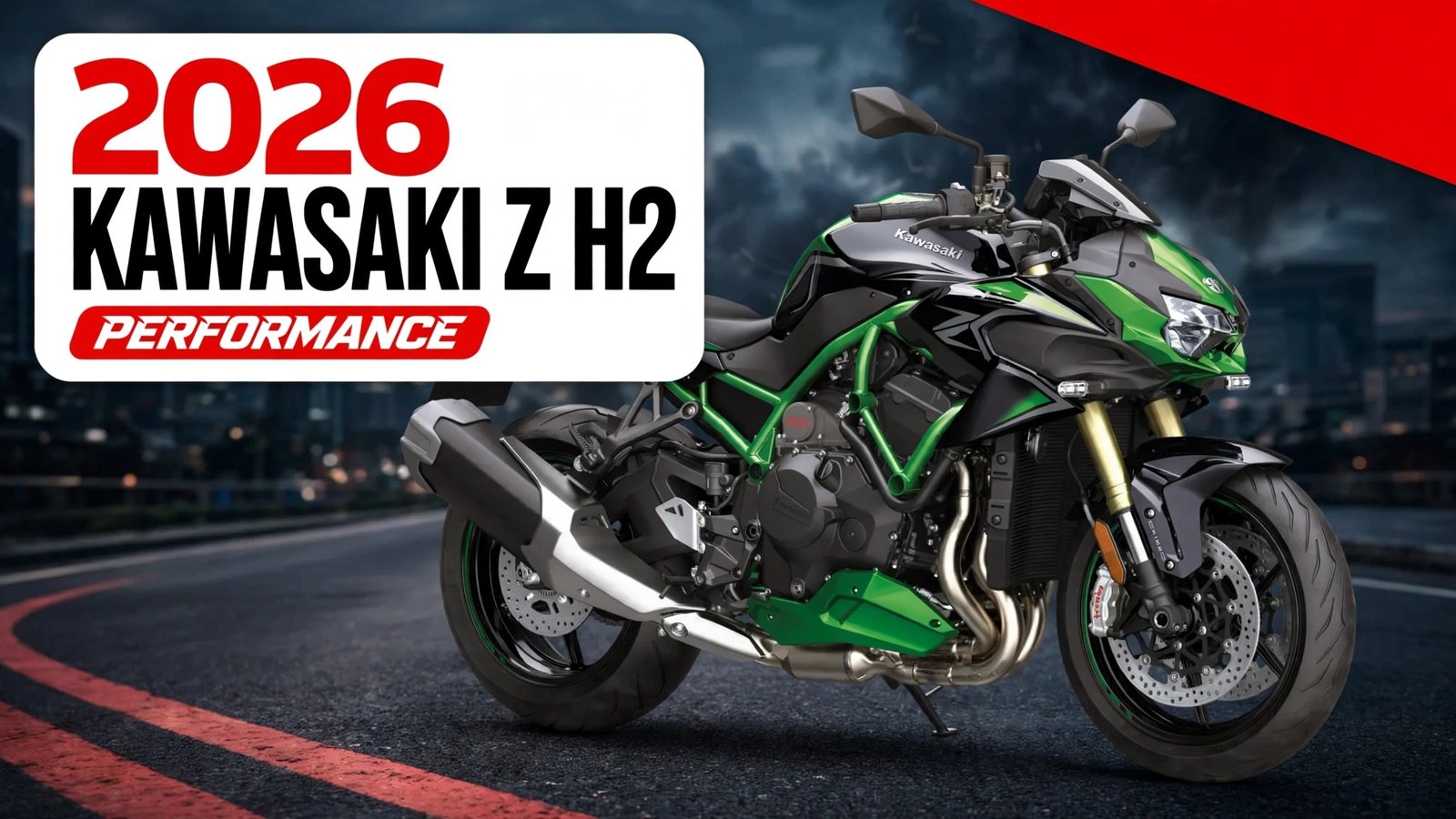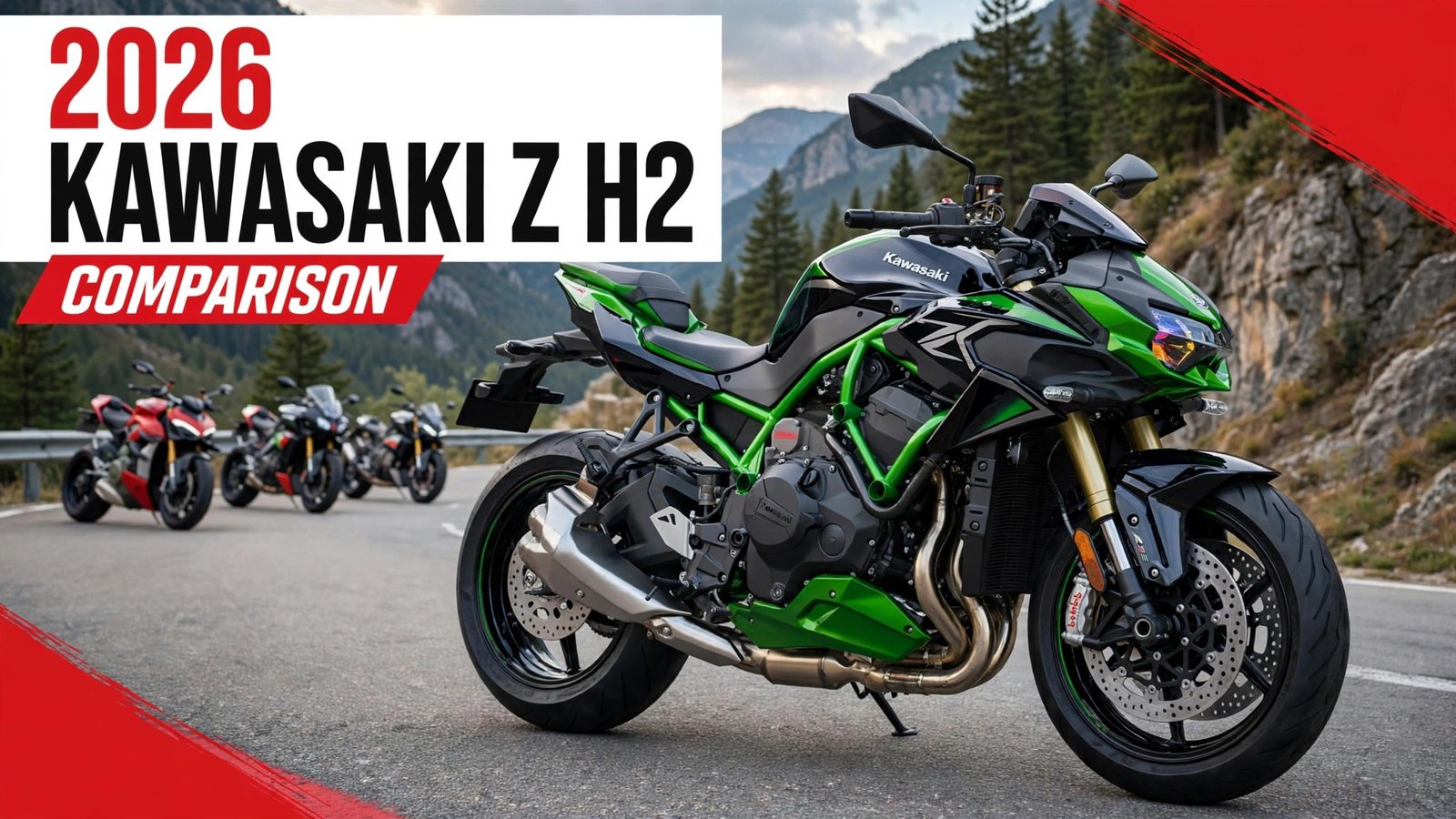
Four hyper-nakeds, one supercharger — that is the short version of this Kawasaki Z H2 comparison, and the fact that shapes every section that follows: the Z H2 SE is the only forced-induction bike in this group, and also the heaviest bike in the group and — against two of the three rivals — the cheapest way to nearly 200 horsepower.
The other three bikes are the Ducati Streetfighter V4, the Aprilia Tuono V4 Factory and the Yamaha MT-10 SP, all priced here on 2026 US figures. This Kawasaki Z H2 comparison prices all four the same way and names the source behind every number, because the launch prices most comparison pages still quote are five years out of date.
Kawasaki Z H2 Overview and Its Closest Rivals
The Z H2 arrived in 2020 as Kawasaki’s answer to a question nobody else was asking: what happens when you put a supercharged litre engine in a naked bike? Six years on, nothing else in the class does it — that is the fact this Kawasaki Z H2 comparison starts from. Motorcycle.com named it the Best Naked Motorcycle of 2020.

Only Supercharged Hyper-Naked
The Z H2’s engine is a liquid-cooled, supercharged 998cc inline-four: a centrifugal blower driven by a planetary gear train off the crankshaft, its impeller spinning up to 9.2 times crank speed, with no belt and no intercooler — Kawasaki says the blower’s high efficiency and minimal heat gain made an intercooler unnecessary. Claimed output is 197.1 hp at 11,000 rpm and 101.1 lb-ft at 8,500 rpm, both from the Motorcycle.com database — Kawasaki’s own sheets print torque at 101.0 lb-ft and no power line at all. The Ducati, the Aprilia and the Yamaha are all naturally aspirated, with nothing like the Z H2’s low-down shove — and that is the first thing this Kawasaki Z H2 comparison establishes. The Z H2 is also the only bike of the four with a 5.0-gallon tank, and its supercharged family includes the track-only 322 hp Ninja H2R and the supercharged sport-tourer Ninja H2 SX. The Kawasaki Z H2 review covers the base bike’s 2020–2023 run and the SE that followed it.
How the Four Bikes Differ at a Glance
Here is the whole field on one table, all on 2026 US figures — the gaps this Kawasaki Z H2 comparison keeps returning to.
| Item | Kawasaki Z H2 SE (2026) | Ducati Streetfighter V4 (2026) | Aprilia Tuono V4 Factory (2026) | Yamaha MT-10 SP (2026) |
|---|---|---|---|---|
| MSRP | $21,999 | $24,595 | $19,999 | $17,499 |
| Destination | $840 | $1,295 | Not published | $775 |
| Delivered | $22,839 | $25,890 | Not computable | $18,274 |
| Claimed power | 197.1 hp @ 11,000 rpm | 205 hp @ 12,650 rpm | 180 hp @ 11,800 rpm (as published) | Not published by Yamaha (Euro 163.6 hp) |
| Torque | 101.1 lb-ft @ 8,500 rpm | 88.3 lb-ft @ 11,500 rpm | 89.2 lb-ft @ 9,650 rpm | Not published (Euro 82.6 lb-ft) |
| Engine | 998cc supercharged inline-four | 1,103cc V4 | 1,099cc 65° V4 | 998cc CP4 inline-four |
| Weight | 531.4 lb (SE) | 421 lb | 465.2 lb | 472 lb |
| Seat height | 32.7 in | 33.3 in | 32.9 in | 32.9 in |
| Fuel capacity | 5.0 gal | 4.2 gal | 4.8 gal | 4.5 gal |
| Front brakes | Dual 320 mm, Brembo M4.32 (2021 SE: Stylema) | Dual 330 mm, Brembo Hypure | Dual 330 mm, Brembo radial monobloc | Dual 320 mm, radial-mount 4-piston (brand unnamed) |
| Suspension | KECS semi-active (SE) | Öhlins S-EC 3.0 semi-active (S only; base Showa/Sachs) | Öhlins Smart EC 2.0 semi-active | Öhlins Gen-2 semi-active |
| Cruise control | Yes | No | Yes | Yes |
| Supercharged | Yes — the only one | No | No | No |
Note: All prices are 2026 US figures. The 2024–2026 SE prices rest on the Motorcycle.com database alone, and this Kawasaki Z H2 comparison labels them that way. The Aprilia’s freight charge is unpublished, so its delivered price cannot be computed. The Tuono’s 180 hp is Aprilia’s published figure; Yamaha publishes no US power or torque for the MT-10 SP, so the Euro figures are labelled Euro only; the Ducati’s US figure is 205 hp, never the 214 hp Euro PS figure.
Kawasaki Z H2 vs Ducati Streetfighter V4
The Ducati is the bike the Z H2 is most often measured against, and the only rival in this Kawasaki Z H2 comparison with a direct head-to-head test behind it: Cycle News put the two 2020 bikes together in July 2020, still the only ridden verdict in the group.
Cycle News put the 2020 Kawasaki Z H2 and the 2020 Ducati Streetfighter V4 S together in its July 2020 comparison test, presenters Rennie Scaysbrook and Sean Finlay riding both bikes back to back. The verdict is a dead heat split on price: both presenters pick the Ducati if money is no object — its handling is much better, and in the corners “the Ducati is just going to smoke it” — while the Z H2 wins on straight-line acceleration (“just blows it away”) and on value at $17,000 against the Ducati’s $23,995. Rennie’s closing line is “we might have a dead heat on this one” — and the video below is that test, in English.
Engine, Specs and Performance Side by Side
On paper the Ducati has the edge — more power, 110 lb less weight — as the table below shows. But the torque table runs the other way: the Z H2 makes 101.1 lb-ft at 8,500 rpm against the Ducati’s 88.3 lb-ft at 11,500 rpm, and that low-down supercharged torque is what the CycleNews testers felt — the Z H2’s acceleration “feels dramatically faster” than the Ducati’s, while the Ducati won on mid-corner poise and brakes, its Brembo/Brembo setup trumping the Z H2’s Nissin/Brembo combination. Two caveats: the 2020 test bikes are not the 2026 bikes (the 2020 Streetfighter made 208 hp claimed), so the 2020 verdict is not a verdict on the 2025-generation Ducati; and the Z H2’s measured figures are a spread, not one number — Bennetts 160 bhp on a 2020 base, Cycle World 167.22 hp on a 2021 SE on its Dynojet 250i, Motorcycle Mojo 182 hp on a 2020 base on a Bazzaz dyno, as the Kawasaki Z H2 performance guide records in full. The best-sourced top speed is 168 mph GPS (Ultimate Motorcycling, 2020 base); MCN timed the Z H2 SE at 10.7 seconds in the quarter-mile.
| Item | Kawasaki Z H2 SE (2026) | Ducati Streetfighter V4 (2026) |
|---|---|---|
| Claimed power | 197.1 hp @ 11,000 rpm | 205 hp @ 12,650 rpm |
| Torque | 101.1 lb-ft @ 8,500 rpm | 88.3 lb-ft @ 11,500 rpm |
| Engine | 998cc supercharged inline-four | 1,103cc Desmosedici Stradale V4 |
| Weight | 531.4 lb | 421 lb |
| Seat height | 32.7 in | 33.3 in |
| Fuel capacity | 5.0 gal | 4.2 gal |
| Front brakes | Dual 320 mm, Brembo M4.32 | Dual 330 mm, Brembo Hypure |
| Cruise control | Yes | No |
Note: The Ducati’s US power figure is 205 hp; the 214 hp figure is the Euro PS number, never printed as US horsepower in this Kawasaki Z H2 comparison. The 2020 test bikes made 208 hp (Ducati) and 197.1 hp (Kawasaki) claimed, so the 2020 verdict belongs to the 2020 bikes. The Z H2’s dyno spread (160 / 167.22 / 182 hp) is three different bikes on three different dynos, never blended into one figure.
Price, Equipment and Which Suits Which Rider
For 2026 the Ducati base costs $24,595 plus $1,295 destination, $25,890 delivered, against the Z H2 SE at $21,999 plus $840, $22,839 delivered — a $3,051 gap in the Kawasaki’s favour in this Kawasaki Z H2 comparison. Ducati’s own site shows $24,995 with no model-year label — possibly a late-2026 rise or the 2027 price — and it is never printed here as the 2026 price. On equipment, the base Ducati runs a Showa BPF fork and Sachs shock, the S gets Öhlins NIX30 and TTX36 semi-active suspension, and the Z H2 SE answers with KECS semi-active suspension, an up/down quickshifter as standard, and cruise control — which the Ducati lacks. The choice is straightforward: the rider who values cornering precision above everything and can pay for it buys the Ducati — 110 lb lighter, sharper in the corners, the testers’ pick when money is no object. The rider who wants the hardest straight-line hit for the least money buys the Kawasaki: supercharged torque, cruise control and the $3,051 saving.
Kawasaki Z H2 vs Aprilia Tuono V4 Factory
The Aprilia is the quiet one in this Kawasaki Z H2 comparison: no major magazine has tested the Tuono V4 Factory directly against the Z H2, so this section is a spec comparison, not a ridden verdict. What the numbers show is a V4 against a supercharged four — two answers to the same hyper-naked question, priced $2,000 apart on MSRP.

Engine, Specs and Performance Side by Side
The Tuono V4 Factory runs a 1,099cc 65-degree V4 making 180 hp at 11,800 rpm and 89.2 lb-ft at 9,650 rpm as published — the 180 figure is Aprilia’s published PS-rounded number (132.4 kW is 177.5 mechanical horsepower), so this Kawasaki Z H2 comparison prints it as published, never as a “177.5 hp” headline. Against the Z H2’s 197.1 hp at 11,000 rpm and 101.1 lb-ft at 8,500 rpm, the Aprilia gives away 17 hp and 12 lb-ft on the claimed figures — and the supercharger’s low-down delivery too, with the Z H2’s torque peaking 3,100 rpm lower than the Tuono’s. The weight gap is 66.2 lb in the Aprilia’s favour — 465.2 lb against the Z H2 SE’s 531.4 lb — which is the Tuono’s strongest card in this Kawasaki Z H2 comparison. Both wear semi-active Öhlins suspension (Smart EC 2.0 on the Aprilia, KECS on the Kawasaki SE) and have cruise control; the Aprilia stops on dual 330 mm front discs against the Z H2’s dual 320 mm. The Tuono’s caliper model and whether its wheels are forged or cast were never verified, so neither is claimed here. No direct test exists, so no ridden verdict is offered — a spec comparison is what the evidence supports.
Price, Equipment and Which Suits Which Rider
The Tuono V4 Factory costs $19,999 for 2026, $2,000 less than the Z H2 SE’s $21,999 on MSRP — but Aprilia USA publishes no fixed freight charge, so the Tuono’s delivered price cannot be computed and this Kawasaki Z H2 comparison does not guess one. The Z H2 SE’s delivered price in this Kawasaki Z H2 comparison is $22,839 ($21,999 plus $840 destination, Motorcycle.com database). On equipment the two are close: semi-active Öhlins, cruise control, a 6-axis IMU and a TFT dash on both, and the Aprilia adds its a-PRC electronics suite with six riding modes. The rider who wants a V4 and semi-active Öhlins at the lowest MSRP in this group buys the Aprilia — lighter, cheaper on the sticker, with a V4 character no inline-four can copy. The rider who wants forced-induction thrust, the bigger 5.0-gallon tank and stronger low-down torque buys the Kawasaki, paying the $2,000 MSRP premium to get them.
Kawasaki Z H2 vs Yamaha MT-10 SP
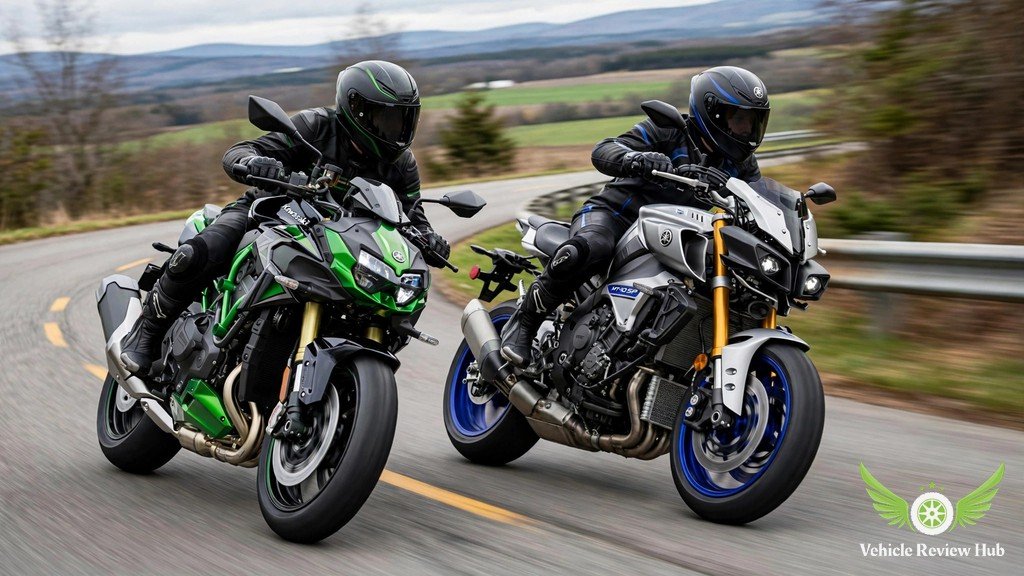
The Yamaha is the value pick in this Kawasaki Z H2 comparison, and the cheapest bike in the group by a long way: $17,499 against the Z H2 SE’s $21,999. It is also the closest thing to a like-for-like rival the Kawasaki has — both Japanese inline-fours with semi-active Öhlins suspension and cruise control, except one has a supercharger and the other does not.
Engine, Specs and Performance Side by Side
The MT-10 SP runs Yamaha’s 998cc CP4 crossplane inline-four, and here this Kawasaki Z H2 comparison hits a wall: Yamaha USA publishes no horsepower or torque figure for the MT-10 SP at all. The Euro figures are 163.6 hp at 11,500 rpm and 82.6 lb-ft at 9,000 rpm, labelled Euro only, never printed here as US figures. Against the Z H2’s claimed 197.1 hp at 11,000 rpm and 101.1 lb-ft at 8,500 rpm, the Yamaha is the weaker bike on paper by any reading — forced induction against natural aspiration, same displacement. The Yamaha’s answer in this Kawasaki Z H2 comparison is weight — 472 lb against the Z H2 SE’s 531.4 lb, a 59.4 lb advantage — and agility, since its 55.3-inch wheelbase is two inches shorter than the Kawasaki’s 57.3 inches. Both have semi-active Öhlins suspension (Gen-2 spool-valve on the Yamaha), a 6-axis IMU, quickshifter and cruise control. The Yamaha’s brakes are dual 320 mm discs with radial-mount four-piston calipers, and Yamaha names no caliper brand — only a Brembo radial master cylinder — so no Brembo caliper claim is made. No direct test of the MT-10 SP against the Z H2 exists, so no ridden verdict is offered for this pairing.
Price, Equipment and Which Suits Which Rider
The MT-10 SP costs $17,499 plus $775 destination for 2026, $18,274 delivered, against the Z H2 SE at $22,839 delivered — a $4,565 gap, the widest in this Kawasaki Z H2 comparison. The Yamaha had no mechanical change for 2026 (MSRP up $200, destination up $150 only); its price history runs $16,899 (2022), $17,199 (2023), $16,999 (2024), $17,299 (2025) and $17,499 (2026). On equipment the two are evenly matched in this Kawasaki Z H2 comparison — semi-active Öhlins, cruise control, quickshifter, IMU — so the money buys the engine, not the kit. The rider who wants value and agility buys the Yamaha: $4,565 cheaper delivered, 59 lb lighter, and the sensible pick for daily use. The rider who wants forced-induction thrust buys the Kawasaki: the supercharger, the bigger tank and the 197.1 hp claim are worth the premium, and nothing the Yamaha does closes the straight-line gap.
Kawasaki Z H2 Price and Value Compared
Price is where this Kawasaki Z H2 comparison turns from spec sheets into buying advice: the four bikes span $8,391 delivered from cheapest to dearest, and the Z H2 sits in the middle — neither the value pick nor the dearest bike in the group.
Weight Trails Every Rival
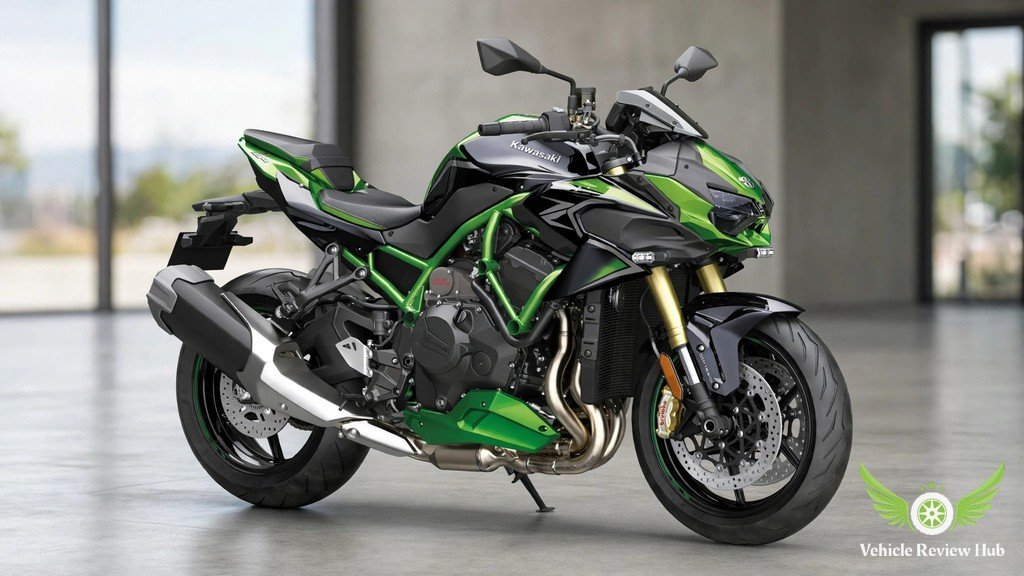
The weight gap is the single biggest weakness this Kawasaki Z H2 comparison finds in the Kawasaki: the Z H2 SE weighs 531.4 lb — 59.4 lb more than the MT-10 SP at 472 lb, 66.2 lb more than the Tuono V4 Factory at 465.2 lb, and 110.4 lb more than the Streetfighter V4 at 421 lb. Even the base Z H2, at 527.0 to 529.2 lb by year, trails every rival in this Kawasaki Z H2 comparison. The weight costs in slow turns and quick direction changes, where the CycleNews testers said the Ducati’s mid-corner poise put it firmly ahead; it buys stability at speed and a planted feel on the highway, and the supercharger’s torque means the extra mass never shows in a straight line.
Running Costs and Resale Value Compared
On running costs, this Kawasaki Z H2 comparison prints only verified figures — and they are thin. The Z H2’s 5.0-gallon tank is the largest of the four (Tuono 4.8, MT-10 SP 4.5, Ducati 4.2), and its only observed road economy is Motorcyclist’s 2023 test at 40–45 mpg freeway and 28–30 mpg on back roads, cited via mirror — and no rival MPG figure is printed here. On servicing, the Z H2’s supercharger oil screen is a replacement at 24,000 km, and no rival service-cost comparison was verified, so no “cheapest to service” verdict is given; on resale, no verified retention data was found for any of the four bikes, so no resale verdict is given either. What is verified is supply: the base ended after 2023 and only the SE is sold new now — never a resale prediction.
| Bike (2026) | MSRP | Destination | Delivered |
|---|---|---|---|
| Yamaha MT-10 SP | $17,499 | $775 | $18,274 |
| Aprilia Tuono V4 Factory | $19,999 | Not published | Not computable |
| Kawasaki Z H2 SE | $21,999 | $840 | $22,839 |
| Ducati Streetfighter V4 | $24,595 | $1,295 | $25,890 |
Note: The delivered ladder in this Kawasaki Z H2 comparison runs MT-10 SP $18,274, Z H2 SE $22,839, Streetfighter V4 $25,890. The Tuono sits at $19,999 before freight, with no fixed freight charge published, so its delivered price cannot be placed in the ladder. The Z H2 SE’s 2026 price rests on the Motorcycle.com database alone; the 2025 SE delivered price is never printed as settled (destination conflict $815 vs $840), and the 2024 SE destination was never found.
Kawasaki Z H2 Comparison Verdict and US Alternatives
Every comparison ends with a pick, and this Kawasaki Z H2 comparison ends with two of them: a winner for thrust, a winner for corners, and a winner for value — three different bikes.
Verdict: Boost Beats Polish
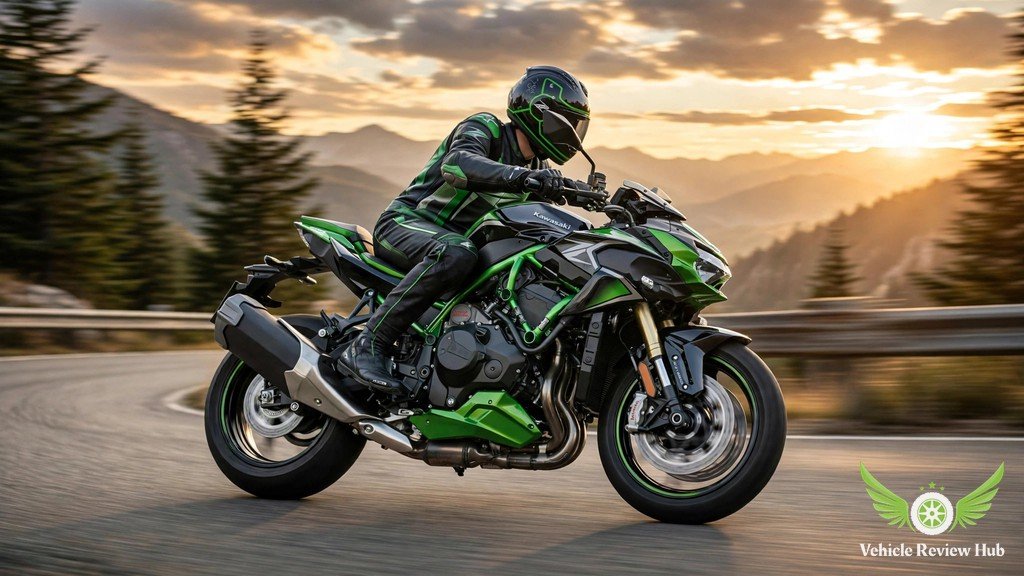
Boost beats polish when the road is straight and the budget matters — the verdict this Kawasaki Z H2 comparison reaches. The Z H2 wins on forced-induction thrust, cruise control and price against the Ducati: $3,051 less delivered, with stronger low-down torque and the bigger tank. It loses on weight and mid-corner poise, where the Ducati’s 110 lb advantage and sharper chassis put it firmly ahead, exactly as CycleNews found in 2020. In this Kawasaki Z H2 comparison, the Ducati is the pick for the rider who values cornering above everything and can pay for it; the Tuono for the rider who wants a V4 and semi-active Öhlins at the lowest MSRP in the group; the MT-10 SP for value and agility. But the Z H2 is the only bike here that does something no rival can copy — a supercharger — and that is why it still leads this Kawasaki Z H2 comparison on character, even as it trails on the scales.
New Means SE Only Now
A buyer walking into a US Kawasaki dealer in 2026 buys the SE or nothing new: the base ended after 2023, and the 2026 SE costs $21,999 ($22,839 delivered, Motorcycle.com database). The cheapest way into a Z H2 is a used 2020–2023 base; no used price is printed here, none was verified. Before buying any used Z H2, check both recalls by VIN — 21V-593 covers 2020–2021 Z H2 bikes and the 2021 SE for an oil-pressure relief valve fault (324 Z H2 bikes), and 22V-912 covers 2020–2023 Z H2 and 2021–2023 SE bikes for a cam-chain tensioner fault (1,176 Z H2 and SE bikes combined), both fixed free at the dealer, as the Kawasaki Z H2 reliability guide records in full. The NHTSA Part 573 report for 22V-912 is the source for those figures. US alternatives? The naturally-aspirated Kawasaki Z900 and the retro premium Kawasaki Z900RS SE both sit below the Z H2 on price — but neither is supercharged.
Kawasaki Z H2 Comparison FAQs
The questions below cover what buyers ask about most in this Kawasaki Z H2 comparison: which rival is faster, which is cheapest, whether the blower is unique, and what a new buyer can still buy.
Kawasaki Z H2 SE or Ducati Streetfighter V4 — which is faster?
The Ducati claims more power (205 hp vs 197.1 hp), weighs 110 lb less, and won CycleNews’ 2020 comparison on mid-corner poise and brakes. But the Z H2’s supercharged torque “feels dramatically faster” in a straight line, and this Kawasaki Z H2 comparison prices the Kawasaki $3,051 less delivered ($22,839 vs $25,890).
What is the cheapest bike in this comparison?
The Yamaha MT-10 SP at $17,499 MSRP ($18,274 delivered for 2026) — the cheapest bike in this Kawasaki Z H2 comparison. The Aprilia Tuono V4 Factory is $19,999 before freight (no fixed freight charge published). The Z H2 SE is $21,999 ($22,839 delivered); the Ducati Streetfighter V4 is $24,595 ($25,890 delivered).
Is the Kawasaki Z H2 the only supercharged bike here?
Yes. It is the only supercharged hyper-naked in this Kawasaki Z H2 comparison — the Ducati, Aprilia and Yamaha are all naturally aspirated. It is also the only one of the four with a 5.0-gallon tank.
Which bike is the heaviest?
The Z H2 SE at 531.4 lb — 59 lb heavier than the MT-10 SP (472 lb), 66 lb heavier than the Tuono V4 Factory (465.2 lb) and 110 lb heavier than the Streetfighter V4 (421 lb) — the Z H2’s biggest disadvantage against all three rivals in this Kawasaki Z H2 comparison.
Can I still buy a new base-model Z H2?
No. The base bike ended after 2023; only the SE is sold new in the USA now (2026 SE: $21,999). A used 2020–2023 base is the cheapest way into a Z H2, and this Kawasaki Z H2 comparison prints no used price — none was verified.
Z H2 SE or Yamaha MT-10 SP — which suits which rider?
The MT-10 SP is $4,565 cheaper delivered, 59 lb lighter and the value pick. The Z H2 SE answers with 197.1 hp against Yamaha’s unpublished US figure (163.6 hp in Europe, Euro only), a supercharger, a bigger tank and cruise control. Buy the Yamaha for value and agility; buy the Kawasaki for forced-induction thrust — the choice this Kawasaki Z H2 comparison comes down to.