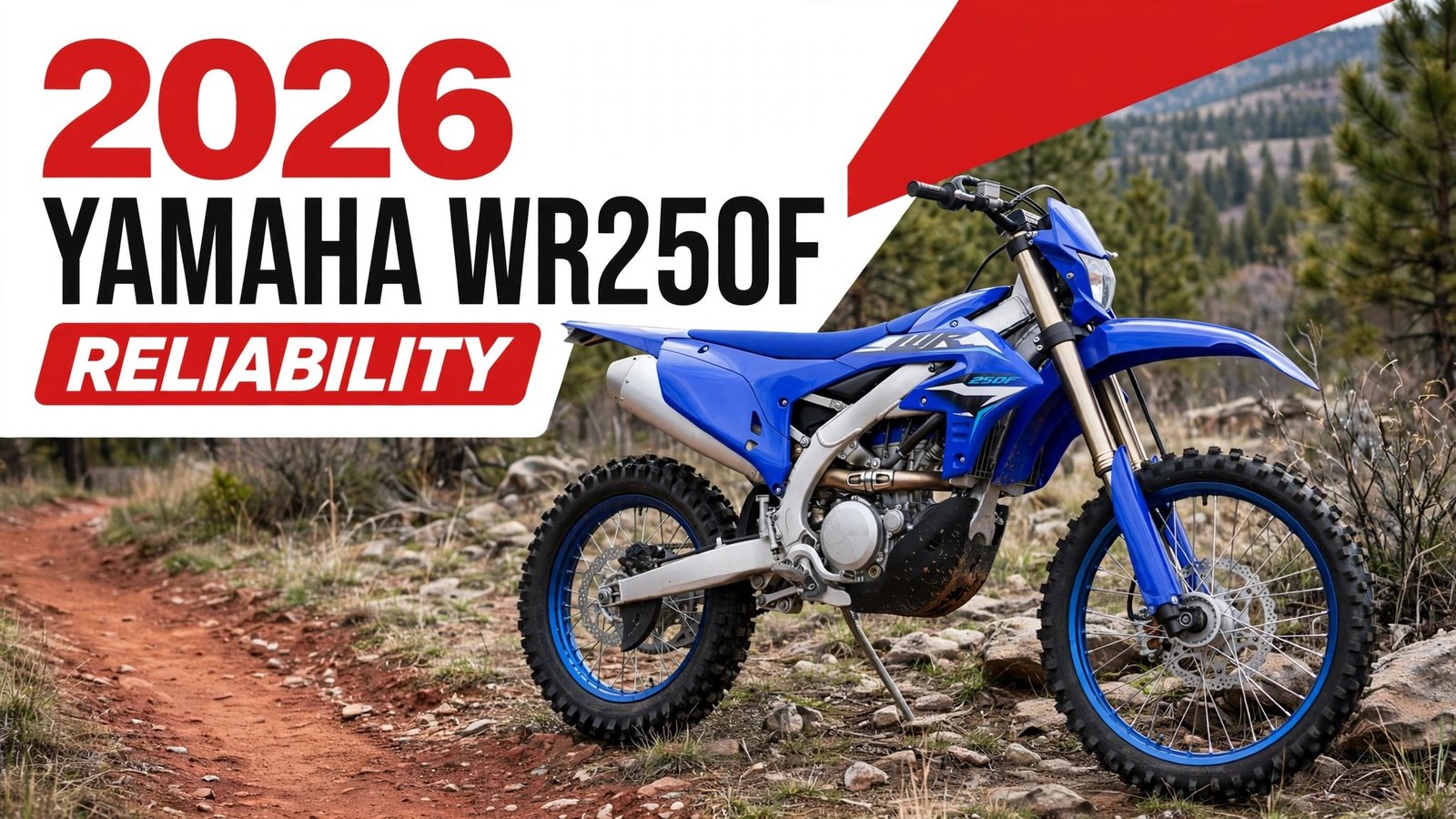
Yamaha WR250F reliability is why this enduro keeps appearing on used-bike shortlists. It is an off-road-only bike with a high-revving 250cc four-stroke, yet long-term tests show an engine that holds valve clearances, survives triple-digit hours, and rarely produces a big repair bill. It is not maintenance-free; Yamaha WR250F reliability comes from predictable maintenance: oil changes in hours, valve checks done cold, and wear items replaced on schedule.
The WR250F is not a street bike or dual-sport, so none of the advice here uses road mileage. Service is counted in riding hours, off-highway rules vary by state, and California sticker rules have changed, so run a VIN check. For a full model overview, read the Yamaha WR250F review alongside this guide to Yamaha WR250F reliability.
Yamaha WR250F Reliability Overview
Yamaha WR250F reliability rests on a proven 250cc reverse-cylinder engine, a six-speed wide-ratio trail gearbox, and a trail-ready chassis. The two best pieces of evidence are independent long-term tests that opened the engine after serious use, and Yamaha WR250F reliability shows up in both: clean oil, clean filters, and honest hour counts matter more than model year.
Dirt Rider 200-Hour Test: Valves in Spec and Internals Like New
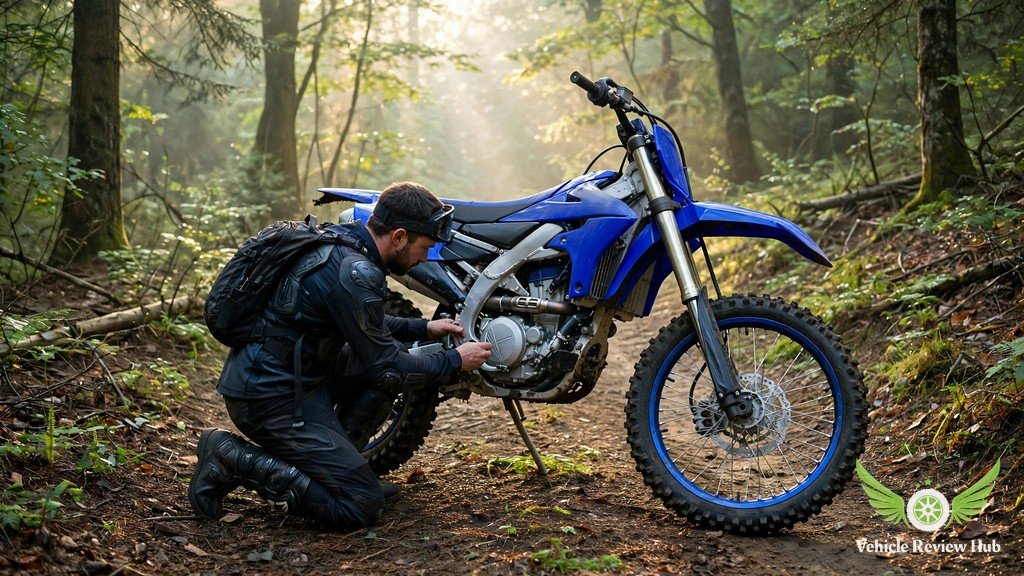
The strongest single data point for Yamaha WR250F reliability comes from Dirt Rider’s Long Haul test of a 2007 WR250F, documented in the magazine’s 2007 Yamaha WR250F long-term test. After 125 hours, the bike had lost only half a horsepower against its fresh figure on the same Yamaha dyno, recording 31.9 hp, with valves still in spec and internals brand-new. At the final teardown at 202 hours, the valves hardly showed wear and never needed adjustment.
Dirt Bike Test’s teardown points the same way: a 2015 WR250F run for roughly 125 hours over a year of racing, trail riding, and course setup, stripped with Yamaha’s Gerrad Capley helping, as described in their YZ250FX and WR250F long-term wrap-up. The piston, ring, cylinder, and valves all measured mid-range, with no reason to touch the valves beyond cleaning. Gears were pristine, basket wear minimal, chassis uncracked. Only the rod and wrist pin felt in need of replacement after 100 hours, not quite out of spec but loose. That is the core of Yamaha WR250F reliability: an engine that stays in spec long past the point where owners expect trouble.
How Riding Hours, Maintenance History and Previous Use Affect Reliability
Hours tell the truth that road mileage cannot on a dirt bike. A 60-hour bike with regular oil changes and a clean air filter beats a 30-hour bike with a clogged filter and seasonal oil changes. Dust is the enemy of Yamaha WR250F reliability: a poorly sealed or neglected air filter lets grit into the engine, showing up as valve-seat wear, cylinder scoring, and oil that turns black far too fast. Previous use shapes what to inspect: a former race bike may have perfect maintenance and a tired clutch, while a casual trail bike may have low hours and gaps. None of this makes Yamaha WR250F reliability a gamble; it makes the pre-purchase inspection your most valuable hour.
Yamaha WR250F Common Problems and Wear Items
For Yamaha WR250F reliability, the wear list is short, familiar, and cheap to catch early: trail damage, the clutch, the chain and sprockets, wheel bearings, and small electrical parts.
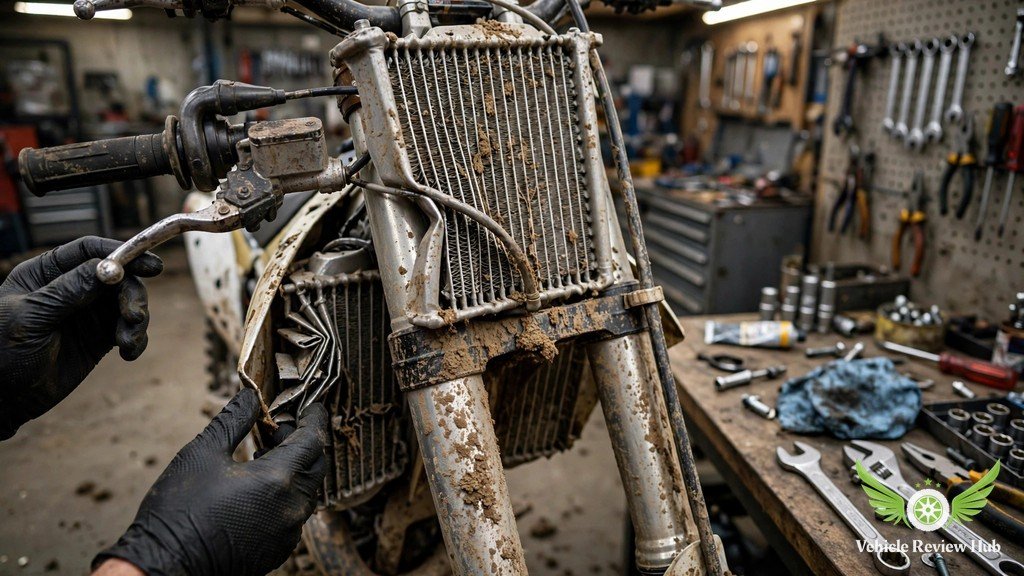
Bent Radiators, Abused Clutch and Trail Damage Inspection Points
Radiators sit out front and take hits. A bent radiator or flattened fins restrict airflow, and on slow trails normal warmth becomes overheating. Check both radiators for bent fins, seam leaks, and cracked louvers, and coolant stains pointing to a slow leak. Motosport’s WR250F overheating guide lists the same causes: clogged radiators, low coolant, a failing cap or pump, a collapsed hose, lean mapping, out-of-spec valves, degraded coolant, or a stuck thermostat.
The clutch is the second inspection point: one hard-handed rider can consume a clutch that would last seasons. Dirt Bike Test found minimal basket wear after a year of hard use, so a deeply grooved basket signals abuse. The 2015 Dirt Bike Test bike survived around four hours with no water in the cooling system after a skid-plate swap; Yamaha said to run it if the oil looked normal. That is not permission to ignore cooling problems; it shows how much margin Yamaha WR250F reliability carries when a problem is caught early.
Chain, Sprockets, Wheel Bearings, Battery and Electrical Checks
The chain and sprockets wear fastest: Dirt Bike Test’s most worn part was the neglected chain guide, with the countershaft sprocket second and the chain itself due — the drivetrain side of Yamaha WR250F reliability. Check chain slack, look for hooked sprocket teeth, and replace chain and both sprockets as a set. A sealed O-ring chain is standard on recent WR250Fs, but it still needs cleaning and lubrication to protect Yamaha WR250F reliability. Wheel, linkage, and steering-head bearings are the quiet wear items: lift each wheel, feel for play, and check swingarm and linkage for movement. The battery is easy to overlook: test it under load, check terminals for corrosion, and confirm brisk starter spin, because a weak battery causes hard starting misdiagnosed as trouble. Finally, check lights, meter, fan, and wiring routing.
Yamaha WR250F Maintenance Schedule and Servicing
Yamaha WR250F reliability is built on an hour-based schedule. For Yamaha WR250F reliability, it prevents two common mistakes: servicing by road miles, which do not apply, and quoting the manual as if it listed hours. The manual’s chart is race-based; the hour figures owners use are a translation.
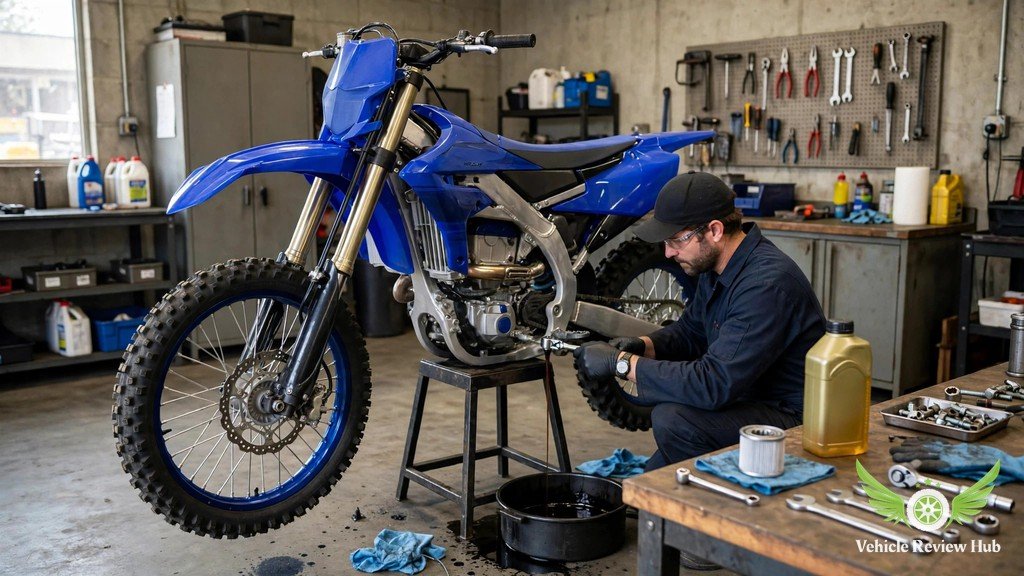
Oil Every 10 Hours Recreational or 5 Hours Racing From the Manual Pattern
The WR250F service manual’s maintenance chart, available through the WR250F service manual maintenance chart, uses columns headed after break-in, every race, every third race, every fifth race, and as required. Engine oil is marked for replacement, and the manual’s note says the schedule is a general guide, with weather, terrain, location, and usage altering intervals. The owner and shop translation: change oil roughly every 10 hours recreational, and roughly every 5 hours racing, filter included. Those hour figures are the widely used conversion of the manual’s race-based pattern, not a direct quotation. Check oil before every ride, change it hot, and inspect drained oil and filter for metal particles — cheap habits behind Yamaha WR250F reliability. For Yamaha WR250F reliability, fresh oil is the cheapest insurance on a high-revving 250F.
Valve Checks at 30 or 15 Hours and Top-End Inspection Intervals
The widely used hour translation is a check roughly every 30 hours recreational and roughly every 15 hours racing, an owner and shop conversion of the manual’s race-based chart, not a direct quotation. The 2016 owner’s manual gives cold clearances of 0.12–0.19 mm (0.0047–0.0075 in) intake and 0.17–0.24 mm (0.0067–0.0094 in) exhaust, with idle speed at 1900–2100 rpm, as listed in the 2016 WR250F owner’s manual valve section. Reassuringly, those checks rarely find anything wrong, which is why Yamaha WR250F reliability surprises new owners: Dirt Rider’s 200-hour bike never needed adjustment, and Dirt Bike Test’s 125-hour bike needed nothing beyond a clean-up. For the top end, the manual uses inspect-and-replace cycles tied to race counts; most recreational owners look at 100 hours. Dirt Bike Test’s teardown at roughly 100 hours found piston, ring, cylinder, and valves mid-range, with only the rod and wrist pin feeling loose. For Yamaha WR250F reliability: inspect at 100 hours, replace what measures out, and do not rebuild on a schedule the bike does not need.
The video below walks through a valve-clearance check on a 2023 WR250F, including the specifications to measure against.
Yamaha WR250F Tires, Brakes and Suspension Maintenance
Yamaha WR250F reliability extends beyond the engine to the parts that touch the ground and stop the bike. These parts wear visibly, and a used-bike inspection pays off fastest here for Yamaha WR250F reliability, because worn parts are cheap next to engine work.
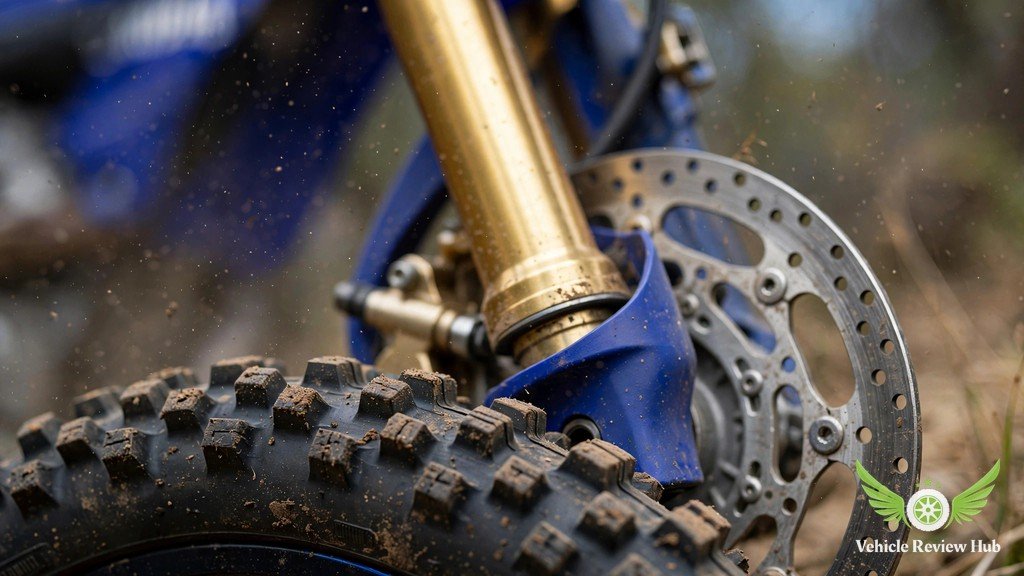
Tire Condition, Pressure, Tread Wear and Replacement
Knobby tires wear fast on a 250F, and the wear pattern tells you how the bike was ridden — useful evidence for Yamaha WR250F reliability. Check tread depth, look for torn knobs, sidewall cuts, and age cracking, and replace tires worn to the indicators. Pressure matters as much as tread: too high and the bike skitters, too low and you risk pinch flats and rim damage, so set pressure for the terrain. Recent US-spec WR250Fs run Dunlop MX3S tires in 80/100-21 front and 110/100-18 rear sizes on the 2024 model; European 2025 sizes differ.
Brake Pads, Brake Discs, Fork Seals and Rear Suspension Checks
Brake pads are a consumable: Dirt Bike Test’s teardown found them due after a year. Check pad thickness, look for scored discs, and feel for a spongy lever pointing to air or a tired cylinder. The 2024 US specification lists 270 mm front and 240 mm rear discs; keeping them clean and true matters more than upgrades. Fork seals are the other regular job: Dirt Bike Test replaced theirs preventively and noted fork-seal life is not the best, so oil mist or drips should be handled promptly before dirt scores tubes. Check the rear shock for leaks, test linkage for play, and service suspension on hours. The Yamaha WR250F performance guide covers how the KYB suspension behaves on the trail, but the maintenance point is simpler: clean tubes, fresh oil, and honest intervals.
Yamaha WR250F Maintenance and Ownership Costs
Yamaha WR250F reliability keeps ownership costs predictable because expensive failures are rare and routine costs are small and regular. Budget by separating seasonal consumables from larger jobs; every price below is a planning estimate, not a quote.
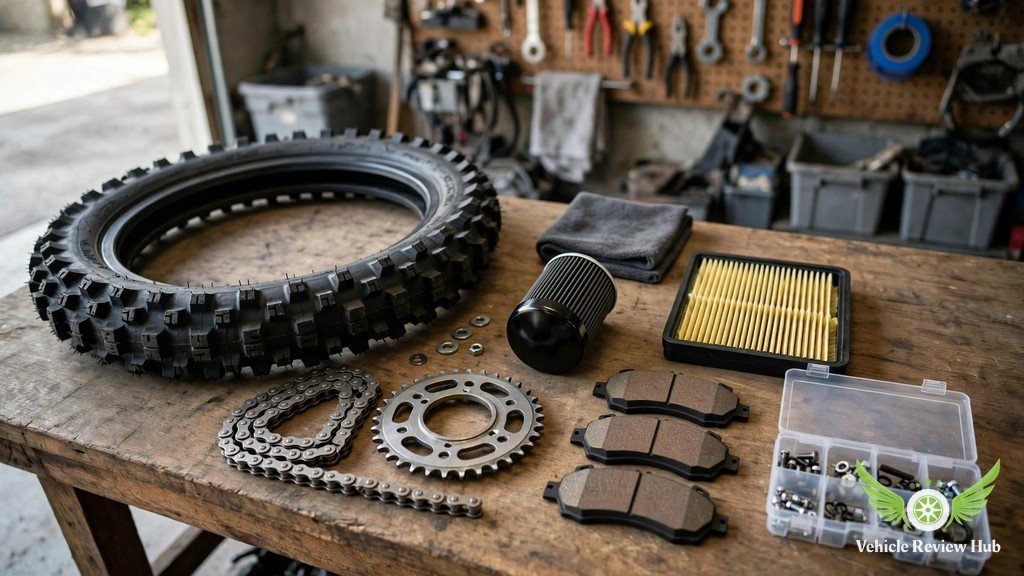
Fuel, Oil, Air Filters, Tires and Replacement Parts
Fuel is the smallest line in the budget. Yamaha publishes no miles-per-gallon figure, and the tank holds 2.1 gallons on the 2024 US model and around 2.0 gallons on 2025-on models, per Yamaha’s 2025 WR250F factsheet, so roughly 50 to 70 trail miles per tank is a planning estimate. For Yamaha WR250F reliability, that discipline matters more than any single part choice.
| Wear item | Typical interval (hours) | Planning estimate, parts only |
|---|---|---|
| Engine oil + filter | 10 recreational / 5 racing | $25–$50 |
| Chain + both sprockets | As wear dictates, often 40–80 | $120–$220 |
| Tires (each) | As tread dictates | $90–$160 |
| Brake pads (per end) | As thickness dictates | $30–$60 |
| Fork seal kit + fork oil | At suspension service | $40–$90 |
| Piston kit | Around 100, if inspection says so | $150–$300 |
| Season total, typical trail rider | Per riding season | A few hundred dollars in parts |
For scale, Dirt Bike Test’s 2015 bike needed a water pump cover at $66.95 and a Competition ECU kit at $107.05 by 50 hours (2015 prices). Parts availability is a strength for Yamaha WR250F reliability: the WR250F shares much of its engine architecture with the YZ250F family, and dealer and aftermarket support is deep. One caution: do not order YZ250F parts blindly, because the WR’s wide-ratio gearbox, lights, meter, fan, and suspension settings differ, so confirm part numbers. The Yamaha WR250F buying guide covers used prices and inspection in more detail.
Repair Expenses, Parts Availability and Long-Term Ownership Costs
Repair expenses stay low when the schedule above is followed, because the jobs that cost real money — valve work, top-end rebuilds, and bottom-end work — are rarely needed early, which is the financial side of Yamaha WR250F reliability. A professional valve-clearance check typically costs a few hundred dollars in shop labor, worth paying for Yamaha WR250F reliability if you are uncomfortable opening the engine yourself, and it buys the measurement record that protects resale value. A piston replacement at 100 hours is parts-plus-labor in the mid hundreds; a full rebuild runs into four figures. Riders wanting more displacement sometimes look at the bigger sibling in our WR450F review. Long-term ownership also includes coolant, brake fluid, fork oil, and grease. Yamaha WR250F reliability rewards owners who spend a little regularly, and shows up at resale time as a documented service history worth real money.
How to Keep a Yamaha WR250F Reliable
Yamaha WR250F reliability is mostly a habit, not a purchase. The best owners kept the same short checklist every ride, logged their hours honestly, and fixed small things before they became big ones — the habit behind Yamaha WR250F reliability. This section turns everything above into that checklist for Yamaha WR250F reliability, plus the recall check every buyer should run.
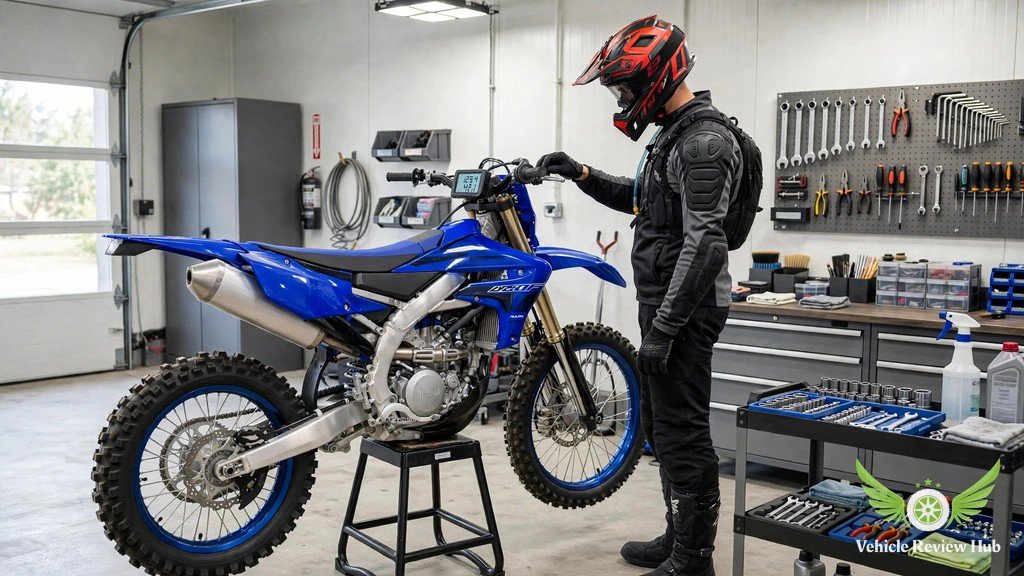
Preventive Maintenance, Hour Meter Use and Regular Inspections
Fit an hour meter if the bike does not already have one, and log every service against it — the simplest tool for Yamaha WR250F reliability. The WR250F’s enduro meter covers trail functions, but a dedicated hour meter makes the 10-hour oil and 30-hour valve rhythm easy to follow, and buyers ask about it first. Before every ride, check oil and coolant levels, chain slack, tire pressures, brake feel, , controls, and fresh leaks. After every ride, clean the bike and check radiators for mud and bent fins. Monthly, or every few rides, inspect chain and sprockets, wheel and linkage bearings, fork seals, brake pads, and the battery for Yamaha WR250F reliability, and keep a logbook of dates, hours, and parts. This routine is exactly what the long-term test bikes received, and Yamaha WR250F reliability is what happens when ordinary maintenance is done on time, every time.
Recall Reality Check: No WR250F-Specific US Recall, Beware Wrong-Bike Lists
Here is the plain answer for Yamaha WR250F reliability: no US safety recall names the Yamaha WR250F in the model years checked through the National Highway Traffic Safety Administration’s own records — 2015, 2018, 2020, 2024, and 2025 all returned zero records — and the NHTSA recalls lookup is where any owner can repeat that check. Recall 16V800 (Yamaha 990108) covers certain 2014–2016 WR250R dual-sports, 2,550 units built August 1, 2013 to June 1, 2016, where a clutch push lever oil seal may crack and leak oil onto the rear tire, with a free seal replacement; it began November 11, 2016. Recall 15V410 covers certain 2008–2011 WR250X and 2008–2015 WR250R machines, 12,721 units, where stator coil insulation may short, the battery goes dead, and the engine stalls, with a free stator replacement; it began July 30, 2015. Neither names the WR250F: the R and X are street dual-sport and supermoto machines, while the F is off-road-only — a distinction that matters for Yamaha WR250F reliability. One genuine WR250F document does exist: a technical service bulletin, not a safety recall. Bulletin M2018-002 (NHTSA ID 10131618) covers certain 2018 WR250F models, prefix CG353, units 000004–000241, code 2GBF, for ECU reprogramming to correct diagnostic-mode errors, where the Yamaha Diagnostic Tool displayed incorrect information, via a modified ECU file through YDT 3.1 or later, with no emissions change, per the M2018-002 service bulletin record. The bulletin expired on January 17, 2020. For Yamaha WR250F reliability, check NHTSA by your exact model and year, and ignore lists that say WR250R or WR250X.
Yamaha WR250F Reliability FAQs
These are the questions owners and buyers ask most about Yamaha WR250F reliability, answered from the manual, the long-term tests, and the recall records above.
Is the Yamaha WR250F reliable?
Yes, by the best available evidence. Dirt Rider’s 200-hour test bike kept its valves in spec and its internals brand-new, and Dirt Bike Test’s 125-hour bike measured mid-range at teardown. Yamaha WR250F reliability is strong with hour-based oil changes, clean air filters, and regular valve checks.
How often should I change the oil on a WR250F?
For Yamaha WR250F reliability, use the widely adopted hour translation of the manual’s race-based chart: roughly every 10 hours recreational and roughly every 5 hours racing, with the filter changed at the same time.
Do WR250F valves go out of spec often?
Rarely — and that is Yamaha WR250F reliability in practice. Dirt Rider’s test bike never needed a valve adjustment in 202 hours, and Dirt Bike Test’s bike needed nothing beyond a clean-up at 125 hours.
How many hours will a WR250F engine last before a rebuild?
There is no fixed hour limit, because maintenance and riding style decide Yamaha WR250F reliability. The test bikes were still healthy past 100 and 200 hours, with only the rod and wrist pin loose at 100 hours on one bike.
What are the most common WR250F problems?
For Yamaha WR250F reliability, the common items are wear and trail damage, not defects: bent radiators and clogged fins, worn chains and sprockets, tired brake pads, weeping fork seals, and batteries that age unnoticed.
Does the WR250F overheat on slow trails?
It runs hot on slow technical trails, which is normal for a liquid-cooled 250F, and the radiator fan helps at low speed. Clean radiators and check coolant cold before assuming a Yamaha WR250F reliability defect.
Are there any recalls on the Yamaha WR250F?
No US safety recall names the WR250F in the model years checked through NHTSA’s records — good news for Yamaha WR250F reliability: 2015, 2018, 2020, 2024, and 2025 all returned zero records. Beware lists citing 16V800 and 15V410, which cover the WR250R and WR250X street bikes.
How much does WR250F maintenance cost per year?
For Yamaha WR250F reliability, a typical trail rider spends a few hundred dollars a year in parts on oil, filters, tires, chains, and brake pads, with larger jobs like a piston kit or valve check arriving every few seasons.
What should I check when buying a used WR250F?
Start with the hour meter and service records — the two best guides to Yamaha WR250F reliability — then check cold starting, valve-check history, radiators, chain and sprocket wear, bearings, fork seals, brake pads, and the battery.
Is the WR250F street legal?
No. The WR250F is an off-road-only enduro with no street-legal equipment or plate, and it should never be presented as a road bike — Yamaha WR250F reliability is an off-road story. Off-highway registration rules vary by state, and California sticker rules have changed over the years, so run a VIN check for the exact year before buying.